Last updated 2026.09.16 · Edited by silveston · Compiled by an independent hobbyist without professional credentials

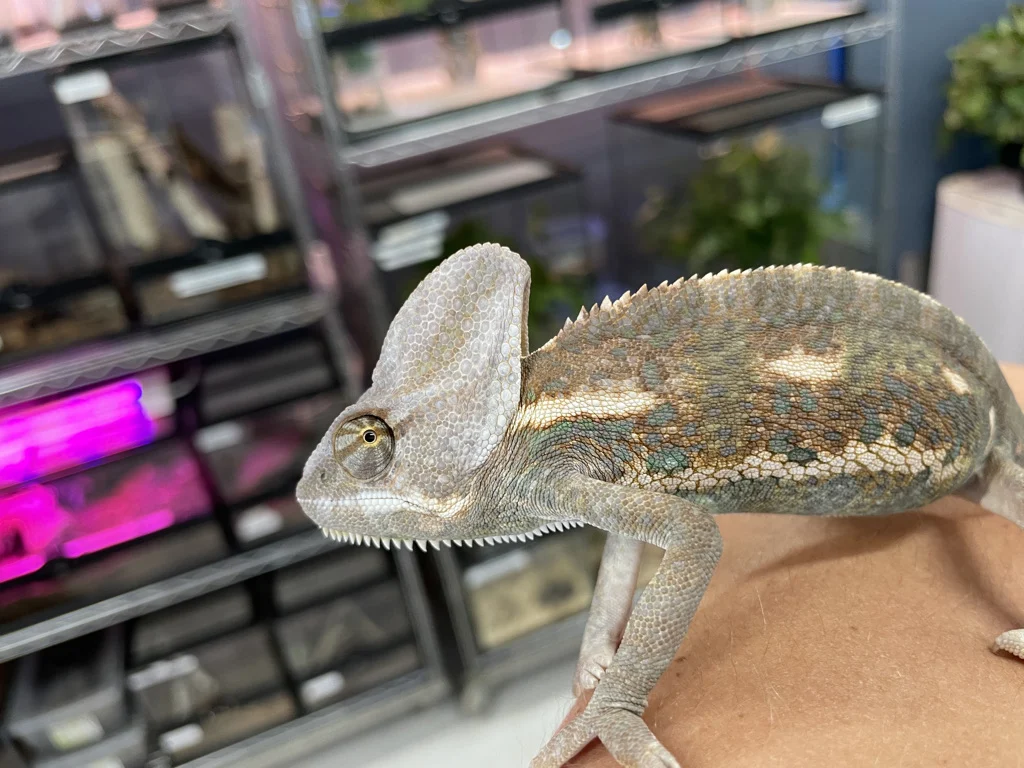
Describing the veiled chameleon simply as an animal that changes color is insufficient. Its independently moving eyes, ballistic tongue, pincer-like feet, and vibration signals transmitted through branches combine to form a unique system adapted for an arboreal lifestyle.
This document focuses on classification, ecology, behavior, evolution, and conservation in the wild. Please refer to a separate care guide for specific details regarding temperature, humidity, and feeding guidelines.
At a glance
| Korean name | Veiled chameleon |
|---|---|
| English name | Veiled chameleon |
| Scientific name | Chamaeleo calyptratus |
| Taxonomic scope | Species |
| Class | Reptilia (or Sauropsida in a phylogenetic context) |
| Order | Squamata |
| Family | Chamaeleonidae (Chameleon family) |
| Genus | Chamaeleo |
| Natural Distribution | Mountainous areas and valleys in Yemen and southwestern Saudi Arabia |
| Primary Habitat | Seasonal shrublands, edges of agricultural land, and wooded semi-arid valleys |
| Activity Period | Arboreal predator that moves slowly along branches during the day |
| Wild Diet | Primarily insects and other small animal prey; also consumes some plant matter |
| Reproduction | Egg-laying; females dig into the ground to create a nesting tunnel |
| Conservation Note | IUCN Least Concern; introduced populations exist in various regions outside its native range |
Taxonomy and Naming
The common name “veiled chameleon” derives from the large, elevated *casque* on its head, which resembles a veil or helmet. The specific epithet *calyptratus* also carries a meaning related to a covering or hood.
A mountain-dwelling chameleon adapted to strong seasonal variations
Its native habitat is not a perpetually humid rainforest, but rather the valleys and mountains of Yemen and southwestern Saudi Arabia, characterized by distinct wet and dry seasons. Temperature, precipitation, and vegetation vary according to altitude and season, and the animals utilize trees, shrubs, and vegetation surrounding agricultural areas. Introduced populations have become established outside its native range, such as in Florida and Hawaii (USA).
A Body Built for Arboreal Life
Their pincer-like feet, with toes facing each other, grip branches from both sides, while their prehensile tails provide an additional anchor point. Their eyes move largely independently to scan the surroundings, but when prey is spotted, both eyes focus on a single point to gauge distance. A long tongue, powered by elastic tissue and muscles, can be projected with great speed.
Color Change as Communication
A chameleon’s color change is driven more by body temperature, stress, and social communication than by camouflage intended to mimic the background. Dramatic shifts in color and pattern contrast occur when males encounter one another or when a female signals her receptiveness to mating. Interpreting body color requires looking beyond a simple color name to consider the context, posture, and speed of the change.
Slow Movement and Swaying
The swaying motion of the body when moving between branches helps conceal the animal’s outline by blending in with the rhythm of leaves and branches moving in the wind. Their cautious gait—maintaining stable anchor points while moving a single foot—may appear slow, but it is a sophisticated strategy to minimize the risk of falling from slender branches.
Invisible Vibrational Signals
Veiled chameleons can generate low-frequency body vibrations and detect bio-vibrations transmitted through branches. Research has observed these vibrational signals during interactions involving competition, courtship, and encounters between individuals of different sizes. This indicates that chameleon communication encompasses not only visible colors and postures but also signals transmitted through the vegetation.
Rapid Cycles of Predation and Reproduction
They primarily locate insects visually and capture them with their tongues, calculating the precise position with their eyes before turning their entire bodies toward the prey. Females can descend to the ground to dig tunnels and lay large clutches of eggs. High reproductive capacity and rapid growth rates are advantageous in volatile environments but exact a significant energy cost from the female.
Dual Roles: Native Habitat vs. Introduced Range
While they act as insect predators within their native ecosystems, in areas where they have been introduced, they can impact native arthropods and small vertebrates. Since the release or escape of pets can lead to the establishment of new populations, wildlife conservation efforts must encompass not only the protection of native habitats but also the prevention of the spread of non-native species.
Physiology and Environmental Adaptation
Their eyes move independently, providing a wide field of view; upon spotting prey, they align their vision for binocular depth perception. They use their feet to grasp branches like pincers and their tails for additional support, while their tongues are launched at high speed using elastic energy.
Conservation and Wild Populations
Their native range spans the mountainous regions and valleys of Yemen and southwestern Saudi Arabia. However, introduced populations exist in various other regions due to human activity, necessitating a distinction between native habitat conservation and the management of non-native species.
Captive Populations, Morphs, and Selective Breeding
Color changes serve purposes beyond simple camouflage, relating instead to body temperature, excitement, and social signaling. Interpretations that directly equate specific color displays in captivity with human emotions should be avoided.
Key Ecological Points
- They move their eyes independently, but when they spot prey, they focus both eyes on a single point to gauge the distance.
- The primary function of their color change is less about blending into the background and more about social signaling and expressing physiological states.
- Communication involving the generation and detection of low-frequency vibrations transmitted through branches has been observed.
- They use their pincer-like feet and tail in tandem, ensuring multiple points of contact are maintained at all times while moving.
Frequently Asked Questions
Do chameleons freely change color to match their background?
Color change is influenced by various physiological and behavioral factors, including thermoregulation and social signaling, not just camouflage.
Do their eyes move independently?
Yes. They scan a wide area independently, but once they spot prey, they lock both eyes onto the target.
How does their tongue move so quickly?
It utilizes a mechanism that rapidly releases energy stored in specialized muscles and elastic tissues.
Where do they originate from?
They are native to the mountainous and valley regions of Yemen and southwestern Saudi Arabia.
References
- The Reptile Database — Chamaeleo calyptratus
- Communication via Biotremors in the Veiled Chameleon
- Veiled chameleon as a model for reptile evolution
Data review date: August 2026. Classification and conservation status are subject to change based on new research and assessments.
Related species


Suggest an edit
Tell us which sentence may be incorrect and provide a verifiable source. Submissions are reviewed before publication.