Last updated 2026.09.16 · Edited by silveston · Compiled by an independent hobbyist without professional credentials
%2C_Entomica_4.jpg?width=1280)
A comprehensive guide covering the essentials of Veiled Chameleon care: temperature, humidity, enclosure setup, diet, nutrition, and health monitoring.
Information on their distribution in the wild, behavior, and evolution Veiled Chameleon Wiki can be found here.
Housing Environment
| Category | Recommended Range & Key Points |
|---|---|
| Daytime Air Temperature | Approx. 22–26°C |
| Basking | Maintain conservatively: approx. 29–32°C for adult males, approx. 27–29°C for females |
| Nighttime | A drop to approx. 16–21°C is beneficial |
| Humidity | 40–50% during the day; rising to near 80–100% at night. Ensure both lower temperatures and ventilation at night. |
| Enclosure | A tall, well-ventilated enclosure; include branches of varying thicknesses and safe live plants. |
| Essential Supplies | Linear T5 UVB, basking lamp, bright lighting, automatic misting/dripper system, drainage setup, temperature and humidity sensors, and a laying bin for females. |
Allow branches and leaves to dry during the day; ensure high nighttime humidity does not
result in stagnant air. They often drink from water droplets on leaves or a dripper
rather than a water bowl.
Diet and Supplements
- Feed a variety of insects, such as crickets, Dubia roaches, silkworms, grasshoppers, and black soldier fly larvae.
- Ensure feeder insects are thoroughly gut-loaded; limit excessively large prey and high-fat treats.
- Follow product guidelines and veterinary advice for calcium (without D3), D3, and multivitamin supplementation,
adjusting based on UVB readings and whether the female is laying eggs. - Overfeeding and overheating females can lead to frequent laying and large clutch sizes,
so managing body condition is crucial.
Temperament, Handling, and Health Concerns
- They are highly territorial, and handling can be stressful; minimize contact
except when necessary for transport or veterinary care. - Females can lay infertile eggs without a male, so a laying bin suitable for digging is required.
- Watch out for dehydration, kidney disease/gout, metabolic bone disease, respiratory issues, burns, stomatitis, and egg-binding (dystocia).
- Sunken eyes, keeping eyes closed during the day, mouth-breathing, inability to grip branches, and lethargy after wandering the enclosure floor during the laying season are signs requiring urgent consultation.
Check the distance based on head height, not branch height.
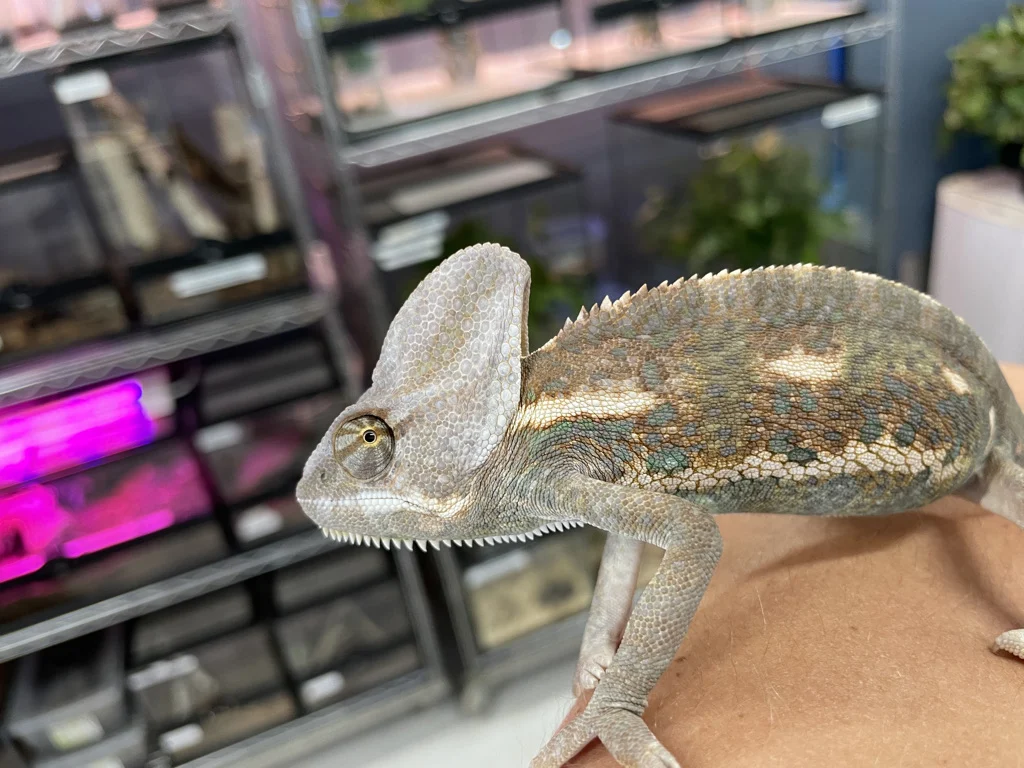
A Veiled Chameleon’s tall casque brings the top of its head closer to the heat lamp than its back. Do not determine safety distances based solely on branch height; consider the position where the top of the head rests when the animal is actually perched. Chameleon Academy emphasizes preventing overheating and burns, recommending a conservative starting basking temperature of around 29°C. Since figures vary across sources, do not interpret the higher end of the range as a mandatory target.
Check water supply, ventilation, and drainage as a single, integrated system.
You must verify where water from misters and drippers collects and drains. Monitor whether water beads on leaves, if there are areas that dry out during the day, and ensure the drainage reservoir does not overflow. Methods to increase nighttime humidity must account for lower night temperatures and ventilation conditions; do not simply pump mist into a warm, enclosed space.
Checklist before adopting a female.
She may need preparations for egg-laying even if she has not been housed with a male. Before adoption, verify her sex, previous laying history, feeding regimen, and the availability of a suitable laying site. Do not arbitrarily or drastically reduce food or heat in an attempt to control egg-laying. Distinguish between floor-exploring behavior and lethargy when recording observations; consult a veterinarian if you are unsure whether the behavior is normal egg-laying activity.
Check the integration of misting, lighting, and the egg-laying area.
For Veiled Chameleons, it is not enough for equipment to simply function; the enclosure must simultaneously provide leaves for drinking, surfaces that dry out during the day, and branches that offer shelter from heat and light. For females, review the layout—including the egg-laying area—prior to adoption.
| Observed Situation | Items to Check | Details to Record |
|---|---|---|
| Dripper is working, but water drains directly to the bottom. | Check if water droplets form on leaves near the perch. | Watering location/timing and the status of the drainage container. |
| Cranial crest getting too close to the lamp. | Closest approach point after growth and movement between branches. | Distance between the top of the head and equipment; resting posture. |
| Female frequently exploring the floor. | Sex, history of previous egg-laying, and accessibility of the laying site. | Record times of exploration, feeding, defecation, and changes in energy levels. |
Is higher humidity at night better?
Simply aiming for a higher number is not appropriate. High humidity levels create vastly different conditions depending on whether the air is cool and well-ventilated or warm and stagnant. If moisture remains into the day, do not just check the mister settings; also inspect airflow and drainage. Readings taken from the actual sensor location are compared against the equipment’s settings; if abnormal signs—such as the animal keeping its eyes closed or failing to grip branches—are observed, the behavior is not interpreted as normal resting.
Record-keeping and Medical Safety
Keep a dated log of feeding, waste elimination, shedding, activity levels, weight, and environmental readings. If a loss of appetite coincides with weight loss, or if you observe respiratory issues, tremors, bleeding, hernias, suspected egg-binding, or impaired limb function, prioritize a consultation with a veterinarian specializing in reptiles over attempting self-treatment.
References
- Long
Island Birds & Exotic Veterinary Clinic: Chameleon Care - Chameleon
Academy: Veiled Chameleon Care
Suggest an edit
Tell us which sentence may be incorrect and provide a verifiable source. Submissions are reviewed before publication.