Last updated 2026.09.16 · Edited by silveston · Compiled by an independent hobbyist without professional credentials

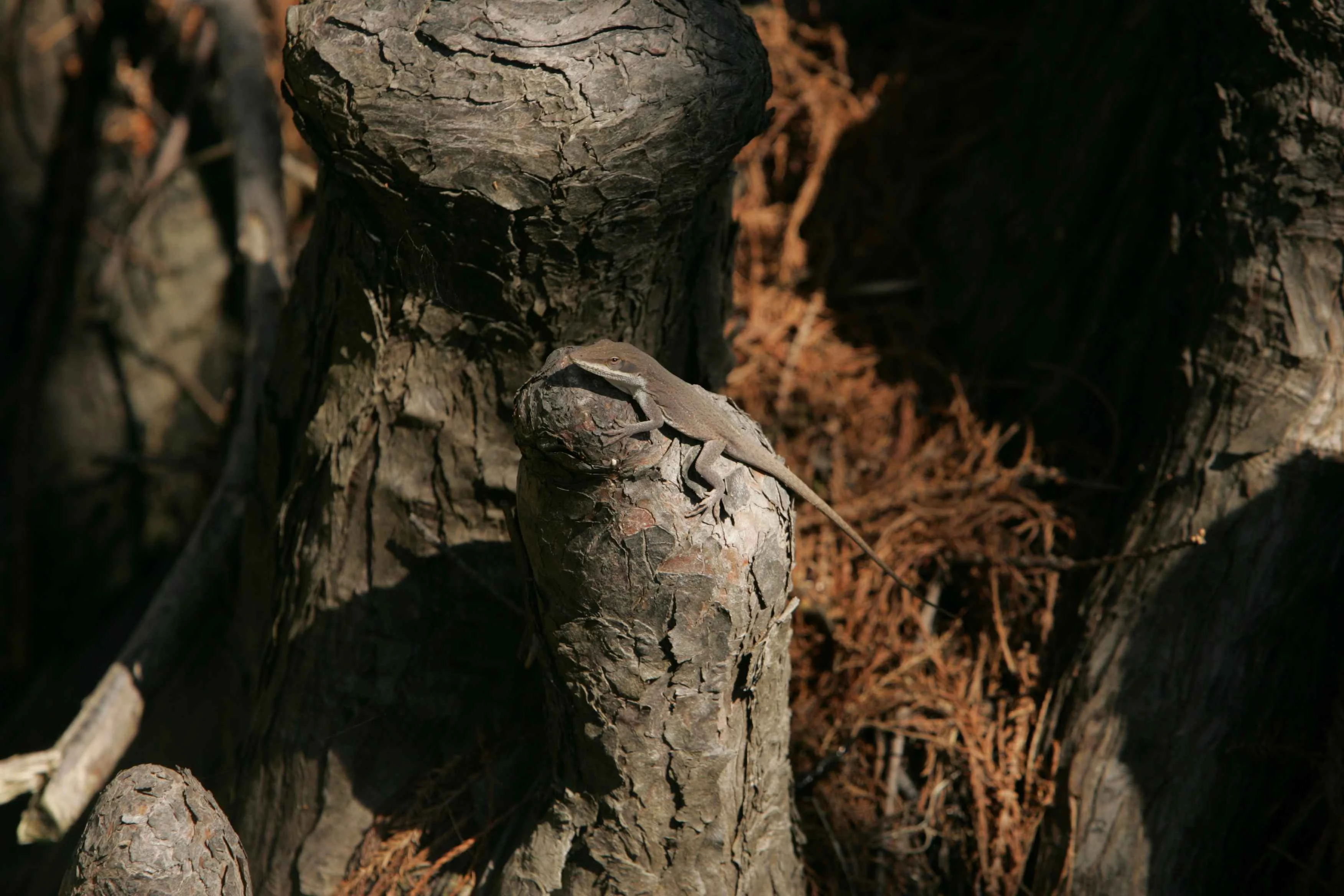
The green anole is a small arboreal lizard that employs a complex visual language involving body color shifts between green and brown, a red dewlap, and gestures resembling push-ups.
This document focuses on classification, ecology, behavior, evolution, and conservation in the wild. Please refer to a separate care guide for specific details regarding temperature, humidity, and feeding guidelines.
At a glance
| Korean name | Green Anole |
|---|---|
| English name | Green anole |
| Scientific name | Anolis carolinensis |
| Taxonomic scope | Species |
| Class | Reptilia (or Sauropsida in a phylogenetic context) |
| Order | Squamata |
| Family | Dactyloidae (Anole family) |
| Genus | Anolis |
| Natural Distribution | Native to the southeastern United States; introduced to various regions including Pacific islands and East Asia |
| Primary Habitat | Forest edges, shrubs, tree trunks, and vertical spaces in urban green areas |
| Activity Period | Monitors territory while moving between branches and trunks during the day |
| Wild Diet | Small arthropods such as insects and spiders |
| Reproduction | Lays small eggs singly over multiple intervals during the breeding season |
| Conservation Note | Widely distributed in its native range but may be managed as an invasive species in areas where it has been introduced |
Taxonomy and Naming
The specific epithet *carolinensis* refers to the Carolina region, while the common name “green anole” derives from its characteristic green body color; however, the color can shift between green and brown.
Anoles: A Massive Evolutionary Experiment
The genus *Anolis* has diversified into hundreds of species across the Caribbean and the Americas, adapting to various vertical niches such as tree trunks, twigs, the ground, and the canopy. The green anole primarily utilizes the zone between trunks and the canopy, moving rapidly between branches using long limbs and adhesive toe pads. Anoles are a prime group for studying the repeated evolution of ecology and morphology.
Native Habitats and Urban Vertical Spaces
Inhabits forests, shrublands, and wetland edges in the southeastern United States, while also utilizing urban structures such as fences and garden trees. Even within the same location, the height at which they perch varies depending on sunlight, vegetation density, and predator distribution. In areas where competing species like the brown anole have been introduced, instances have been reported where the lizards utilize higher perches and their toe structures have evolved over generations.
The Significance of Green vs. Brown
Changes in body color are more strongly linked to social situations, temperature, and physiological states than to simple camouflage that merely mimics the background color. Recent studies suggest that the dynamic coloration of males, in particular, plays a crucial role in communication. A brown color does not automatically indicate illness or stress; the behavioral context must also be considered.
Dewlap and Push-up Signals
Males extend the red or pink dewlap located beneath their throats and perform head-bobs or push-ups. The speed, repetition, and orientation of these signals communicate territorial ownership and a willingness to fight to rivals, while conveying courtship information to females. In environments with swaying vegetation, they can adjust the rhythm of their signals to ensure their movements stand out against the background “noise.”
Small Ambush Predators
They scan their surroundings from branches or leaves and launch a short dash when they spot insects or spiders. Their strategy focuses on rapidly capturing small arthropods that enter their field of vision rather than engaging in prolonged chases for large prey. Green anoles themselves serve as prey for birds, snakes, and larger lizards, thereby linking the food webs of urban areas and forests.
Sequential Egg-Laying
During the breeding season, females employ a strategy of laying small eggs individually at relatively short intervals. Rather than producing a single large clutch, they spread their reproductive investment over multiple events, thereby hedging against the risks posed by environmental fluctuations. Juveniles utilize small branches and dense vegetation, avoiding predators by inhabiting microhabitats distinct from those of the adults.
Competitor Species and Rapid Ecological Changes
Green anole populations that encountered the introduced brown anole are famous for a study showing how they altered their perch heights; over generations, their toe characteristics evolved to favor movement at greater heights. This demonstrates that urbanization and invasive species can rapidly alter not only population numbers but also behavior and the direction of evolution.
Physiology and Environmental Adaptation
As diurnal, arboreal lizards, they rely heavily on vision. Males use their dewlaps, head-bobbing, and push-up displays for territorial and courtship signaling, while their body color is influenced by light, temperature, stress, and social context.
Conservation and Wild Populations
While widely distributed in their native southeastern United States, they are managed as an invasive species in some introduced areas, such as Japan and Pacific islands. This serves as an example of how a single species can present vastly different conservation issues in its native versus introduced ranges.
Captive Populations, Morphs, and Selective Breeding
They have been widely used in laboratory and captive settings to study behavior, color change, development, and evolution. However, behaviors observed under experimental conditions must be interpreted with an understanding of how they differ from those in the wild.
Key Ecological Points
- Changes in body color may be more closely linked to social signals and physiological states than to background matching.
- They communicate territorial and courtship information through a combination of dewlap displays, head-bobbing, and push-ups.
- In areas where a competing species was introduced, they moved to higher branches, and their toe morphology underwent rapid changes.
- Instead of laying a large clutch of eggs at once, they lay small numbers of eggs individually at multiple times throughout the breeding season.
Frequently Asked Questions
Is the green anole a chameleon?
No, it is not. Although they change body color, they belong to the Dactyloidae family, distinct from chameleons.
Why do they spread the red membrane on their throat?
The dewlap is used for visual communication, such as marking territory and courtship.
Are they always green?
No. Their body color shifts between green and brown, influenced by their environment and physiological state.
Where do they originate from?
They are native to the southeastern United States and have been introduced to various other regions by humans.
References
- The Reptile Database — Anolis carolinensis
- Sexual dimorphism in dynamic body color
- Green anole urban ecology review
Data review date: August 2026. Classification and conservation status are subject to change based on new research and assessments.
Related species


Suggest an edit
Tell us which sentence may be incorrect and provide a verifiable source. Submissions are reviewed before publication.