Last updated 2026.09.16 · Edited by silveston · Compiled by an independent hobbyist without professional credentials
SPECIES WIKI · AGAMIDAE
Chinese Water Dragon
Physignathus cocincinus

1. Classification and Naming
The Chinese Water Dragon belongs to the order Squamata, family Agamidae, and subfamily Amphibolurinae; The currently accepted scientific name is Physignathus cocincinus it was described by Cuvier in 1829.
Described by Georges Cuvier in 1829, it is a representative species of large, semi-aquatic agamid lizards in Southeast Asia and has long Physignathus been treated as the central species of the genus.
The specific epithet cocincinus The name is interpreted as originating from the place name “Cochinchina,” which historically referred to southern Vietnam. While spelling variants such as
In the literature, Physignathus cochinchinensis have appeared in the literature, cocincinus—based on the original designation—is currently the standard form used. The English names “Chinese Water Dragon,” “Asian Water Dragon,” and “Green Water Dragon” reflect its distribution in southern China and Southeast Asia, its semi-aquatic lifestyle, and the green coloration of adults, respectively. In Korean, the transliterated name “Chinese Water Dragon” is the most common term in the reptile pet community, used far more widely than translated names like “Chinese water lizard.” There are currently no generally recognized official subspecies; regional populations across its broad Indochinese range are treated as geographical variations within a single species. Although the genus formerly included various water lizards from both Australia and Asia, molecular phylogenetic studies revealed that the traditional genus was not a natural monophyletic group, leading to the reclassification of several species into other genera. Consequently, the genus is now understood primarily in the context of this specific species, while the Australian Eastern Water Dragon is classified in a separate genus. Chromosomal and molecular data are being used to refine the understanding of this species’ position within the family Agamidae, though the genetic structure of regional populations and the mechanism of sex determination remain areas requiring further research.
the English names—Chinese Water Dragon, Asian Water Dragon, and Green Water Dragon—reflect its distribution in southern China and Southeast Asia, its semi-aquatic lifestyle, and the green coloration of adults, respectively.
In Korea, the transliterated name “Chinese Water Dragon” is the most common term used in the pet reptile community, far surpassing translated names like “Chinese water lizard.”
There are currently no generally recognized official subspecies; regional populations across its broad Indochinese range are treated as geographical variations within a single species.
Populations from the Great Plains, Physignathus Although the genus previously included various water lizards from both Australia and Asia, molecular phylogenetic studies revealed that the traditional genus was not a natural monophyletic group, leading to the reclassification of several species into other genera.
Consequently, in the strict sense, Physignathus is understood with this species as the central reference, while the Australian Eastern Water Dragon now belongs to a separate genus, Intellagama lesueurii.
Chromosomal and molecular data are being used to refine the analysis of this species’ position within the family Agamidae, while the genetic structure of regional populations and the mechanism of sex determination remain areas requiring further research.
2. Distribution and Habitat
Its natural distribution spans southern China and Indochina, with records from parts of Yunnan, Guangxi, and Guangdong in China; Vietnam, Laos, and Cambodia; and eastern and southeastern Thailand.
In Vietnam, it ranges from northern mountainous areas to humid valleys in the central and southern regions; key locations include Son La, Thua Thien Hue, and various forest areas across the Central Highlands and coastal mountains.
Its distribution extends westward along forest watersheds in Thailand and Laos, and eastward and southward toward the coastal and Mekong watersheds of Vietnam, with major rivers and mountain ranges shaping the movement paths of local populations.
Its habitat encompasses tropical and subtropical evergreen forests, valley forests, riparian forests, monsoon forests, and humid secondary forests, all closely linked to permanent water bodies such as streams, rivers, and ponds.
It can be found from lowlands up to mountain valleys exceeding 1,000 meters in elevation, with a higher frequency of sightings in areas featuring riverside shrubs and tree branches overhanging the water.
The mean annual temperature across its range is generally between 20°C and 27°C; summer highs exceed 30–35°C, while nighttime temperatures in mountainous areas during winter can drop to around 10°C or lower.
Annual precipitation ranges from approximately 1,200 mm to over 2,500 mm, heavily influenced by the monsoon; the rainy season brings significant increases in river water levels, vegetation growth, and insect productivity.
Key microhabitats include tree branches protruding over the water, thick trunks along the riverbank, rocks, and waterside shrubs, which allow for simultaneous basking and predator surveillance.
When threatened, they dive directly into the water from high branches; thus, an environment combining waterside vegetation and deep water serves not merely as a feeding ground but as a crucial escape refuge.
Deforestation, river channelization, hydroelectric development, and the expansion of agricultural land fragment riparian forests; additionally, capture for the wildlife trade persists in some native ranges, placing compounded pressure on populations.

3. Morphology and Body Structure
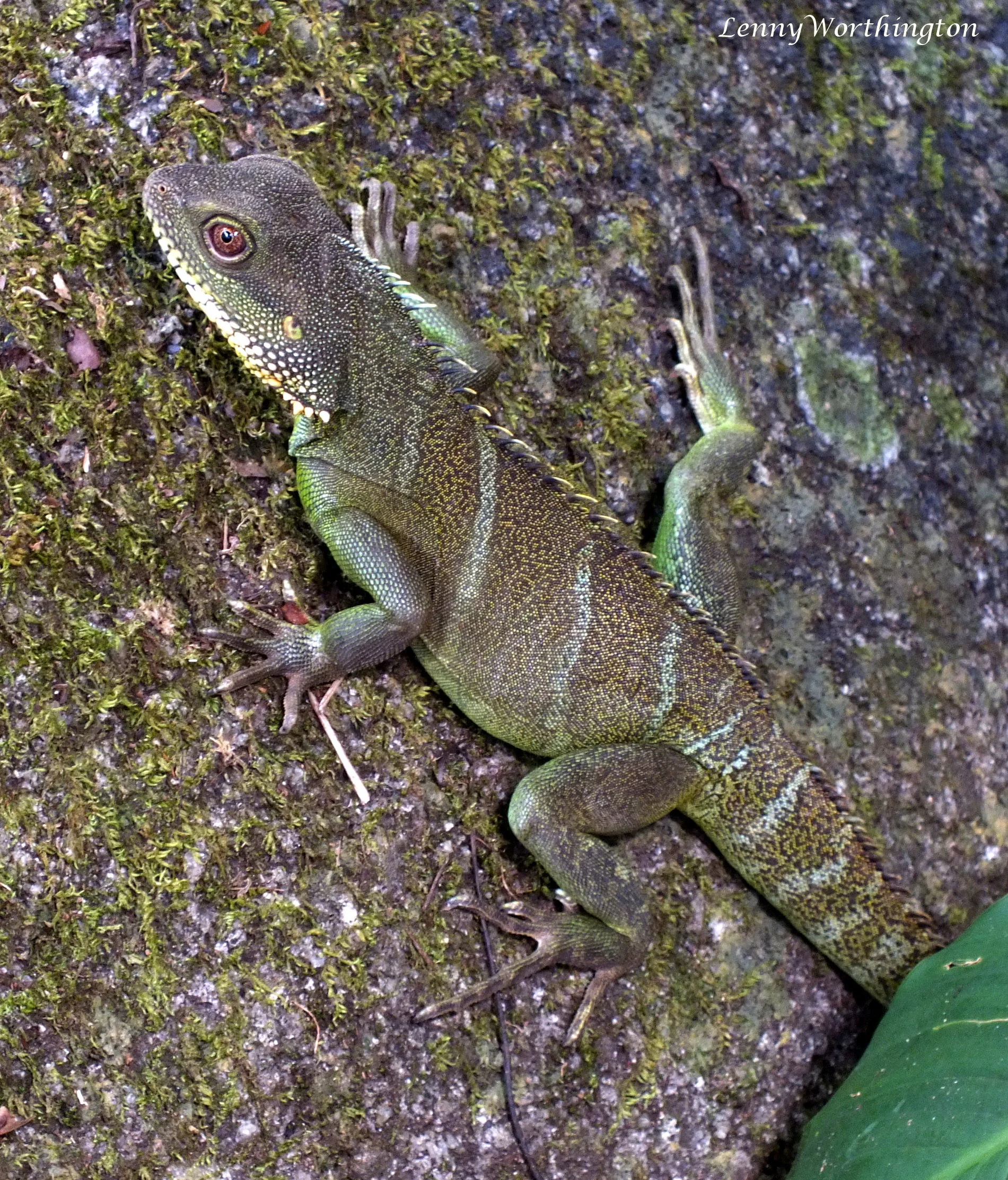
The total length of adults is approximately 80–100 cm for males and 60–80 cm for females; the very long tail accounts for more than half—and sometimes up to two-thirds—of the total length.
Adult body weight typically ranges from 600–1,000+ g for males and 400–700 g for females; mature males possess a more robust head, neck, and torso.
The head is triangular and the snout relatively long; adult males have highly developed jaw muscles and cheek areas, resulting in a wider head than that of females.
The eyes are positioned on the sides of the head and have round pupils, an adaptation suited for detecting color, movement, and social visual signals during their diurnal activity.
The base body color ranges from bright green to blue-green or dark green, and yellow, blue, or light-colored bands may appear along the sides of the body and around the jaw.
Juveniles have less developed crests and smaller heads than adults; as they grow, the crests running along the head, neck, and center of the back—particularly in males—become high and distinct.
The body is covered in relatively small, keeled scales, while elongated, protruding crest scales form a continuous row along the head and the center of the back.
The four limbs are long and strong, and the long toes and sharp claws on each foot are effective for gripping wet tree trunks, branches, and rocks.
The tail is very long and laterally compressed; when swung side-to-side in water, it functions as a powerful swimming organ that generates propulsion.
Key characteristics include a vivid green body color, large crests (in males), and a long, laterally compressed tail; it differs significantly from the Australian Intellagama lesueurii species in terms of head shape, body color, crest structure, and natural distribution.
4. Ecology and Behavior
The Chinese Water Dragon is a typical diurnal lizard; after sunrise, it basks on riverside branches and rocks to raise its body temperature to an active level.
It regulates its body temperature by rapidly moving between sunlight, shade, and water, retreating to the shade of the tree canopy or into the water if it overheats during midday.
It is an omnivore that actively forages, moving across the ground, trees, and waterside areas to search for insects, small vertebrates, and plant matter.
Branches overhanging the water serve as basking spots and vantage points for spotting predators; a characteristic behavior involves diving directly into the water from these high positions upon sensing danger.
In the water, they swim rapidly by swaying their long tails from side to side and can remain submerged to evade pursuing predators.
Adults are not strictly gregarious; mature males, in particular, may exhibit strong territorial behavior around prime basking spots and breeding areas.
Visual signals—such as head-bobbing, body orientation, and displays involving the crest and throat—are crucial for communication between individuals, while chemical and tactile signals also play a role in reproduction.
During male-male competition, they attempt to appear larger and engage in rapid head movements and chasing; prolonged conflicts can escalate into biting and physical grappling.
Predator avoidance strategies include diving into the water, underwater escape, tree climbing, and rapid running, as well as tail-whipping and biting when cornered.
Activity and reproductive patterns vary with monsoon seasonality and temperature fluctuations; during the cool dry season, basking duration may increase, while overall activity levels and food intake decrease.
5. Diet and Feeding Habits
Chinese Water Dragons are omnivorous, consuming insects, other invertebrates, small vertebrates, and various plant materials.
Their insect diet includes a wide range of taxonomic groups, such as Orthoptera, Coleoptera, Blattodea, Lepidoptera, and Hymenoptera.
They also consume invertebrates such as spiders, earthworms, and snails, actively foraging for them in the moist soil and vegetation along stream banks.
Vertebrate prey may include small frogs, tadpoles, lizards, small fish, and occasionally very small rodents.
Plant-based food consists of tender leaves, shoots, flowers, and fruits; adults tend to utilize plant resources more extensively than juveniles.
During the rainy season, the productivity of both insects and plants increases, leading to greater dietary diversity, whereas in the dry season, the variety of prey and overall food intake may decrease.
Juveniles rely relatively more on protein-rich small insects and animal-based prey to support rapid growth.
In the wild, they do not follow a fixed feeding schedule but instead opportunistically consume prey encountered during activity, spending time resting and digesting after consuming large prey items.
They obtain hydration not only by drinking directly from streams and pools but also by consuming prey, fruits, and water droplets on leaves, giving them greater access to water than many other agamid species.
Vision is crucial for locating moving prey, while the tongue, sense of smell, and chemosensory capabilities assist in identifying prey at close range; a high active body temperature supports rapid digestion and active foraging behavior.
6. Reproduction
Reproduction is linked to local temperatures and monsoon cycles, with reproductive activity increasing during the warm season, the onset of the rainy season, or periods of abundant prey.
Males approach females and signal their presence to rival males through visual displays involving head-bobbing, body-raising, and crest-flaring.
If the female is receptive, the male approaches, secures his position, aligns his tail with hers, and inserts one hemipenis to mate.
This species is oviparous, laying approximately 6 to 18 eggs per clutch, with larger females capable of producing more eggs.
While laying multiple clutches in a single breeding season is possible under favorable conditions, the annual frequency of egg-laying in the wild depends on the region and the female’s energy reserves.
The eggs have white, oval, leathery shells, and the female creates a nesting burrow by digging into moderately moist soil along riverbanks or on the forest floor.
Incubation takes approximately 60 to 90 days at temperatures of around 27–30°C, with temperature and soil moisture determining the rate of embryonic development and hatching success.
It is not currently classified as an established TSD (Temperature-Dependent Sex Determination) species where breeders can reliably select sex via specific temperatures; further research into its sex-determination mechanism is required.
Hatchlings are small—measuring approximately 12–18 cm in total length and weighing around 5–10 g—but are born with long tails and claws, enabling them to immediately begin climbing and hunting insects.
Sexual maturity depends on growth rates; males typically mature at 1.5–2 years of age, while females take two years or longer, with adequate body size being crucial for reproductive success.
7. Conservation Status and Threats
Although the Chinese Water Dragon is widely distributed across Southeast Asia, habitat loss and intensive wild capture in certain regions have raised the need to re-evaluate its conservation status.
The latest IUCN Red List classification and assessment year should be verified via the official species page; one should not assume that population status is uniform across all countries.
Applicability of CITES regulations and trade rules in countries of origin must be checked against the latest official lists, as cross-border commercial movement is subject to national wildlife laws.
The most direct threats include the loss of riparian vegetation caused by the logging of riverside forests, agricultural expansion, road and tourism development, and hydroelectric projects or river channel modifications.
In some regions, wild capture for food, traditional use, and the pet trade places additional pressure on adult populations.
Given that large males are highly conspicuous and commercially valuable, the potential long-term impact of selective harvesting on sex ratios and reproductive structures warrants further study.
Precise estimates of wild population sizes across the entire distribution range are lacking, and direct comparisons of regional trends are difficult due to the inaccessibility of certain forest areas and disparities in survey standards between countries.
While protected area regulations and wildlife laws in China, Vietnam, Laos, Cambodia, and Thailand offer some protection for habitats and populations, effective enforcement and market monitoring are crucial for actually curbing illegal harvesting.
Captive breeding can reduce the pet market’s reliance on wild-caught specimens, but it requires source records and international traceability to verify that the traded individuals were indeed captive-bred.
Long-term conservation requires monitoring populations in major river systems, protecting riparian forests, surveying wildlife markets, sharing cross-border trade data, and studying changes in precipitation and river flow driven by climate change.
References
- Nguyen, T.Q. et al. 2018. First population assessment of the Asian Water Dragon (Physignathus cocincinus) in Thua Thien Hue Province, Vietnam. Nature Conservation 26:1–14. https://natureconservation.pensoft.net/article/21818/
- Miller, K.L. et al. 2019. Parthenogenesis in a captive Asian water dragon (Physignathus cocincinus) identified with novel microsatellites. PLOS ONE 14:e0217489. https://doi.org/10.1371/journal.pone.0217489
- Uetz, P. et al. Physignathus cocincinus. The Reptile Database. https://reptile-database.reptarium.cz/Physignathus/cocincinus
Related species


Suggest an edit
Tell us which sentence may be incorrect and provide a verifiable source. Submissions are reviewed before publication.