Last updated 2026.09.16 · Edited by silveston · Compiled by an independent hobbyist without professional credentials

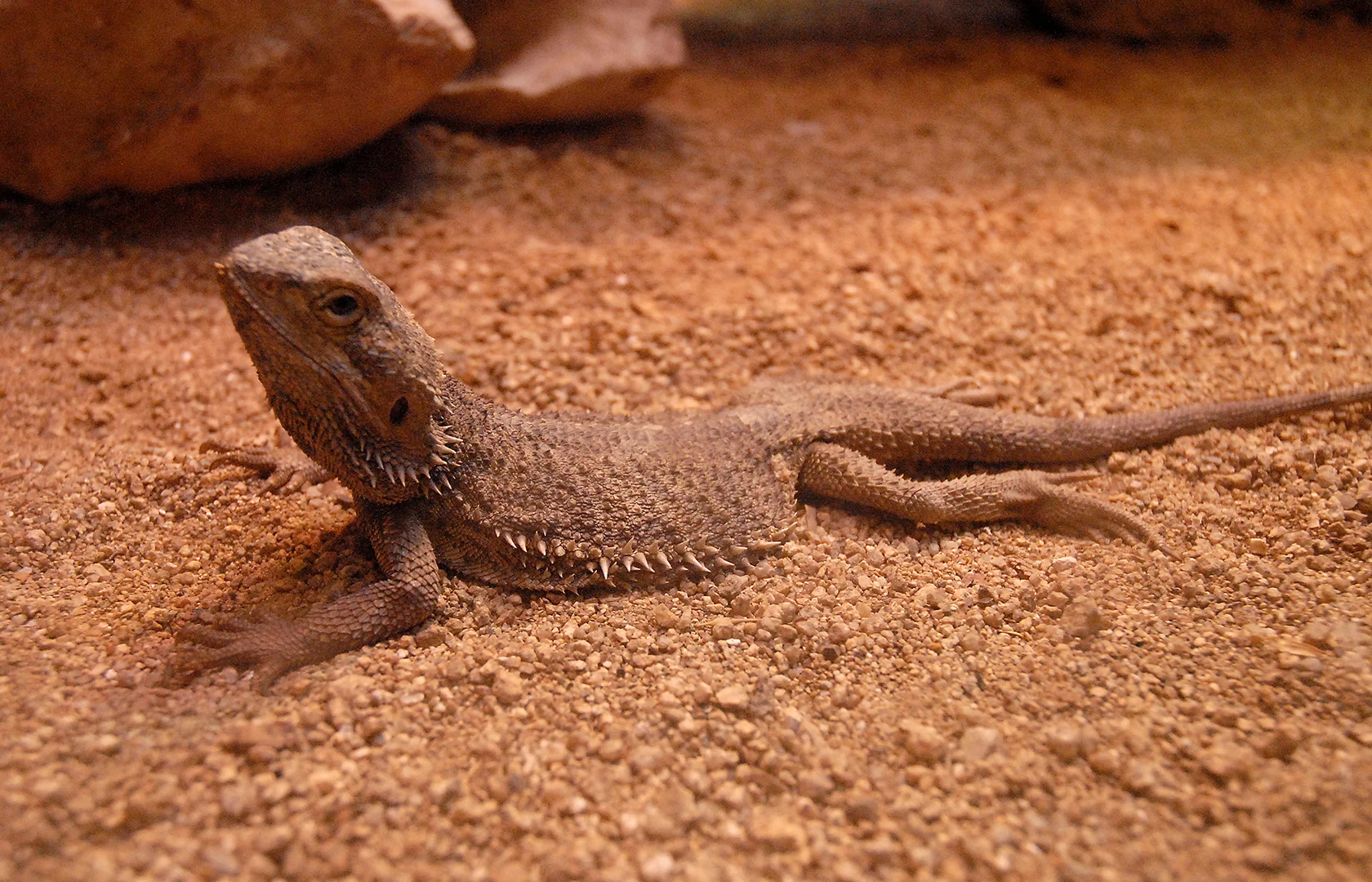
The Bearded dragon’s flattened body, its beard that turns black, and movements resembling push-ups all serve as signaling mechanisms to manage both heat regulation and social communication in the scorching Australian outback.
This document focuses on classification, ecology, behavior, evolution, and conservation in the wild. Please refer to a separate care guide for specific details regarding temperature, humidity, and feeding guidelines.
At a glance
| Korean name | Bearded dragon |
|---|---|
| English name | Central Bearded Dragon |
| Scientific name | Pogona vitticeps |
| Taxonomic scope | Species |
| Class | Reptilia (or Sauropsida in a phylogenetic context) |
| Order | Squamata |
| Family | Agamidae family |
| Genus | Pogona |
| Natural Distribution | Extensive inland regions of eastern and central Australia |
| Primary Habitat | Arid and semi-arid shrublands, grasslands, open woodlands, and rocky terrain |
| Activity Period | Diurnal; regulates body temperature by moving between sunlight and shade |
| Wild Diet | Omnivorous; feeds on arthropods and various plant matter |
| Reproduction | Egg-laying; the relationship between temperature and embryonic development is a subject of active research |
| Conservation Note | Widely distributed, but requires monitoring regarding land-use changes and local environmental conditions |
Taxonomy and Naming
The common name “Bearded dragon” derives from the behavior of flaring out the spiny scales beneath the throat—making them resemble a beard—during threats, courtship, or competition. The specific epithet *vitticeps* refers to the striped or banded pattern on the head.
Classification within the Agamidae family
The genus *Pogona* consists of agamid lizards adapted to the Australian environment; the name “Bearded dragon” comes from the throat scales that flare out during displays of threat or courtship. The spines on their bodies are keratinized scales, not structures that stand up like mammalian fur. Their flattened bodies and long limbs are advantageous for moving quickly across the ground and climbing onto low trees, fences, or rocks to survey their surroundings.
Mosaic Habitats in Arid Environments
Their natural habitat is not merely a stretch of sand but a mosaic of grasses, shrubs, fallen logs, rocks, and shaded areas. Individuals move repeatedly between exposed spots for basking and shelters where they can lower their body temperature. Variations in the thermal environment affect the energy cost of movement and the time spent basking; studies have shown that these animals regulate their body temperature with considerable precision.
The Dual Roles of Body Coloration
Bearded dragons do not change their entire body color in the same way. Color changes on the back are closely linked to thermoregulation—specifically, the absorption of solar radiation—whereas darkening of the throat and chest serves primarily as a social signal directed at rivals or potential mates. In other words, the meaning of turning “black” depends on which specific body part changes color.
Body Language and Social Learning
Male behaviors such as head-bobbing, beard-flaring, and body-puffing signal size and intent, while “arm-waving”—a slow, circular motion of the forelimb—is observed in contexts involving the de-escalation of tension or reactions to other individuals. Experiments have documented social learning, where individuals opened a door in the same direction after watching another do so; this has broadened the perspective that previously viewed reptilian learning merely as simple reflex action.
Seasonally Variable Omnivory
Juveniles tend to consume a diet with a higher proportion of animal matter to support growth, whereas adults utilize a wider range of plant resources, such as leaves, flowers, and fruits. In the wild, food availability fluctuates with rainfall and the seasons, making opportunistic dietary choices more important than relying on a single, fixed food source. They function as both insect predators and consumers of plant matter.
Reproduction and Temperature-Sensitive Development
Females dig into the ground to lay their eggs. Although Bearded dragons possess a genetic sex-determination system, a phenomenon known as sex reversal occurs in which genetic males develop into females when exposed to extremely high incubation temperatures. This is a prime example of how climate and developmental environments can influence the sex ratio and evolution of reptiles.
Dormancy and Changing Environments
During cold seasons or periods of resource scarcity, the animals may undergo brumation, a state characterized by significantly reduced activity and feeding. Seasonal patterns in the wild vary by individual and region, and do not simply align with a calendar. Changes in climate can alter the time available for basking, the timing of prey availability, and reproductive success, necessitating long-term monitoring.
Physiology and Environmental Adaptation
As diurnal ectotherms, they actively regulate their body temperature by alternating between basking and moving into the shade. Changes in dorsal coloration are closely linked to heat absorption, while the dark coloration on the neck and chest serves as a social signal.
Conservation and Wild Populations
Although widely distributed across Australia, habitat quality can be affected by regional changes in land use, roads, fire regimes, and climate change. A broad distribution does not guarantee the stability of populations in every region.
Captive Populations, Morphs, and Selective Breeding
In the pet trade, traits related to body color, patterns, and scales have been subject to strong selective breeding. It is important to distinguish between the morphological diversity found in captive populations and the adaptive traits observed in the wild.
Key Ecological Points
- Dorsal and neck coloration play distinct roles, with the former primarily serving thermoregulation and the latter functioning as a social signal.
- Experimental results demonstrate that they can learn problem-solving methods by observing the behavior of other individuals.
- At very high developmental temperatures, the phenotypic sex may differ from the genotypic sex.
- Arm-waving is not a cute greeting but a signal used to manage social tension.
Frequently Asked Questions
Why does a Bearded dragon’s beard turn black?
It serves various functions, such as social signaling and thermoregulation; one must observe which body parts change and under what circumstances.
Is arm-waving a form of greeting?
Rather than a greeting in the human sense, it is interpreted as a social response to another individual.
Are they herbivores in the wild?
They are omnivores, and the ratio of animal-based to plant-based food varies depending on age, season, and region.
Can incubation temperature affect sex?
In this species, research has documented a phenomenon of sex reversal, where the phenotypic sex differs from the genetic sex at very high incubation temperatures.
References
- Colour change provides thermal and signalling functions
- Thermoregulatory behavior of Pogona vitticeps
- Social learning by imitation in a reptile
Data review date: August 2026. Classification and conservation status are subject to change based on new research and assessments.
Related species


Suggest an edit
Tell us which sentence may be incorrect and provide a verifiable source. Submissions are reviewed before publication.