Last updated 2026.09.16 · Edited by silveston · Compiled by an independent hobbyist without professional credentials

Uromastyx are not merely animals that endure desert heat; they are diurnal, herbivorous lizards that precisely regulate their body heat and moisture levels by moving between sunlight and deep burrows.
This document focuses on classification, ecology, behavior, evolution, and conservation in the wild. Please refer to a separate care guide for specific details regarding temperature, humidity, and feeding guidelines.
At a glance
| Korean name | Uromastyx |
|---|---|
| English name | Spiny-tailed lizards |
| Scientific name | Uromastyx spp. |
| Taxonomic scope | Main article on the genus |
| Class | Reptilia (or Sauropsida in a phylogenetic context) |
| Order | Squamata |
| Family | Agamidae family |
| Genus | Uromastyx |
| Natural Distribution | Arid regions spanning from North Africa to the Arabian Peninsula and Southwest Asia |
| Primary Habitat | Rocky and gravel deserts, and areas around deep burrows in arid grasslands |
| Activity Period | Diurnal; alternates between basking and retreating into burrows |
| Wild Diet | Adults primarily consume plant matter such as leaves, flowers, and seeds |
| Reproduction | Egg-laying; influenced by seasonal rainfall and plant productivity |
| Conservation Note | Conservation status varies by species; international trade is regulated under CITES Appendix II |
Taxonomy and Naming
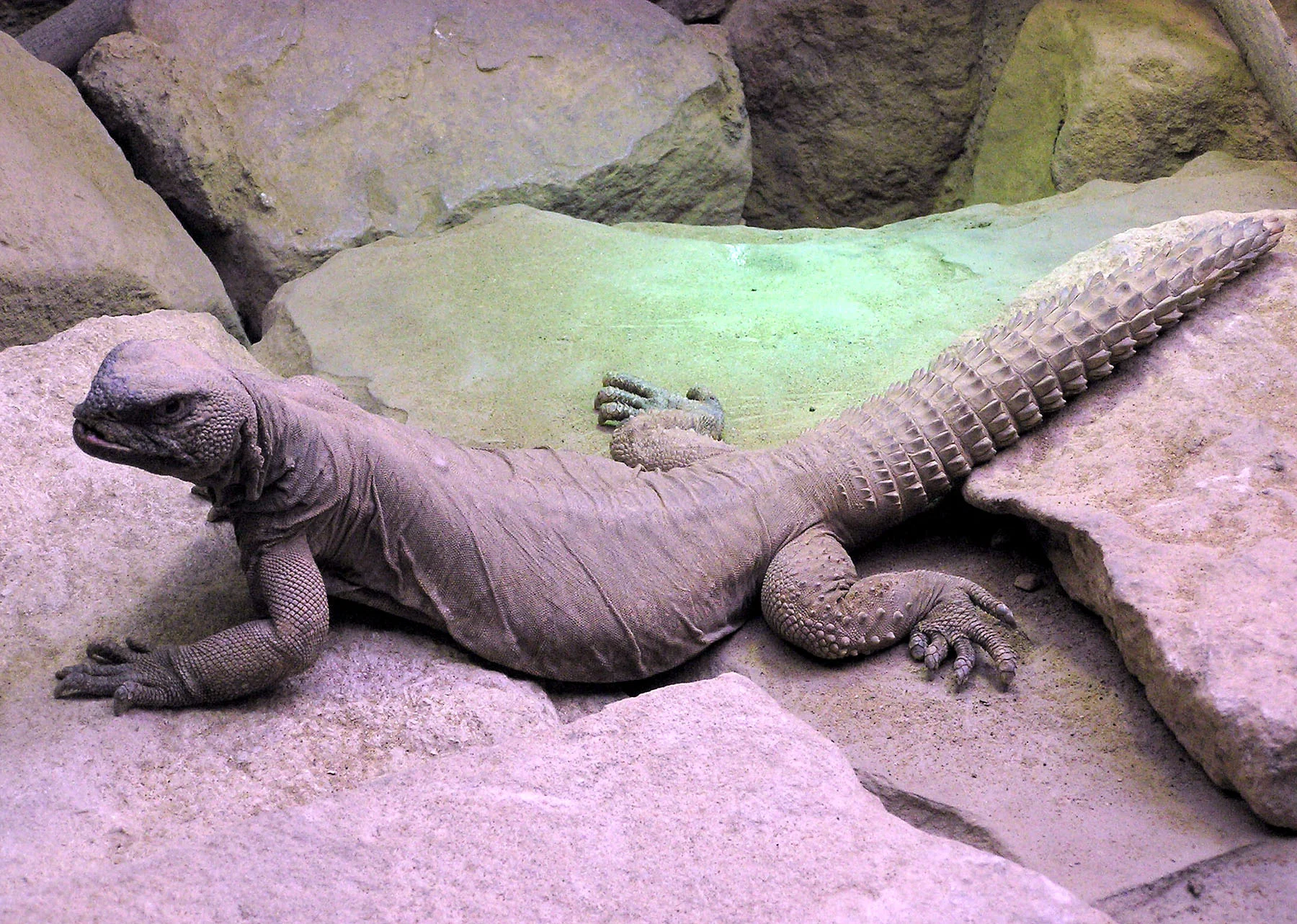
The name *Uromastyx* is derived from the Greek words *oura* (tail) and *mastix* (whip), referring to their thick, spiny tails. As this document covers the entire *Uromastyx* genus rather than a single species, it is important to verify differences between specific species.
A desert lineage comprising multiple species
*Uromastyx* includes several species distributed across North Africa, the Middle East, and Southwest Asia. Because body size, coloration, elevational range, and rainfall patterns vary by species, the genus cannot be simplified into a single desert environmental profile. Common characteristics include strong limbs, a broad body, a spiny tail, and a lifestyle centered around burrows.
The Underground Climate Created by the Burrow
While the surface becomes extremely hot during the day and cools rapidly at night, deep burrows buffer temperature fluctuations and retain moisture. Field studies show that the temperature and humidity inside the burrow remain more stable than at the entrance. The burrow serves as a foundation for survival, acting simultaneously as a resting place, a refuge from predators, and a space for seasonal dormancy.
Balancing Sunlight and Shade
In the morning, they warm their bodies at the burrow entrance and set out to forage once they reach an optimal body temperature. When the surface becomes excessively hot at midday, they retreat into the burrow; the duration of sunbathing varies depending on the season, altitude, sex, and body size. Rather than simply preferring high temperatures, they allocate their time by weighing the benefits of activity against the risk of overheating.
Defense with a Spiny Tail
Their short, thick tails are lined with sharp, ring-like scales. When threatened, they retreat into the burrow and either block the entrance with their tail or swing it vigorously to deter predators. Pressing their broad bodies tightly against the burrow walls makes them difficult to extract, effectively combining the burrow’s structure and their own physique into a single defense system.
Desert Herbivores
Adults consume a wide variety of leaves, flowers, seeds, and seasonal plants, intensively utilizing the vegetation that briefly flourishes after rainfall. Nutritional studies indicate that they can adjust their intake of protein and energy in response to seasonal changes. While the consumption of animal-based food has been reported in juveniles, the diet of adults relies primarily on plant resources.
Burrows as Ecosystem Engineers
A large *Uromastyx* burrow serves as more than just a home for a single individual; invertebrates and small vertebrates utilize the area around the burrow or occupy abandoned ones, while the excavated soil alters surface structures and conditions for plant colonization. In desert environments, deep burrows provide rare microhabitats that allow organisms to escape extreme temperatures, making them valuable to surrounding wildlife.
Varying Conservation Risks by Species
Some species are widely distributed, whereas others rely on restricted ranges and specific rock or soil types. Activities such as road construction, quarrying, agricultural expansion, and the trade of these animals as pets or food can place pressure on local populations. The fact that the international trade of all *Uromastyx* species is regulated under CITES Appendix II underscores the importance of verifying the species-level origin of these animals.
Physiology and Environmental Adaptation
Rather than merely “enduring” high-temperature environments, they precisely regulate their body temperature and water loss by alternating between basking and retreating into deep burrows. Their kidneys employ an excretion method that favors water conservation, and the adult diet relies heavily on plant matter.
Conservation and Wild Populations
Conservation status varies by species; some have limited distributions or face significant trade pressure. As the genus *Uromastyx* is subject to CITES regulations regarding international trade, it is essential to verify the legal status at both the regional and species levels.
Captive Populations, Morphs, and Selective Breeding
In the captive trade market, multiple species are sold under the collective name “*Uromastyx*.” Applying the same temperature, diet, and adult size standards to all *Uromastyx* species without identifying the specific species leads to errors.
Deep burrows maintain much more stable temperatures and humidity levels than the hot surface.
The spiny tail serves as both a weapon for defense and a shield to block the burrow entrance.
Adults exhibit a strong herbivorous tendency, which is rare among desert lizards.
*Uromastyx* is not a single species; therefore, conservation status and ecological traits must be assessed individually for each species.
Is *Uromastyx* a single species?
No. It is a collective name for the genus *Uromastyx*, which comprises multiple species.
Why is the tail covered in spines?
It allows the lizard to anchor itself in burrow entrances or rock crevices and serves as a defensive tool against predators.
Are they all herbivores?
Adults rely heavily on plant-based diets, though this varies depending on the species, age, and region.
Do they not live outside of deserts?
While adapted to arid environments, specific habitats vary by species—ranging from rocky deserts and gravel plains to dry grasslands.
Key Ecological Points
- Deep burrows maintain much more stable temperature and humidity levels than the hot surface.
- The spiny tail serves as both a weapon for swinging and a shield to block the burrow entrance.
- Adults exhibit a strong herbivorous tendency, which is rare among desert lizards.
- *Uromastyx* is not a single species; conservation status and ecology must be distinguished by specific species.
Frequently Asked Questions
Is *Uromastyx* a single species?
No, it is a collective name for the genus *Uromastyx*, which comprises multiple species.
Why is the tail covered in spines?
It allows the lizard to anchor itself in burrow entrances or rock crevices and serves as a defense against predators.
Are they all herbivores?
Adults generally rely heavily on plant-based diets, though this varies by species, age, and region.
Do they not live outside of deserts?
While adapted to arid environments, specific habitats vary by species—ranging from rocky deserts and gravel plains to dry grasslands.
References
- Field thermoregulatory behavior in Uromastyx acanthinura
- Daily and seasonal activity patterns of a spiny-tailed lizard
- Desert lizards modulate nutritional responses seasonally
Data review date: August 2026. Classification and conservation status are subject to change based on new research and assessments.
Related species


Suggest an edit
Tell us which sentence may be incorrect and provide a verifiable source. Submissions are reviewed before publication.