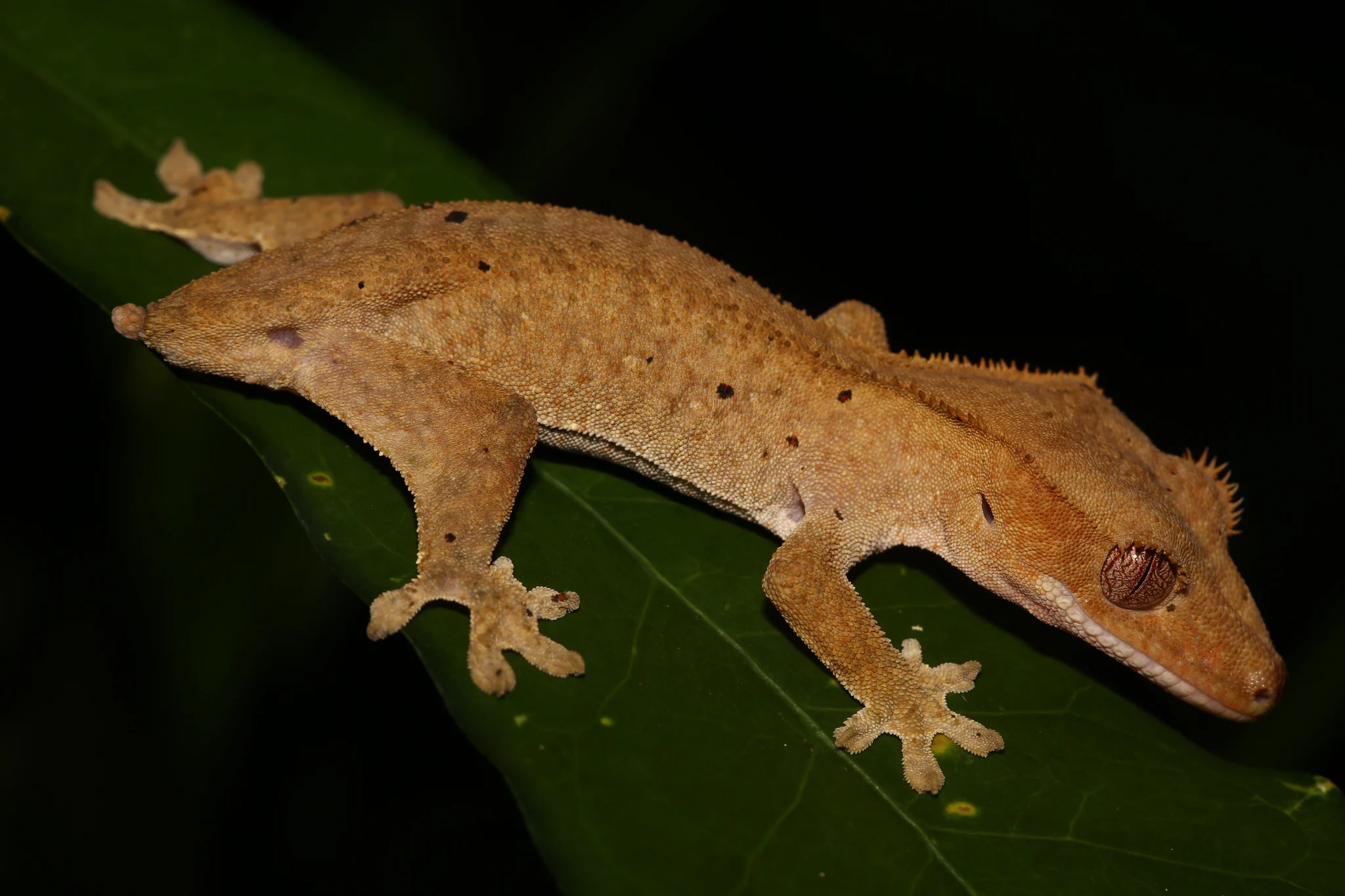
While the sight of geckos walking on glass walls and ceilings is often attributed to “suction,” they do not actually possess suction cups or sticky adhesives on their feet. An even more interesting fact is that not all geckos can climb walls. This article examines how microscopic hairs on their toes increase contact area, how geckos instantly switch between adhesive and release forces, and why this mechanism has appeared and disappeared multiple times throughout the course of evolution.
30-Second Summary
- Gecko adhesive pads feature a hierarchical microstructure consisting of lamellae, setae, and spatulae.
- Adhesion is primarily attributed to van der Waals interactions occurring at numerous microscopic contact points.
- Geckos engage and disengage their adhesive grip by altering the direction of pressure and pulling, as well as the angle of detachment.
- The hyperextension movement—lifting the toes by flipping them backward while walking—also contributes to self-cleaning by dislodging dust.
- Some geckos, such as the Leopard gecko, lack adhesive pads; a major 2025 phylogenetic reconstruction estimated that these pads evolved at least 12 times and were lost 11 times.
1. Adhesive pads function through a hierarchical structure of hairs

When viewing the underside of a gecko’s toe with the naked eye, one can see horizontally arranged ridges or plates known as lamellae. These lamellae are not merely simple folds but serve as platforms for a vast array of much smaller structures.
The surface of the lamellae is densely covered with microscopic, hair-like structures called setae. Classic morphological and biomechanical studies have reported that a single foot possesses approximately 500,000 setae, each ranging from roughly 30 to 130 micrometers in length.
The tip of an individual seta does not end at a single point; instead, it branches out into hundreds of flat, spatula-shaped structures known as spatulae, each measuring approximately 0.2 to 0.5 micrometers in width.

This multi-level branching serves to maximize the contact area. While a wall may appear smooth to the human eye, it is actually full of irregularities at the microscopic level; the fine, flexible spatulae conform to these contours, creating countless tiny points of contact.
When the contact distance becomes sufficiently close, weak van der Waals interactions arise between molecules. Although the force at a single contact point is minuscule, the combined effect of millions of simultaneous contacts generates enough force to support the animal’s body.
Therefore, simply describing a gecko’s foot as “sticky” misses the point. It does not rely on applying a secreted adhesive, nor does it utilize pressure differentials like the suction cups of an octopus.
This hierarchical structure offers the advantage of accommodating surface irregularities of varying scales. Flexibility is distributed across the structure: the lamellae and setae conform to relatively large undulations, while the tiniest spatulae fill in the remaining gaps.
This mechanism is known as “dry adhesion.” While the term implies that the gecko can adhere repeatedly without replenishing a liquid adhesive, it does not mean the process is entirely unaffected by water or humidity.
If a surface is excessively rough, the actual contact area available to the spatulae is reduced. Conversely, on a very smooth surface like glass, a vast number of contact points are established, making the adhesive capability strikingly apparent.
Understanding this structure reveals that a gecko “sticking” to a wall is not a passive state. The posture of the toes and the distribution of weight continuously modulate the contact state of these microstructures; as we will see in the next section, the adhesive force varies significantly depending on the direction of the load.
2. ‘Direction’ and ‘peeling angle’ are more critical than adhesive force.

A foot that always adheres with maximum strength is actually disadvantageous for walking. Since lifting a foot requires significant energy—making it difficult to run quickly or change direction—rapid detachment is just as important to a gecko as strong adhesion.
Geckos place their toes down with a rolling motion, allowing the lamellae and setae to make contact sequentially. This action minimizes air gaps and gives the microscopic structures time to conform to the surface’s irregularities.
Next, a ‘shear preload’ is applied by slightly pulling the foot toward the body. During this phase, the setae tilt into an orientation favorable for adhesion, and more spatulae come into close proximity with the surface, causing the adhesive force to increase rapidly.
Setae are not isotropic materials that exert equal force in all directions. They are directional structures where adhesive strength increases when the alignment matches the direction of the pull; consequently, the posture of the toe itself acts as a switch.

The reverse process occurs when lifting the foot. Geckos employ ‘digital hyperextension’—bending the toes backward starting from the tips—to peel the contact surface away sequentially from the edge, rather than pulling it all off at once.
This is similar to how tape comes off more easily when you lift the end and peel it at a steep angle, rather than pulling it parallel to the surface. When the angle exceeds the critical threshold, the contact area shrinks rapidly, and the strong bond breaks in an instant.
This process of attachment and detachment repeats with every step while running. Adhesion is not simply a matter of being present or absent; it is a value continuously modulated as toe muscles and tendons control the orientation of the microstructure.
On vertical walls, the action of pulling the foot toward the body—countering the force that causes it to slide downward—naturally enhances adhesion. On ceilings, stability is maintained by distributing the load across multiple feet and carefully coordinating the shear direction of each foot.
However, actual performance depends on surface material, contamination, humidity, and the presence of water. Under certain wet conditions, adhesion may hold or fail depending on the material’s wettability; therefore, generalizations such as “geckos stick to any wet wall” are inaccurate.
This principle of directionality is precisely why research into biomimetic adhesives and climbing robots focuses on gecko feet. The goal is not simply an adhesive with maximum strength, but a reusable surface that provides strong support while allowing for clean detachment with a small movement when needed.
Ultimately, the gecko’s secret cannot be summed up by “how strongly it sticks. The true key lies in the rapid control of the entire process: establishing contact, aligning with the direction of the applied force, and peeling away starting from the edge.
3. Cleaning feet while walking, even when covered in dust

Tree bark and rocks in the wild are not as pristine as laboratory glass. Contamination—such as dust and sand getting trapped between the spatula and the surface, thereby reducing the actual contact area—is a significant ecological challenge that adhesive pads must overcome.
Gecko feet do not remain completely free of contamination; rather, they largely regain their performance capabilities as the animal moves. This process is known as “self-cleaning,” though it does not involve washing with soap or water.
A 2005 study demonstrated a passive self-cleaning effect, showing that contaminant particles tend to remain on the substrate rather than on the foot. A subsequent study in 2012 experimentally showed that the toe hyperextension motion occurring during actual locomotion facilitates faster, dynamic cleaning.
In that experiment, gecko feet allowed to undergo natural toe hyperextension regained their adhesive strength twice as fast as those where hyperextension was restricted. After four steps, they recovered approximately 80% of their pre-contamination adhesive strength.

The key factors are the acceleration and the peeling motion that occur during the rapid backward bending of the toes. Particles adhering to the setae are more likely to detach when the contact is broken sequentially, due to the interplay between inertial forces and interfacial forces.
When the toe makes fresh contact with a clean surface during the next step, some of the remaining particles may transfer to the ground. In other words, rather than a single, perfect cleaning event, the process relies on the accumulation of incremental removal over successive walking cycles.
Removal efficiency varies depending on particle size, material, surface energy, and the level of contamination. The term “self-cleaning” does not imply that all contaminants vanish instantly; excessive contamination can significantly reduce adhesive strength.
This mechanism is particularly crucial in the wild. Since the animal cannot stop to clean its feet while fleeing or hunting, it is advantageous for the natural act of walking to also serve a maintenance function.
There is no need to forcibly rub the toes of captive animals or test their adhesive strength simply because foreign matter is visible. This text explains the biomechanics involved; if you observe toe damage, swelling, discoloration, or persistent difficulty climbing, it is best to inspect the environment and consult a veterinarian specializing in reptiles.
Self-cleaning is a feature that appeals to engineers just as much as adhesion does. For robotic feet or dry adhesive surfaces used in medical and industrial applications, performance degrades as dust accumulates; therefore, designs that minimize contamination through the operational movement itself can enhance both lifespan and reliability.
A single step taken by a gecko involves the simultaneous processes of locomotion, detachment, and contaminant removal. It represents a biological design that integrates multiple functions into the existing movement of the toes, rather than requiring a separate cleaning mechanism.
4. Not all geckos have adhesive pads

The phrase “geckos climb walls” generalizes the abilities of a few famous species to the entire group. While some gecko species possess broad toe pads, others—such as the Leopard gecko—rely on claws and standard walking mechanics rather than pads.
Leopard gecko It lives primarily on the ground, and its toe tips do not spread out broadly like those of the Crested gecko. Its inability to climb smooth, vertical glass walls is not a sign of a health issue but a result of its natural anatomy and lifestyle.
The evolution of gecko adhesive pads is not a simple story of a trait emerging once in an ancestor and being passed down to all descendants. Recent large-scale phylogenetic reconstructions suggest that the ancestral state of early geckos was likely padless.
An analysis published in 2025, covering over 1,400 gecko species, estimated that adhesive pads originated independently at least 12 times and were lost 11 times. While the exact figures depend on the phylogenetic tree and trait coding used, the broader pattern of repeated gain and loss is clear.

The phenomenon in which similar solutions independently emerge in distantly related lineages convergent evolution Environments requiring navigation of vertical surfaces and slender branches may have repeatedly selected—across various lineages—for feet that maximize contact area while allowing for rapid detachment.
adhesive pads and an arboreal lifestyle While there is a strong correlation between the two, they are not synonymous. Some species climb trees effectively using only claws, whereas others with pads also utilize rocky terrain, man-made structures, and the ground.
A trait that is advantageous in one setting can become a liability if the environment changes. While feet with well-developed adhesive pads excel on specific surfaces, other toe proportions and claws may offer greater advantages than broad pads on loose sand or extremely rough terrain.
The loss of pads does not signify evolutionary regression. A trait may diminish or disappear when the benefits of alternative locomotor capabilities outweigh the costs of maintaining an adhesive mechanism in a given habitat; evolution has no predetermined ‘final form.’
A 2025 study compared the fore- and hind-limb morphology of 403 species across 83 genera, analyzing how microhabitats and adhesive pads are intertwined with the evolution of limb proportions. This suggests that one must consider the organism’s overall locomotor strategy rather than focusing solely on toe pads in isolation.
Crested gecko, Gargoyle gecko, Mourning gecko feet and Leopard gecko feet, one can easily observe this difference. Diverse ecological niches and modes of locomotion coexist under the name ‘gecko.’
“Therefore, the ability to climb walls is not the sole defining characteristic of geckos. Adhesive pads are evolutionary tools that have emerged and disappeared multiple times at the intersection of environment and behavior, and this very diversity is what makes geckos so fascinating.
Recommended reading from herp.blog
- What Is a Reptile? — A Starting Point for Evolution, Classification, and Ecology
- Crested gecko Ecology Encyclopedia
- Gargoyle gecko Ecology Encyclopedia
- Mourning Gecko Ecology Encyclopedia
- Leopard gecko Ecology Encyclopedia
Frequently Asked Questions
Are gecko toes suction cups?
“No, they are not. The key lies in molecular-level interactions that occur when the setae and spatulae beneath the broad lamellae make extremely close contact with a surface. They do not adhere through a vacuum or a pool of liquid.
Why can’t Leopard geckos climb glass walls?
Leopard geckos lack broad adhesive pads. Because their toes and claws are adapted for a terrestrial lifestyle, it is normal for them to be unable to climb smooth, vertical glass surfaces.
Can geckos always stick to wet glass?
Not always. A layer of water and the surface’s wettability alter how closely the setae can approach the surface; the outcome depends on the species, the material, and whether the surface is submerged.
Can I wipe their feet if their grip seems weak?
Roughly rubbing their toes or forcibly testing their adhesion can damage their skin and microscopic structures. First, check the cleanliness of the enclosure and ensure environmental conditions are appropriate; if you observe swelling, wounds, discoloration, or persistent difficulty climbing, consult a veterinarian specializing in reptiles.
References
- Autumn K. et al. (2000). Adhesive force of a single gecko foot-hair. Nature 405: 681–685.
- Autumn K. et al. (2002). Evidence for van der Waals adhesion in gecko setae. PNAS 99(19): 12252–12256.
- Hansen W. R. & Autumn K. (2005). Evidence for self-cleaning in gecko setae. PNAS 102(2): 385–389.
- Hu S. et al. (2012). Dynamic self-cleaning in gecko setae via digital hyperextension. Journal of the Royal Society Interface 9: 2781–2790.
- Gamble T. et al. (2012). Repeated origin and loss of adhesive toepads in geckos. PLoS ONE 7(6): e39429.
- Microhabitat and adhesive toepads shape gecko limb morphology (2025). Large-scale phylogenetic and morphological comparative study.
- Stark A. Y. et al. (2013). Surface wettability plays a significant role in gecko adhesion underwater. PNAS 110(16): 6340–6345.
Editorial Criteria: This document explains the ecology, evolution, and biomechanics of gecko adhesion; it does not address husbandry or disease diagnosis. As experimental species and surface conditions vary across studies, the numerical values provided have been interpreted within the context of their specific research parameters. Last reviewed: August 24, 2026.
Reply 남기기