Last updated 2026.09.16 · Edited by silveston · Compiled by an independent hobbyist without professional credentials

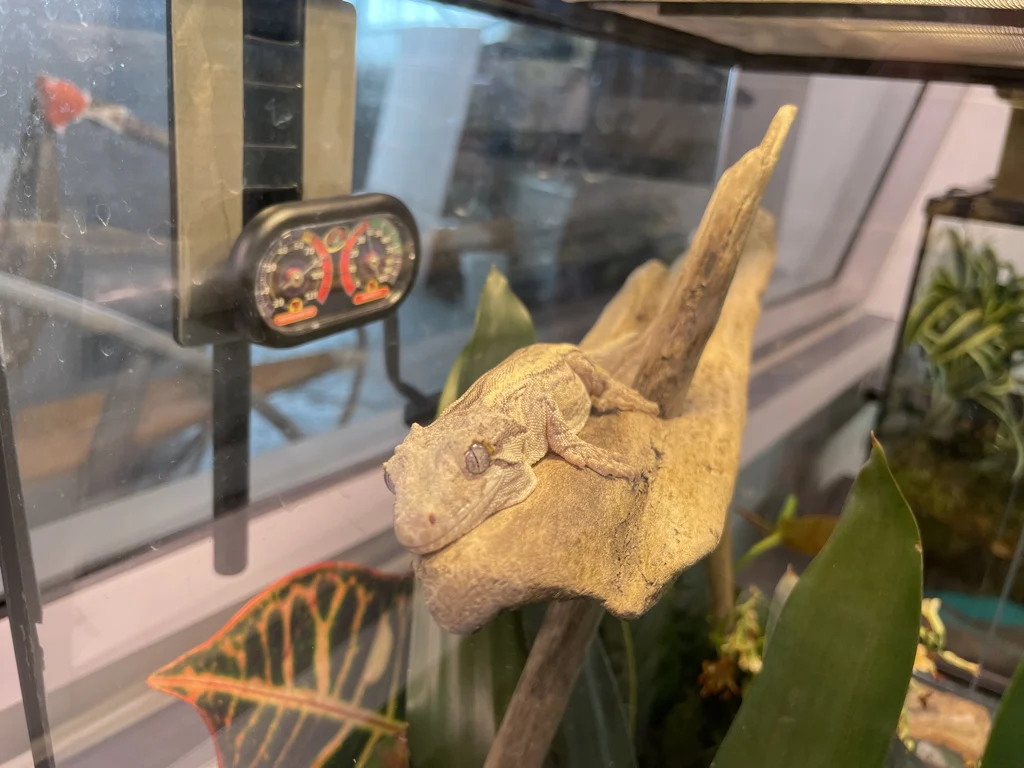
The Gargoyle gecko gets its name from the protrusions on either side of its head, but its true charm lies in its versatile lifestyle, moving vertically between the forest floor and the canopy in the forests and shrublands of southern New Caledonia.
This document focuses on classification, ecology, behavior, evolution, and conservation in the wild. Please refer to a separate care guide for specific details regarding temperature, humidity, and feeding guidelines.
At a glance
| Korean name | Gargoyle gecko |
|---|---|
| English name | Gargoyle gecko |
| Scientific name | Rhacodactylus auriculatus |
| Taxonomic scope | Species |
| Class | Reptilia (or Sauropsida in a phylogenetic context) |
| Order | Squamata |
| Family | Diplodactylidae |
| Genus | Rhacodactylus |
| Natural Distribution | Southern Grande Terre, New Caledonia |
| Primary Habitat | Stems, branches, and low-lying vegetation in humid forests and shrublands on mining substrates |
| Activity Period | Nocturnal; moves between arboreal and near-ground strata |
| Wild Diet | Arthropods, plant matter, and occasionally small lizards |
| Reproduction | Egg-laying; breeding influenced by seasonal and rainfall changes |
| Conservation Note | IUCN status: Least Concern; however, southern habitats are affected by mining, wildfires, and invasive species |
Taxonomy and Naming
The common name “Gargoyle gecko” derives from the horn-like cranial projections on either side of the head, which resemble architectural gargoyles. The specific epithet *auriculatus* also refers to these ear-like projections.
Lineage endemic to New Caledonia
The Gargoyle gecko belongs to a lineage of large geckos that diverged independently in New Caledonia. The island’s ancient geology and isolation have fostered the evolution of lizards with diverse forms and lifestyles, even within limited geographic ranges. The scientific name *auriculatus* refers to the ear-like head projections; these are not true horns but structures formed by the combination of the skull’s contours and the scales.
Between Forests and Maquis Shrubland
In southern Grande-Terre, the landscape features not only humid forests but also extensive areas of *maquis* shrubland—vegetation adapted to soils rich in heavy metals. Gargoyle geckos do not confine themselves to a single stratum; they move between tree trunks and branches, the shrub layer, and hiding spots near the ground. They conceal themselves within bark crevices and vegetation during the day and move about at night in search of food and mates.
Cranial Projections and Regenerating Tails
Their broad heads, prominent ridges, and marbled, mottled patterns help blur their outlines against tree bark and shadows. Adhesive toe pads and claws facilitate vertical movement, while the tail aids in balance and support. Unlike the Crested gecko—whose tail does not grow back—the Gargoyle gecko is capable of tail regeneration, although the regrown tail may not perfectly match the original’s shape.
Nocturnal Foraging and Territorial Behavior
At night, they rely on a combination of vision, scent, and tactile cues. When individuals come into close proximity, a progression of behaviors may ensue, ranging from body orientation and mouth-gaping to vocalizations and biting. While they do jump between branches, they are also observed utilizing the zone near the forest floor; thus, it is more accurate to view them as a species that exploits the forest’s three-dimensional space rather than simply as strictly arboreal animals.
A Surprisingly Varied Diet
Field observations indicate a diet that includes not only a wide range of arthropods but also plant matter and smaller geckos or skinks. This reveals the gecko to be an active, opportunistic predator rather than merely a fruit-eater. As food availability fluctuates with rainfall and the seasons, their diet likely varies significantly depending on the location and time of year.
Color changes associated with reproduction and growth
Females lay their eggs in microhabitats on the ground or beneath vegetation. Juveniles may display more high-contrast bands and blotches than adults, and the boundaries of their colors and patterns shift as they mature. Changes in color intensity—darkening or lightening based on ambient light, body temperature, or levels of excitement—must be distinguished from actual changes in their underlying genetic patterns.
Conservation in mining areas
Although the global conservation status is currently relatively stable, local populations face significant threats from nickel mining, wildfires, forest fragmentation, and invasive predators within their core distribution range. A wide distribution across multiple sites is not the same as having those sites effectively connected. Conservation efforts must consider not only the total habitat area but also the connectivity—such as movement corridors—between forest and shrubland habitats.
Physiology and Environmental Adaptation
They navigate trees, shrubs, and structures close to the ground using a combination of adhesive toe pads and strong claws. Their tails aid in balance; while they can regenerate a tail after autotomy (detachment), the regenerated tail differs in appearance from the original.
Conservation and Wild Populations
They are found only in a restricted range in southern New Caledonia. Despite a relatively stable global status, nickel mining, wildfires, invasive species, and habitat fragmentation pose significant risks at the local level.
Captive Populations, Morphs, and Selective Breeding
In captivity, selective breeding is actively practiced to produce specific phenotypes, such as striped or blotched patterns and red or orange colorations. Many traits are treated as polygenic and line-bred characteristics rather than being determined by a single, simple gene.
Key Ecological Points
- The “gargoyle-like” head projections are not horns, but rather shapes formed by the contours of the skull and scales.
- There are field records of them eating small geckos and skinks, in addition to arthropods.
- Unlike the Crested gecko, a tail lost through autotomy can regenerate.
- They utilize not only the forest canopy but also low-lying shrubs and the layer close to the ground.
Frequently Asked Questions
Where do Gargoyle geckos live?
They are naturally distributed in the forests and shrublands of southern Grande Terre, New Caledonia.
Does the tail grow back?
It can regenerate after autotomy, but it does not perfectly restore to the original tail’s form.
Do they eat only fruit in the wild?
No. They consume both arthropods and plant matter, and there are known instances of them eating small lizards.
Are they in the same genus as the Crested gecko?
No. Currently, the Gargoyle gecko belongs to the genus *Rhacodactylus*, while the Crested gecko belongs to *Correlophus*.
References
- IUCN Red List — Rhacodactylus auriculatus
- Endemia New Caledonia — Rhacodactylus auriculatus
- Ecological observations on the gargoyle gecko
Data review date: August 2026. Classification and conservation status are subject to change based on new research and assessments.
Related species


Suggest an edit
Tell us which sentence may be incorrect and provide a verifiable source. Submissions are reviewed before publication.