Last updated 2026.09.15 · Edited by silveston · Compiled by an independent hobbyist without professional credentials

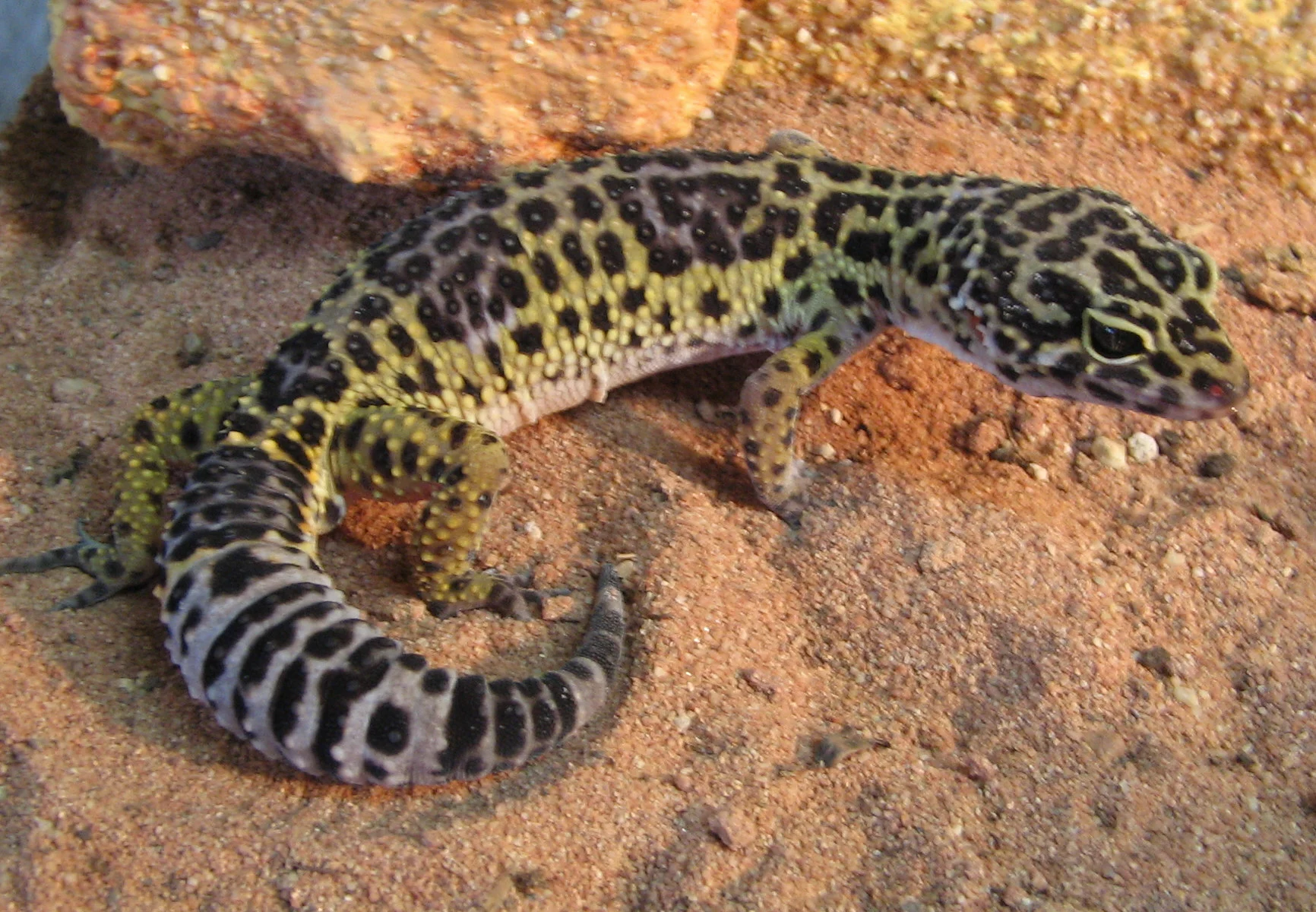
The leopard gecko is a ground-dwelling species that challenges the familiar image of a gecko climbing glass. Its movable eyelids, clawed toes and thick, energy-storing tail all reflect a life spent on dry ground.
This article focuses on wild taxonomy, ecology, behavior, evolution and conservation. Consult the separate care guide for practical temperature, humidity and feeding recommendations.
At a glance
| Korean common name | Reopadeu geko |
|---|---|
| English common name | Leopard gecko |
| Scientific name | Eublepharis macularius |
| Scope of this article | Species |
| Class | Reptilia; Sauropsida in a phylogenetic context |
| Order | Squamata |
| Family | Eublepharidae, the eyelid geckos |
| Genus | Eublepharis |
| Native range | Northwestern South Asia, particularly Pakistan and Afghanistan |
| Main habitats | Crevices and burrow margins in dry grassland, scrub and rocky terrain |
| Activity | Mainly active on the ground around dusk and at night |
| Wild diet | Insects and other small arthropods |
| Reproduction | Egg-laying, with small clutches produced repeatedly during a breeding season |
| Conservation note | Wild population data are limited; local habitat change and collection pressure should be considered together |
Taxonomy and names
The genus name Eublepharis comes from Greek roots meaning “good” or “true eyelid,” while the species name macularius refers to spotting. Together, they describe two conspicuous features: movable eyelids and the spots of the adult animal.
Evolutionary relationships
Unlike many geckos, members of the family Eublepharidae retain movable eyelids. Their toes bear claws rather than broad adhesive pads, making them better suited to soil, gravel and rock crevices than smooth vertical surfaces. These features show that geckos have diversified into different terrestrial and arboreal environments rather than converging on a single way of life.
Distribution and microhabitats
Wild leopard geckos inhabit dry landscapes combining rocks, low vegetation, earthen burrows and crevices, rather than simply the middle of vast sand deserts. When the ground heats up during the day, cracks and burrows provide shelter from the heat. After sunset, as surface temperatures fall, geckos slowly explore around these refuges. Even within the same dry region, they use microhabitats whose temperature and humidity vary considerably with shade, soil depth and the orientation of rocks.
Body structure and changes with growth
The broad transverse bands of young geckos tend to break up into adult spots as they grow. Fat accumulates in the tail, but tail thickness alone cannot establish an animal’s health or nutritional status. A threatened gecko may shed its tail through autotomy. Although the tail can regrow, the regenerated structure does not recreate the original vertebrae or scale arrangement, so its shape and texture differ.
Activity and sensory behavior
During their main active period, leopard geckos assess their surroundings using smell and subtle ground vibrations as well as vision. They lower their bodies and approach prey slowly before making a short lunge. When confronted by unfamiliar objects or predators, they may inflate their bodies or wave their tails. Experiments have documented defensive responses to several snake species, suggesting a general predator-recognition system that can operate before an animal has gained direct experience.
Their role in the food web
Wild diets consist mainly of animal prey encountered on the ground, including beetles, grasshoppers, spiders and other small invertebrates. As small predators, leopard geckos influence arthropod populations while also providing food for snakes, birds and small to medium-sized predators. Tail autotomy can be an effective escape tactic by drawing a predator’s attention away from the body, but it carries substantial costs, including the loss of stored energy and some locomotor function.
Reproduction and life history
Chemical signals and physical contact help individuals recognize one another during the breeding season. Females lay a small number of eggs at a time but may produce several clutches in one season. Leopard geckos have been widely used to study the relationship between embryonic development temperature, sex determination and adult traits. This research has contributed to our understanding of how reptile development interacts with the environment.
Wild conservation and gaps in our knowledge
Being common in captivity does not mean a species’ wild ecology is well documented. Captive lines have been studied extensively, but comparatively few studies have tracked population size, movement distances, seasonal diets and habitat use across the species’ range over long periods. When reading a natural history article, it is important to distinguish field research from captive studies and avoid automatically treating captive behavior as representative of life in the wild.
Physiology and environmental adaptation
As ectotherms, leopard geckos regulate their body temperature through behavior. During the day they use the relatively stable microclimates of burrows and rock crevices, then expand their activity after dusk as surface temperatures fall. The tail stores energy, but nutritional condition should be assessed alongside body weight, appetite, droppings and activity.
Conservation and wild populations
Although leopard geckos are extremely common in the pet trade, long-term monitoring of wild populations remains relatively limited. Distribution records still contain regional uncertainties. Abundance in captivity should therefore not be equated with security in the wild.
Captive populations, morphs and selective breeding
Decades of artificial selection have produced many phenotypes, including albino, snow and other pattern variants. These morphs are traits of captive populations shaped by selection pressures different from those acting in the wild. They are best discussed separately from the species’ natural history.
Key natural history facts
- Leopard geckos can close movable eyelids to protect their eyes, rather than cleaning exposed eyes with their tongues.
- Juvenile bands change into spots during growth, so the same individual can look markedly different as it matures.
- A regenerated tail differs from the original in its internal structure as well as its appearance.
- Experiments have observed differences in the strength of defensive responses to different snake species.
Frequently asked questions
Why do leopard geckos struggle to climb walls?
They belong to a terrestrial lineage with clawed toes and lack the broad adhesive toe pads found in many other geckos.
Why is the tail so thick?
It contains tissue involved in energy storage. However, tail thickness alone is not a reliable way to diagnose health.
Are they nocturnal?
They are mainly active around dusk and at night, although activity patterns can vary by region and season.
Can the tail grow back?
It can regenerate after autotomy, but the new tail is not identical to the original in shape or internal structure.
References
- The Reptile Database — Eublepharis macularius
- Antipredatory reaction of the leopard gecko
- Comparative growth in Eublepharis
Sources reviewed: August 2026. Taxonomy and conservation assessments may change as new research and evaluations become available.
Related species


Suggest an edit
Tell us which sentence may be incorrect and provide a verifiable source. Submissions are reviewed before publication.