Last updated 2026.09.22 · Edited by silveston · Compiled by an independent hobbyist without professional credentials
This account explains both the species as a whole and its regional variation.
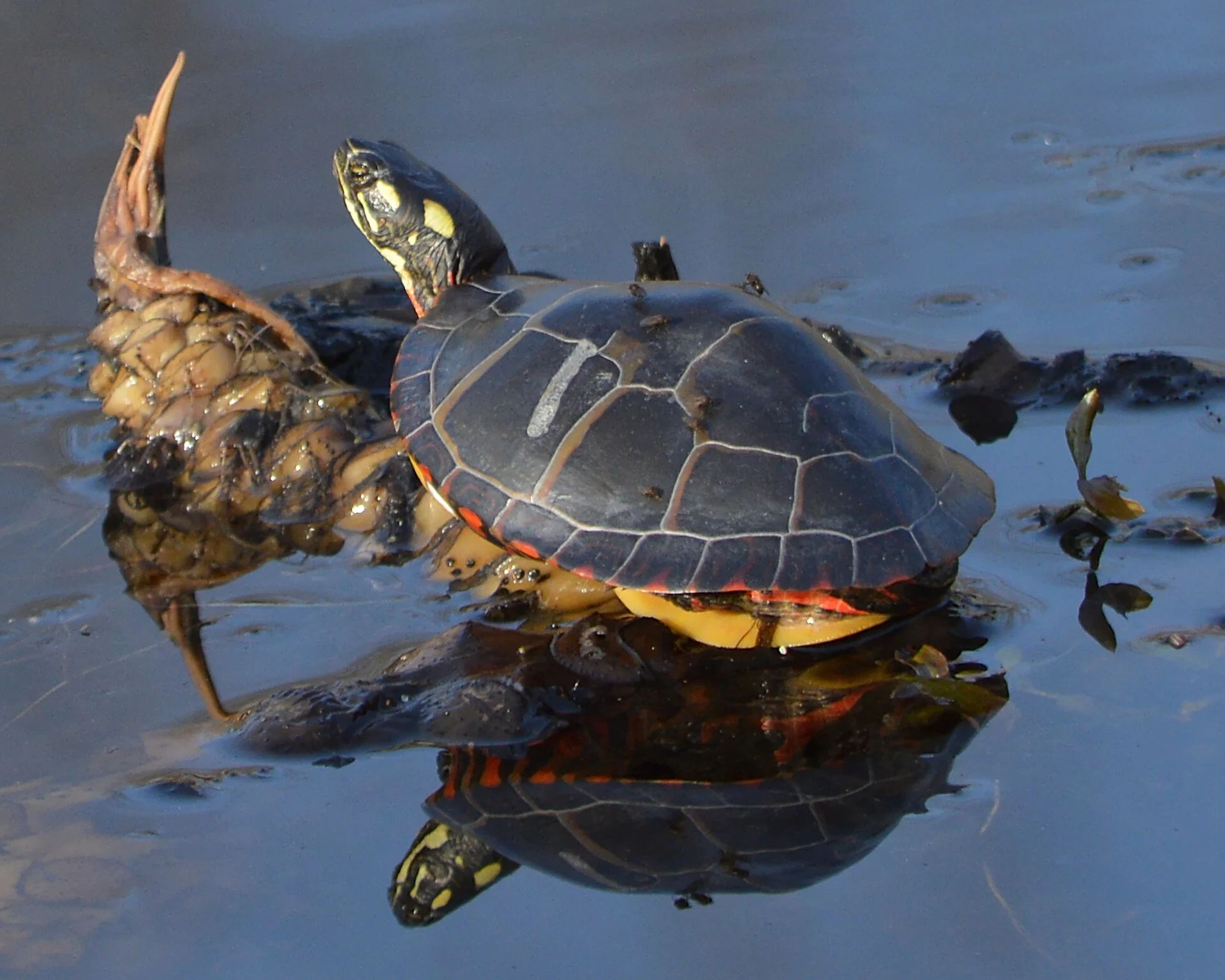
The painted turtle (Painted Turtle) is one of the most conspicuous freshwater turtles in North American ponds, marshes, and slow rivers. Yellow and red lines edge the dark olive or black shell, while finer stripes continue over the head and neck. “Painted” refers to these natural markings. Beneath the colorful surface is a hardy temperate turtle that crosses land seasonally and survives both frozen soil and oxygen-poor water under winter ice.
Its biology is more remarkable than its color. Some hatchlings spend their first winter inside the nest and can supercool their body fluids to avoid freezing. Adults overwintering underwater can mobilize carbonate from shell and bone to buffer lactic acid when oxygen nearly disappears. Incubation temperature also affects offspring sex. Behavior, physiology, and climate-change research therefore meet inside one shell.
“Common” should not be confused with “ordinary.” A broad range reflects success across many climates and wetlands, but local populations differ in nesting season, overwintering depth, body size, and markings. One regional measurement is not a continental rule. Changing taxonomy, such as the status of the southern form, must also be separated from extreme laboratory tolerances and routine wild behavior. Those distinctions reveal why this familiar turtle is a major model in evolution and climate research.
Observe without remaining close enough to stop a turtle from returning to its log, and never shake the perch to force movement. Repeated disturbance can remove valuable heating and digestion time on cool days. A distant photograph accompanied by place, date, water temperature, and weather is more useful natural-history evidence than a close trophy shot.
Key points in 30 seconds
- The painted turtle is the only member of Chrysemys and is widespread in North America.
- Eastern, midland, western, and southern forms were traditionally treated as subspecies, but many current classifications recognize the southern form as C. dorsalis.
- Basking raises body temperature, dries the shell, and supports digestion and vitamin-D physiology.
- Terrestrial overwintering by hatchlings and underwater anoxia tolerance by adults are different strategies; neither means that freezing is harmless.
- Nest temperature influences sex determination, so climate and nest change can alter long-term sex ratios.
At a glance
| Classification | Reptilia · Testudines · Emydidae · Chrysemys |
|---|---|
| Scientific name | Painted Turtle (Schneider, 1783) |
| English name | Painted Turtle |
| Size | Usually about 10–25 cm carapace length; females and western lineages tend to be larger |
| Range | Southern Canada through most of the United States and parts of northern Mexico |
| Habitat | Sunlit ponds, wetlands, lake margins, and slow streams |
| Diet | Omnivorous: aquatic invertebrates, small vertebrates, carrion, algae, and aquatic plants |
| Conservation | Broadly distributed, but locally affected by roads, wetland loss, and releases |
One species, many regional colors and lineages
The carapace is smooth and fairly low, without a strongly serrated rear edge. Yellow head and neck stripes, red or orange lines on the limbs and tail, and bright marginal scutes contrast with the dark ground color. Age, sex, regional lineage, algae, and lighting all alter the apparent brightness and width of the pattern.
Traditional taxonomy recognized eastern C. p. picta, midland C. p. marginata, western C. p. bellii, and southern C. p. dorsalis. Eastern turtles often have aligned seams between the large carapace scutes; western turtles commonly carry a large, complex dark plastral figure. Contact zones blur those distinctions, so a photograph alone may not establish subspecies.
Molecular work strengthened the case for treating the southern painted turtle as the separate species Chrysemys dorsalis. Some field sources and older papers still use the four-subspecies scheme. A careful account states which treatment it follows and explains historical names instead of erasing them. This article covers painted-turtle natural history broadly while flagging the changing status of the southern form.
Sex differences also connect form with behavior. Mature males tend to have long foreclaws and a thicker, longer tail, while females usually grow larger. The claws are used in a rapid courtship vibration in front of a female’s head. Differences are unclear in juveniles and variable among adults, so sex should not be assigned from one claw. Carapace length, the cloacal position on the tail, maturity, and lineage must be considered together without repeatedly flipping and stressing the turtle.

The shell is living skeleton, not a dead case: ribs and vertebrae are integrated into it. Keratin growth marks can remain, but wear and variable growth make ring counts unreliable for exact age. The bridge between plastron and carapace, retracting neck and limbs, and low streamlined profile combine aquatic movement with defense. A damaged shell can bleed and hurt because living tissue lies beneath the surface.
A compact home range built from ponds, marshes, and slow water
Suitable habitat combines a sunny log or rock, shallow vegetated cover, productive bottom habitat, and deeper winter water. Marsh edges, quiet coves, beaver ponds, and floodplain wetlands can matter more than open lake centers. Reproduction also requires accessible terrestrial soil; protecting only the water can leave half the life cycle blocked.
Underwater, the front feet steer while the hind feet and tail provide thrust. Several turtles may stack on a limited basking log during a cool morning. That gathering need not indicate social attachment; it may simply reflect competition for a scarce thermal resource. When approached, their nearly simultaneous dive balances predator avoidance against the cost of leaving a good site.
Females can travel tens of meters or more over land to nest, and drought or falling water may trigger movements to another wetland. Roads, lawns, and drains become lethal barriers. The loss of a large adult female removes both a long-lived turtle and many future clutches, which is why pond conservation must include surrounding travel corridors.
A home range is better understood as a seasonal network than a fixed circle. Shallow warming water and productive feeding sites matter in spring; deep water and plant shade provide summer refuge; bottom stability and oxygen shape autumn choices. New or abandoned beaver ponds and flood connections change movement opportunities. Frequent sightings in one pond therefore do not prove that an individual spends its entire life without leaving it.

Basking, feeding, and predator avoidance in one day
Painted turtles regulate body temperature with external heat. A shell in morning sun warms faster than the water, improving digestion and muscle function. Extending the limbs and neck increases exposed area, and drying may limit algae and some microbes on the shell. The turtle returns to water before overheating, so a basking site must connect to an immediate aquatic escape.
Diet shifts with season and size. Hatchlings and juveniles use more aquatic insects, snails, crustaceans, tadpoles, and carrion to support growth. Adults consume more aquatic vegetation and algae but remain opportunistic. They are flexible omnivores that forage and scavenge, not specialists that survive only by catching healthy, fast-moving fish.
Raccoons, foxes, skunks, herons, and large fish consume eggs or young turtles. The adult shell improves defense but is not invulnerable. A threatened turtle dives and becomes still among mud or vegetation. Thrashing or voiding when held is an escape response, not evidence of a naturally aggressive temperament.
Positions within a basking aggregation differ in value. A stable warm center may reduce the chance of being pushed into water, and a large turtle may climb over or displace a smaller one. Underwater, chemical and visual cues guide foraging and seasonal pursuit of mates. A turtle that looks slow is making repeated decisions among heat, risk, and food, and those tradeoffs continually reshape its daily route.

Survival beneath ice: hatchlings and adults solve different problems
In northern populations, some late-summer hatchlings remain in the nest through their first winter. Experiments have shown limited freeze tolerance, but field survival commonly depends on remaining unfrozen through supercooling. By clearing ice-nucleating material from the gut and bladder and resisting the entry of external ice crystals through the skin, body fluids can stay liquid below 0°C. The protection still fails when cold is too deep or prolonged.
Adults and larger juveniles generally overwinter on the aquatic bottom. When surface ice blocks gas exchange, they suppress metabolism and heart rate. Anaerobic energy production accumulates lactate and hydrogen ions; carbonate released from shell and bone buffers the acid, and some lactate is stored in the skeleton. The shell is thus both armor and a major winter chemical reservoir.
These abilities do not justify chilling a captive turtle. Wild success depends on seasonal acclimation, sound body condition, gradual cooling, and a stable bottom environment. A cold aquarium after a power failure or an improvised refrigerator has very different oxygen and water-quality conditions. Artificial brumation is best avoided unless there is a defined breeding purpose and veterinary review.
Anoxia tolerance is not a magical halt to all metabolism. Low temperature suppresses energy demand so stored fuel and buffering capacity last; the same oxygen shortage becomes dangerous far faster in warm water. When oxygen returns in spring, accumulated lactate must be processed and acid-base balance restored. Time, temperature, and body size therefore belong beside any survival claim. The striking phrase “months without breathing” loses its essential conditions and recovery cost when quoted alone.

Reproduction in which nest temperature changes sex
From late spring into summer, a female leaves the water for sun-exposed soil and digs a flask-shaped nest with her hind feet. She may release bladder water to soften dry soil. After laying and covering the eggs, she provides no nest defense or food. A female may lay more than once in a season, but clutch frequency and size vary with locality, body size, and climate.
Painted turtles have temperature-dependent sex determination. Cooler incubation generally produces more males and warmer incubation more females, with both sexes across an intermediate range. Natural nests do not remain at one mean temperature; day, night, rain, and shade create complex fluctuations. A 2019 experiment showed that wider fluctuations around a cool nest profile could unexpectedly increase female production.
Climate effects therefore extend beyond the slogan “warm equals female.” Nesting date, maternal site choice, soil moisture, shade, and genetic differences among populations interact. If change outruns behavior and evolution, one sex may become too rare. Moving nests or adding shade without local evidence can also produce the opposite of the intended conservation result.
Hatchlings do not all begin surface life in the same season. In warmer regions or years they may move to water in autumn, while some northern populations remain in the nest until spring. Soil temperature, rainfall, predators, and distance to water influence emergence. With no mother guiding them, the first trip is independent. This geographic variation is why hatch month should not be presented as one fixed calendar date and why conservation plans must be local.

An ancient lineage facing modern roads
Fossils and genetic evidence show a long North American history. Populations were probably divided among southern refuges during glacial periods and expanded again as climates warmed, leaving regional forms and contact zones. A broad present-day range does not make every population secure; it joins groups with distinct histories under one familiar name.
Wetland drainage, degraded water, road mortality, hooks, boat strikes, collecting, and pet releases act locally. Taking a wild adult removes a breeding animal, while releasing a turtle elsewhere can spread pathogens and mix lineages. If a turtle must be moved from a road, place it on the safe side in the direction it was traveling, never lift it by the tail, and do not prolong danger for photographs.
The species is a major model for hypoxia physiology, skeletal acid-base buffering, temperature-dependent sex determination, longevity, and population ecology. A common animal can illuminate extremes because long field records can be connected to experiments. Its paint-like shell is only the introduction; the deeper story is a turtle that reads seasons, alters body chemistry, and remembers a wetland for decades.
Long-lived populations are easy to misread in a short survey. Adults may remain visible for years even when juvenile recruitment has failed, while one poor hatchling year does not by itself prove collapse. Researchers need long records of sex, size, marked-animal recapture, nest success, and road mortality. Painted turtles are a useful model of delayed population change and a warning that a common species can still require monitoring.

Human relationships also have two sides. Painted turtles are familiar nature-education animals in parks and farm ponds, yet familiarity encourages collecting, impulse purchases, and releases. A pet may live for decades while large tanks, electricity, and filtration remain recurring costs. Responsible ownership begins by planning for adult space, moves, long-term care, and legal origin before bringing home a small juvenile.
Frequently asked questions
Is a painted turtle the same species as a red-eared slider?
No. The painted turtle is Painted Turtle; the red-eared slider is Trachemys scripta elegans. They differ in head markings, shell form, natural range, and sometimes in local keeping and release rules.
Can it really survive freezing?
Some hatchlings show limited freeze tolerance under experimental conditions, but supercooling without freezing is central in many natural nests. Adult underwater anoxia tolerance is a separate mechanism. Neither is a reason to chill a pet turtle.
May I take a wild turtle home?
Collection may be prohibited or require permits, and it is poor conservation and welfare practice. Choose a legally captive-bred animal with source records and leave wild turtles where they were found.
Related reading
References
- The Reptile Database — Painted Turtle
- Montana Field Guide — Painted Turtle
- Packard & Packard (2004) — To freeze or not to freeze
- Jackson (2000) — How a Turtle’s Shell Helps It Survive Prolonged Anoxic Acidosis
- Janzen (1994) — Climate change and temperature-dependent sex determination
- Valenzuela et al. (2019) — Extreme thermal fluctuations and TSD
Suggest an edit
Tell us which sentence may be incorrect and provide a verifiable source. Submissions are reviewed before publication.