Last updated 2026.09.22 · Edited by silveston · Compiled by an independent hobbyist without professional credentials
Record every target value together with its measurement location and equipment conditions.
During quarantine, do not share nets, hoses, or towels with established tanks, and keep handwashing and work order consistent. Even a small temporary enclosure still needs a dry dock, UVB, and full water testing. Simple records from the first weeks establish the baseline needed to distinguish normal behavior from later warning signs.
The painted turtle (Painted Turtle) is hardy, but the idea that a small turtle needs only a small bowl is dangerously wrong. An adult needs broad swimming space, a completely dry basking platform, strong visible light and UVB, and stable water quality at the same time. Usable footprint, filtration reserve, and measurements taken at the shell’s actual basking height matter more than the advertised tank volume.
The values below are starting points for a healthy indoor turtle. Subspecies, sex, body size, seasonal room temperature, lamps, and enclosure geometry require adjustment. Artificial winter cooling is not routine pet care. Do not dismiss poor appetite or abnormal buoyancy as seasonal; combine environmental records with assessment by a reptile-experienced veterinarian.
Before purchase, calculate adult tank weight and monthly costs rather than juvenile size. A roughly 300 L aquarium and stand, canister filter, backup heater, UVB and heat lamps, water tests, and a practical drainage route are needed. Consider floor loading, leak damage, and future moves. Verify legal captive origin and local possession rules. A low price for a small hatchling is not a responsible reason to accept a lifespan measured in decades.
On arrival, prioritize quarantine and observation over elaborate decor. Use a simple cleanable setup and record weight, feeding, elimination, and basking from day one. Keep air, tools, and water routes separate from established turtles and care for the newcomer last. A normal outward appearance can hide parasites or respiratory disease, so plan quarantine duration and fecal testing with a reptile veterinarian before any cohabitation or shared filtration.
Quick conditions
| Adult space | For one adult, start with at least a 120 × 60 cm footprint and roughly 300 L class; provide more for a large female |
|---|---|
| Water depth | At least 2–3 shell lengths, with room to right itself and submerged resting shelves |
| Water temperature | Start near 24–26°C for juveniles and 22–24°C for healthy adults |
| Basking surface | About 31–34°C at the central surface touching the shell, with cooler edges |
| UVB | A gradient of roughly UVI 2–4 at shell height plus complete shade, verified by measurement |
| Water quality | Ammonia 0, nitrite 0, nitrate kept low; dechlorinate and test regularly |
| Diet | Complete turtle pellets, aquatic plants, leafy greens, and suitable invertebrates by life stage |
| Cohabitation | House singly by default because competition, bites, and health tracking are difficult |
Design space, depth, and filtration as one system
A hatchling can begin in a smaller temporary enclosure, but plan the adult home from the start. For one adult, use a footprint around 120 × 60 cm and a water system of roughly 300 L or more as a starting point. Females over 20 cm and larger western lineages need more length and volume. Rules based only on liters per centimeter of shell ignore swimming distance and volume displaced by the basking dock.
Painted turtles are capable swimmers. Provide water at least 2–3 carapace lengths deep, while adding sloped shelves and underwater rests for a juvenile or weak turtle. There must be enough room to right itself at every depth. Guard filter intakes from feet and tails, and secure cable openings and lids against pushing.
Choose filtration for waste production rather than label volume. A canister or biological filter marketed for roughly two to three times the actual water volume is a practical starting point for a turtle tank. Redirect excessive current. A filter is a home for nitrifying microbes, not a device that makes waste disappear; remove solids and combine filtration with partial water changes.
The stand must support the combined mass of water, decor, and turtle on a level base; 300 L of water alone weighs about 300 kg. Add a leak sensor, ground-fault protection, drip loops below outlets, and a heater guard. During a power failure, withhold food and record the cooling rate and filter restart. A spare tub, water containers, and battery air supply reduce the chance that one equipment failure becomes an immediate animal emergency.

Growth requires more than adding water. Ramps, intake guards, dock clearance, and lid height must be redesigned as the turtle grows. A gap safe for a hatchling can trap a larger head or claw, and an adult can push light decor into an escape step. Confirm that the dock leaves real swimming space and that the turtle can surface from every direction. A system planned for disassembly and temporary housing is far easier to maintain.
Water gradient, basking surface, and night conditions
Juveniles can start near 24–26°C and healthy adults near 22–24°C. Use a guarded heater on a thermostat and independent thermometers in the circulation path and opposite side. Large tanks can stratify, so one reading is insufficient. Stable day and night conditions take priority over abrupt nightly cooling.
Measure the center of the basking surface with an infrared thermometer and start near 31–34°C. Air temperature and lamp wattage do not substitute for the surface touched by the shell. The turtle must climb easily, dry the plastron and entire body, and move to a cooler edge. If it never basks, review the ramp, wobble, exposure, and overheating together.
Turn off bright red or blue lamps at night and provide real darkness. Breeding-style winter cooling is unnecessary for an ordinary healthy pet. Cooling with undigested food, infection, or poor water quality can be fatal. Do not improvise refrigerator or outdoor brumation without advanced experience and veterinary planning.
A number is meaningful only with its measurement location. A probe beside the heater does not represent the opposite end, and infrared readings can be distorted by reflective wet shell or water. Measure the same stabilized point on the basking surface, protect submerged sensors from chewing, and compare daily minimum and maximum values. A pattern across locations and times is more informative than one convenient reading.

UVB, visible light, and a truly dry basking site
UVB supports calcium metabolism and healthy shell and bone. At shell height on the basking site, provide a broad gradient around UVI 2–4 with complete shade and underwater retreat. Distance, reflector, and mesh strongly change output. Use manufacturer charts and preferably a UV meter; window glass blocks useful UVB and window tanks can overheat.
Overlap the heat and UVB beams so the warm basking position is not separated from useful ultraviolet exposure. Begin with a bright 10–12 hour day and adjust modestly by season. A lamp can still look bright after UVB output declines, so record operating hours and replacement dates.
The dock must stay level under the turtle’s weight and provide grip without abrasive wire. Above-tank platforms preserve swimming space but must be checked for fall gaps and escape routes. Do not scrub algae aggressively or apply oil to the shell. Correct drying, UVB, water, and diet first, and have true lesions assessed professionally.
Ultraviolet cannot be judged by apparent brightness. Dust and mineral scale on mesh or reflectors reduce output, while placing a lamp too close can harm eyes and skin. Measure the center, edge, and shaded retreat at the actual shell height. Never place a closed glass tank in direct sun. An outdoor enclosure is appropriate only with predator exclusion, thermal refuge, escape prevention, and a climate suitable for the animal.

Water quality, substrate, cleaning, and ventilation
Cycle a new enclosure like an aquarium. Use liquid tests to confirm ammonia and nitrite at 0 and monitor nitrate. Adjust weekly partial changes to the measured results and waste rate; match temperature and treat chlorine or chloramine in new water. Clear water can still contain toxic nitrogen compounds.
A bare bottom is easiest for cleaning and observing waste. If a natural look is desired, use only large smooth stones that cannot be swallowed or a manageable sand layer. Gravel smaller than the head may be ingested with food. Avoid sharp decor, unstable rock piles, foot-trapping grids, and toxic metals. Use only pesticide-free edible aquatic plants.
Remove leftovers and large waste daily and siphon the bottom during scheduled partial changes. Rinse filter media in removed tank water, in stages, instead of sterilizing all media under hot chlorinated tap water. Ventilate the humid air space without creating a cold draft, and do not ignore persistent condensation or mold under a sealed lid.
After adding decor or replacing filter media, test more often for an ammonia rebound. Water clarifiers do not solve the cause, and antibiotics or disinfectants added to the main tank can collapse biological filtration. Use a simple, washable hospital tub when treatment is needed. Measured partial changes create less instability than repeatedly stripping and replacing all water. If source-water hardness or pH differs greatly, avoid abrupt shifts.

Diet composition, feeding frequency, and calcium
Use a nutritionally complete aquatic-turtle pellet as the staple, with varied leafy greens such as dandelion, collard, and romaine plus safe aquatic plants. Earthworms, snails, suitable insects, and small whole prey can supplement it. Raw meat strips, processed meat, bread, and dairy are not balanced foods. Do not repeatedly use fatty or thiaminase-rich feeder fish such as goldfish.
Offer juveniles a small meal daily or every other day according to growth and condition. For adults, a reasonable starting point is three or four moderate staple meals per week, while greens and aquatic plants can be available more often. Adjust using pellet guidance, weight trend, fat around the neck and limbs, and shell growth. Rapid growth and thick fat folds are not signs of superior health.
UVB and a balanced staple come first. Cuttlebone or a veterinarian-directed supplement can provide calcium. Dumping powder into water gives an unknown dose and fouls filtration. Both deficiency and excess of vitamins A and D can cause harm, so do not improvise with human products or high-dose injections. Investigate heat, UVB, water, mouth, and breathing before adding more supplements for poor appetite.
Record the product, amount, leftovers, and body weight rather than writing only “fed.” Feeding in the main tank supports normal swallowing but requires prompt cleanup; a separate tub may add transfer stress and cooling. Keep whichever method you use consistent and observable. If an adult rejects greens, review temperature and basking, vary safe plants and presentation, and allow time instead of offering only animal foods or forcing change through prolonged fasting.

Behavior, handling, cohabitation, and warning signs
A healthy turtle alternates exploration with basking and may dive when a person approaches. Routine hand-holding is unnecessary. For transfer, support both sides and the underside of the shell with two hands, keeping claws and head away from the body. Never lift by one leg or the tail. Turtles and tank water can carry Salmonella, so wash hands and keep equipment out of food-preparation sinks.
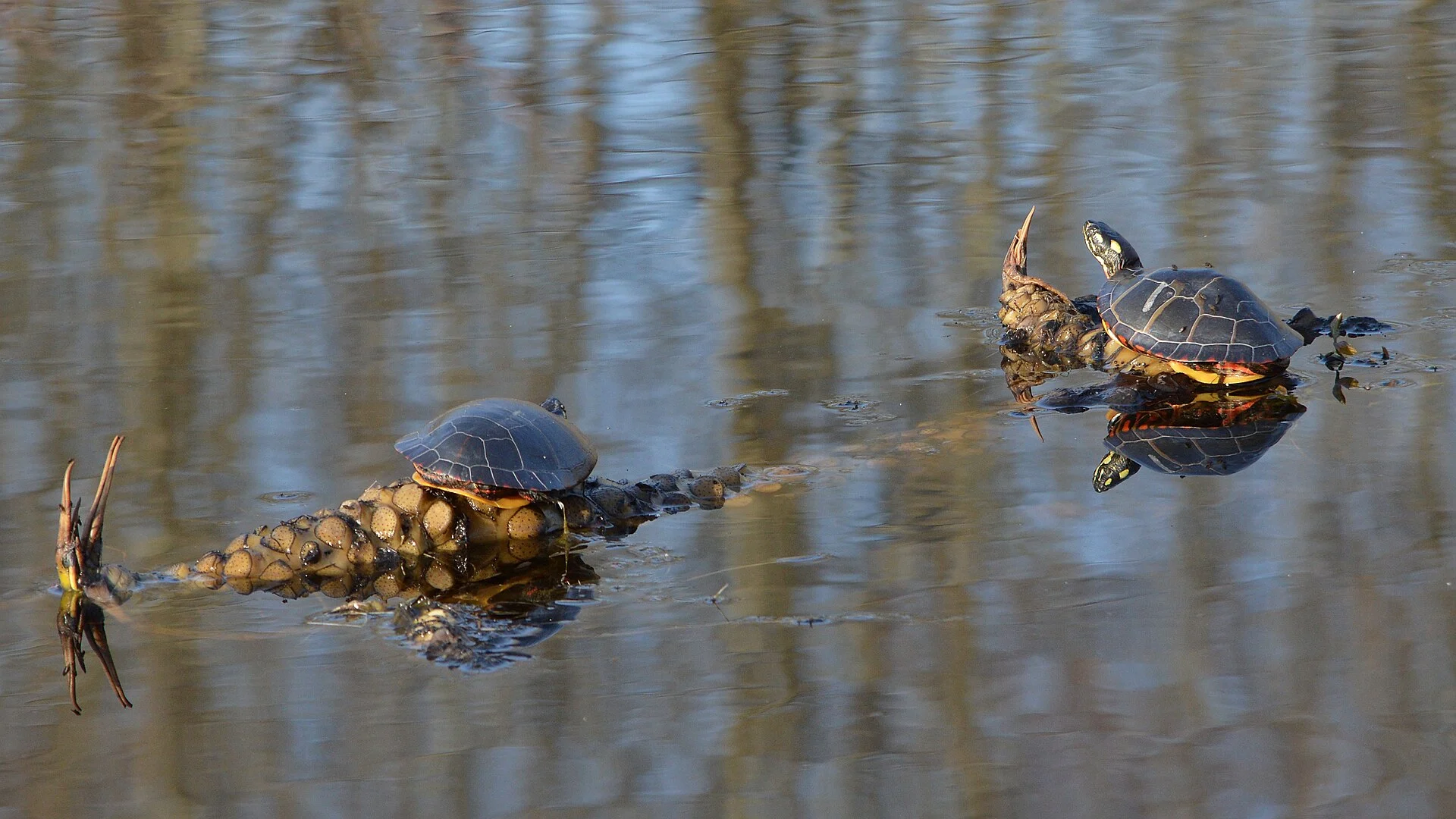
The default is one turtle per enclosure. Stacking on one dock may signal scarce resources rather than friendship. Biting, chasing, food monopolies, and persistent courtship cause wounds and chronic stress. Any attempted group needs a full dry site for each animal, individual feeding and health records, and an immediately available separation tank. Quarantine newcomers with separate tools.
Swollen or persistently closed eyes, nasal bubbles, open-mouth breathing, listing buoyancy, repeated failure to dive, soft or discolored shell, bleeding or foul lesions, prolonged anorexia, and weight loss require veterinary attention. A female repeatedly climbing or digging without laying needs a suitable nest box and assessment. Do not start antibiotics, vitamin injections, or force-feeding from online advice.
Health review extends beyond the carapace. In stable adults, monthly weight trends are more useful than stressful daily weighing; juveniles or patients may need a veterinarian-directed schedule. Photograph eyes, nostrils, mouth margins, skin folds, claws, tail tip, and plastron under consistent light. Do not peel normal shed or suspected diseased tissue. Bring water tests, temperature and UVI locations, food, weight, and elimination records to an appointment.

A female can show nesting behavior without a male because of stored sperm or unfertilized eggs. Repeated escape attempts or digging with the hind feet calls for a warm, slightly moist soil-sand nest box deep enough to bury the body. Do not squeeze the abdomen or attempt to remove eggs. Lethargy, straining, or hind-limb weakness requires prompt care where imaging is available.
Lifetime care includes an emergency plan. Leave written, photographed instructions for water temperature, lighting, feeding, and power failures during travel or illness. Never solve a housing problem by releasing a turtle into a pond or wild waterway. Seek legal rehoming or a rescue; release can spread disease and mix lineages and does not ensure survival in an unfamiliar climate.
A checklist for commonly missed details
- Daily: verify water and basking temperatures, heater and filter operation, breathing, buoyancy, eyes, locks, and visible contamination.
- Weekly: review ammonia, nitrite, nitrate, water-change volume, dock stability, feeding, and waste records.
- Monthly: review weight and condition, UVB lamp operating hours, filter flow, intake guards, cables, shell, and claws.
- Seasonally: remeasure lamp distance and heater performance as room temperature changes; prevent sudden chilling or overheating.
- When trouble appears: change one variable at a time and preserve measurements and photographs so the cause remains traceable.
Frequently asked questions
Can a small hatchling go straight into deep water?
A healthy hatchling can swim, but begin with abundant submerged shelves and plant-like supports and confirm that it surfaces easily. Resting options, intake safety, stable temperature, and room to right itself matter more than depth alone.
Does a sunny window replace a UVB lamp?
No. Glass blocks most useful UVB and a window aquarium can overheat quickly. Indoors, provide measured UVB, a heat source, and full shade as separate controlled elements.
If it stops eating in winter, should I brumate it?
No. First verify water and basking temperature, UVB, water quality, weight, breathing, and elimination. Unplanned cooling can worsen disease or digestive problems; consult a reptile veterinarian.
Related reading
References
- Tree of Life Exotic Pet Medical Center — Painted Turtle Care
- Chicago Exotics Animal Hospital — Painted Turtle Care
- The Reptile Database — Painted Turtle
- Packard & Packard (2004) — Painted turtle overwintering review
Suggest an edit
Tell us which sentence may be incorrect and provide a verifiable source. Submissions are reviewed before publication.