Last updated 2026.09.16 · Edited by silveston · Compiled by an independent hobbyist without professional credentials
The Common Musk Turtle (also called the Eastern Musk Turtle or Stinkpot) is a small freshwater turtle that roams the bottoms of ponds, swamps, and slow-moving streams in eastern North America. Its scientific name is Common Musk Turtle. In the Korean pet-keeping community, it is also known as the ‘musk turtle’ or ‘Mississippi musk turtle.’ Even when fully grown, its carapace length generally ranges from 8 to 14 cm—roughly the size of a human palm—yet this small body packs a large head, powerful jaws, an extendable neck, odor-producing defensive glands, and a unique anatomy adapted for walking along the bottom of the water.
Its English nickname, ‘stinkpot,’ stems from the foul-smelling secretions it releases from four musk glands located along the lower edge of its shell when threatened. However, focusing solely on the odor tells only half the story. Unlike slider turtles that swim rapidly near the surface, this species is an ‘underwater walker’ that forages by strolling among submerged branches and aquatic plants; it is also surprisingly adept at climbing onto logs protruding from the water.
This article focuses on how the species survives in the wild rather than on husbandry methods. By examining its classification, physical appearance, distribution, microhabitats, diet and sensory capabilities, reproduction, overwintering, and relationship with humans, one can appreciate the sophisticated way this small turtle utilizes the seasonal changes and food webs of freshwater ecosystems.
30-Second Summary
| Item | Details |
|---|---|
| Scientific Name | Common Musk Turtle (Latreille, 1801) |
| Classification | Order Testudines · Family Kinosternidae · Genus Sternotherus |
| Adult Size | Carapace length generally 8–14 cm |
| Distribution | Freshwater systems in southeastern Canada and the eastern/central United States |
| Habitat | Ponds, swamps, lake margins, slow-moving rivers, and areas with muddy bottoms and abundant submerged timber |
| Activity | Highly aquatic; walks along the bottom; tends to be active during the evening, at night, and in overcast weather |
| Diet | Omnivorous; feeds on aquatic insects, mollusks, crustaceans, small fish, carrion, and some plant matter. |
| Key characteristics | Bright stripes on the head, sensory barbels (whisker-like projections), small plastron, and musk glands. |
| Conservation | Generally common worldwide, but northern populations are vulnerable to habitat fragmentation, road mortality, and illegal capture. |
Classification and name: An older lineage than the ‘stinkpot’ (common musk turtle)
Common Musk Turtle belongs to the family Kinosternidae. This family consists of small turtles adapted to freshwater environments in the Americas, including the mud-turtle genus Kinosternon and the musk-turtle genus Sternotherus. The latter includes the Common Musk Turtle as well as the Razor-backed, Loggerhead, and Flattened Musk Turtles; current classification treats them as distinct, independent species.
The genus name Sternotherus derives from Greek roots meaning ‘chest’ or ‘plastron’ and ‘hinge.’ The specific epithet odoratus has a Latin meaning related to odor. Older literature used combinations such as Testudo odorata and Kinosternon odoratum, but modern reptile taxonomies recognize Common Musk Turtle as the valid name.
The fossil record for the family Kinosternidae is ancient, and embryological studies suggest this group holds a significant position in the study of turtle evolution. A 2020 study on developmental stages identified the Common Musk The process of shell, skeletal, and muscular formation in turtle embryos has been outlined across 20 developmental stages. Because their small, hard-shelled eggs are relatively easy to observe without damaging the embryo, this species has the potential to serve as a model for studying the evolutionary origins of the turtle body, going beyond its role as a simple pet.

.jpg)
Physical appearance: A distinct defensive strategy shaped by a small plastron and a large head
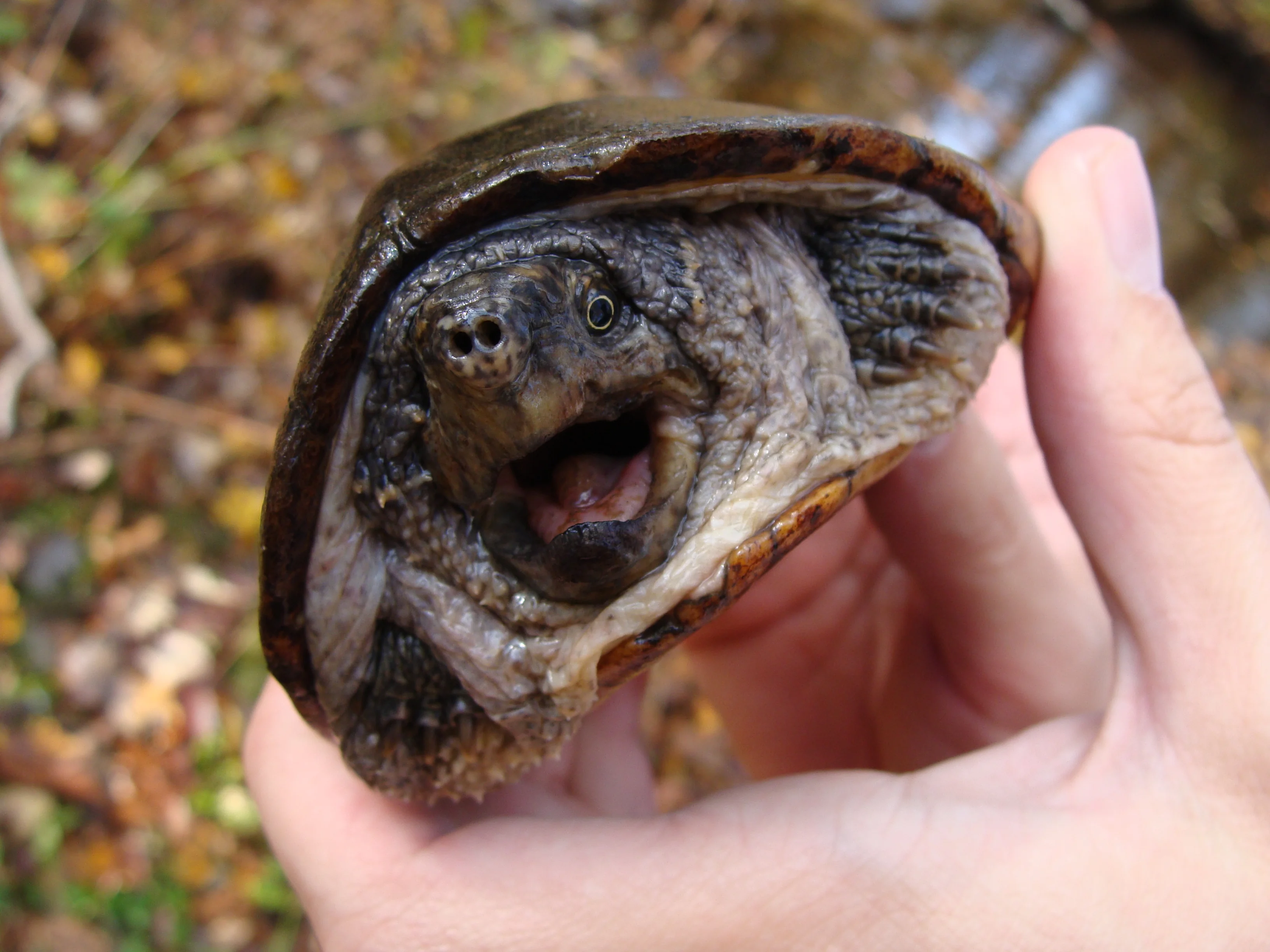
The adult shell is typically 8–14 cm long and rounded-oval in shape, ranging in color from black to dark brown or grayish-brown. Juveniles clearly display three low ridges along the back, though these often smooth out as the turtle matures. Two pale yellow or cream-colored stripes run along each side of the head from the snout to the neck, and the chin and neck feature small, whisker-like projections that help detect tactile and chemical stimuli in the water.
The difference from other turtles becomes even more apparent when looking at the underside. The plastron is small and roughly cross-shaped, leaving large areas of soft skin around the legs and neck exposed. While this design is less effective for completely sealing the body—unlike that of mud turtles—it allows for a wider range of limb movement while swimming. Instead of fully closing its shell, it relies on a combination of odor, powerful jaws, a long neck, and agile underwater movement.
Males generally have longer, thicker tails than females, and their cloaca is positioned further back toward the rear of the carapace. They also tend to have relatively larger heads and develop rough, tubercular scales on the inner sides of their hind legs. However, since relying solely on body size can lead to errors, sex determination should be based on an examination of both the tail and cloacal position in fully developed adults.

.jpg)
Distribution: From southeastern Canada to the eastern and central United States
The species is primarily distributed across eastern North America. Its northern range extends to parts of southern Ontario and Quebec, Canada, while in the United States, it spans widely from south of the Great Lakes and the Atlantic coast to Florida, the Gulf Coast, the Mississippi River basin, and the central regions. This broad distribution indicates that the species is not confined to a single climate but thrives in diverse environments, ranging from northern waters that freeze seasonally to warm southern wetlands.
However, a wide distribution does not mean the species is equally common in all areas. In the north, suitable shallow waters and overwintering sites may be fragmented—like islands—limiting movement between populations; additionally, roads and shoreline development pose significant barriers, particularly for females emerging to lay eggs. Consequently, the Canadian government’s management plan addresses the connectivity and threats facing northern populations separately from the species’ global extinction risk.
When musk turtles are found in the wild in Korea, one should first consider the possibility that they were abandoned or escaped pets, rather than assuming they are part of a native population. Records of non-native Sternotherus found in the Korean wild in 2024 demonstrate that releasing pet individuals into the wild can create problems for both biodiversity and animal welfare. Under no circumstances is releasing them into natural waterways an appropriate solution.


Habitat and microhabitat: Hiding spots matter more than open water
Common musk turtles utilize a wide range of freshwater environments, such as swamps, ponds, lake margins, reservoirs, canals, and slow-moving streams. Common features include relatively calm water (rather than fast currents), substrates rich in mud or organic matter, and underwater structures like aquatic vegetation, fallen logs, roots, and rock crevices. While they can survive in turbid water, this does not mean they ‘prefer dirty water’; natural turbidity and harmful pollutants are entirely different issues.
Submerged logs and the lodges of beavers or muskrats are not merely decorative elements. They serve as daytime refuges, staging points for breathing near the surface, basking spots for sun exposure, and overwintering sites. In Canadian populations, individuals gather around beaver lodges in autumn. Documented cases suggest that sites used for spawning, mating, and overwintering may overlap depending on the season.
Although this species is highly aquatic, it cannot survive in complete isolation from land. Females emerge from the water to lay eggs, utilizing sites such as areas beneath rotting logs, soil covered with vegetation, crevices in sand or gravel, and even exposed soil along roadsides. Straightening the shoreline with concrete—even if some water area remains—eliminates both nesting sites and the pathways connecting water to land, thereby significantly degrading the habitat’s functionality.

Activity and Movement: An Underwater Explorer That Walks the Bottom Rather Than Swims
When people think of aquatic turtles, they often picture them gliding gracefully beneath the water’s surface. While the Common Musk Turtle does swim, it spends much of its time walking along the bottom, clambering over branches and stones, and extending its neck to breathe at the surface. Its short legs and heavy shell are better suited for navigating complex, shallow-water bottoms than for high-speed, long-distance swimming.
Activity patterns vary depending on the region, water temperature, and season. Although generally known to be active at dusk and night, they may move during the day in colder seasons to seek out warmer microhabitats. A study tracking northern populations revealed that their movement toward habitats with better thermal conditions was not random: they utilize their environment selectively. Rather than simply enduring the ambient temperature passively, they actively choose locations within their accessible range that are advantageous for their physiological state.
Surprisingly, they are also adept at climbing. They climb onto logs and branches that protrude diagonally above the water to bask, dropping back into the water if startled. There are even amusing anecdotes of them falling into canoes or small boats after climbing to considerable heights. While this behavior can lead to escapes from captivity, in the wild, it serves as a three-dimensional movement strategy that allows them to absorb heat and breathe while avoiding predators.


Senses and Communication: In Murky Water, Scent Serves as a Map
Amidst muddy bottoms and aquatic vegetation where visibility is limited, relying solely on sight makes it difficult to locate prey or other turtles. Common Musk Turtles utilize sensory capabilities around their noses and jaws to interpret chemical signals and tactile stimuli in the water. The whisker-like projections beneath their chins help detect environmental changes while they forage along the bottom, while olfactory and gustatory information helps narrow down the direction in which prey is hiding.
Experimental results indicate that they also respond to chemical signals from other members of their species. This suggests that secretions from their musk glands are not merely “stink bombs” used for defense against predators, but may also be linked to a system of communication between individuals. However, since determining which specific compounds convey which messages requires studying behavioral contexts, sex, and seasonality, one cannot attribute a single, definitive meaning to every olfactory response.
While Musk Turtles are not known for vocalization, their interactions in an aquatic environment involve a complex interplay of sight, smell, and touch. They perceive sudden vibrations as threats, prompting them to hide, extend their necks to bite, or—as a final line of defense—release a pungent odor when captured. To ensure safety for both humans and the turtles, it is best to avoid picking them up unnecessarily when encountering them in the wild.
Diet and Ecological Role: A Small Predator and Scavenger
Their wild diet is broad, ranging from aquatic insect larvae, earthworms, mollusks (such as snails and clams), and crustaceans to tadpoles, small fish, carrion, and even some plant matter. Their strong jaws and pointed beaks are well-suited for crushing hard shells or extracting prey from crevices in the substrate. Juveniles rely heavily on small invertebrates, while adults consume larger and more varied prey.
When foraging, they slowly investigate leaf litter, mud, and the edges of submerged wood on the bottom rather than patrolling the open water surface. They also track scents to locate and consume carrion, acting as scavengers that return organic matter to the aquatic food web. At the same time, they serve as predators of insects and snails, while falling prey to larger fish, raccoons, herons, and crocodilians.
Eggs and hatchlings are particularly vulnerable to predation by mammals (such as raccoons and skunks), snakes, large fish, and birds. Although adults possess a hard carapace, their smaller plastron leaves large areas of soft tissue exposed; consequently, they employ a combination of scent, biting, and snapping for defense. Rather than relying on a single, absolute defense mechanism, they increase their chances of survival by layering multiple, less potent strategies.

.jpg)
Reproduction and Growth: Shallow nests, hard-shelled eggs, and region-specific timing
Mating occurs underwater, with activity concentrated in the spring and autumn in certain regions. Canadian data indicate that mating has been observed in waters shallower than 30 cm during April–May and September–October. While females in southern regions may lay eggs more frequently due to longer active seasons, those in the north—with their shorter summers—typically lay eggs only once a year.
Females lay hard, white eggs in shallow pits near the water’s edge, beneath decaying logs or vegetation, inside beaver or muskrat lodges, or within crevices in sand and gravel. Depending on the study area, clutch sizes typically range from one to six eggs, and in warmer southern regions, females may lay multiple clutches in a single season. Instances of communal nesting—where multiple females use the same log—have been observed, indicating that ‘prime nesting sites’ are a spatial resource selected repeatedly over time.
The incubation period generally lasts two to three months, depending on temperature and local conditions, with some data citing a range of 60 to 86 days. Embryonic sex determination is known to be influenced by incubation temperature. While hatchlings in the south may overwinter within the nest, those in colder northern regions—such as Canada—prioritize moving to the water shortly after hatching. This serves as a prime example of how the life history schedule of the same species can vary according to latitude.
Growth is rapid during the juvenile stage but slows down upon reaching adulthood. As their lifespan can span several decades, their small body size does not imply a short life. Given the turtle’s life-history traits—characterized by slow maturation and a reliance on adult survival—the repeated loss of reproductive females on roads means that the population cannot easily recover simply by slightly increasing the number of nests.
Overwintering and Physiology: A Small Body Surviving Beneath the Ice
In northern populations, individuals overwinter in sheltered areas—such as mud, beneath submerged logs, or inside beaver or muskrat lodges—during the season when the water surface freezes. They drastically reduce activity and respiration, lowering their metabolic rate to adapt to underwater oxygen levels. Ideal overwintering sites are not merely deep; they must remain unfrozen, offer protection from predators and strong currents, and provide suitable oxygen and temperature conditions. The microenvironment must be one where changes are not too extreme.
Studies comparing the low-temperature responses of northern and southern populations demonstrate that physiological differences adapted to the climate can emerge even within the same species. Furthermore, a 2019 study reported on thermal adaptation capabilities—specifically, the ability to rapidly adjust immune function in response to external temperature fluctuations. This implies more than just a simple trait of being “cold-tolerant”; it means that multiple physiological systems coordinate to withstand seasonal temperature changes.
Climate change entails more than just an increase in warm days. Spawning temperatures influence embryonic sex ratios and developmental rates, while winter ice and oxygen levels can alter overwintering survival. Shifts in the timing of floods and droughts affect the stability of shallow waters and nesting sites. Even for widely distributed species, the risks faced by local populations vary by region.
Observation and Research: What a Small Species Reveals About Freshwater Ecosystems
Studying the common musk turtle involves more than merely counting individuals. Researchers must track which water depths and temperatures an individual selects, when it migrates, and whether it repeatedly uses the same log or beaver lodge. Accumulating data over several years—using radio transmitters and mark-recapture methods—reveals that even these small, inconspicuous turtles maintain specific home ranges and seasonal migratory paths.
The northern edge of their distribution range is a particularly valuable location for studying climate-related responses. Even when the water body is generally cold, specific microhabitats—such as sunlit shallow coves, dark muddy bottoms, or submerged logs near the surface—can be warmer than the surrounding environment. The behavior of individuals in selecting these sites influences the time required for digestion, immune function, and egg development. Therefore, habitat assessment requires looking not just at a single figure for average water temperature, but also at the diversity of spaces that offer a range of different temperatures.
This species holds special value in the field of embryology as well. Thanks to their hard-shelled eggs and small embryos, researchers can capture detailed images of how their shells, shoulders, and muscles form, and study the unique process by which their ribs and shoulder blades shift into positions vastly different from those of other vertebrates. The small ‘stinkpot’ turtle we encounter in the wild serves as an experimental model that helps answer major questions about vertebrate evolution.
Citizen science photographs also provide valuable data on distribution and activity periods. However, since revealing exact locations can increase the risk of poaching, it is safer to obscure the coordinates of sensitive nesting sites and small populations. For ecological research, observations that document the turtle’s natural posture, microhabitat, date, and weather conditions are far more useful than staged photos taken after removing the animal from the water.
Conservation and Human Interaction: Even Common Species Can Disappear Locally
Although the Common Musk Turtle is widely distributed globally and classified as a species of ‘Least Concern,’ this does not guarantee its safety at the local level. Isolated populations can rapidly decline when faced with a combination of threats such as wetland reclamation, waterfront development, water pollution, accidental capture in fishing gear, boat collisions, road mortality during nesting season, and collection for the pet trade.
While their small, cute appearance makes them popular in the pet trade, capturing wild individuals places a strain on both the population and the animals themselves. Consumers should choose legally captive-bred individuals, avoid impulse purchases, and utilize professional rescue or rehoming channels if they cannot commit to lifelong care. Releasing them into the wild is not merely ‘returning them to nature’; it can lead to the spread of disease and the establishment of non-native populations.
The most practical way to protect this turtle in the wild is to preserve the complexity of its shoreline habitat. It requires a combination of elements: fallen logs, shallow water, natural muddy bottoms, terrestrial nesting sites, and corridors for movement between water bodies. If you encounter one on a road and can safely assist it, move it a short distance in the direction it was heading; do not relocate it to a distant body of water or take it home.
FAQ
Do they always smell terrible?
No. Releasing secretions from their musk glands is a defensive behavior triggered when wild individuals are captured or severely threatened. If you avoid unnecessary contact, you often won’t smell anything while observing them.
Are they poor swimmers because they are small?
They can swim, but they are more inclined to walk along the bottom and use underwater structures than to continuously swim through open water. Rather than labeling them ‘poor swimmers,’ it is more accurate to view them as turtles that prefer walking underwater, favoring shallow edges and structures where they can rest.
Is it the same species as the red-eared slider?
No. The red-eared slider belongs to the pond turtle family Emydidae (Trachemys scripta elegans), while the common musk turtle belongs to the mud turtle family Kinosternidae (Common Musk Turtle). They differ in size, plastron (belly shell) characteristics, head markings, behavior, and ecology.
Related Articles
Common Musk Turtle Care Guide · Red-eared Slider Ecology Wiki · Sulcata Tortoise Ecology Wiki
References
- The Reptile Database. Common Musk Turtle. https://reptile-database.reptarium.cz/Sternotherus/odoratus
- Environment and Climate Change Canada. 2022. Eastern Musk Turtle management plan. https://www.canada.ca/en/environment-climate-change/services/species-risk-public-registry/management-plans/eastern-musk-turtle-proposed-2022.html
- Animal Diversity Web. Common Musk Turtle. https://animaldiversity.org/accounts/Sternotherus_odoratus/
- Smith-Paredes D. et al. 2020. A developmental staging system and musculoskeletal development sequence of the common musk turtle. Developmental Dynamics 250:111–127. https://doi.org/10.1002/dvdy.210
- Picard G., Carrière M.-A., Blouin-Demers G. 2011. Common Musk Turtles select habitats of high thermal quality at the northern extreme of their range. Amphibia-Reptilia 32:83–92. https://doi.org/10.1163/017353710X541913
- Goessling J.M., Ward C., Mendonça M.T. 2019. Rapid thermal immune acclimation in common musk turtles. https://doi.org/10.1002/jez.2252
- NatureServe Explorer. 2026. Common Musk Turtle. https://explorer.natureserve.org/Taxon/ELEMENT_GLOBAL.2.104790/Sternotherus_odoratus
Suggest an edit
Tell us which sentence may be incorrect and provide a verifiable source. Submissions are reviewed before publication.