Last updated 2026.09.16 · Edited by silveston · Compiled by an independent hobbyist without professional credentials
SPECIES WIKI · EUBLEPHARIDAE
African Fat-tailed Gecko
Hemitheconyx caudicinctus · A terrestrial gecko with eyelids that inhabits the savannas and sheltered microhabitats of West Africa.

1. Classification and Evolutionary Position
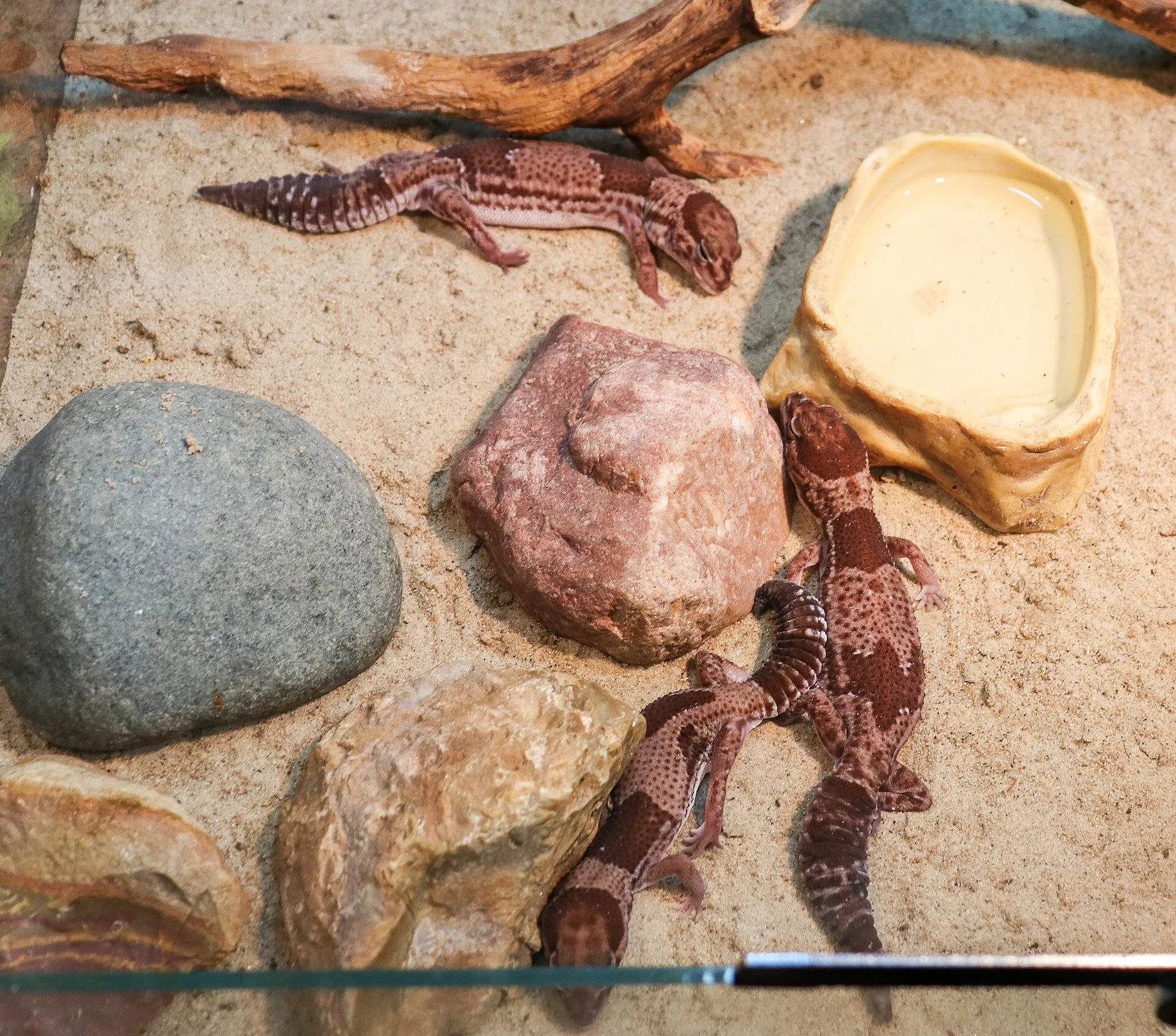
The scientific name of the African fat-tailed gecko is Hemitheconyx caudicinctus It belongs to the order Squamata, the infraorder Gekkota, and the family Eublepharidae. Unlike many typical geckos, members of this family possess movable eyelids. Instead of having broad toe pads specialized for wall adhesion, they utilize claws. Hemitheconyx Currently, the genus includes H. caudicinctus and H. taylori Although it belongs to the same family as the Leopard gecko Eublepharis macularius it is in a different genus, and their natural distributions are widely separated. This relationship indicates that the physical resemblance between the two species is not merely coincidental but reflects traits of the Eublepharidae family inherited from a common ancestor. The specific epithet caudicinctus is interpreted in relation to the banded pattern appearing on the tail. When first described in 1851, it was assigned a different generic name before being reclassified into its current combination. Therefore, this species should be understood not simply as an “African gecko resembling a Leopard gecko,” but as a lineage of Eublepharidae that diverged independently in West Africa.

2. Natural Distribution and West African Geography
The natural distribution of this species spans several West African countries, with records ranging from Senegal to Nigeria and northern Cameroon. The distribution range is not uniform in terms of climate or soil; it encompasses a continuum of zones—such as the southern Sahel, Sudanian savanna, and Guinean savanna—that differ in rainfall and vegetation. Consequently, describing it simply as an “African species adapted to very dry conditions” would be an oversimplification of its actual distribution. The alternation between wet and dry seasons affects both the availability of insect prey and the moisture levels within the geckos’ shelters. Regional variations in soil composition, rock formations, fallen logs, and the distribution of termite mounds also influence the types of shelters available to the geckos. This extensive range suggests the potential for regional differences in behavior and coloration among populations. It is important not to conflate the “morph” names used in the pet trade with actual geographical variations found in the wild. Viewing the species’ distribution on a map of West Africa makes it easier to understand that this is a reptile associated with savanna zones rather than the deep desert.

3. Natural Habitat and Microhabitat
The African Fat-tailed Gecko is primarily a ground-dwelling species. In the wild, it is found in environments that combine open spaces with vegetation, such as grasslands, savannas, and shrublands. However, it is not an animal that remains exposed on the ground surface during the day. They utilize protected microhabitats such as spaces beneath stones or logs, crevices in the soil, and areas around burrows and termite mounds. Natural history records from northwestern Ghana have highlighted the importance of protected ground structures, particularly those surrounding termite mounds. These microhabitats experience less temperature fluctuation than the ambient air and help minimize moisture loss; in other words, the temperature and humidity inside the actual shelter—rather than the regional average—constitute the environment that most directly affects the animal. During the rainy season, increased soil moisture and invertebrate activity can alter the conditions for nocturnal activity. In the dry season, deeper, more stable crevices become increasingly valuable. Therefore, understanding this species’ habitat requires looking beyond a simple “dry vs. wet” dichotomy and instead viewing the environment as a spatial mosaic where dry surface areas coexist with moist shelters.

4. Morphological characteristics and the thick tail
The body is low-slung and robust, with relatively short legs. Although the head is broad, its proportions and coloration create a different impression from that of the Leopard gecko. The eyes feature movable upper and lower eyelids, and the pupils contract vertically. The toes are short and cylindrical, adapted more for using claws than for relying on adhesive pads. Its most distinctive feature is, true to its name, a thick tail. While the tail serves as an energy storage organ, an individual’s health status should not be judged solely by tail thickness. Wild-type individuals commonly exhibit a pattern of alternating brown, dark brown, and beige bands. Some individuals also display a light-colored stripe running down the center of the back. Such markings can aid in camouflage by breaking up the animal’s outline against a ground surface composed of a mix of fallen leaves, soil, and stones. Physically, this species is better adapted for moving steadily across the ground and over rough terrain than for the rapid wall-climbing typical of other geckos.

5. Nocturnal activity, diet, and defensive behavior
The African fat-tailed gecko is a nocturnal species that is primarily active after sunset. At night, it emerges from its hide to forage for small prey near the ground. Its diet is known to consist mainly of insects and other small invertebrates, though the actual composition of its diet may vary depending on the region and season. It navigates its surroundings using a combination of sight, smell, and tactile cues. Reduced activity during the day is not a sign of lethargy but rather part of its natural rhythm in the wild. When threatened, it quickly retreats to a hide or lowers its body to evade danger. If necessary, it can shed its tail (autotomy) to divert a predator’s attention away from its body. While autotomy is an effective defense strategy, it comes at a high cost in terms of lost energy reserves and tissue. To properly understand this species’ behavior, both its nocturnal foraging and diurnal hiding habits must be viewed as integral parts of its natural ecology.

6. Reproduction, Development, and Limitations of Field Research
The African fat-tailed gecko is an oviparous (egg-laying) species. A significant amount of data regarding reproductive cycles and hatching has been accumulated from captive populations. Temperature-dependent sex determination—a relationship between incubation temperature and sex ratio—has been documented in this species. However, the availability of extensive data on captive breeding does not mean that its reproductive ecology in the wild is fully understood. Long-term field data regarding the specific soil types, depths, and moisture conditions that wild females prefer for egg-laying sites are limited. Further research is also needed to understand the microhabitats utilized by hatchlings and the predation pressures they face. The timing of the rainy season and soil moisture levels in specific regions likely influence reproductive success. Data on temperature-dependent sex determination must also be interpreted with a distinction between experimental and natural conditions. Furthermore, the reproductive success of captive individuals should not be equated with the health of wild populations. Ultimately, while this species is very familiar in captivity, many questions remain regarding its movement, egg-laying habits, and hatchling survival in the wild.

Related content
- Leopard gecko Wiki — Comparison with South Asian lineages within the Eublepharidae family
- List of species-specific care guides — Data from other species cannot be directly applied to the African fat-tailed gecko.
- Nocturnal
- Terrestrial
- Microhabitat — Environmental differences inside and outside the hide
Reference Materials
- The Reptile Database — Hemitheconyx caudicinctus
- The Herpetological Bulletin — natural-history observations in northwestern Ghana
- University of Michigan Animal Diversity Web
- NCBI Taxonomy
Related species


Suggest an edit
Tell us which sentence may be incorrect and provide a verifiable source. Submissions are reviewed before publication.