What kind of experience is handling for a snake in front of visitors?
In zoo education programmes, snakes are often supported by staff while visitors touch them. Far less is known about how that experience affects snake welfare than about comparable interactions in mammals or birds. A study published in Veterinary Medicine and Science on 14 September 2026 examined the behaviour of two Children’s pythons and one woma python.
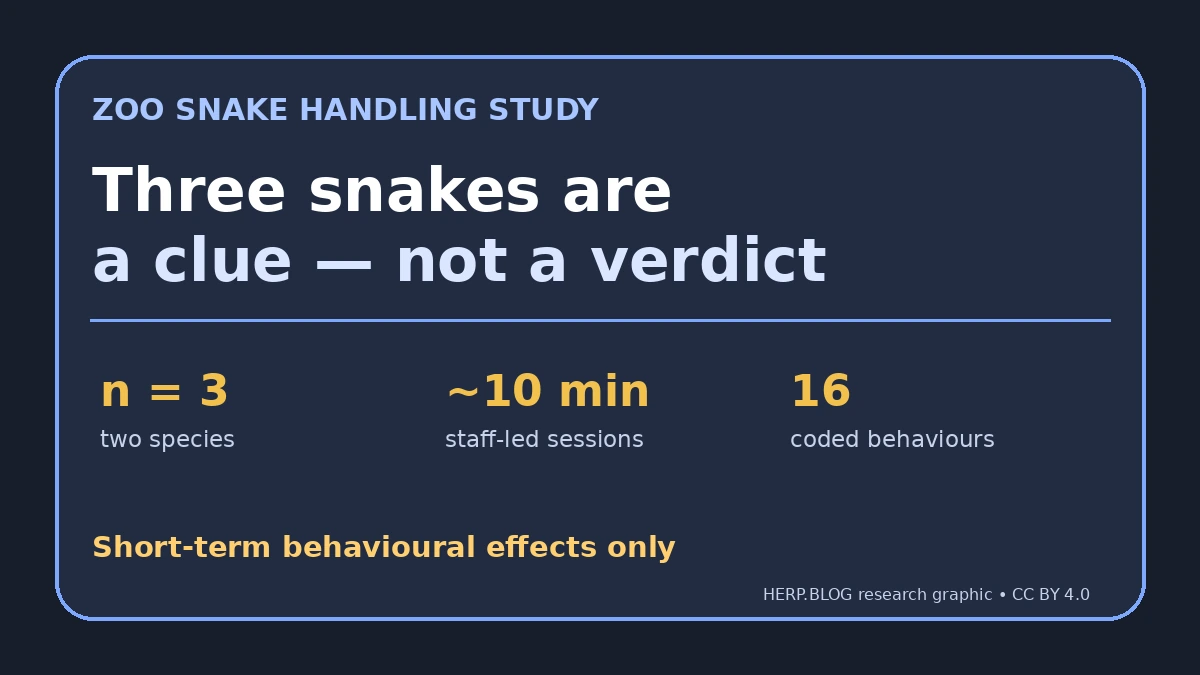
In brief, active and abnormal behaviour did not change significantly after roughly 10 minutes of staff-led handling. Inactive behaviour increased and time out of sight decreased. But the sample contained only three snakes, all previously accustomed to educational handling. Translating this into “snakes do not get stressed when touched” would go well beyond the evidence.
The 30-second summary
- Subjects were two Children’s pythons, Antaresia childreni, and one woma python, Aspidites ramsayi.
- Trained staff supported the snakes while visitors touched the caudal body with an open palm; sessions lasted about 10 minutes.
- Inactive behaviour rose from 5.21% to 22.92%, while time out of sight fell from 93.75% to 75.00%.
- Pre/post differences in active and abnormal behaviour were not statistically significant.
- With three snakes at one facility and behavioural measures only, the result cannot be extended to all snakes or ordinary pet keeping.
Study species and individuals
| Field | Children’s python | Woma python |
| Scientific name | Antaresia childreni | Aspidites ramsayi |
| Classification | Squamata · Pythonidae | Squamata · Pythonidae |
| Study animals | 2 (Bella, Helga) | 1 (Nefti) |
| Snout–vent length | 121 cm, 111 cm | 101 cm |
| Pre-study mass | 563 g, 702 g | 493 g |
| Wild range | Northern Australia | Inland central and western Australia |
| IUCN | No current global assessment verified | Least Concern (2017 assessment record) |
What the researchers compared

Cameras recorded 10-second clips every five minutes across 10 hours each day. Sixteen behaviours were grouped into Active, Inactive, Abnormal, Out of sight and Other, and observers scored footage while blind to handling condition. Data were collected from 22 August through 17 October 2025.
There were two comparisons: two hours immediately before versus two hours after handling, and equivalent periods on handling versus non-handling days. Snakes were not handled when showing signs of shedding or during and immediately after feeding days. Visitors did not lift the snakes; trained staff supported each animal while visitors touched the caudal body with an open palm.
What the numbers showed

Across the three snakes, mean active behaviour changed from 0.00% to 2.08%, inactive from 5.21% to 22.92%, abnormal from 1.04% to 0.00%, and out of sight from 93.75% to 75.00%. Inactive behaviour increased and out-of-sight behaviour decreased significantly, each at p=0.014. Changes in active (p=0.157) and abnormal behaviour (p=0.317) were not significant.
Abnormal behaviour was significantly lower on handling days than on non-handling days (p=0.034). The authors interpreted brief handling as having no pronounced adverse behavioural impact on these three individuals. Yet more resting cannot automatically be labelled “relaxed,” nor increased visibility “enjoyment.” The same behaviour can arise from different internal states.
What it means for welfare and husbandry
The study’s value is that it moves discussion of snake handling from anecdotes toward observable behaviour and a comparative design. A short programme in which staff support the animal, restrict the area touched and account for feeding and shedding status provides one defined condition that can be evaluated.
It is not a husbandry instruction to handle pet snakes frequently. Caregivers still need to watch whether an animal tries to hide, supports unsupported body weight, breathes rapidly, adopts defensive postures or repeatedly attempts escape. Suspected illness or pain calls for assessment by a veterinarian experienced with reptiles, not a handling experiment.
Limits and unanswered questions
- The sample comprised three snakes, two species and one facility.
- Every subject was already accustomed to regular educational handling.
- Daytime recording may have missed behaviour during other activity periods.
- The study used behaviour only and did not measure physiological indicators such as corticosterone.
- Inter-observer reliability was not calculated separately, and temperature or lighting differences may have confounded responses.
Follow-up work should combine more species and individuals, handling-naive comparison animals, physiological indicators and longer-term health data. Whether an animal can choose to withdraw, and how programme frequency and rest days matter, are also important questions. These results are better treated as preliminary evidence that opens a more precise research design than as a verdict that closes the welfare question.
Four things to remember
- The study examined brief, staff-led handling in a zoo programme.
- No pronounced adverse behavioural shift was detected in the three subjects.
- The emotional meaning of increased inactivity and visibility remains uncertain.
- A tiny sample must not be generalised to every species, individual or pet-keeping situation.
Related HERP.BLOG articles
- Antibody responses in 40 Children’s pythons
- Carpet python care guide
- A 34-case western hognose snakebite survey
- What is a reptile?
Reply 남기기