
Last updated 2026.09.23 · Edited by silveston · Compiled by an independent hobbyist without professional credentials
The carpet python (Morelia spilota) is hardy and behaviorally rewarding, but describing it as automatically easy for beginners invites mistakes. Regional forms differ in adult size and climate response, individuals may live for decades, and powerful adults need an enclosure with height and structure as well as length. Before adoption, confirm lineage, current weight, feeding history, and legal origin.
The numbers below are starting points, not prescriptions for every locality. Jungle and coastal lineages may respond differently from southeastern diamond pythons to seasonal temperature and humidity. Measure the actual enclosure with digital probes and an infrared thermometer, then adjust while tracking breathing, sheds, digestion, activity, and body condition.
Key points in 30 seconds
- Adults need a spacious, tall enclosure matched to locality and individual size.
- Measure the basking surface, warm hide, and cool end separately to create a gradient.
- Combine moderate humidity and strong ventilation with a humid hide for shedding.
- Feed appropriately sized whole prey and adjust intervals from body condition.
- House singly and use a safety plan and assistant when handling a large adult.
At a glance
| Suggested level | Intermediate |
|---|---|
| Adult enclosure starting point | About 180 × 75 × 90 cm or larger for many medium-to-large adults; expand for locality and length |
| Basking surface | About 31–33°C, measured directly with an infrared thermometer |
| Warm-side air/hide | About 28–30°C |
| Cool end | About 24–27°C |
| Night | A gentle drop to roughly 21–24°C for a healthy adult, adjusted for locality and condition |
| Relative humidity | Usually begin around 40–60% with a humid hide; avoid continuously wet substrate |
| Food | Thawed whole prey, with interval adjusted to body condition and digestion |
What to calculate before adoption
First identify the locality and expected adult size. The name carpet python covers relatively compact animals as well as powerful snakes exceeding two meters. Do not rely on a sales label alone; ask for parental size, hatch date, ancestry, and feeding records. If origin is an uncertain cross, do not impose the climate schedule of one named subspecies.
A lifespan of decades and a furniture-sized adult enclosure create long-term costs. Include thermostats, heating equipment, backup power planning, freezer space for prey, and access to an experienced reptile veterinarian. Decide who can provide care during moves or travel and how a large adult can be transported safely.
Check local law and transfer documents, and avoid animals of unclear wild origin. Appetite alone is not a health examination. Inspect nostrils, mouth, scales, vent, body musculature, and signs of external parasites. Quarantine the new snake in a separate area from any established reptiles.
Enclosures through growth
A juvenile is not harmed by space itself; problems arise when cover is poor and water, prey, or thermal zones are hard to locate. A secure enclosure with several hides, branches, and visual barriers allows even a young animal to use room confidently. If a small temporary tub is used, treat it as a brief management stage and plan upgrades.
About 180 × 75 × 90 cm can be a practical starting point for many medium-to-large adults, but it is not a universal endpoint. The snake should be able to extend, turn on the floor, and use perches at more than one height. A large coastal form or a highly active individual needs greater length and height.
Doors and vents must resist sustained pushing and should be locked. Seal cable openings too small for a head and check gaps between sliding panels for juveniles. A keeper should be able to locate the snake before reaching inside, and a temporary secure container should be ready for major cleaning.


Thermal gradient and probe placement
Use approximately 31–33°C for the basking surface, 28–30°C for warm-side air and the warm hide, and 24–27°C at the cool end as initial targets. Measure surfaces with an infrared thermometer and air at the snake’s resting height with fixed digital probes. One display near the ceiling cannot represent the floor and perches.
Connect every heat source to a thermostat. Ceramic heaters and radiant panels need guards that prevent contact, and probes must be secured so displacement cannot trigger overheating. Distinguish a small intense point below a lamp from the broader warm zone, and test new equipment for at least a day before adding the snake.
After a meal, the snake needs access to an adequately warm secure hide, but it does not need to be confined there. If it remains only at the cool end or never leaves the heat source, review hide security, ventilation, and probe position as well as the targets. Behavior is valuable evidence alongside instruments.
Night cooling and seasonal change
A healthy adult can often tolerate a gentle night drop to about 21–24°C, but locality and health matter. Juveniles, recovering animals, and tropical-origin lines may need more stable nights. A cool seasonal schedule suited to a southeastern diamond python should not be copied directly for a jungle line.
Night cooling should not be a sudden chill when lights switch off. Check room temperature and enclosure insulation and record the lowest value near dawn. Abrupt cooling combined with high humidity can increase respiratory risk, so seasonal transitions should occur gradually over several days.
Large seasonal changes used for breeding are not routine companion care. Without a breeding plan, a reliable day-night rhythm and modest seasonal adjustment are sufficient. If fasting or reduced activity occurs, compare temperature records and weight trend before deciding whether it is seasonal behavior or illness.


Balancing humidity and ventilation
A relative humidity range around 40–60% is a useful starting point, adjusted for locality and room ventilation. Keeping the entire enclosure wet to raise a number is not good husbandry. Humid air, wet substrate, and cold surfaces are different conditions and should be considered separately.
Before a shed, offer a humid hide with damp moss or paper so the snake can choose it. Moving the water bowl toward the warm side increases evaporation; placing it toward the cool side reduces that effect. Try local solutions before repeatedly spraying the whole enclosure.
Ventilation is not the enemy of humidity; it limits mold and stagnant air. Cross-flow or high-and-low vents should maintain air exchange while useful humidity remains. Wheezing, open-mouth breathing, bubbles, or repeated poor sheds require a review of the environment and advice from a reptile veterinarian.
Lighting and UVB
Provide a day-night cycle close to twelve hours as a baseline, with gentle seasonal adjustment if desired. Window light does not guarantee a consistent photoperiod or safe ultraviolet exposure. A timer keeps the schedule predictable, and bright red or blue lamps should not remain on at night.
A python eating whole prey does not immediately become deficient without UVB, but low-level UVB and bright visible light can support behavioral choice and vitamin D physiology. Install the lamp so complete shade and hides remain available. Select the lamp output using the manufacturer’s specifications, mesh attenuation, and the actual distance to the snake.
UVB does not create a thermal gradient by itself. Map heat, visible light, and UVB as separate zones. Follow manufacturer distance and replacement guidance; visible light from a lamp does not prove that ultraviolet output remains adequate.


Branches, hides, and safe structure
A carpet python is not a floor-only snake. Thick, firmly fixed branches and shelves at several heights allow climbing, ambush postures, and thermoregulation. Supports must carry the full body and must not fall against glass or the animal.
Place snug hides at both warm and cool ends. A broad open box may not feel secure. Cork bark, artificial foliage, and visual barriers let the snake choose how exposed it wishes to be, and a secure elevated resting point expands behavioral options.
Decor must not contain neck-sized loops, sharp edges, or exposed adhesive. Put heavy rocks directly on a stable base rather than loose substrate so burrowing cannot undermine them. Plan an order for removing structures during inspection and cleaning.
Choosing substrate
Newspaper or plain paper towel is useful for quarantine and medical observation because feces, regurgitation, and mites are easy to see. For long-term display, low-dust aspen, coconut-based material, or cypress mulch may work depending on ambient humidity.
Do not choose substrate from humidity alone. Consider ingestion, dust, mold, cleaning, and the heating method. Avoid strongly aromatic softwoods, chemically treated wood, and a deep bed of sand as the sole substrate. Observe breathing and skin after introducing a new material.
Offer prey over a clean plate or flat surface to reduce attached particles. Moving the snake to a separate feeding tub every time can add stress and handling risk. Controlled feeding with long tongs inside the enclosure is usually simpler.


Prey size and feeding interval
Use thawed whole prey roughly equal to or slightly narrower than the snake’s broadest body section. One oversized meal is not automatically better than several appropriate meals. Excessive prey increases regurgitation and obesity risk, so size and interval must follow condition and digestion.
Juveniles eat more often than adults, but the calendar should not replace observation. Rough starting intervals might be 7–10 days for a small juvenile, 10–14 days while growing, and 2–4 weeks or longer for an adult depending on prey size and condition. Adjust from weight trend, musculature beside the spine, and seasonal activity.
Thaw prey in a refrigerator and warm it fully before offering it with long tongs. Live rodents can severely injure a snake and should be avoided. Do not handle unnecessarily for at least 48 hours after feeding, and if regurgitation occurs, stop and investigate rather than immediately feeding again.
Water and shedding
Clean drinking water must always be available. Use a bowl heavy enough to resist tipping even if part of the body enters it, and place it where daily inspection is easy. If the snake defecates in water, clean and disinfect the bowl promptly, rinse it thoroughly, and replace wet substrate below it.
When the eyes cloud and color dulls before a shed, keep the humid hide moist. Inspect a completed skin from head to tail, but do not pull retained shed by force. If eye caps or tail-tip skin remain, first correct the cause and provide a safely warm, humid microenvironment.
Repeated soaking does not necessarily mean the snake enjoys bathing. Check for overheating, dehydration, mites, and skin irritation. A larger bowl alone does not solve the underlying problem; review thermal records and inspect for external parasites.

Behavior and handling
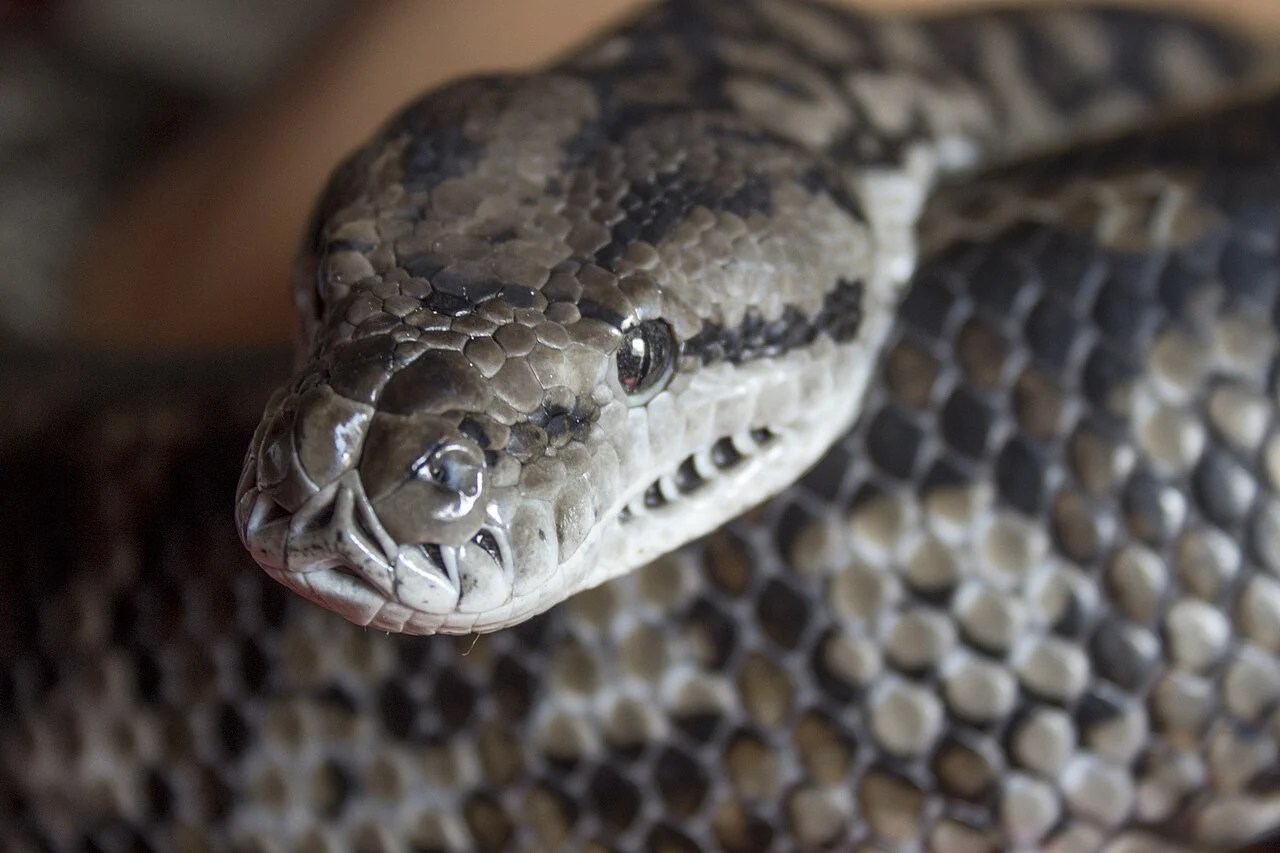
Learn to distinguish a rapid feeding response from a defensive approach. Before opening the enclosure, locate the head and posture; a consistent cue such as a light hook touch can signal routine handling. Never approach with prey scent on the hands or wave quickly at the doorway.
Begin with short, predictable sessions once the snake is settled. Support several parts of the body and never lift by the tail or pin the neck. Delay handling before a shed, soon after feeding, or whenever the animal repeatedly flees and remains tense. Let it grip safe support.
A large adult may exceed what one person can manage safely. Work near a clear exit, do not allow coils around the neck, and use an experienced assistant when appropriate. A safety plan respects the strength of the animal; it does not assume aggression.
Cohabitation and other animals
House carpet pythons singly by default. Even conspecifics can compete for heat and hides, experience breeding stress, or bite accidentally. Resting together for a moment does not demonstrate the absence of chronic stress, and mites or disease can spread quickly.
Breeding introductions require health checks, confirmed sex, adequate body condition, and a separate enclosure ready immediately. Unplanned pairing can burden the female and increase injury. Never feed two snakes together, and continue individual records after mating.
Do not allow contact with dogs, cats, or caged birds. Either animal may be predator or prey, and small wounds can become serious. Locks, closed doors, and separated care routines are reliable prevention.

Cleaning and quarantine
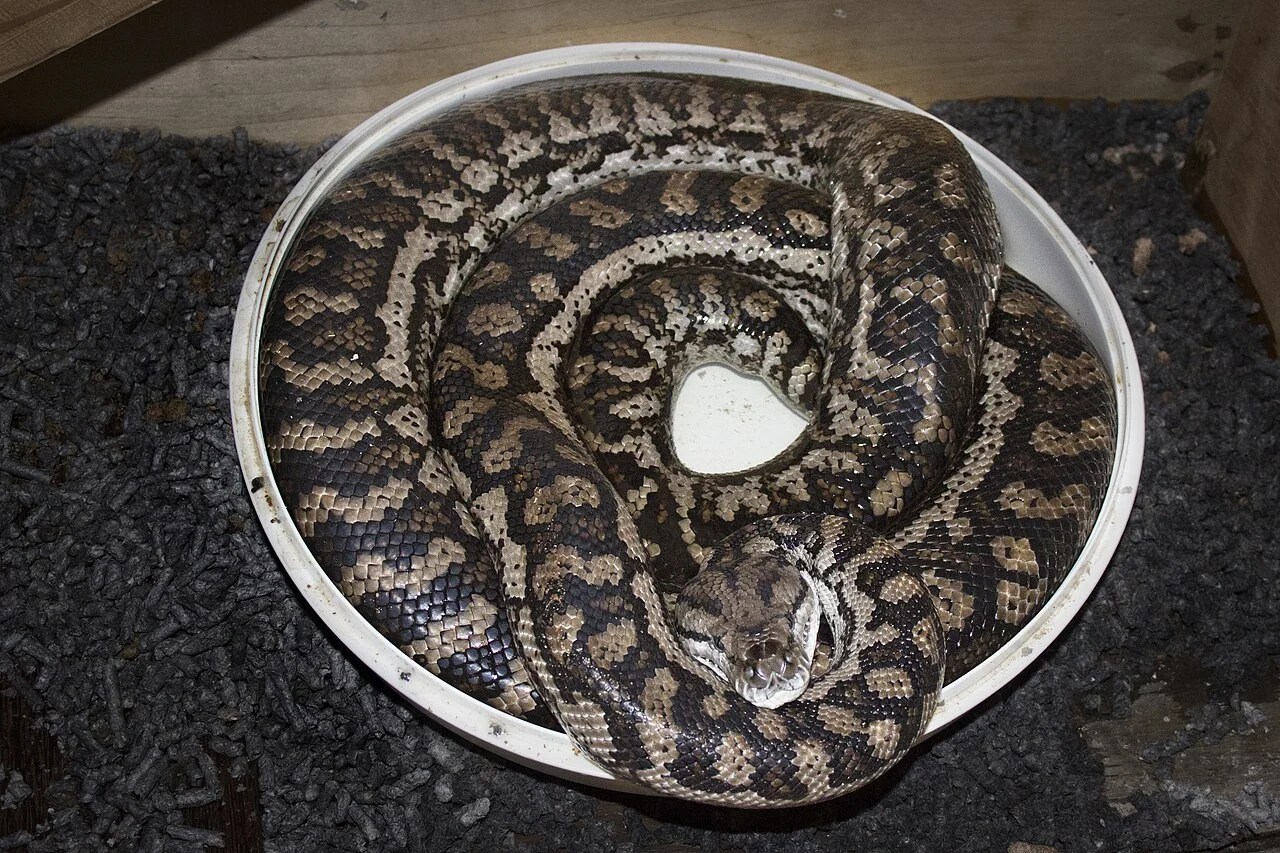
Spot-clean feces and wet substrate promptly and inspect the water bowl every day. Periodically remove and wash furnishings, but unnecessary complete dismantling can add stress. Match the schedule to contamination and material.
Use a reptile-appropriate disinfectant at the specified dilution and contact time. Cleaning and disinfection are separate: remove organic material first, then disinfect, rinse, and dry. Do not improvise with phenolic or heavily fragranced household products.
Keep a new snake in a separate area for weeks to months and use separate tools. Care for it after established reptiles, then wash hands and equipment to reduce cross-contamination. Discuss fecal testing and the first examination with a reptile-experienced veterinarian.
Signs that need veterinary attention
Wheezing, open-mouth breathing, bubbles or mucus, and an unusually elevated head during respiration warrant veterinary attention. Repeated regurgitation, rapid weight loss, or persistent anorexia also need environmental records and clinical assessment. Do not diagnose a disease from one sign online.
Moving specks between scales, specks floating in water, and excessive rubbing can indicate mites. Red or blistered belly scales may be associated with wet contamination or thermal injury. Even a small burn or wound can become infected and deserves prompt professional care.
Regular records of weight, meals, sheds, and feces make change easier to detect. Bring temperature logs, humidity range, diet details, and recent photographs to the veterinarian. Medication and force-feeding should never begin without diagnosis and instruction.
Common mistakes and a care checklist
Common mistakes include installing heat without measuring the surface, keeping substrate wet to chase humidity, and feeding frequently to accelerate growth. Weak branches in a tall enclosure also create risks of falls and equipment damage.
Daily, check doors, locks, water, posture, breathing, and current sensor values. Weekly, review minimum and maximum temperature and humidity, contamination, skin, and shed quality. Monthly, check weight and body condition, heater guards, probe attachment, branches, and sealed joints.
Good husbandry is not the ability to freeze every number. It is a system that detects change quickly. Mark probe locations on an enclosure map and keep records so causes can be traced. Respect locality and behavior, and adjust one variable at a time within evidence-based ranges.
Frequently asked questions
Is a carpet python suitable for a beginner?
It can be manageable for someone who understands basic equipment and can provide adult space and safe handling, but responsibility and cost exceed those of a small snake. Because locality matters, it is safer to treat the species as intermediate.
Exactly how large should the adult enclosure be?
No single number fits every animal. About 180 × 75 × 90 cm or larger is a practical starting point for many adults, expanded so the snake can extend, turn, and use sturdy elevated structures.
Is higher humidity always better?
No. Begin around 40–60% with a humid hide and good ventilation. Continuously wet substrate and cold stagnant air can increase skin and respiratory risk.
Does one refused meal require a vet visit?
One refusal does not prove illness. Review temperature, shedding, season, reproductive behavior, and weight. Seek a reptile veterinarian when refusal repeats with weight loss, abnormal breathing, or regurgitation.
Related reading
References
- RSPCA Australia — How should I care for my carpet python?
- ReptiFiles — Carpet Python Care Sheet
- The Reptile Database — Morelia spilota
- Australian Museum — Diamond Python
- NSW Government — Reptile keeper licences
Suggest an edit
Tell us which sentence may be incorrect and provide a verifiable source. Submissions are reviewed before publication.