Last updated 2026.10.11 · Edited by silveston · Compiled by an independent hobbyist without professional credentials
It raises its tail like a scorpion, but it has no stinger. Pristurus carteri is a diurnal gecko of arid Arabian ground that uses its tail like a flag. This article centers accepted taxonomy and wild ecology rather than trade labels.
Scorpion-Tailed Gecko at a Glance
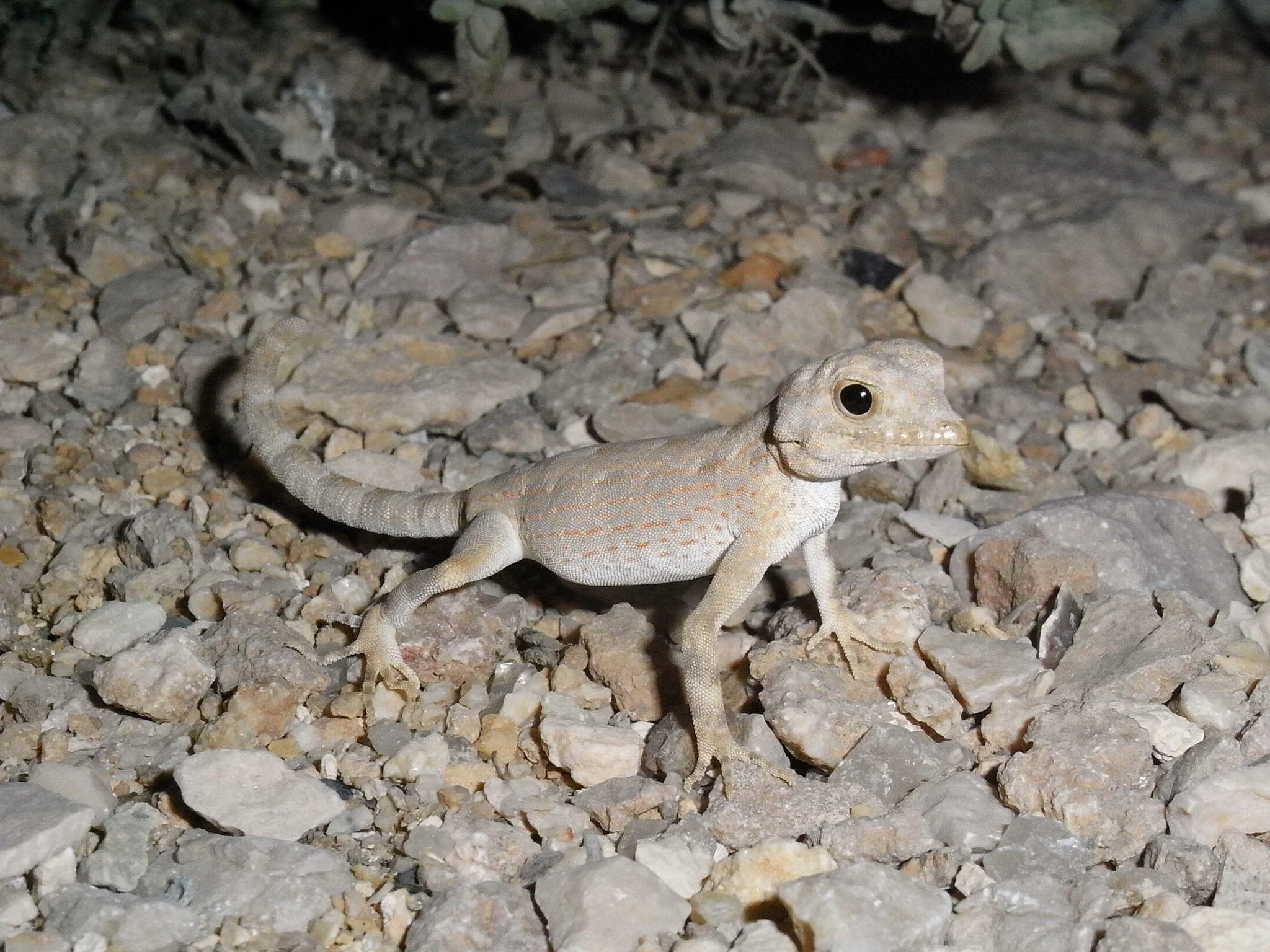
The scorpion-tailed gecko is not a venomous, stinging animal. It is a tiny diurnal gecko that lives under the Arabian sun. An adult can appear no longer than a finger, and its sand-to-gray-brown body can vanish into a gravel field when it remains still. When alarmed or facing another gecko, however, it lifts a laterally compressed tail edged with prominent, saw-like scales. That posture recalls a scorpion and explains the common pet-trade name.
It is also called Carter’s rock gecko or Carter’s semaphore gecko. “Semaphore” refers to communication by conspicuous visual signals, much like flag signaling. The name captures the fact that the tail is not merely ornamental: it advertises presence and arousal to other geckos. The animal has no venom or tail stinger. Instead, it combines color, posture, and movement with remarkable precision to survive on bright, exposed ground.
| Field | Summary |
|---|---|
| Scientific name | Pristurus carteri (Gray, 1863) |
| Family | Sphaerodactylidae |
| English names | Carter’s semaphore gecko / Carter’s rock gecko |
| Range | Oman, Yemen, the United Arab Emirates, and southeastern Arabia |
| Activity | Diurnal, behavioral thermoregulation |
| Diet | Small arthropods |
| Conservation | IUCN Least Concern |

Taxonomy and Names: A Semaphore Gecko, Not a Scorpion
The currently accepted name is Pristurus carteri (Gray, 1863), in Squamata, Sphaerodactylidae, and the genus Pristurus. The species was originally described in the combination Spatalura carteri, and literature also contains subspecific names such as Pristurus carteri carteri and P. c. tuberculatus. Old trade or regional labels must therefore be separated from accepted names and true synonyms. Recent genomic and morphological revision divided the P. rupestris complex into several species, but that change does not automatically transfer P. carteri to a different species.
The genus name Pristurus evokes the saw-like tail. The genus contains several “semaphore geckos” from Arabia, Socotra, and the Horn of Africa. Even when two small gray-brown geckos look similar, range, tail crest, scale arrangement, head proportions, and genetic lineage may differ. A single photograph should not be used to identify a regional population with unwarranted certainty.
Size and Form: A Body That Resembles Gravel
The body is slender and somewhat flattened, with a relatively broad head and prominent eyes. The skin looks rougher than that of many tropical arboreal geckos, and sand-colored speckles and bands scatter across the back and flanks. This irregular pattern breaks the outline against bright gravel and tiny shadows. The toes do not form the broad adhesive pads associated with glass-climbing geckos; they suit walking and short dashes over rock and firm ground.
The tail is both a counterbalance and a billboard. Its compressed profile and projecting edge scales enlarge the silhouette from the side. By lowering the body while raising the tail, a gecko can create an unfamiliar outline for a predator and an easily recognized signal for its own species. Sex, age, and tail regeneration can alter shape and pattern, so no single feature should be used to determine sex or subspecies.

Range: Southeastern Arabia Centered on Oman
The Reptile Database reports the species from Oman, Yemen, the United Arab Emirates, and records associated with Saudi Arabia. In Oman it is known from a broad variety of coastal plains, gravel desert, rocky wadi margins, and low hills. A country shaded on a range map does not mean every point contains the same density. Stone size, soil particles, shelter gaps, vegetation, and prey insects determine occurrence at a much smaller scale.
The 2018 atlas of Oman’s terrestrial reptiles analyzed 5,359 observations representing 101 species. Geckos made up roughly 45% of the country’s reptile diversity, and Pristurus was a prominent genus spanning different climatic and elevational niches. “Desert gecko” therefore does not describe one uniform environment. P. carteri lives in hot, arid country, yet its use of stones, shade, crevices, and activity windows is finely partitioned within that landscape.

The Daily Schedule of a Diurnal Gecko
Unlike many commonly kept geckos, this species uses daylight and visual signaling. In the morning it may emerge onto exposed rock to warm after the night. When midday surface temperatures become excessive, it moves beneath stones or into shaded cracks. Later it can resume foraging and territorial patrols as usable microclimates return. “Diurnal” does not mean tolerating intense heat all day; it means regulating body temperature through repeated short exposures and retreats.
Ground surfaces heat and cool much faster than the air. A tiny body gains heat quickly but can also overheat quickly. Sun and shade only centimeters apart, or the upper and lower surfaces of one stone, may determine survival. Flattening the body can increase heat gain, while extending the legs and lifting the trunk reduces contact with hot ground. Such behavioral regulation is central to small reptiles in arid habitats.
Flag Signals Sent with the Tail
Semaphore behavior in Pristurus involves lifting, curving, or moving the tail to create a conspicuous visual signal. Husbandry and behavioral literature on P. carteri describes threat and display postures. When another gecko approaches, raising the body, presenting the flank, or elevating the tail can advertise presence and increase the apparent cost of coming closer. If signals maintain distance, a tiny animal may avoid damaging bites and physical fights.
Not every raised tail is aggression. Tail posture can also change during exploration, balance, surprise, or attempts to confuse a predator. A short clip should not automatically be labeled courtship or dominance. Observers should record whether another gecko was present, the direction of approach, repetition rate, body height, and any later chase or retreat. Meaning comes from the sequence before and after the signal.

Diet and Hunting: Rapid Strikes at Tiny Prey
In the wild, the gecko takes arthropods appropriate to its size. Small crickets, beetles, ants or termites, spiders, and other ground-dwelling invertebrates are plausible prey. Large eyes detect movement in daylight, followed by a short approach and a rapid strike. When prey disappears, the gecko may search shallow cracks with its head low, but it is better described as a visual hunter moving across exposed surfaces and shallow gaps than as a deep-burrowing ambush predator.
Its size favors multiple small prey captures rather than swallowing a single oversized item. Wild prey differ in calcium, moisture, and chitin and vary seasonally. Feeding one insect species indefinitely in captivity cannot reproduce that diversity. “Insectivorous” does not mean that every insect is safe in unlimited quantity; prey size and nutritional preparation remain essential.
Reproduction and the Temperature-Dependent Sex Study
The species lays eggs and, like many small geckos, invests in a few eggs rather than producing a large clutch at once. Season, temperature, food, rainfall, and female condition can alter laying frequency. Literature also reports sperm storage, so interpreting fertile eggs requires more than checking only the most recent cohabitation history.
A 2024 Journal of Experimental Zoology study experimentally investigated temperature-dependent sex determination in P. carteri. About 26°C appeared close to the lower viable developmental limit, and samples incubated at 28°C produced a strongly male-biased outcome. The authors considered temperature-dependent sex determination more parsimonious than sex-specific embryo mortality, while noting that dead embryos were not sexed. The result is not a simple recipe for producing a chosen sex; it warns that incubation temperature may affect both survival and sex ratio.

Avoiding Predators and the Tail’s Other Jobs
A tiny ground gecko is exposed to birds, snakes, larger lizards, and arthropod predators. Camouflage helps it avoid detection first; once found, it uses a short burst toward a crevice. Raising the tail may draw attention rearward or confuse the direction of travel. Tail loss can be a final defense, but regeneration costs energy and time and may weaken its visual signaling function.
Freezing and sudden escape can alternate depending on the background. Movement is obvious on uniform sand, whereas a short dash followed by stillness can frustrate tracking in complex gravel. Chasing a captive by hand or grasping its tail repeatedly activates these defenses unnecessarily. Understanding its wild ecology therefore explains why handling should remain minimal.

Relatives: Not Every Small Brown Gecko Is the Same
The related P. rupestris and several Arabian semaphore geckos share a similar build and coloration. Species differ in distribution, elevation, tail crest, dorsal scales, and head proportions. Recent work on the P. rupestris group combined morphology, mitochondrial DNA, and nuclear genomic data to recognize several cryptic lineages as distinct species. The case illustrates why location and genetics matter in superficially similar arid-zone geckos.
In the pet trade, “scorpion-tail” or “semaphore” may be used loosely for more than one species. Color or tail shape cannot confirm subspecies or locality without origin and parental records. Scientific-name labels, legal acquisition documents, and breeder records should be retained so an animal’s identity remains traceable if taxonomy changes.
People and Conservation
The species is currently treated as Least Concern by IUCN. A broad distribution and use of multiple arid habitats support that assessment, but “Least Concern” does not mean “free of threats.” Roads, urban expansion, quarrying, heavy grazing, and tourism can simplify stone layers and crevice systems. Tiny geckos are easily overlooked, so decline can remain unnoticed until late.
Protected areas cover a small proportion of Oman yet contain many of the terrestrial reptile species documented by surveys. Conservation must protect connected gravel surfaces, rocks, and microhabitats, not only famous large animals. In the pet trade, buyers should verify captive-bred origin and legal import documentation and avoid choices that increase wild-collection pressure.
Observation Notes: Record Context and Sequence, Not Just the Tail
Useful observation records include tail angle, body height, distance to another gecko, substrate temperature, and time of day. Time spent basking before retreating, pauses before a feeding strike, and whether a display is followed by pursuit or withdrawal can reveal individual tendencies and environmental responses.
The appeal of the scorpion-tailed gecko lies less in size or brilliant color than in precise signaling by a tiny animal. It disappears into gravel, then raises its tail and turns an apparently empty desert into a stage crossed by light, heat, and sightlines. Practical management is covered separately in the Scorpion-Tailed Gecko Care Guide.
Field records must distinguish broad climate values from the surface actually touched by the animal. Annual mean temperature or a city weather forecast does not directly reveal the instantaneous temperature of a rock face, humidity inside a crevice, or heat lost from the body in moving air. At one locality, pale stone may heat less than dark stone, while the space under a thin flake cools faster than a deep crack. The scorpion-tailed gecko changes posture and position over minutes to exploit these small differences. A single photograph should therefore not be generalized into a claim that the species always prefers extreme heat and dryness. Range data, time of day, substrate, and behavioral sequence must be considered together.
References
- The Reptile Database. Pristurus carteri. Species account.
- Carranza S. et al. (2018). Diversity, distribution and conservation of the terrestrial reptiles of Oman. PLOS ONE 13:e0190389. DOI.
- Burriel-Carranza B. et al. (2019). Terrestrial reptiles of the United Arab Emirates. PLOS ONE 14:e0216273. DOI.
- Straková B. et al. (2024). Pivotal temperature is not for everyone. Journal of Experimental Zoology Part A. DOI.
- Kowalski T. (2010). Beobachtungen zum Droh- und Imponierverhalten bei Pristurus carteri. Sauria 32(1):31–34.
- Wikimedia Commons. Category: Pristurus carteri. Photographer and license verified on each file page.
Suggest an edit
Tell us which sentence may be incorrect and provide a verifiable source. Submissions are reviewed before publication.