Last updated 2026.10.11 · Edited by silveston · Compiled by an independent hobbyist without professional credentials
This guide does not replace diagnosis or treatment. It translates the arid, diurnal ecology of Pristurus carteri into selectable gradients of heat, light, and humidity. Consult a veterinarian experienced with reptiles if breathing, weight, or general condition is abnormal.
Before You Begin: A Tiny, Fast Display Gecko
The scorpion-tailed gecko is better suited to behavioral observation than routine handling. It is small, moves extremely quickly over short distances, and can slip through door gaps and decorations. Chasing increases the risk of collision and tail loss, so opening the enclosure must not create a clear escape route. For cleaning or transfer, guiding the animal into a transparent cup with a flat card is safer than grabbing it.
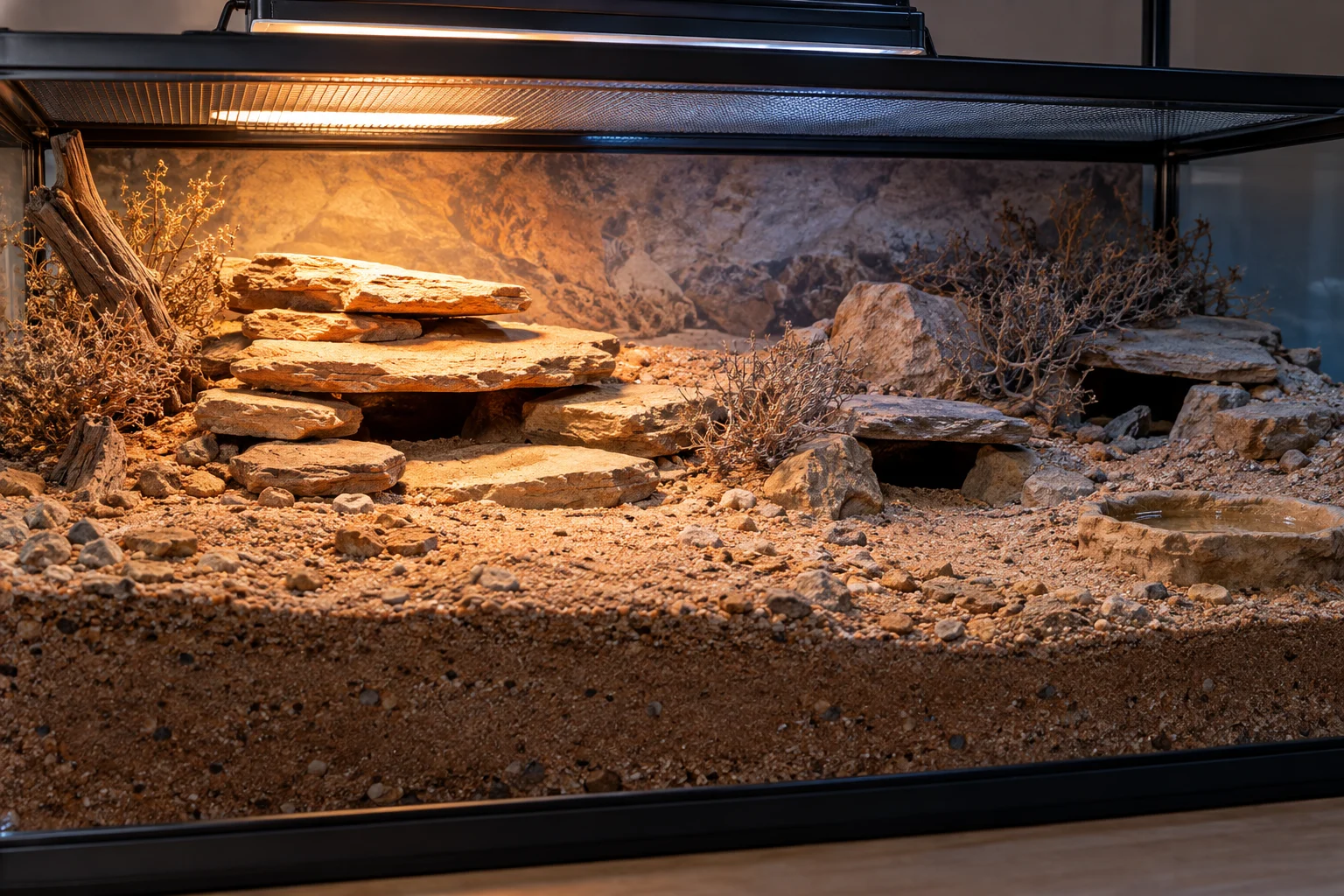
A hot box of sand is not adequate merely because the species comes from arid country. In the wild it moves among sunlit rock, ventilated exposed surfaces, cool undersides, and cracks that retain slightly more moisture. Husbandry should provide choices, not one average value. A bright warm site, a moderate activity zone, and a cool dark retreat must exist at the same time and be measured separately.
| Care variable | Initial target |
|---|---|
| Adult enclosure | At least about 45 × 30 × 30 cm; preferably 60 × 30 × 30 cm or larger |
| Basking surface | About 32–35°C by day |
| Warm-side air | About 28–31°C by day |
| Cool side | About 24–27°C by day |
| Night | Generally 20–24°C |
| General humidity | Generally 30–50%, with a separate local humid hide |
| Lighting | Bright visible light, linear UVB, and about a 12-hour cycle |

Enclosure Size and Growth Stages
For one adult, a floor area around 45 × 30 cm with about 30 cm of height is a reasonable minimum starting point. Because the species repeatedly runs horizontally and climbs low rocks, 60 × 30 × 30 cm or larger is easier to manage where space permits. Juveniles should not be confined to tiny tubs; use an escape-proof enclosure around 30 × 30 × 30 cm that still allows prey location and a thermal gradient. Dimensions are starting points and should increase with body size, furnishing density, and measurement results.
Floor area and stable low rockwork matter more than a tall arboreal format. Check sliding-door gaps, cable ports, and mesh corners against the smallest juvenile. Seal openings that allow feeder insects to escape. Run a new enclosure empty for at least 48 hours and record the hottest surface, air temperature at animal height, and the coolest retreat before introducing the gecko.
Thermal Gradient: Measure Surfaces and Air Separately
An initial daytime target can be a basking-rock surface of about 32–35°C, air at animal height on the warm side of 28–31°C, and a cool side of 24–27°C. These values must be adjusted for lamp distance, ventilation, season, and behavior. Measure surfaces with an infrared thermometer and air with a secured digital probe at the gecko’s height. Connect the heat source to a thermostat and fix the probe so it cannot shift.
Heating the entire enclosure to one target removes the animal’s escape options. If it remains on the warmest site all day yet digests slowly, the overall setup may be too cool. If it continually seeks shade, gapes, or climbs the walls, suspect overheating. Adjust in steps of 1–2°C while watching behavior, feces, and feeding. Check daily for lamp-access burns and localized overheating from under-tank heaters.

Night Conditions and Seasonal Change
Turn visible lights off at night and generally allow a gradual drop to roughly 20–24°C. A healthy adult briefly experiencing a cooler night in a dry, ventilated enclosure is not equivalent to keeping a juvenile or debilitated animal cold for long periods. If the room falls below 18°C, use a non-light-emitting heat source on a thermostat, but do not keep the entire enclosure at daytime temperature overnight.
Routine pet care does not require extreme seasonal cooling or an artificial drought unless a carefully planned breeding program has veterinary and species-specific support. Reflect seasons gradually through modest changes in photoperiod and normal room temperature. Reduced appetite should not automatically be labeled winter behavior; assess weight, feces, shedding, mouth, and abdominal condition.
Lighting and UVB
As a diurnal species, it needs a clear light-dark cycle and bright visible light. A 12-hour day is a practical baseline, with gradual seasonal adjustment within roughly 10–13 hours. Use low-to-moderate linear UVB and set exposure at the actual basking perch according to manufacturer distance charts and, preferably, Solarmeter readings. Glass and acrylic block most UVB, so identify every material between lamp and animal.
UVB does not eliminate the need for appropriate calcium and prepared feeders. Conversely, heavy vitamin D3 supplementation combined with strong UVB can create excess. Lamps may look bright after effective UV output has declined, so record the manufacturer’s replacement interval. Always leave complete shade where the whole body can withdraw from radiation.

Humidity, Water, and Ventilation
Keep most of the enclosure dry while remembering that “arid” does not mean “dehydrated.” General relative humidity can usually move around 30–50% with ventilation and season. Lightly mist one wall or a local hide in late afternoon and allow it to dry within several hours. Permanently wet substrate and condensation increase risks of mold, skin problems, and respiratory disease.
Provide a shallow, stable water dish and replace it with clean water daily. It must not be deep enough to trap a tiny gecko; add a slope or small stone so feeder insects can escape. A small ventilated humid hide containing slightly damp material gives an optional microclimate without wetting the whole enclosure. Use both high and low vents for air exchange while avoiding a cold draft aimed at one perch.

Substrate, Rocks, and Hides
A firm mixture of compacted sand and clay-rich soil provides natural footing and limited digging. Deep loose fine sand alone is easier to swallow with prey and allows heavy stones to settle. Place rock structures directly on the enclosure floor, secure them, and then fill substrate around them. Press and test every stack so it cannot collapse after digging.
Provide tight-fitting hides on both warm and cool sides and combine cork, flat slate, and textured stone. Remove sharp edges. Offer varied roughness so toes and belly do not remain on slippery glass or smooth plastic. Clean natural materials thoroughly and use only items free from pesticides, salt, and metal contamination.
Diet and Nutrition: Small, Varied Prey
Rotate prey no wider than the space between the gecko’s eyes: small crickets, small locusts where legal, fruit flies, small silkworms, and other legally available captive-produced insects. Dubia roaches are not recommended in Korea. Do not use wild-caught insects because of pesticide, parasite, and identification risks. Gut-load feeders for 24–48 hours with nutritious food and a safe moisture source.
Start juveniles with a small daily meal or feeding on five to six days per week. Start adults at three to four feeding days per week and adjust for body condition and response. Record consumption and remove prey remaining after 10–15 minutes. Apply a light calcium dusting to most meals and use multivitamins at the interval specified for the product. Whether vitamin D3 is included depends on UVB and the full diet; avoid duplicating supplements.

Shedding and Skin Checks
Color may dull and hiding may increase before a shed. Rough surfaces and a localized humid hide help the gecko remove skin. Inspect toes, eyes, and the tail crest for constricting rings of retained shed. Do not pull dry skin. Correct the environment, allow gentle rehydration, and seek an experienced reptile veterinarian when assistance is needed.
Repeated shedding problems may reflect more than misting frequency. Consider dehydration, low temperatures, nutritional imbalance, skin injury, and systemic illness. Weekly photographs of the back, toes, and tail under consistent light make small changes easier to compare.

Behavior, Handling, and Cohabitation
Raised tails, lateral body displays, pursuit, food blocking, and exclusive use of a hide indicate social conflict. Visual signaling does not prove that group housing is safe. Separate housing is the default for males, differently sized animals, and females exposed to persistent breeding pressure. Anyone attempting cohabitation must first have a complete second enclosure ready for immediate separation.
Limit handling to necessary health checks and transfers. Guide the animal with a transparent cup and flat card rather than striking from above. Never grip the tail and never handle over a high surface. Repeated wall climbing, nose rubbing, or panic dashes when people approach should prompt improvements in hides, visual barriers, and enclosure placement.
Cleaning and Routine Records
Remove feces and dead prey daily and wash the water dish. Weekly, check thermometers, lights, door gaps, and rock stability, replacing only contaminated substrate. Perform a full change when odor and contamination accumulate or pathogen control requires it. Transfer the gecko to a secure temporary container, dismantle structures one at a time, rinse away all cleaning residue, and dry everything completely.
Quarantine a new animal separately for at least 60–90 days with dedicated tools. Care for established animals first, then the quarantine animal, washing hands and equipment between them. Weigh juveniles weekly and stable adults every two to four weeks on the same scale. Food intake, feces, shedding, and behavior must accompany the number for weight to be meaningful.
- Locate the animal and block escape routes before opening
- Measure basking surface, warm-side air, and cool retreat separately
- Wash the water dish and remove uneaten prey
- Inspect toes, eyes, and tail for retained shed
- Record weight, feeding, feces, and behavior
Warning Signs and Common Beginner Errors
Veterinary warning signs include appetite loss with weight decline lasting several days, sunken eyes, open-mouth breathing, nasal fluid or bubbles, persistent lethargy, diarrhea, blood in feces, deformity of the jaw or limbs, toe necrosis, and repeated shedding failure. Do not give antibiotics, dewormers, or calcium medication without diagnosis. Bring thermal records, weight history, recent diet, and fecal photographs to a veterinarian experienced with reptiles.
Common errors include heating the entire enclosure, placing heavy rock on loose sand, omitting ventilation or lighting because the animal is small, leaving feeders loose indefinitely, and interpreting a tail display as affection that invites handling. Measure at the animal’s actual position rather than trusting a device display. When behavior changes, avoid changing several variables at once; test causes one at a time.
Management Checklist and the Link to Natural History
A good enclosure allows the gecko to warm in the morning, track prey, and disappear beneath rock when it chooses. Even when tail displays are fascinating, do not provoke them with mirrors or repeated exposure to another gecko. Natural behavior should be observed through voluntary choices, not staged conflict.
When adjusting the environment, change one variable at a time and keep records. Measure the surface directly under the heat source, the middle level where the gecko actually perches, and the inside of the cool hide at the same time of day. Comparing readings before the lights come on, two hours after they come on, and just before they turn off reveals the daily pattern better than a single maximum temperature. An infrared thermometer reads surface temperature, whereas a probe thermometer reads air temperature at a specific point, so the two should not be treated as interchangeable. Do not judge humidity from one reading beside the water dish or immediately after misting; record how long the enclosure takes to dry. Logging food intake, defecation dates, shed quality, activity period, and body weight once a week under consistent conditions can reveal a trend sooner than an impression such as “it eats well.” For safer weighing, place the animal in a small container on a digital scale and subtract the container’s weight; never hold the tail for measurement. Observe juveniles and newly acquired animals in a separate area without sharing tools with established animals, and keep the care route separate until fecal condition, appetite, breathing, and skin have been consistently assessed. After changing temperature or humidity, watch for several days to see how feeding response and hiding location change. Persistent weight loss, repeated refusal of food, open-mouth breathing, nasal discharge or bubbles, obvious jaw or limb deformity, wounds, or retained shed call for assessment by a veterinarian experienced with reptiles; bring the environmental chart and husbandry log. These records are not a tool for diagnosing disease at home. They help detect problems early and give the veterinarian an accurate timeline.
The numerical ranges in this guide are starting points. Adjust them for room season, enclosure material, body size, and health. Taxonomy, distribution, semaphore displays, and reproductive research are covered in the Scorpion-Tailed Gecko Natural History Wiki.
References
- The Reptile Database. Pristurus carteri. Species account.
- Carranza S. et al. (2018). Diversity, distribution and conservation of the terrestrial reptiles of Oman. PLOS ONE 13:e0190389. DOI.
- Straková B. et al. (2024). Pivotal temperature is not for everyone. Journal of Experimental Zoology Part A. DOI.
- Kowalski T. (2004). Erfahrungen bei der Haltung und Vermehrung von Pristurus carteri. Sauria 26(2):31–36.
- Peters K. (2004). Ergänzende Bemerkungen zur Terrarienhaltung von Pristurus carteri. Sauria 26(1):11–13.
- Merck Veterinary Manual. Management of Reptiles.
Suggest an edit
Tell us which sentence may be incorrect and provide a verifiable source. Submissions are reviewed before publication.