Last updated 2026.09.28 · Edited by silveston · Compiled by an independent hobbyist without professional credentials
A Monitor More Complex Than Its Familiar Name


When the dry season ends and rain softens West African ground, insects erupt from the soil. The heavy-bodied monitor moving through low grass at that moment is the savannah monitor, also called Bosc’s monitor, Varanus exanthematicus. Describing it merely as a large lizard of dry grassland misses its strong seasonality and unusual feeding specialization.
The Reptile Database currently places the species in Varanidae, Varanus, and the subgenus Polydaedalus. Bosc described it in 1792, and older combinations such as Lacerta exanthematica and Monitor exanthematicus remain in the literature. Older husbandry books sometimes pooled several forms, but modern V. exanthematicus must be distinguished from East African white-throated monitor lineages.
The name “savannah monitor” is also applied loosely to the southern African white-throated monitor, Varanus albigularis. A comparatively short broad head, robust body, rounded nostrils, and a primarily West African range help identify V. exanthematicus. A trade name alone is insufficient; scientific name and provenance should be checked together.
Adults are often described as roughly 90–120 cm in total length, but the tail contributes substantially and sex, nutrition, and origin create wide variation. Repeated internet claims about a “maximum” often lack a documented measuring method or specimen. Snout–vent length, body mass, and tail condition are more informative than one dramatic total.
Ochre Armor and a Tongue That Reads the Ground


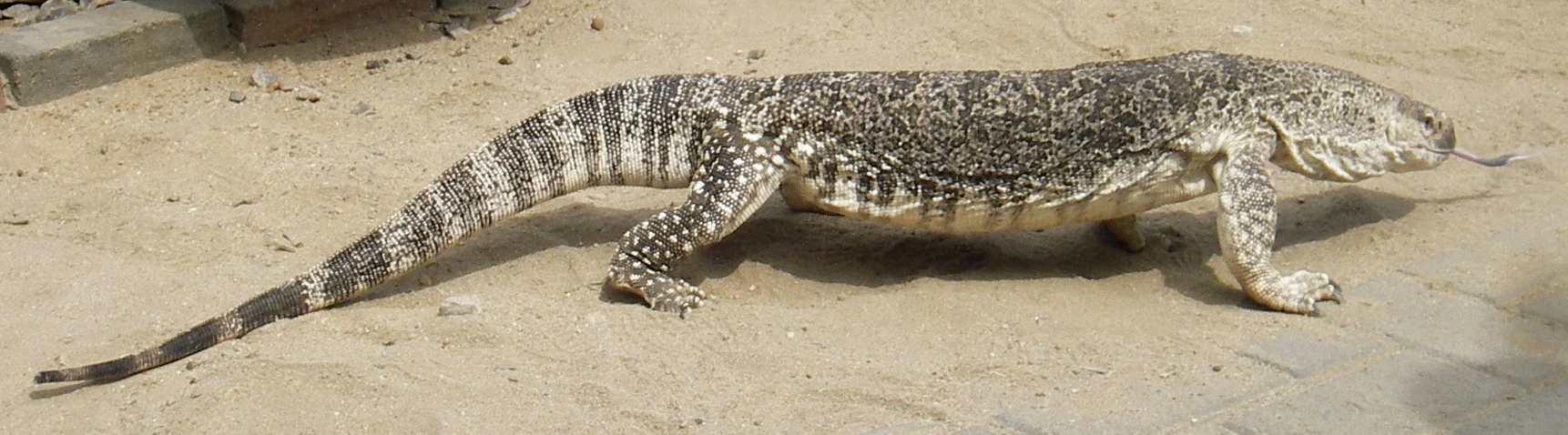
The back ranges from gray-brown to ochre, with pale ocelli and darker bands. Coarse rounded scales break up the outline in sun and dry soil, while the belly is paler. Juveniles show stronger contrast that may fade with growth. Lighting, shed stage, and soil color make color alone unreliable for judging health or origin.
The head appears short and blunt beside many large monitors, and the rear teeth are comparatively rounded for crushing hard prey. Cranial-biomechanics research shows how monitors transmit jaw forces differently with prey size and type. The savannah monitor’s face is not that of a slow herbivore but a predatory tool for beetles and snail shells.
A long forked tongue transfers chemical particles to the vomeronasal organ. Repeated tongue flicks after prey appears compare scent information in air and soil. Controlled observations found a marked increase from baseline after prey stimulation. This is not a hunter guided by vision alone; it constantly updates a chemical map.
The legs look short but the claws and forelimbs are powerful diggers. The tail balances the body in a run and can whip defensively. A threatened animal inflates, broadens the throat, and hisses loudly. It can bite or lash, although retreating into a burrow or crevice is usually safer in the wild.
A Broad West African Belt, but Not Just Any Desert


The range extends broadly from Senegal and The Gambia through Ghana, Togo, Benin, and Nigeria into parts of Central Africa. Current records point to grassland, open woodland, farm edges, and coastal plains south of the Sahel. National borders are not ecological borders; rainfall, soil, and structures suitable for burrowing matter more than a country list.
The species is often sold as “arid,” yet it is not an animal of only extreme desert. It uses wet-season productivity and deep dry-season shelter. A sunlit surface and a humid burrow can differ sharply within a few meters. One annual humidity number cannot reproduce that wild landscape.
A Ghana coastal-plain study of juvenile density showed that animals are not evenly spread even within one region. Prey concentrations, diggable soil, and escape cover create small core patches. “Savannah” is not an empty lawn but a three-dimensional mosaic of trees, termite structures, rock, and burrows.
Introduced records exist in Florida, but an observation outside the native range should not automatically be called a large established population. Nor does surviving one or two winters make release harmless. Abandoning a captive monitor threatens both the animal and native ecosystems.
Feasting with Rain and Sheltering through Drought


The year divides into a prey-rich wet season and a dry season of reduced activity. Rain brings crickets, grasshoppers, beetle larvae, and snails, allowing juveniles to grow rapidly. As drought deepens, monitors spend longer in shelter and use stored fat. This “feast and fast” pattern means a major seasonal shift in activity and energy balance, not constant starvation.
A wild monitor does not walk on a scorching surface all day. It warms in the morning and searches, then retreats to a burrow, root system, or crevice when the surface overheats. It may reappear as conditions ease. Diurnal does not mean equally active through every daylight hour.
Movement and burrow use change with growth. Juveniles gain and lose heat quickly and are exposed to smaller predators. Adults can travel farther but need longer to warm a larger body. At the same air temperature, wind, cloud, and prey odor can change behavior.
Male encounters can include raised postures, pushing, and ritualized grappling. Not every meeting becomes a severe fight; size and experience may cause one animal to withdraw. These observations also explain why cohabitation is dangerous in an enclosure without ample space and escape routes.
The Surprisingly Small Prey of a Large Lizard

.jpg)
Wild diet centers on invertebrates rather than vertebrate flesh. Data from Ghana and Senegal show juveniles taking many burrowing crickets and other insects, while larger animals use snails, millipedes, beetles, and scorpions. Small frogs, eggs, and carrion occur, but calling this species a monitor that eats anything erases its ecology.
Rounded posterior teeth and a short head reveal adaptation to hard prey such as snail shells. Juveniles have sharper teeth suited to holding small insects, while rear teeth become blunter with growth. As body size changes, tools and menu change together within one species.
Chin-rubbing before eating millipedes has also been reported. It may reduce defensive secretions or help process the prey, but it should not be assumed for every monitor or millipede. A rare behavior is fascinating, yet repeated observation and chemical study are needed before its function is settled.
Moving a wet-season feeding record into unlimited captive feeding creates obesity. Wild abundance is followed by travel, digging, drought, and scarcity. Frequent fatty rodents in a small enclosure are not the same ecological diet, and a heavy animal can easily be mistaken for a healthy adult.
Eggs Entrusted to Soil and the Clock of the Rains


Breeding timing is linked to local rainfall and prey. Females lay in deep burrows or stable soil, and captive records report clutches of several dozen. A maximum clutch should not be presented as a target. Female age and condition, mating time, nest conditions, and survival all create wide variation.
A 2007 Biawak breeding account stressed that genuine captive breeding remained surprisingly uncommon despite enormous trade volume. Many cheap juveniles in commerce do not prove that sustainable breeding is easy. Nest depth, moisture, temperature, and female condition all have to align.
Incubation records cluster around five months, but temperature and moisture alter development. One figure is not a universal natural constant. Eggs lose water if too dry and lose gas exchange if flooded. A wild nest buffers the sharp changes at the surface.
Hatchlings soon pursue small arthropods, but predation risk is high. Snakes, birds, mammals, and larger reptiles can all be threats. Many eggs do not mean many adults. The crucial life-history question is how many young survive to the first dry season.
What Relatives and Taxonomic Change Reveal


Varanus albigularis was once treated as part of V. exanthematicus, so old books mix size, range, and diet. It is now treated separately; white-throated monitors occupy southern and eastern Africa and can grow much larger. Many claims of savannah monitors exceeding two meters begin with this naming confusion.
The Nile monitor, Varanus niloticus, is more elongate and strongly tied to water, with different swimming and vertebrate-predation habits. Being African monitors does not make their enclosure or diet interchangeable. Evolutionary kinship is not ecological identity.
The Polydaedalus group records the diversification of African monitors and the history of drying landscapes. Morphology, distribution, and DNA can reveal independent lineages inside what was once a broadly defined species. Current taxonomy should lead, while old synonyms remain necessary for connecting historic literature to modern data.
Museum specimens and CT datasets reveal skull and tooth structures hidden beneath the skin. The Digimorph specimen is one example of a digital record used in research and education. Behavior from living animals and anatomy from preserved specimens are complementary tools answering different questions.
Predator, Prey, and Its Uneasy Distance from People
Savannah monitors consume insects and mollusks and are eaten by raptors, snakes, and carnivorous mammals. Digging and enlarging shelters may turn soil and leave openings for smaller animals. Their role is better understood through food webs and soil disturbance than through a slogan about controlling pests.
People have used the species for meat, skins, and the pet trade. Species+ records international trade and national export quotas, and CITES documentation applies to international movement of monitor lizards. A legal label does not prove absence of collection pressure. Traceability requires connected origin, export, and hatching records.
An IUCN global category of Least Concern does not make every local population secure. Agricultural change, pesticides, collection, and altered rainfall can affect prey and burrows together. A broad range can provide resilience while hiding decline in heavily traded localities.
The closest human contact often begins with an impulse purchase. A small inexpensive juvenile may look manageable, but an adult needs room-scale housing, intense heat and UV-B, large quantities of invertebrates, and years of care. Responsible choice asks first about origin and lifetime resources, not whether the animal can be tamed.
Research Rewrites the Myth of an Indiscriminate Eater
Older general husbandry books recommended rodents, chicks, and meat broadly for savannah monitors. Field diet studies instead show a narrower and more interesting picture dominated by arthropods and snails. Historical advice is not worthless, but uncertain locality and species identification prevent direct transfer into current care.
A digestion study measured oxygen consumption and acid–base status for days after a meal of about 10% of body mass at 35°C. It demonstrates that a large meal is a costly metabolic event, not that every routine meal should equal 10% of body mass. Experimental conditions and feeding prescriptions must be kept separate.
Important field gaps remain. Seasonal adult movement, geographic diet variation, reproductive success, and trade effects are not known with equal precision. Marking uncertainty instead of filling it with a story is an essential function of a natural-history wiki.
The species’ true surprise is not sheer size but a life synchronized with seasons. Rain brings intense searching for small prey; hard dry ground shifts the animal toward burrows and stored fat. A short head, blunt teeth, chemical senses, and powerful forelimbs all fit that rhythm. The annual cycle explains it better than one photograph of a threat display.
Continue to the Care Guide
Practical management must combine generous floor area, a whole-body basking surface, deep stable substrate, strong UV-B, and an invertebrate-centered diet. Detailed ranges and checks are in the Savannah Monitor Care Guide.
Defense, Senses, and Movement as a Process
A threatened savannah monitor looks formidable when it expands the throat and hisses, but the purpose is often to keep an opponent from approaching rather than to start a fight. It can turn sideways, appear larger, and lash while moving toward a burrow. Distinguishing warning from attack also explains why cornering a wild animal for a dramatic photograph is inappropriate.
Some accounts describe a cornered animal becoming limp in apparent death-feigning. How often this occurs in the wild and which predators it deters have not been quantified well. Rather than making one rare response the species’ defining habit, it is more accurate to place it among a sequence of options including hissing, escape, burrow use, and inflation.
Vision and chemical sensing are especially important in hunting, but the senses do not work separately. The monitor sees a moving insect, narrows the trail with its forked tongue, scrapes soil with the forefeet, and seizes with the jaws. When prey is hidden, odor, vibration, and memory of previously searched patches may work together.
Its walk looks deliberate, yet it can accelerate rapidly over a short distance. A robust body and low center of gravity provide stability on open ground, while the long tail balances sharp turns. It is less specialized for prolonged travel on thin branches than arboreal monitors. Juveniles may use low trees and structures more often to avoid predators, creating age-related differences in space use.
A burrow is more than a bedroom. It buffers dangerous surface heat, conserves moisture through drought, and shelters the animal from predators and fire. Monitors may use mammal burrows or termite structures as well as dig their own. Reading only surface climate without burrow temperature and moisture makes the species’ real environment appear too uniformly hot and dry.
Climate change is not merely an increase in average temperature. A shift in the first rains can desynchronize insects, snail activity, soil hardness, and nest moisture. Flash rain can flood burrows while prolonged drought delays prey even under the same annual rainfall total. Conservation therefore requires long-term records of monthly and seasonal rhythms.
Field photographs and community-science observations can fill gaps across a wide range, but records lose value without a correct name, place, date, and behavioral context. Uploading a captive photograph as wild or misidentifying a white-throated monitor can corrupt maps. Observers should document the whole body, head, pattern, and habitat while limiting precise coordinates where collection risk is high.
A single photograph is also insufficient for judging whether a wild monitor is thin or obese. Feeding and fat storage rise in the wet season, while activity and condition shift through drought. Researchers need season, sex, snout–vent length, mass, and capture time together. That prevents captive body standards from being forced out of one wild image and allows populations with different growth and energy strategies to be compared. Long-term mark–recapture and noninvasive imaging can show how the same individual changes across rain and drought.
In field work, not seeing an animal does not prove absence. Detection changes when dry-season burrow use rises or wet-season access becomes difficult. Repeated routes and times, burrow signs, tracks, and cameras are needed to separate population change from behavioral change. Trade pressure likewise cannot be inferred by simply opposing market numbers to animals remaining in the wild; collection locality, age, mortality, and export documentation must be connected.
References
- The Reptile Database — Varanus exanthematicus
- Animal Diversity Web — Savannah Monitor
- Digital Morphology — CT specimen
- Coiro 2007, Captive Breeding of Varanus exanthematicus
- Cranial biomechanics of monitor lizards (2015)
- Hartzler et al. 2006, digestion physiology
- Species+ — Varanus exanthematicus
- IUCN Red List — Varanus exanthematicus
Suggest an edit
Tell us which sentence may be incorrect and provide a verifiable source. Submissions are reviewed before publication.