Last updated 2026.10.09 · Edited by silveston · Compiled by an independent hobbyist without professional credentials
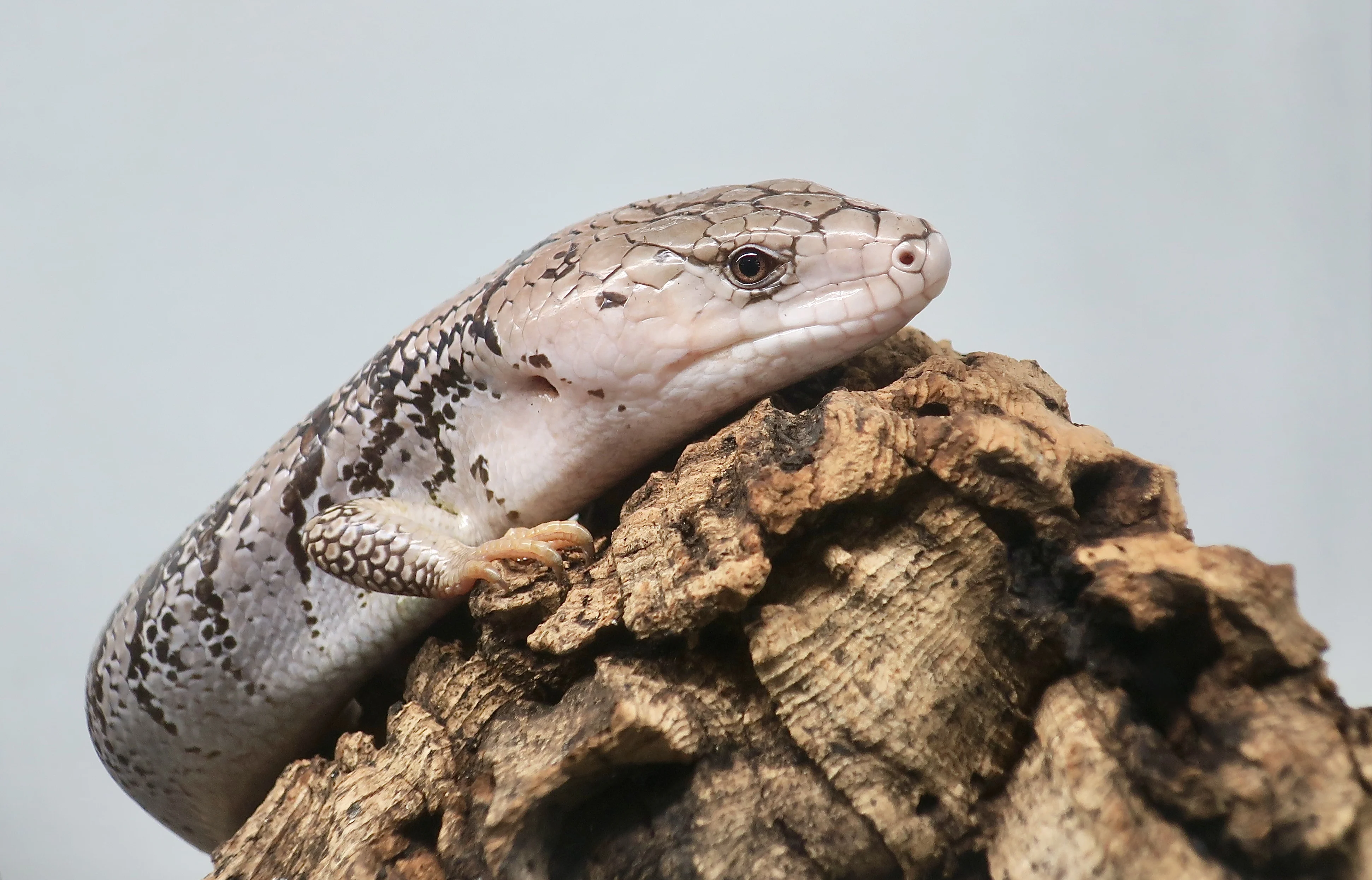
The Pink-tongued Skink (Cyclodomorphus gerrardii) may sound like a color form of a blue-tongued skink, but it is a distinct valid species from humid forests and forest margins of eastern Australia, specialized for finding snails and slugs. Its long body and slender tail carry it across low branches and fallen timber, while enlarged rounded rear teeth process hard prey. More remarkable than tongue color alone is the way a blue juvenile tongue, a pink adult tongue, a mollusk-rich diet, and a partly arboreal lifestyle come together in one species.
Korean trade listings mix forms such as “Pink-tongued Skink,” “Pink Tongue,” and spelling variants. A morph name or product label should not be treated as a species identification; the scientific name, parental records, and lawful captive-breeding origin should be checked together. This article does not use sales descriptions as ecological evidence. It relies on The Reptile Database, IUCN material, Australian state records, and original research to summarize current taxonomy and natural history.
Classification and key facts at a glance
| Classification | Reptilia · Squamata · Scincidae · genus Cyclodomorphus |
| Scientific name | Cyclodomorphus gerrardii (Gray, 1845) |
| English names | Pink-tongued Skink · Pink-tongued Lizard |
| Range | Queensland and New South Wales in eastern Australia |
| Size | Adults generally about 35–45 cm total length; some sources mention up to about 55 cm |
| Activity | Mostly crepuscular and nocturnal, with daytime activity in cooler conditions |
| Living space | Leaf litter, fallen timber, low branches, and vines in moist forest, wet sclerophyll forest, and forest edge |
| Diet | A mollusk specialist centered on snails and slugs, with other invertebrates also taken |
| Reproduction | Viviparous; gives birth to live young rather than laying external eggs |
| Conservation | IUCN Least Concern; regional habitat change still requires monitoring |

Name and taxonomy: one species moved among several genera
John Edward Gray described the species in 1845 as Hinulia gerrardii. It later moved among Hemisphaeriodon, Tiliqua, and Cyclodomorphus. This is why a record using Hemisphaeriodon gerrardii or Tiliqua gerrardii is not automatically about a different species. The Reptile Database currently accepts Cyclodomorphus gerrardii as the valid name and recognizes no subspecies.
The epithet gerrardii honors Edward Gerrard, who worked at the British Museum. Historical synonyms include Hinulia picta and Tiliqua longicauda. Searching these names alongside the current one helps recover older specimen and husbandry records, but new writing should standardize on the currently accepted scientific name to reduce confusion.
A large 2024 phylogenetic study of Tiliquini found that the traditional genus Cyclodomorphus may not be monophyletic and placed the group containing C. gerrardii closer to Tiliqua. The result suggests that generic boundaries may be reconsidered, but a scientific name does not change automatically when one phylogeny is published. The most accurate approach is to use the currently accepted database name while noting the phylogenetic uncertainty.
Blue tongue when young, pink tongue as an adult
Adults have dark crossbands over a gray-brown ground color, a relatively narrow head, and a longer, more flexible body and tail than blue-tongued skinks. The tongue ranges from pale pink to deep rose. Juveniles, however, can show a vivid blue or violet-blue mouth and tongue that changes toward pink with growth. A blue juvenile tongue is therefore not evidence of a different species despite the common name “Pink-tongued.”
Juvenile crossbands are usually sharper than those of adults, breaking up the outline among leaf litter and narrow shadows. Contrast often softens and the head and jaws become more robust with age, yet variation among sexes, individuals, and lighting conditions is substantial. Sex cannot be confirmed from band darkness or head width alone, and color in sales photographs is strongly affected by lighting and white balance.

Size and body design: between ground and branches
Adults are commonly reported at about 35–45 cm total length, although larger maxima appear in some sources. The species is a medium-sized skink by length, but its long tail makes its body mass and apparent bulk lower than those of a blue-tongued skink of the same total length. Comparisons must distinguish snout-vent length from total length, and a regenerated or shortened tail can distort total-length records.
The legs are short, but the body bends readily and the toes and claws grip bark, cork, and vines. The tail is not as specialized as a chameleon’s fully prehensile tail, yet it is commonly described as semi-prehensile and assists balance and support during partly arboreal movement. Treating the animal as a heavy, ground-only lizard overlooks the height and pathways it actually uses.
Range: a long, narrow band in eastern Australia
The natural range follows Australia’s eastern seaboard from humid northern Queensland into eastern New South Wales. State observation datasets include records from areas such as Innisfail, Kuranda, Eungella, Conondale, and Tamborine. These points do not imply continuous high density; the range is better understood as a mosaic of forest patches and riparian areas with suitable humidity, shelter, and mollusk prey.
A Least Concern assessment at national or state scale does not mean that every local population is equally secure. Urban expansion, roads, drying forest edges, pesticides, and molluscicides can reduce prey and microhabitat within an apparently broad range. The species is also seen in gardens and suburban woodland, but occurrence near people is not proof that habitat change is harmless.

Habitat: a three-dimensional link between litter and low branches
Pink-tongued Skinks are known from rainforest, wet sclerophyll forest, riparian woodland, and dense forest edge. Leaf litter and decaying logs provide daytime refuges and snail-hunting sites, while low branches, vines, and shrubs serve as travel routes and resting places. “Semi-arboreal” does not mean living permanently in the canopy; it means repeatedly linking the ground with low elevated structure as one living space.
The key feature of this habitat is not one average humidity number but variation among small spaces. After rain, the layer beneath leaf litter remains moist while a log surface dries, and a sunlit edge differs in temperature from its shaded interior. The skink moves among these microclimates to regulate body temperature and water loss. Describing the forest only as “high humidity” misses the importance of dry options and air exchange.
Activity: neither exclusively nocturnal nor exclusively diurnal
In warm seasons, foraging for snails and slugs is especially conspicuous around dusk and at night, while exposure by day is also observed in cool weather or overcast conditions. An ectotherm’s schedule depends more on surface temperature, humidity, prey activity, and predation risk than on a fixed clock. Calling the species diurnal from one daylight sighting, or permanently nocturnal because many records occur at night, loses this conditional nature.
After leaving cover, an animal makes brief tongue flicks to collect chemical cues and moves slowly along the contours of the ground and branches. When threatened, it may freeze or slide beneath cover rather than sprint immediately. Bending the body and bracing with the tail on low branches shows the advantage of its elongated, flexible form.

A mouth reshaped for eating snails
Land snails and slugs are the signature prey. After seizing one with the front of the mouth, the skink shifts it toward enlarged rounded posterior teeth. The action is often summarized as “crushing the shell,” but it is not merely a pair of hammers meeting vertically. The position of upper and lower teeth and a shearing component help separate and process shell and soft tissue.
One especially large hammer-shaped rear tooth is striking enough to have been compared with the unusual dentition of fossil marsupial relatives. A 2011 study described remarkable convergence between the Australian Cenozoic fossil Malleodectes and living snail-eating skinks. Distant lineages reached similar forms while processing similar hard prey, a vivid example of evolutionary convergence.
Specialization does not mean that nothing except snails is ever eaten. Slugs, earthworms, and other invertebrates may be taken opportunistically in the wild. Even so, applying a generic omnivorous-skink diet and ignoring mollusks would miss the ecological center around which this species’ teeth, behavior, and nutritional strategy evolved.

Defense: camouflage and cover before the tongue
The bright pink tongue attracts human attention, but the first line of defense in the wild is not a display. Crossband camouflage, immobility, and retreat beneath cover come first. If seized or cornered, the skink may gape, expose the tongue, bite, or shed the tail to escape. Because these responses carry energy costs and injury risk, they should never be provoked for entertainment.
A regenerated tail can differ from the original in color, scale pattern, and flexibility. A shorter or blunter tail in a field record or sales image is not evidence of a separate morph. Conversely, comparing “normal size” without accounting for tail loss and regeneration is also inaccurate.
Reproduction and life history: live young rather than eggs
Pink-tongued Skinks are viviparous. Embryos develop inside the female, and she gives birth to live young instead of burying external eggs. Reports range from several offspring to double-digit litters, with differences associated with maternal size, age, condition, and local circumstances. A single maximum should not be repeated as the species’ ordinary value without its range and context.
Newborns move independently and seek small mollusks and soft invertebrates. The blue tongue and strong crossbands change with growth, and the size of snail that can be handled increases with body size. No prolonged parental feeding is known, so live birth should not be confused with mammal-like postnatal care.
Seasonal reproduction links temperature, day length, prey availability, and maternal energy stores. Attempting to imitate wild seasonality in captivity with a single abrupt cooling event can be risky. Natural-history records explain the biological background, but individual health assessment and a breeding plan require separate review with an experienced breeder and a veterinarian familiar with reptiles.
Features revealed by comparison with close relatives
The Eastern Blue-tongued Skink (Tiliqua scincoides) has a much broader head and trunk, a proportionally shorter tail, and a wide blue tongue used in threat display. The Pink-tongued Skink is more elongated, uses branches actively, and has a pink adult tongue. Both are tiliquin skinks, but differences in body design, dietary specialization, and space use make “a small blue-tongue” a misleading simplification.
Other Cyclodomorphus species can show even more extreme limb reduction and elongation, and they occupy drier or otherwise different microhabitats. Color and total length alone are insufficient for identification within the genus. Current taxonomy, locality-vouchered specimens, scale arrangement, skeletal traits, and genetic evidence must be considered together; a trade label such as “pink-tongue type” is not a taxonomic diagnosis.
People, trade, and conservation
IUCN and Queensland sources treat the species as Least Concern, but that category does not mean zero risk. Export and possession of native Australian reptiles are governed by law and permits, and captive animals abroad should be traceable to lawfully established breeding lines. The fact that an animal is offered for sale in Korea does not automatically guarantee origin, import compliance, or health.
Molluscicides and pesticides used in gardens can reduce prey or create exposure through contaminated food. Removing all cover and decaying wood from forest edges also removes the snails, earthworms, and other prey that support the food web. Conservation therefore concerns more than whether one animal is collected; it includes humid microhabitat, invertebrate diversity, and connected woodland routes.

Why husbandry needs a separate guide
Moving between humid litter and drying surfaces in the wild does not mean that a captive enclosure should hold one high humidity number at all times. Eating snails does not mean offering wild-caught snails without screening. Temperature depends on measurement location, UVB on measured exposure, humidity on ventilation and drying cycles, and diet on source and nutrient composition.
Practical management standards, stage-specific space, sensor placement, snail-based feeding, and warning signs are covered in the Pink-tongued Skink Care Guide. Natural history is not converted directly into a prescription; each husbandry value is paired with conditions and observation criteria.
References
- The Reptile Database. Cyclodomorphus gerrardii. Current taxonomy, synonyms, distribution, and viviparity.
- IUCN SSC Snake and Lizard Red List Authority. 2020 Report. Lists Cyclodomorphus gerrardii as Least Concern.
- Queensland Government WildNet. Taxon details: Cyclodomorphus gerrardii.
- Brennan, I. G. et al. 2024. Evolutionary bursts drive morphological novelty in the world’s largest skinks. Current Biology 34:3905–3916.e5. DOI: 10.1016/j.cub.2024.07.039.
- Arena, D. A. et al. 2011. Hammer-toothed ‘marsupial skinks’ from the Australian Cenozoic. Proceedings of the Royal Society B. Full text.
- Cogger, H. G. 2014. Reptiles and Amphibians of Australia, 7th ed. CSIRO Publishing.
Suggest an edit
Tell us which sentence may be incorrect and provide a verifiable source. Submissions are reviewed before publication.