Last updated 2026.09.29 · Edited by silveston · Compiled by an independent hobbyist without professional credentials
Explore the wild life, taxonomy, and conservation of Abronia graminea in Mexico’s montane forests.
A green armored lizard of the canopy


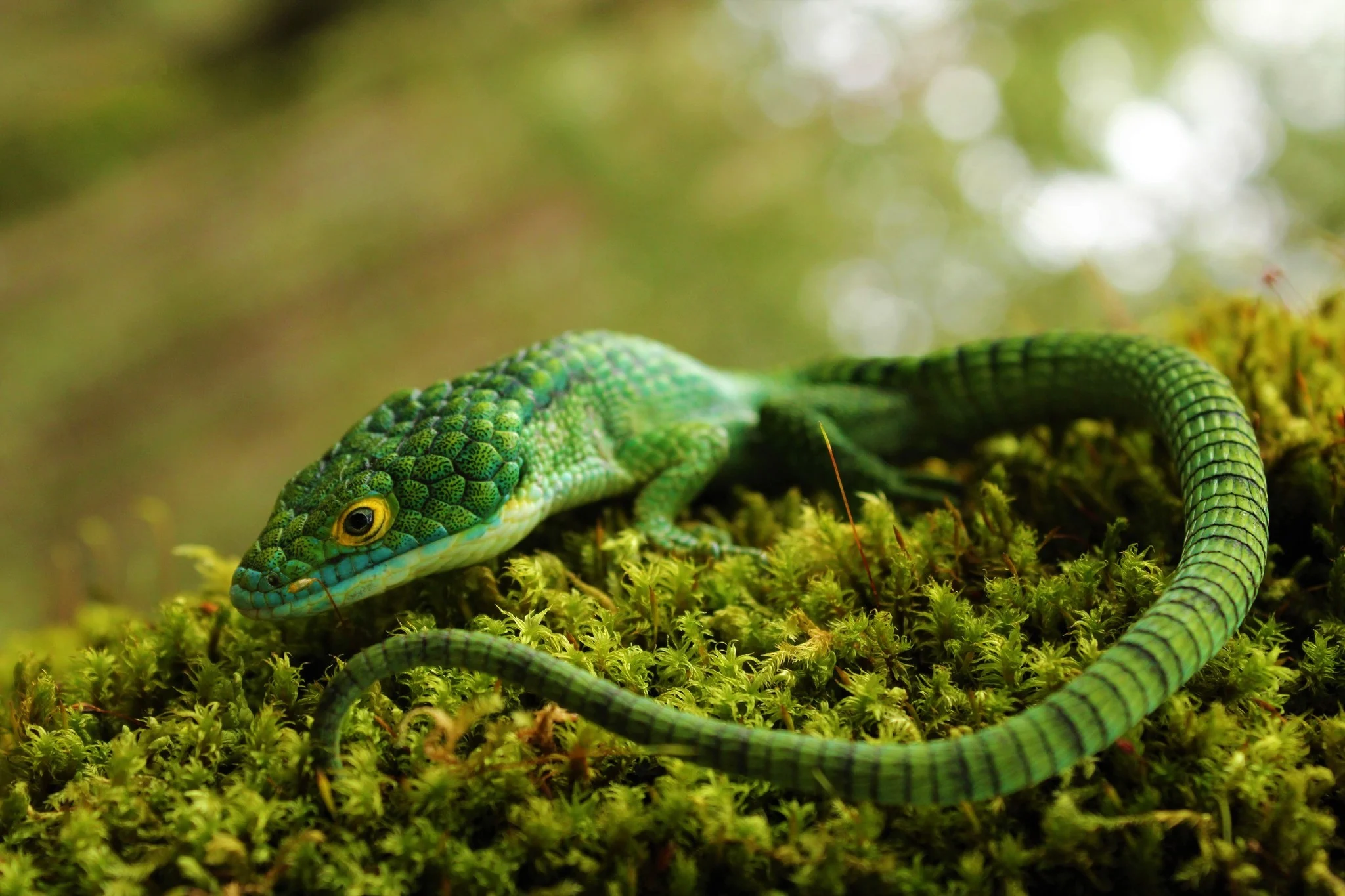
In the misty mountain forests of Mexico, a lizard the color of leaves may be found pressed against rough bark. It is Abronia graminea, the Mexican alligator lizard. Despite its name, it is not closely related to crocodilians: it is an anguid lizard within Squamata. Large overlapping side scales and an angular head merely give it an armored, crocodile-like appearance.
Adults are commonly described as 20–30 cm in total length, including the tail, but values vary among individuals and sources. A claimed record specimen should not be taken as the typical size. The body is fairly compact, the limbs are strong, and the long tail helps with balance among branches. Photographs show bright green, blue-green, olive, and patterned individuals, including females. Color alone does not reliably establish sex or origin.
Current taxonomy recognizes this animal as a separate species of Abronia. Cope described it as Gerrhonotus gramineus in 1864, and the subspecies combination Abronia taeniata graminea was once used. This explains why older papers and trade documents can carry different names. Marketplace labels such as “calico” or “select color” are sales terms, not separate scientific taxa. Provenance and current taxonomy matter more than a listing photograph.
Its green color may invite comparison with day geckos, but a gecko running on adhesive toe pads has a different ancestry and moves differently. Gripping feet on bark, a curved balancing tail, and layered side scales together make this animal recognizable. An English common name such as “terrestrial arboreal alligator lizard” sounds awkward, but the variety of common names shows why a local market name is not a global standard. The scientific name is the most stable key for linking records in different languages.
A three-dimensional home in cloud forest


The recognized range centers on montane central Veracruz, eastern Puebla, and Oaxaca in Mexico. A broad green belt on a map does not imply continuous occupancy of the lowlands; suitable climate and forest structure occur in patches. Field researchers emphasize how difficult these secretive, arboreal lizards are to find. Sparse dots on a map therefore do not prove absence between them. The map below is a schematic based on an earlier assessment, not a directory of collecting sites.
Moss, epiphytes, and dense leaves cover the trees. Intersecting branches and crevices give the lizards routes for concealment and movement. Bark pockets and plant-created spaces can have different humidity and temperature from open air. “Cloud forest” does not mean every surface is perpetually soaked. Wind-exposed branches, wet leaves, and shaded gaps sit close together, letting a lizard change conditions over a short distance. The same three-dimensional structure explains why both ventilation and cover matter in captivity.
Evidence must be kept species-specific. Reports of several A. taeniata sheltering together in tree hollows or rock crevices in winter do not establish that A. graminea does the same. Nor does a little forest change prove that every animal disappears immediately. A 2018 study documented congeners in disturbed patches of trees but cautioned that persistence there does not demonstrate a self-sustaining breeding population.
The same elevation does not make every tree equivalent habitat. Strong sun at an edge, shade inside forest, and wind on a ridge create different conditions for a small ectotherm. Locality names in Veracruz and Puebla are places where specimens or observations were documented, not a single averaged climate for the species. In captivity, the useful lesson is to provide multiple microclimates rather than copy one city’s daily maximum.
Scales and movement beyond the green color


Green is not the only useful feature. Small scales cover the back, while larger angular scales repeat along the sides, maintaining an armored outline as the body bends. From above, the flattened head and broad temporal region stand out; from the side, the tail follows the body in a smooth curve. It is easier to understand this animal as a careful explorer moving between branches than as a high-speed canopy runner. One photographic pose should not be generalized into a rule for the whole species.
Green and blue do not divide neatly into a single “normal” and a single “variant.” Age, sex, locality, lighting, and photographic processing can all alter appearance. A documented female, for example, shows orange tones and cross-bands. A 2016 natural-history note treated color variation as a research subject, and a 2018 study found blurred morphological boundaries between close relatives in their overlap zone. Selectively photographed trade animals do not represent every wild form.
Claims that every animal performs a particular dramatic threat display deserve caution. Abronia may look robust, but it is not immune to falls or tail injury. Disappearing among branches and leaves may be a more practical defense. Bright green can stand out to people yet break up the outline against mossy bark and mixed sunlit and shaded foliage. When motionless against a branch, the lizard can be difficult to detect.
Researchers traditionally used transverse dorsal scale counts, neck-scale arrangements, and adult bands to separate two species. In the 2018 overlap-zone samples, those characters overlapped enough that even the authors treated some identifications as tentative. Counting a few scales in a photograph, or noticing a blue cast, cannot conclusively exclude A. taeniata. Visual appeal and taxonomic certainty are different things; locality and lineage records help.
A small hunter among leaves


The Mexican alligator lizard is treated as a predator of insects and other small invertebrates. Positions near leaves and bark give access to moving prey, a different ecological role from reptiles that swallow very large meals. Epiphytes such as bromeliads can provide both cover and encounters with small arthropods. Evidence is insufficient, however, to name a single dominant prey species or give exact percentages for the wild diet. A list of captive feeders must not be presented as stomach-content data.
Space matters more than a single speed figure when imagining its hunting. A bare branch and a tree threaded with leaves, gaps, and moss channel prey in different ways. A lizard can move between sun and cover and make a short approach when it detects food. Statements that it “always hunts in the morning” erase seasonal and weather variation in the mountains. Observations of congeners and captive animals offer clues, but detailed time budgets measured in wild A. graminea remain scarce.
Like many small predators, Abronia occupies both sides of a food web: it takes arthropods and may itself be taken by larger predators. Species-specific field estimates of predation are limited, so understanding the value of height, cover, and movement is more useful than a long unverified predator list. Branches and visual barriers in an enclosure therefore provide meaningful choices rather than decoration alone. Practical details appear in the separate care guide.
Limited data on wild hunting frequency and success leave worthwhile questions. Do seasonal changes in forest insects alter the height or time at which Abronia searches branches? Does prey differ between epiphyte-rich and simple trees? Behavioral observation and permitted fieldwork can address such questions without indiscriminate collection. A captive animal’s preferred feeder cannot establish the diet of the wild species.
A life history without laid eggs


A striking feature of this species is that it does not lay eggs outside the body; the female gives birth to developed young. The Reptile Database labels this ovoviviparity, and captive observations describe variation among live-born neonates. More important than the terminology is that searching for ground nests is the wrong way to study this lizard. A gravid female needs choices of temperature and shelter, but a single gestation length or litter size should not be asserted for every individual.
Newborns must negotiate small branches and hiding places from the start. Their size and prey capacity differ from adults, so fine-scale space matters during growth. There is no basis to claim parental care or communal rearing without direct evidence. Shared shelter observed in a related species is not evidence of cooperative parenting. In a secretive animal, the distinction between observed facts and open questions is more valuable than a dramatic but unsupported story.
Neonatal color variation has also attracted study. Individuals of one species do not necessarily begin life with identical color and pattern, and a captive-breeding paper recorded such differences. This does not turn a market “morph” name into a new species. Birth records, parental provenance, morphology, and genetics are needed to understand wild and captive lineages. Breeding animals of unknown origin may erase information useful to both conservation and taxonomy.
Live-bearing invites hypotheses about cool, variable montane climates, but climate alone does not prove why this trait evolved in this species. Maternal opportunities to regulate temperature are one possible explanation. Compared with an egg-laying species, carrying developing young may also alter movement and risk. Long-term tracking of wild females is limited, however, so gestational travel distances and birth sites should not be asserted as known.
Close relatives and the conservation question


A surprising result of a 2018 study was that A. graminea and the more prominently banded A. taeniata overlap across a broad region, contrary to an earlier view that they lived apart. Combining field surveys with museum specimens, the authors found that color and scale counts did not separate every animal cleanly in the overlap zone. Older literature had treated graminea as a subspecies of taeniata, but the authors advised against hastily merging names before stronger genetic evidence. Current taxonomy still treats them separately.
This uncertainty makes the animal more interesting, not less. It challenges the habit of assigning species names confidently from a single picture. Arboreal lizards are hard to find, while old museum specimens preserve records from scattered mountains. One new survey can fill a gap in a map and reopen questions about species boundaries. The study deliberately withheld precise coordinates to reduce illegal collecting, while encouraging permitted researchers to preserve vouchers or DNA samples responsibly.
The IUCN assesses this species as Endangered, and changes to montane forest and concern about illegal trade are central conservation issues. The genus Abronia is regulated under CITES Appendix II; that neither makes every transaction illegal nor guarantees that any listing is lawful. Provenance and documents must be checked. A domestic listing is no justification for wild collection. Beyond the green of one animal, conservation depends on the trees, climate, and persistent populations that produce it. The care guide starts with lawful provenance.
A threat category does not mean that every living individual has been counted. The 2007 IUCN assessment reflected the range and habitat concerns known then; later field records and overlap studies made the map more complex. New records do not automatically erase risk. Read an older assessment alongside newer research, keeping their dates and evidentiary scope distinct. For a prospective keeper, the immediate choice is to verify lawful, documented origin and avoid an impulsive purchase.
References
- The Reptile Database — taxonomy, synonyms, range, reproduction
- Clause et al. 2018 — overlap and ecology of two species
- IUCN Red List — conservation assessment
- CITES Checklist — regulation of Abronia
- Clause et al. 2016 — captive reproduction and neonatal variation (Herpetological Review 47:231–234)
- Wikimedia Commons — original photographs and licenses
Suggest an edit
Tell us which sentence may be incorrect and provide a verifiable source. Submissions are reviewed before publication.