Last updated 2026.09.27 · Edited by silveston · Compiled by an independent hobbyist without professional credentials
A large herbivorous lizard that basks in riverside trees and leaps into the water when threatened. Explore the green iguana’s body, behavior, reproduction, and relationship with people through current taxonomy and research.
| Scientific name | Green Iguana |
|---|---|
| Classification | Squamata · Iguanidae |
| Range | Southern Mexico through Central America to tropical South America |
| Activity | Diurnal · arboreal · capable swimmer |
| Diet | Primarily leaves, with flowers and fruit |
| Size | Usually 1.2~1.7 m overall; large males can approach 2 m |
| Conservation and trade | IUCN Least Concern; check CITES and local law |
The green iguana in numbers
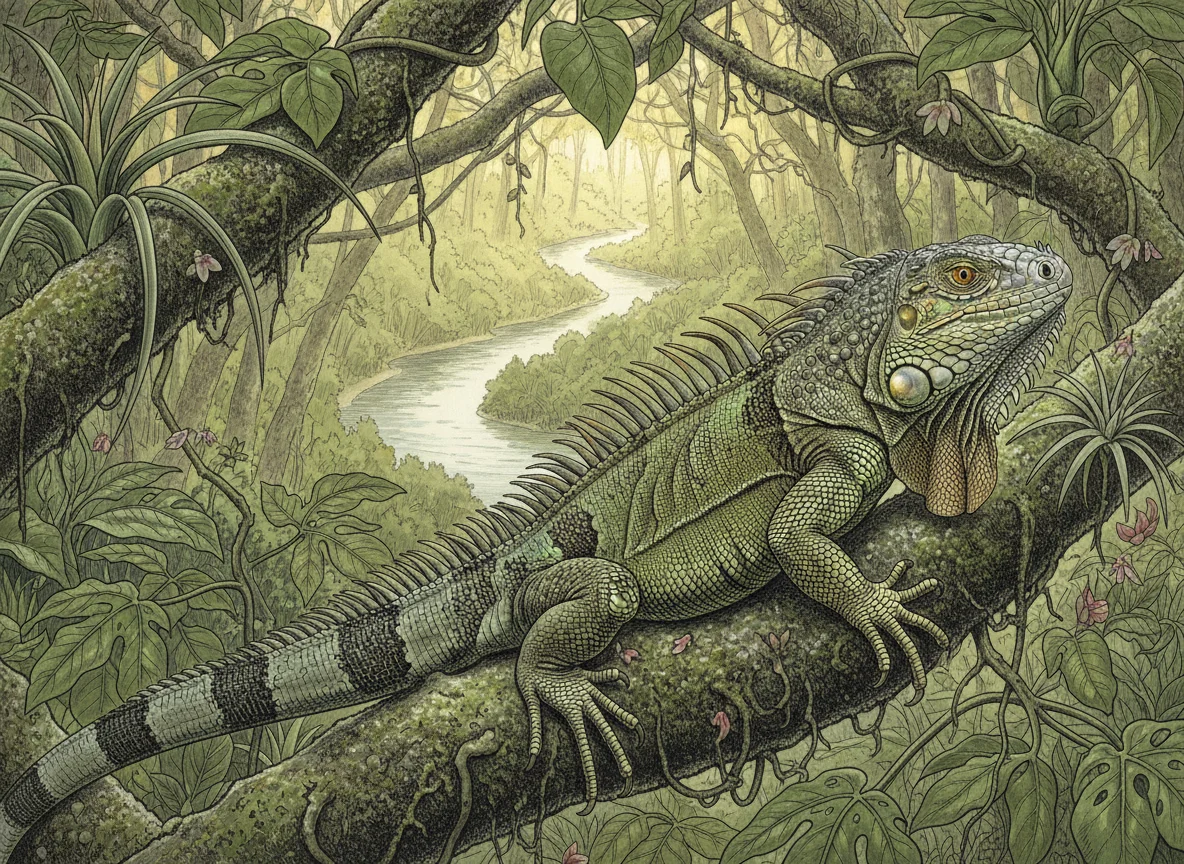
The green iguana is a large tree-dwelling lizard whose tail is much longer than its trunk. Adult males are usually larger than females, with thicker heads and necks, more prominent dorsal spines, and a conspicuous dewlap below the throat. Total length commonly falls around 1.2~1.7 m, though a large male may approach 2 m. More than half that measurement can be the whip-like tail, so its build differs greatly from that of a heavy ground lizard of the same length.

It is active by day, basks in trees, and eats leaves, flowers, and fruit. In danger it may leap from a high branch into water and swim away. It is a familiar wild animal within much of its range, yet in several places beyond that range introduced populations affect crops, embankments, and urban infrastructure. It is at once a familiar pet species and a complicated subject of conservation and management.
Classification and names: not every ‘iguana’ is the same species
Its scientific name is Green Iguana, in the order Squamata and family Iguanidae. Green Iguana and Common Green Iguana are widespread English names. Despite the name, adults are not invariably bright green. Some are gray-brown, blue-green, or orange, and breeding males may show especially warm colors. Color alone is therefore a poor identification tool.
In everyday speech, ‘iguana’ is applied broadly to several large lizards, but the rock iguanas Cyclura, marine iguana Amblyrhynchus, and spiny-tailed iguanas Ctenosaura belong to distinct evolutionary lineages. The green iguana combines a long tail, a large round scale beneath the ear opening, a hanging dewlap, and a row of spines down the back. Classification continues to change. Black Caribbean populations once proposed as the separate species Iguana melanoderma are included as I. iguana melanoderma in The Reptile Database’s 2026 treatment. The nasal projections called I. i. rhinolopha in older sources also are generally not accepted as a distinct subspecies now. A regional label or color is not enough to declare a separate species: check the publication date and current phylogenetic evidence.
A huge tail and a surprisingly light build
At a distance it looks bulky, but its body is long and relatively flattened for life among trees. Strong toes and sharp claws grip rough bark. The long tail serves as counterweight, propeller, and finally a defensive whip. Growth rate and final size vary considerably with sex, food, and climate; a single age-to-length table cannot describe every wild population.
As males age, the head becomes wider and taller, and jaw muscles and fatty swellings stand out. Females also have dorsal spines and dewlaps but are smaller on average. Juveniles are often slender and vividly green, helping conceal them from predators among leaves. When discussing record lengths, distinguish total length from snout-to-vent length. A lost or regenerated tail can make total length underestimate an animal’s biological size.
Where rivers and forests meet
Its native range extends broadly from southern Mexico through Central America into the tropical north and center of South America. It makes particularly good use of riverside forest, mangroves, floodplains, and forest edges, where trees and water are close together. It does not require uniformly wet rainforest: it also lives in seasonal forest with distinct wet and dry periods, and has adopted tree lines on farmland and the canopy of urban parks.

Such a broad range cannot be reduced to one ‘average habitat.’ Rainfall, food plants, predators, and breeding seasons vary across regions, and behavior varies with them. In strong midday heat, iguanas use shade and breezy passages; on cool mornings they emerge onto sunlit branches. Water beneath the trees is more than scenery: feeding sites, thermoregulation, and a route away from predators overlap in this essential habitat structure.
A day guided by the sun
A green iguana’s day follows external heat. It warms on an exposed morning branch, then feeds and moves more as its body reaches a suitable temperature. If it becomes too hot, it shifts into leaf shade or around the far side of a thick trunk to reduce radiant heat. Sun, shade, wind, and humidity form a mosaic even within one tree, and short movements let the lizard fine-tune its condition.
Thermoregulation is more subtle than simply ‘liking the sun.’ Digestion, muscle performance, immune responses, and breeding behavior all depend on temperature. A wild animal can choose heating or cooling when needed, but restricted choices can mean overheating or prolonged chilling. A long spell of apparent stillness on a branch may be energy and temperature management rather than laziness.
The canopy escape artist that leaps into water
On sensing danger, an iguana may flatten its body or hide on the far side of a branch, then flee rapidly if the threat closes in. Above water, it can also drop and dive beneath the surface. It drives itself with side-to-side strokes of its powerful tail while holding the legs close to the body. This escape route through trees and water forces a land predator to change its pursuit.
Dropping from a tree is a survival tactic supported by a relatively light build, broad body, and flexible joints, not reckless acrobatics. Juveniles may move to the tips of narrow branches that cannot support a heavier predator. If caught, an iguana lashes its tail and uses claws and teeth. It can shed part of the tail, but a regenerated tail does not restore the original bone and scale structure, and this costly option is a last resort.
An herbivore’s jaws and microbial factory
Adults mainly eat leaves, adding flowers and ripe fruit with the seasons. Sharp, leaf-shaped teeth slice plant tissue, while microbial fermentation in the gut extracts energy from fiber. This works better at a warm body temperature, so basking and digestion are linked. A variety of food plants contributes micronutrients and influences the gut fermentation environment.

Juveniles are occasionally observed consuming insects or other animal matter, but that does not make a high-protein animal diet normal for adults. Accidentally swallowing a small invertebrate with leaves in the wild is very different from repeatedly feeding animal protein in captivity. Skull, teeth, gut length, and behavior together show a lizard strongly adapted to plant food.
The dewlap is a flag; a head bob is a sentence
The large throat dewlap has a supporting role in heat exchange, but stands out especially as a social signal. A male spreads it, turns sideways to appear bigger, and bobs his head in a rhythm. Depending on the other animal’s sex, distance, and context, that display can convey courtship, warning, or territorial assertion. Bobs that look similar to us may differ in speed, number, and body angle, changing their meaning.
Females and juveniles also communicate visually, and lowering the body or moving away is an important reply. Signals exchanged before contact can prevent unnecessary fighting. Breeding adult males can nevertheless defend areas vigorously; in confined space a subordinate animal cannot escape and conflict escalates. Wild social behavior should not be simplified into a picture of animals happily living in a group.
Reproduction: a generation begins underground
Breeding timing is tied to local wet and dry seasons and food production. After mating, the female seeks sunny, well-drained ground and digs a burrow. Strong forelimbs and claws may produce passages that appear to branch, and several females may nest near one another where suitable sites are scarce. Choosing a nest means finding a microclimate that neither floods the eggs nor dries or overheats them.
Clutch size varies greatly with female size and locality, and can reach dozens of eggs. After laying, the female closes the entrance, but prolonged nest defense of the sort seen in crocodilians and some lizards is not typical. Hatchlings break out of the soil themselves and head quickly toward vegetation. Field research at communal nest sites in Panama found that young from different clutches nevertheless travel in groups and engage in complex social interactions. A group appearing together cannot simply be dismissed as coincidence or identified as a single family.
A hatchling’s world is greener and more dangerous
Hatchlings are far smaller than adults and often bright green. Narrow branches and dense leaves make it hard for large predators to approach, while their color softens their outline among foliage. Young animals have been observed moving near one another, though space use and competition change as they grow. Egg predation, attacks by birds, snakes, and mammals, and fluctuations such as drought and flood all strongly affect survival.
Growing is more than gaining length. The kinds of leaves used as food, the branch thickness available for thermoregulation, and strategies for avoiding predators all change. Male heads, dewlaps, and dorsal spines become more prominent after sexual maturity, as do behavioral differences. Wild lifespan is hard to establish because long-term individual tracking is difficult. In captivity, some live more than 15 years with suitable care: a cute hatchling is not a short-term commitment.
Predators and defense: disappear first, fight last
Eggs and hatchlings face snakes, raptors, herons, small and medium mammals, and other opportunistic predators. Size itself helps defend adults, though large snakes, birds of prey, crocodilians, feral dogs, and human capture remain threats. The least costly defense is not fighting but detecting danger early, hiding behind a tree, or escaping into water.
At close range an iguana may inflate itself, spread its dewlap, and open its mouth in warning. Its tail strikes rapidly, and even climbing claws can scratch skin deeply. A bite can leave a serious wound because of strong jaws and serrated teeth. These weapons are last defenses when an escape route is gone, not proof of constant aggression. Giving a wild animal room is best for the observer and the animal alike.
Alongside people: food, pets, and urban wildlife
Green iguanas have long been part of foodways and culture in various communities and more recently became known worldwide through the international pet trade. An inexpensive small juvenile, however, does not translate into an easy adult to keep responsibly. Large space, intense lighting and heat, and a carefully managed diet over many years are needed. Abandonment and release have seeded breeding populations where climates permit.

In towns, park trees and canals supply canopy and water, while ornamental plants provide food. Feeding by people can reduce wariness and bring animals closer to roads and buildings. Burrows may weaken embankments and paths, and droppings create sanitation conflicts. Indiscriminate persecution creates ethical and ecological problems as well. Responsible pet ownership, prevention of releases, and science-based population management must work together.
When an invader is removed, how quickly do numbers return?
A 2025 review documented green iguana establishment across several tropical and subtropical regions outside the native range, with very high densities in some places. They have been recorded in Florida since the 1960s; warm winters, waterways, and urban vegetation favor expansion. High reproductive capacity, a broad plant diet, and movement through trees, over land, and in water make a powerful combination in a new environment.

Even after many animals are removed quickly, observed numbers can recover as individuals move from neighboring areas or the next breeding generation grows. One successful capture campaign cannot establish long-term success. Compare treated and untreated areas, account for season and detection probability, and address nesting sites and human feeding at the same time. Invasion research asks not only ‘how many were caught?’ but ‘how much did population growth and reinvasion change?’
The management lesson: removal fails without ecology
Basking times, seasonal reproduction, and riverside routes are relatively predictable, allowing targeted green iguana management. Random removal that ignores these traits costs more and may disturb other animals. Managers need to identify points that most affect population growth, such as adult females before breeding, repeatedly used nest sites, and key connected stretches of canal.

Goals must also vary by place. A small island where eradication is feasible and a huge city where damage reduction is the objective cannot use the same plan. Reduce feeding and pet releases, measure damage, and sustain humane, lawful measures. Ecological knowledge is more than a tool for removing animals: it is a standard for avoiding unnecessary suffering and expense.
Conservation status and international trade
The species as a whole has been assessed as Least Concern by IUCN, but this does not mean every local population is secure. Habitat conversion, excessive collection, road deaths, and local genetic isolation can create pressures in parts of its range. Beyond the native range, the same species may be targeted for removal. It shows how conservation value and management direction depend on location and ecological context.
International trade requires checking CITES provisions and each country’s wildlife and invasive-species laws. Even captive-bred animals may face different paperwork, import permits, and local keeping restrictions. Reducing wild capture and illegal trade matters for native populations and animal welfare. A prospective keeper should choose a traceable animal and plan for its entire life, never release it into the wild.
What comparison with relatives reveals
Cyclura rock iguanas, including rhinoceros iguanas, have robust bodies and short, powerful heads suited to dry, rocky island habitats. The marine iguana grazes sea algae, expels salt through nasal glands, and swims with a flattened tail. The green iguana is more strongly arboreal, with a long cylindrical tail and agile climbing ability.
Spiny-tailed iguanas have conspicuously projecting tail scales and use rock crevices or burrows more extensively. Similar faces and dorsal spines make a single photograph misleading, but tail and head scales, habitat, and behavior clarify the differences. Comparison is a way to see the environmental pressures to which each lineage adapted, not simply a memorization exercise.
Taxonomy is not a permanent name tag
Across a widespread species, rivers, mountains, and sea-level changes separate populations and accumulate genetic differences. Earlier studies proposed subspecies using appearance and geography alone; newer research retests the boundaries using DNA alongside specimen morphology. Some names may be reevaluated as independent species, while others fall within a broader range of variation.
If an old husbandry book or museum label differs from a current database, do not assume an error immediately: check when it was published and what evidence it used. This article follows the current species treatment of The Reptile Database for Green Iguana while acknowledging that regional lineage research continues. A scientific name is closer to a testable hypothesis than a final verdict.
Start with natural history before considering captivity
The life of a large herbivore that travels through the canopy and leaps into rivers cannot be compressed into a small glass tank. Strong vertical space, a broad thermal gradient, substantial UV-B, varied leafy greens, water, and ventilation must all be managed. Add an adult male’s territorial behavior, tail strikes, and long lifespan, and it is a demanding impulse choice for a beginner.
The green iguana care guide explains enclosure dimensions, measurement positions, lighting, diet, and health signs step by step. Natural history is not decorative background: it is the blueprint for what choices an animal must have in captivity.
Understanding this species requires more than one snapshot. Resting in a tree can make it look like a slow herbivore, but aquatic escape, territorial signals, and long canopy movements reveal a far richer life history. Recording changes across places, seasons, and ages helps us see more than merely a ‘large green lizard.’
References
- The Reptile Database: Iguana iguana
- IUCN SSC Iguana Specialist Group species account
- Frontiers 2025 review of invasive green iguanas
- MSD Veterinary Manual: reptile husbandry and UV-B
- Baines et al. 2016 UV-Tool / UV-B guidance
- Rodda 1992: The mating behavior of Iguana iguana
- Burghardt et al. 1977: Social behavior in hatchling green iguanas
- CITES Species+ taxon concept 10420
Suggest an edit
Tell us which sentence may be incorrect and provide a verifiable source. Submissions are reviewed before publication.