Last updated 2026.09.27 · Edited by silveston · Compiled by an independent hobbyist without professional credentials
A green iguana cannot spend its entire life in a hatchling terrarium. This guide walks through adult space, temperature and UV-B measurement, a leafy diet, and behavioral and health records needed for practical care.
First question: can you provide space for the adult?
Green iguanas are sold as small juveniles, but adults may reach around 1.5 m in total length, with a large safety radius around the tail and claws. Budget first for a commitment that may exceed 15 years, an enclosure approaching the size of a room, powerful electric lighting and heating, a steady supply of fresh greens, and access to a veterinarian experienced with reptiles. The price of a hatchling tank gives no indication of the cost of keeping pace with growth.
Depending on location, ownership, transport, breeding, or outdoor keeping may be restricted or require notification. Check the animal’s lawful origin and documents, rental rules, electrical capacity, and a plan for summer overheating. Everyone in the household should understand tail-strike and bite risks and hygiene rules. Taming does not remove this large wild animal’s physical abilities.
Enclosures by growth stage: plan backward from adult size
A young animal may begin in a vertical enclosure of about 90×60×120 cm, but this is temporary. Even with branches and shelves installed, there must be room to extend the full body and turn around. During growth, record snout-to-vent length, weight, and movement routes every few months to plan the next facility. Do not wait until one narrow enclosure dimension is shorter than the animal’s total length.

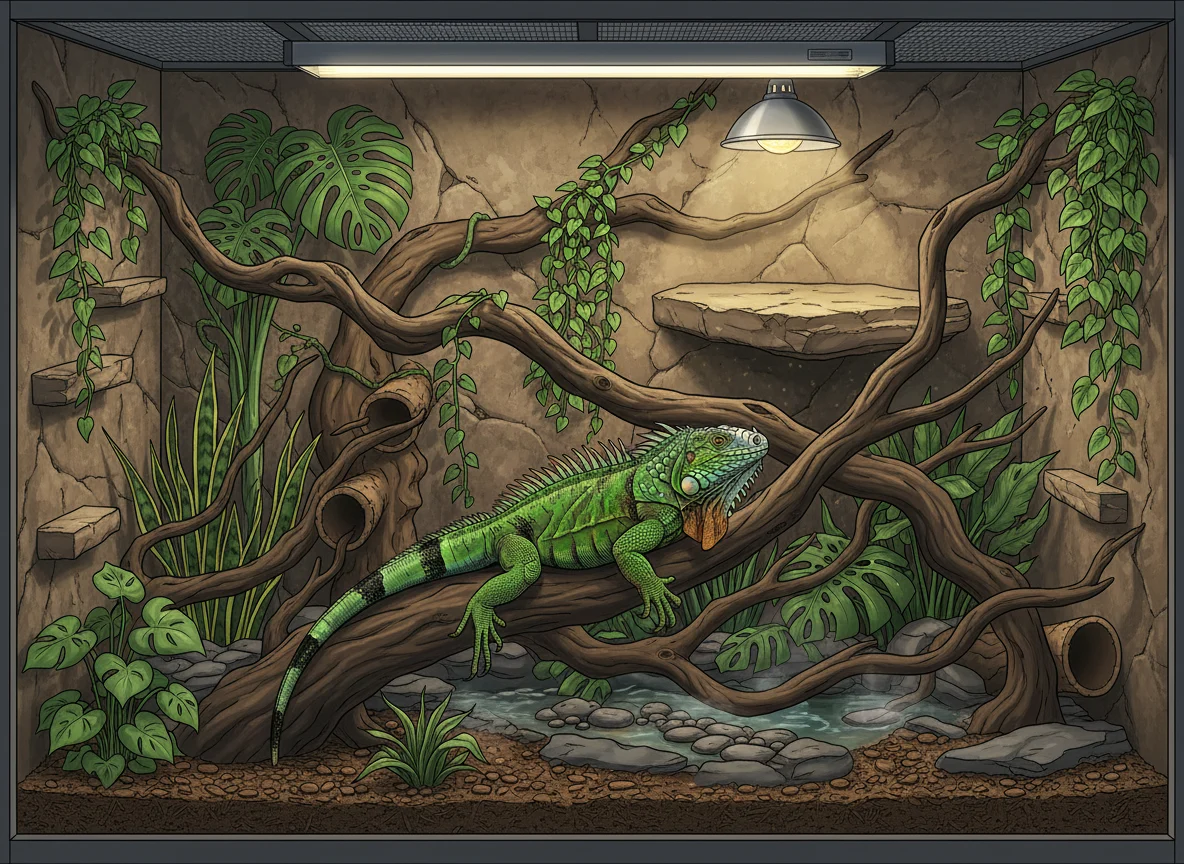
For one adult indoors, consider about 2.4×1.2×1.8 m a minimum starting point, and provide a larger dedicated room or custom vertical space if possible. The dimensions are a starting measure of usable movement space after branches, basking platforms, feeding stations, and water containers are installed, not a license to stop there. Doors and panels must not trap the tail or toes, and locks must withstand an adult pushing them.
Vertical structure and shelter: height feels safe
Secure natural-wood branches thicker than the trunk and broad shelves at several levels. Branches must remain grippy when wet, carry several times the adult’s weight, and have no exposed screw tips or wire edges. Leave clearance below basking sites to lessen a fall, and provide denser movement routes for juveniles.
A shelter is more than one dark box. Visual cover from leaves, the back of a thick trunk against which the animal can rest, and a perch above human eye level all offer choices. An enclosure in the center of a living room approached from every side can create chronic vigilance. Make at least one side opaque and provide an undisturbed high resting area farthest from the door.
Thermal gradients: measure air and surfaces separately
For an adult, start with a basking surface around 38~43°C and adjust to the individual’s response. Aim for about 29~32°C air on the warm side and 24~27°C on the cool side. Measure the surface directly under the lamp with an infrared thermometer and air at iguana body height with digital probes. One number near the ceiling can miss an overheated shelf or a cold floor.

Use thermostats and protective guards on heat sources so the animal cannot touch a bulb or ceramic heater. Let it heat part of its body or change height rather than warming the entire basking platform uniformly. Record basking surface, warm-side air, and cool-side air temperatures separately each day. As the room warms in summer, recheck lamp output and ventilation for that season.
Night conditions: darkness and a gentle temperature drop
Turn off visible light and UV-B at night and permit a gradual decline to about 21~25°C. A room within this range for a healthy adult does not need a colored bulb or red ‘night light.’ Continuous light disrupts daily rhythms and rest. Only if the room cools further should a lightless radiant panel or guarded ceramic heat source be connected to a thermostat.
Measure the night low on the high shelf where the animal actually sleeps, not just on the floor. Windows, exterior walls, and air-conditioning drafts can create local cold spots. A data logger’s daily minimum reveals brief temperature dips. Keep morning lights consistent with a timer while allowing some seasonal change, generally within an 11~13-hour photoperiod.
UV-B and visible light: what reaches the animal matters more than the bulb label
For a diurnal herbivorous lizard, UV-B is crucial to vitamin D3 production and calcium metabolism. Use a linear T5 HO UV-B fixture covering a substantial area of the adult enclosure, creating a choice of basking positions around UVI 3~4. A manufacturer’s distance chart is only a starting point: reflector, mesh, angle, and lamp aging alter exposure. Measure it, if possible, with a meter such as a Solarmeter 6.5.
Shade and a lower-UVI zone must sit beside the UV-B area. Constant confinement beneath intense ultraviolet light can burden eyes and skin. Bright visible lighting around 6500 K helps make the whole facility feel like daytime and supports activity and plant recognition. Record replacement dates and do not place the source behind glass or ordinary acrylic that blocks UV-B.
Humidity, ventilation, and water: damp surfaces are not humid air
Let daytime relative humidity fluctuate around 60~80%, rising after misting and falling again with ventilation. Permanently wet floors and stagnant air favor bacteria, mold, and skin problems. Provide high exhaust and low intake, supplemented by plants and a broad water vessel. Place hygrometers at resting height on both warm and cool sides, rather than directly in front of a spray nozzle.

Green iguanas also obtain moisture from leaves and other plant food, but provide clean water continuously. A heavy vessel in which an adult can immerse part of its body must not tip and should be washed daily. Many individuals defecate in water, so replace it immediately when soiled. Use drainage or replaceable absorbent material so spilled water cannot pool beneath heat sources.
Substrate and drainage: can it be kept clean without slipping or being eaten?
For juveniles and during quarantine, unscented paper, plain white paper, or washable mats make droppings easy to inspect. In a large adult enclosure, use replaceable absorbent material over a sealed floor or a well-drained mix of coir and soil. Assess every material for accidental ingestion with food, trapped claws, slipping, and mold.
Avoid materials readily swallowed or dusty, such as wood chips, corn cob, and cat litter. A planted bioactive facility is not automatically sanitary: check soil depth, drainage, and the safety of cleanup organisms against an adult’s weight, digging, and substantial waste. Place food dishes on shelves separated from substrate to reduce accidental ingestion.
Dark leafy greens belong at the center of the diet
Build daily meals from varied calcium-rich leafy greens. Rotate collard, mustard, turnip, and dandelion greens, chicory, and endive; supplement with vegetables such as squash, bell pepper, and green beans and safe edible flowers. Do not rely on one plant for long periods; finely mixing ingredients can reduce selective feeding. Because of its sugar content, limit fruit to a small supplement of about 10% or less of the whole diet.

Do not make high-oxalate leaves such as spinach and chard, or nutrient-poor lettuce, dietary staples. Do not routinely feed dog or cat food, eggs, meat, or insects as protein sources. Occasional consumption of animal matter in the wild does not justify a high-protein diet. Wash all produce to reduce pesticide residues and discard spoiled parts.
Calcium and supplements: assess them alongside UV-B
Select foods to keep the diet’s calcium-to-phosphorus ratio near 2:1 and apply a light dusting of phosphorus-free calcium powder. Growing animals and females around egg laying may have higher requirements, but extra powder must not mask problems with light or diet. The appropriate frequency depends on dietary analysis, measured UV-B, age, and health; adjust it with a reptile veterinarian.
When suitable UV-B is available, avoid excessive overlapping use of supplements containing D3. More multivitamin is not necessarily safer; fat-soluble vitamins can accumulate. Ingredient lists and feeding records matter more than brand names. Dust lightly and evenly so thick clumps do not deter feeding, and record the date, product, and amount.
Feeding by age and recording body condition
Offer growing animals fresh food daily and remove leftovers within a few hours. Adults also generally receive leafy greens daily, with quantity adjusted for build and activity. An empty bowl alone does not prove the amount is right: measure weight and snout-to-vent length under consistent conditions once a month. Photographs of the tail base, thigh muscles, and abdominal contour help show change.
A sudden loss of appetite may relate to temperature, UV-B, stress, egg laying, or illness. Do not dismiss weight loss, unusual abdominal swelling, and reduced defecation as simple pickiness. Conversely, too much sugary fruit or energy-rich food raises the risk of adult obesity and fatty liver. Even in a growing animal, rapid weight gain should not itself be the goal.
Shedding, claws, and tail care
Green iguanas shed in patches rather than peeling the whole body at once. With appropriate humidity, hydration, and rough branches, old skin usually comes away naturally. Check toes and tail tips each week for ring-like retained skin that could restrict blood flow. Do not pull it off; soften it with lukewarm water and a humid setting, and consult a veterinarian if it remains.
Claws are necessary for climbing, so do not cut them excessively short. Natural wood and varied surfaces help wear them down, but carpet or coarse mesh can catch them and injure toes. A tail tip turning black, cold, or hard can indicate injury or impaired circulation. If the tail breaks, have bleeding and infection risk evaluated; do not apply medication on your own to ‘promote regrowth.’
Behavioral enrichment and choice
Enrichment means creating reasons to move and explore, not filling the enclosure with toys. Vary feeding station heights, hang safe edible plants to browse, and offer branches with different diameters and angles. Introduce new objects one at a time and observe any wary response. Sunlight through a window provides visual stimulation but cannot substitute for UV-B, which glass blocks.
Brief target training can make movement and health checks less coercive. Following a specific target onto a shelf or into a carrier reduces the need to grab the animal each time. Reward with preferred leaves or flowers from the everyday diet rather than fruit. If training is refused, do not force it: check temperature, stress, and condition first.
Handling: trust comes from choice, not the number of times an animal is held
Allow a new arrival at least 1~2 weeks to adapt to its setting and feeding routine, limiting unnecessary contact. A hand descending quickly from above may resemble a predator; approach slowly from the side. Support the trunk, pelvis, and tail base together and avoid a position, such as a shoulder, from which retrieval is difficult. Adult males may become more reactive during the breeding season.

Before striking with the tail, an iguana may turn sideways, tense up, or spread its dewlap. Continuing to approach despite these signals increases the risk of bites and scratches. Supervise direct contact with children and other pets and do not bring the animal close to faces. Wash hands with soap afterward; do not handle reptiles in kitchens or at dining tables.
Keeping multiple iguanas together is not the default
Plan for one animal per enclosure. In a spacious wild habitat, individuals can control their distance; in a confined facility, they must share the same heat, food, and high perches. Adult males may fight severely, while a female may be worn down by repeated courtship and mating attempts from a male. Even without visible fighting, one animal may monopolize food and basking.
In a specialist facility where several must be managed, provide independent basking, feeding, and shelter sites that all can use simultaneously, plus spare space for immediate separation. Record weight, intake, and space use for each individual. Separate them promptly if you see facial wounds, tail bites, constant floor dwelling, or darkening color associated with stress.
Cleaning, quarantine, and weekly care
Remove waste and leftover food daily and wash the water vessel whenever soiled. Clean contaminated sections of shelves and branches weekly and periodically dismantle movable structures for a deeper clean. Follow each disinfectant’s dilution and contact time, then rinse thoroughly and dry. Do not improvise with phenolic household cleaners or strongly scented products.

Quarantine a new animal in a separate room for at least 60~90 days with dedicated tools. Care for established animals first and the quarantined animal afterward. Arrange a fecal examination and baseline veterinary visit early. Each week check weight trend, appetite, feces, shedding, toes, nostrils, eyes, mouth, lamp operation, and temperature and humidity records. Finding small changes before they accumulate reduces the burden of treating a large reptile.
Warning signs and veterinary care
Seek immediate advice for labored open-mouth breathing, nasal discharge or bubbles, swollen eyes, unusually soft jaws or limbs, tremors, repeated falls, sudden paralysis, serious bites or burns, or persistent bleeding. Arrange care within days for reduced appetite with weight loss, red or discharging mouth, diarrhea or reduced stool, swollen toes, retained skin, or a discolored tail tip.
A female can develop eggs without mating. Persistent digging, refusal of food, abdominal enlargement, and lethargy may signal an egg-laying problem; prepare a quiet nesting box and veterinary assessment. Do not diagnose from a photograph or administer antibiotics, calcium injections, or dewormers on your own. Temperature, UV-B, diet, and weight logs, plus a recent fecal sample, help the clinician evaluate causes.
Common beginner mistakes
Frequent errors include keeping an enclosure sized for a juvenile too long, placing just one thermometer, and assuming one coil UV-B bulb covers a large facility. Offering too much fruit, relying on salad lettuce, or feeding animal protein as a growth diet are other recurring mistakes. Blocking ventilation to raise humidity worsens respiratory and skin problems.
It is also risky to ignore warning displays in the belief that frequent handling will tame the animal, or to house two apparently calm iguanas together. Finish the facility before acquiring an animal and secure adult space and an electricity budget first. Numbers are starting points: record where the animal sleeps, which levels it avoids, and how feeding and defecation change, then adjust the environment.
Daily, weekly, and monthly checklist
Daily: check the basking surface and warm- and cool-side air temperatures, water and food, feces, eyes and breathing, and door locks. Weekly: review humidity logs, shedding and toes, body-condition photographs, branch fastenings, lighting timers, and cleaning. Records establish the normal range even when nothing seems wrong.
Monthly: review weight at the same time of day, measured UV-B or lamp hours, electrical equipment and thermostat tests, and dietary variety. At seasonal changes, remeasure heat-source output against room temperature and daylength. Have a carrier, spare heat source, outage plan, and contact details for a reptile veterinarian ready beforehand.
Connect care with natural history
Wild choices among trees, sun, and plants explain high shelves, measuring heat and UV-B together where the animal sits, and varied leafy food. Care standards are not simply numbers to memorize: they are a way to let the animal choose when to heat up, cool down, hide, feed, and move.
Read more about range, swimming and escape, social signals, reproduction, and invasive populations in the green iguana natural-history wiki. A keeper who knows that history is more likely to investigate limited environmental choices than to attribute abnormal behavior to personality.
Even measurements within a recommended range are inadequate if an individual cannot choose. Spending every day in the same high spot, avoiding the floor, or remaining open-mouthed under a heater may reveal a layout problem. Treat the enclosure as adjustable, using measured values and behavior logs to move branches, shade, heat, and food stations as needed.
A final assessment looks beyond matching temperature and humidity numbers. Does the animal move between basking and shade, eat and defecate consistently, and sleep comfortably on a high perch? Assume equipment will fail one day: keep spare lamps and probes, a carrier, and emergency contacts ready. Records and backup plans make long-term care of a large animal safer.
References
- The Reptile Database: Iguana iguana
- IUCN SSC Iguana Specialist Group species account
- Frontiers 2025 review of invasive green iguanas
- MSD Veterinary Manual: reptile husbandry and UV-B
- Baines et al. 2016 UV-Tool / UV-B guidance
- Rodda 1992: The mating behavior of Iguana iguana
- CITES Species+ taxon concept 10420
Suggest an edit
Tell us which sentence may be incorrect and provide a verifiable source. Submissions are reviewed before publication.