Last updated 2026.09.16 · Edited by silveston · Compiled by an independent hobbyist without professional credentials
Centrochelys sulcata is Africa’s largest tortoise, inhabiting the Sahel region south of the Sahara. In Korea, it is widely known as the ‘Sulcata Tortoise’—a name derived from its scientific specific epithet—while in English-speaking regions, it is called the African spurred tortoise or sulcata tortoise. Although they may appear slow and lumbering, their lives in the wild are defined by long burrows excavated with powerful forelimbs, activity cycles synchronized with the brief rainy season, and persistent foraging in search of scarce food. In an environment where the ground surface becomes scorching hot during the day, these tortoises utilize their burrows as miniature, climate-controlled underground chambers.
While Sulcata tortoises are commonly found in the pet trade, wild populations face simultaneous threats from habitat destruction and exploitation. The abundance of easily bred captive individuals is a completely different matter from the security of wild populations. Rather than focusing on husbandry, this article explores their physiology and behavior in the wild, as well as the unique nature of their ecology. Practical care methods are covered separately in the accompanying husbandry guide.
30-Second Summary
- The Sulcata is the largest extant land tortoise in Africa, with males capable of exceeding 100 kg in weight.
- They inhabit the dry savannas of the Sahel (south of the Sahara), areas surrounding seasonal watercourses, and the slopes of stabilized sand dunes.
- Burrows, which can reach lengths of up to approximately 15 meters, serve as vital refuges from heat and aridity and are sometimes shared by multiple individuals.
- Their diet consists primarily of grasses and herbaceous plants, though there are recorded instances of opportunistic feeding on carrion or food scraps near human settlements.
- Males are highly territorial, and larger individuals hold an advantage in competition for mating opportunities.
- While the official IUCN assessment remains “Vulnerable” (VU), the Tortoise and Freshwater Turtle Specialist Group (TFTSG) has issued a stricter provisional assessment of “Endangered” (EN).
| Scientific name | Centrochelys sulcata (Miller, 1779) |
|---|---|
| Classification | Order Testudines · Family Testudinidae |
| Common Name | African Spurred Tortoise, Sahel Tortoise |
| Distribution | Arid Sahelian zones extending from West Africa to East Africa and the southern Arabian Peninsula |
| Diet | Herbivorous (primarily grasses and herbaceous plants); rarely consumes animal matter opportunistically |
| Reproduction | Oviparous; capable of laying eggs 2–3 times per year, with clutch sizes of 14–40 eggs reported |
| Conservation | IUCN 1996 assessment: VU; TFTSG provisional assessment: EN; CITES listed Appendix II |
1. Name and Classification: From ‘Grooved Tortoise’ to a Distinct Genus

The currently accepted scientific name is Centrochelys sulcata. After Miller described it in 1779 as Testudo sulcata, the combination Geochelone sulcata was also widely used for a long time. Consequently, one still frequently encounters the name Geochelone in older papers, husbandry books, and zoo signage. The Reptile Database and the 2025 Turtle Checklist adopt Centrochelys and do not currently recognize any subspecies.
The specific epithet sulcata derives from the Latin word for a groove or furrow, sulcus. It is interpreted as referring to the deeply grooved shape of the carapace above the neck. The common name ‘spurred tortoise’ reflects the prominent keratinous projections around the hind legs. While easily confused with the similarly named ‘spur-thighed tortoise’ group, the Sulcata belongs to a distinct African lineage and grows to a much larger size.
The change in the genus name is not merely a simple renaming. As research on morphology and molecular phylogenetics has accumulated, the past classification system—which broadly grouped large tortoises into a single genus—has been subdivided. Centrochelys sulcata It is the type species of this genus. Although studies have examined mitochondrial variation between East and West African populations, current practical taxonomy does not recognize official subspecies. Therefore, there is insufficient evidence to designate populations from different regions as distinct subspecies or varieties.
Historical names for these tortoises serve as important clues when searching literature. Testudo sulcata, Geochelone sulcata Terms such as “African spurred tortoise” and “Sahel tortoise” should be searched alongside the scientific name to ensure that historical distribution records and captive breeding studies are not overlooked. Conversely, one should not determine an individual’s origin or genetic lineage based solely on commercial trade names. Most specimens in the trade today are the result of multi-generational captive breeding and may not reflect the geographic characteristics of wild populations.
2. Massive Body and Digging Tools: Morphology Adapted to the Sahel

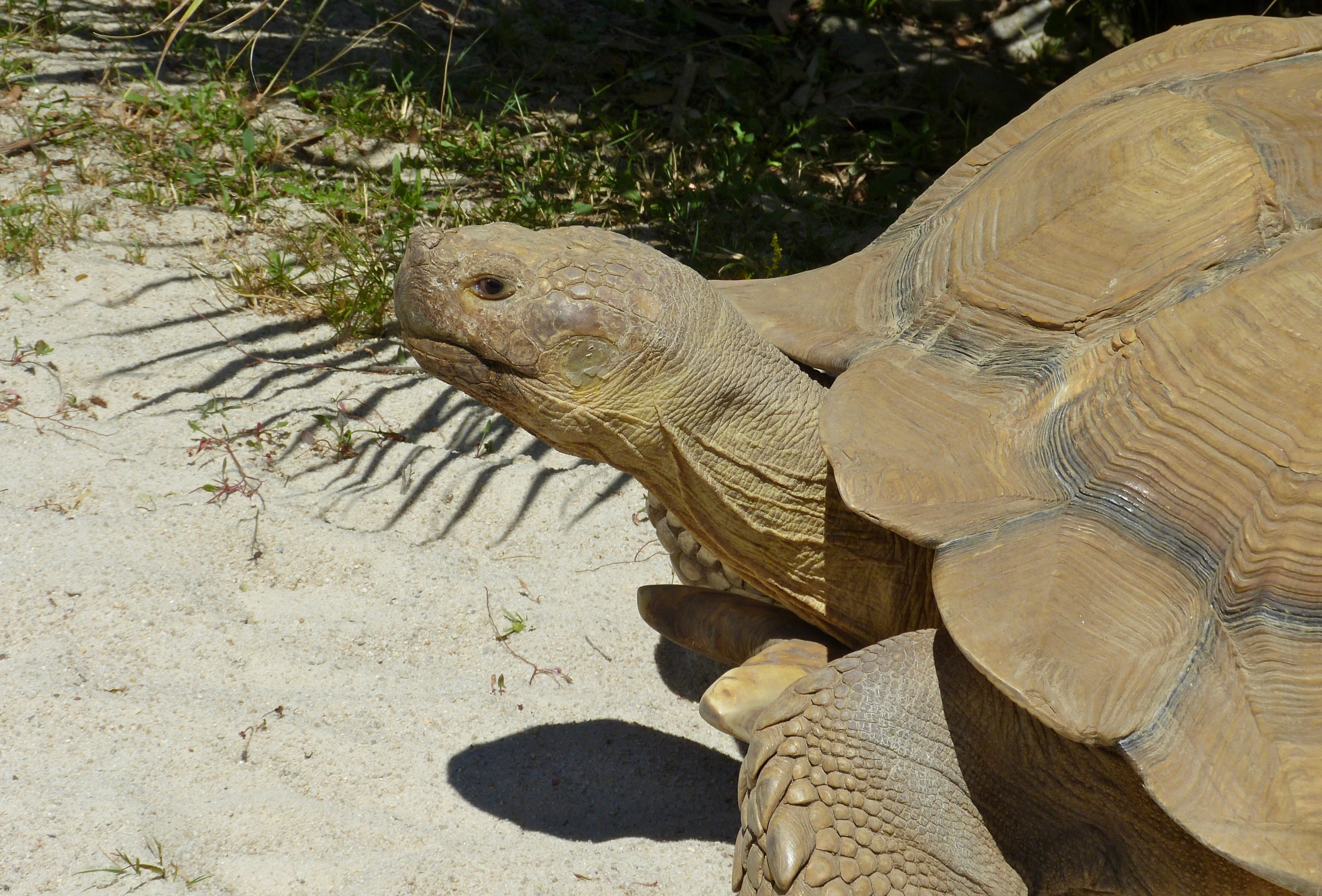
The Sulcata is the largest extant tortoise species in Africa and the largest mainland tortoise, excluding the giant tortoises found on islands. TFTSG species accounts note that large males can exceed 100 kg in weight and reach a straight carapace length of 86 cm. The maximum reported straight carapace length for females is 57.8 cm, making them smaller than males. As these maximum figures represent record-breaking extremes rather than typical averages, one should not assume that all adults reach this size.
The carapace ranges in color from yellowish-brown to sandy and resembles thick shields with distinct growth rings. While the coloration is not flashy, it effectively camouflages the animal against the dry soil and grasses of the Sahel. The carapace is living tissue composed of bone and keratinous scutes, making it susceptible to the effects of growth, nutrition, and hydration levels. The “pyramiding” often observed in captive specimens should not be mistaken for a normal characteristic of the species in the wild.
The forelimbs are thick and broad—resembling shovels—and are covered with large scales and strong claws. These limbs serve not merely as pillars to support the body but as tools for digging into hard soil. Conical projections on the hind limbs are the feature that gave rise to the common name “spur. Although the head is relatively small, it features a robust beak capable of severing plant stems; instead of teeth, the tortoise uses keratinous jaw edges to shear through grasses and leaves.
Adult males are larger than females and have longer tails; differences are also evident in the shape of the rear carapace and the anal scutes. However, it is difficult to accurately determine the sex of juveniles based solely on appearance. Body size and weight are also hard to predict based on age alone. Research indicates significant plasticity in growth rates depending on diet, temperature, and activity levels—whether in the wild or in captivity—so rapid growth should not be viewed as an inherent sign of good health.
3. Distribution and Habitat: Waterways of the Sahel, Not the Deep Desert

The distribution of the Sulcata tortoise stretches along the southern edge of the Sahara Desert, extending from Senegal and Mauritania in the west through Mali, Burkina Faso, Niger, Chad, and Sudan, reaching as far as Eritrea and Ethiopia. Saudi Arabia and Yemen, located at the southern tip of the Arabian Peninsula, are also included in the species’ range. However, while the distribution appears as a continuous band on a map, their actual habitat is fragmented; suitable soil, vegetation, and waterways exist only in scattered pockets, resulting in significant gaps between populations.
Although commonly called the ‘desert tortoise,’ it is not an animal that lives exclusively in the middle of a sea of sand. Studies have reported associations with areas near *kori* (periodic or intermittent watercourses in the Sahel), slopes of stable sand dunes, hills, and semi-deciduous shrublands interspersed with tall grasses. Key habitat features include locations where water and vegetation accumulate during rainfall, and where the soil is easy to dig yet structurally stable enough not to collapse. While they can be found in flat, open areas, not all arid terrains are of equal value.
Such microhabitat selection compensates for their large size and slow movement. Seasonal watercourses, even when appearing dry during the dry season, alter the surrounding soil structure and plant productivity. Sand dune slopes offer good drainage and provide the necessary depth for burrowing. Studies on their habitat have identified overgrazing by livestock and seasonal fires as factors that reduce the likelihood of their presence; when vegetation is removed and the soil becomes compacted, not only is their food supply lost, but so are burrow entrances and areas for concealment.
There are records of the species being introduced and establishing populations on certain Caribbean islands. These instances must be distinguished from their natural distribution in their native range. Releasing captive individuals into areas with similar climates is not a conservation measure; instead, it can lead to issues regarding invasive species and the spread of disease. Reintroduction projects must be professional programs that include verified sourcing, health screenings, genetic compatibility assessments, and post-release monitoring.
4. 15-Meter Burrows and Seasonal Clocks: Climate Refuges Underground

The most impressive behavior of the Sulcata tortoise is its burrowing. Reports on the species document deep, extensive burrows reaching up to 15 meters in length. Burrows are not merely makeshift holes barely large enough to fit a single body; they are underground refuges where temperature and humidity fluctuate less drastically than on the surface. They serve to shield the tortoises from midday heat and dehydration during the dry season, while also mitigating the effects of nighttime cooling and the risk of predation.
The air inside a burrow can maintain higher humidity levels than the air above ground. Consequently, describing the Sulcata tortoise’s habitat simply as “arid” overlooks a crucial aspect of their environment. While the surface may be dry, the microenvironment where the tortoises actually rest is far more stable. This fact has prompted a re-evaluation of the long-standing husbandry practice of keeping young tortoises on consistently dry substrates.
Burrows are sometimes shared by more than one individual. While this does not necessarily imply the existence of a stable social group, it demonstrates that a high-quality refuge—a scarce resource—can be vital for multiple tortoises. Large burrows churn the surrounding soil and create open spaces, potentially providing habitat for other small animals; however, further direct research into the specific species that utilize these burrows and the resulting ecological effects is needed before the Sulcata can be definitively classified as an “ecosystem engineer.”
Surface activity is concentrated in the early morning and during the rainy season. Studies in parts of West Africa have shown that activity peaks coincided with the rainy season in August, whereas observation rates were very low during the rest of the year. Rainfall triggers rapid plant growth, opening a window of opportunity to access food and water. Rather than moving according to a fixed schedule, these tortoises adjust the timing of their activity by integrating cues such as temperature, solar radiation, rainfall, and vegetation conditions.
5. A massive herbivore: a life of competition and reproduction

Sulcatas are primarily herbivores, feeding on grasses, leaves, flowers, and seasonally available herbaceous plants. Their large body size is advantageous for the prolonged digestion of fibrous, low-quality forage. Their foraging behavior—tearing at plants with their beaks while roaming across wide areas—leads them to utilize multiple locations rather than intensively depleting the vegetation in a single spot.
However, labeling them as “strict vegetarians” oversimplifies nature. Records cited by the TFTSG note rare instances of them scavenging carcasses or consuming refuse near human settlements. Such opportunistic feeding does not imply that animal protein is central to their nutritional needs; rather, it is best understood as the utilization of incidental resources in the arid environments where food is scarce.
Males exhibit strong territorial behavior, attempting to shove, ram, or flip over rival males. Studies suggest that larger males are more likely to succeed in sexual competition. Their massive carapaces serve both as shields against predators and as tools for physical combat with other members of their species. Contrary to their typically quiet demeanor, they may display aggressive movements and vocalizations during mating rituals.
It is generally understood that they take approximately 10 to 15 years to reach sexual maturity. Mating is primarily reported between September and the following April, and egg-laying between September and May, though these timings can vary based on local rainfall and temperature. Females have been recorded laying eggs two to three times a year, with clutch sizes ranging from 14 to 40 eggs. While the average egg size is reported as approximately 52 × 44 mm and the weight around 55 g, these figures vary depending on the specific wild population and the size of the female.
6. The Paradox of Survival and Conservation: Abundant in Captivity, Declining in the Wild

Although Sulcata tortoises are bred in large numbers worldwide as pets, their wild populations are in decline. This decline is driven by a combination of factors, including habitat conversion, overgrazing, fire, climate change, exploitation for meat and eggs, and the international pet trade. Species that naturally exist at low population densities and require a long time to reach sexual maturity struggle to recover quickly when adult individuals are continuously lost.
Conservation status classifications must be interpreted alongside their source and the time of assessment. The TFTSG’s 2020 species account lists the official IUCN Red List status as “Vulnerable” (VU)—based on a 1996 assessment—while noting the expert group’s 2013 provisional assessment of “Endangered” (EN). The presence of an outdated status on the official page does not imply that the situation in the wild has stabilized; one must consider the time lag in updating assessments and the lack of regional data.
International trade in these tortoises is managed under a framework where the entire group is listed in CITES Appendix II. While this permits trade in captive-bred individuals, it does not imply that taking them from the wild is harmless or requires no documentation. One must verify national import and husbandry regulations, the legal origin of the animal, and the seller’s breeding records.
On a positive note, captive breeding techniques are well-established, and reintroduction projects have begun in places like Senegal. However, simply releasing large numbers of captive-bred individuals into the wild does not constitute true restoration. Success requires a holistic approach that includes protecting natural habitats, ensuring appropriate genetic lineages, conducting disease screenings, engaging local communities, and monitoring post-release survival. Responsible management of pet tortoises—and efforts to curb impulse buying and abandonment—are also integral to wild conservation.
Size is not the only remarkable thing about the Sulcata tortoise. Their entire life history—enduring extreme seasonality through burrowing and behavioral adaptations, capitalizing on brief windows of productivity, and reproducing slowly over decades—is intricately linked to the Sahel environment. Understanding these massive, burrowing tortoises in the wild naturally reveals why one should not choose the species based solely on the cuteness of small hatchlings.
Frequently Asked Questions
Do Sulcata tortoises really live in the middle of the desert?
Although they inhabit the arid regions south of the Sahara, they utilize Sahelian microhabitats—characterized by seasonal watercourses, sand dune slopes, and areas with grass and shrubs—as well as deep burrows. The image of them living ‘always on hot, parched sand’ does not fully capture their actual living environment.
Do they consume a lot of fruit in the wild?
Their staple diet consists of fibrous grasses and herbaceous plants. While there are records of opportunistic feeding, this should not be interpreted as justification for frequently feeding them fruit or high-protein foods in captivity.
Why do older records list them as *Geochelone sulcata*?
In the past, they were included in the broad category of Geochelone Current major taxonomic references classify them as Centrochelys sulcata.
Related Articles
References
- Petrozzi, F. et al. 2020. Centrochelys sulcata (Miller 1779) – African Spurred Tortoise, Grooved Tortoise, Sahel Tortoise, Tortue Sillonnée. Chelonian Research Monographs 5(14):110.1–16. DOI: 10.3854/crm.5.110.sulcata.v1.2020.
- Uetz, P. et al. 2026. Centrochelys sulcata. The Reptile Database.
- Petrozzi, F. et al. 2017. Habitat Determinants of the Threatened Sahel Tortoise Centrochelys sulcata at Two Spatial Scales. Herpetological Conservation and Biology 12(2).
- Ritz, J. et al. 2010. Body size development of captive and free-ranging African spurred tortoises: high plasticity in reptilian growth rates. The Herpetological Journal 20:213–216.
Suggest an edit
Tell us which sentence may be incorrect and provide a verifiable source. Submissions are reviewed before publication.