Last updated 2026.10.04 · Edited by silveston · Compiled by an independent hobbyist without professional credentials
At first glance it is a spectacular pet gecko; on closer inspection it is a nocturnal predator shaped by the geology, forests and taxonomic history of Hainan.
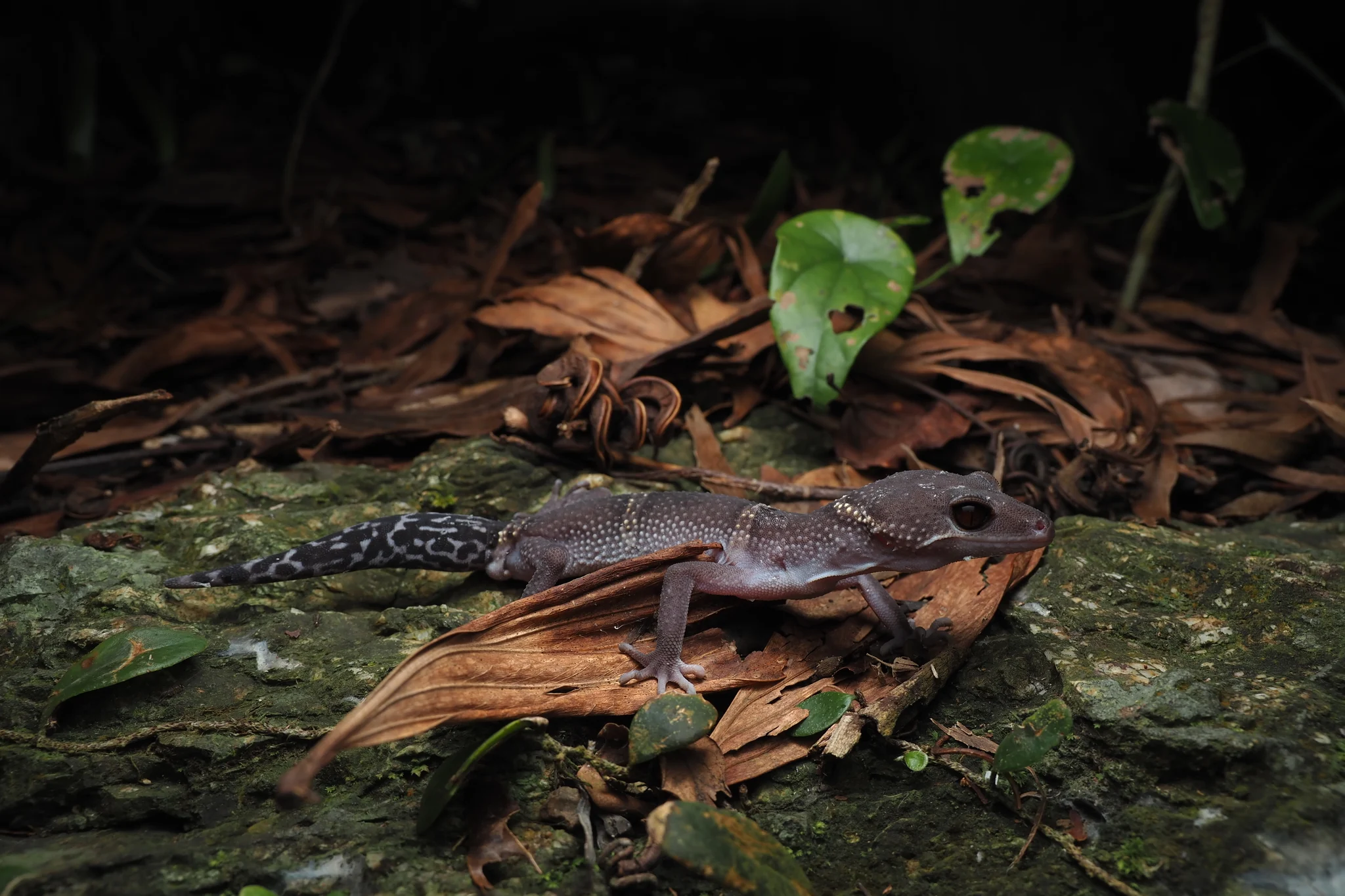
Two red eyes shine above a black forest floor, while yellow bands run across the body like broken moonlight. The Chinese cave gecko, also called the Hainan cave gecko, Goniurosaurus hainanensis, is an eyelid gecko adapted to the nights of China’s Hainan Island. “Cave gecko” should not be taken to mean an animal confined to deep caves. Its world is a three-dimensional mosaic of humid forest floor, rock fissures, leaf litter, low branches and dark retreats.
In the pet trade it is known for dramatic red eyes and high-contrast markings, but its natural history is even more remarkable: the geography of a small island and a century of taxonomic change overlap in this one animal. The genus and species were introduced together in 1908, after which the taxon moved between species, subspecies and synonymy. A 2025 integrative revision returned two recently named forms to synonymy under this species.
This account uses current taxonomic research, a field population study, CITES documents and specialist assessments rather than sales copy. It covers appearance, range, behavior, diet, reproduction and conservation. Practical parameters are provided separately in the Chinese cave gecko care guide.
| Scientific name | Goniurosaurus hainanensis Barbour, 1908 |
| Classification | Squamata · Gekkota · Eublepharidae |
| Range | Centered on southeastern Hainan, China; type locality Mt. Wuchi |
| Size | Usually up to about 10.5 cm SVL; total length reported to about 17.7 cm |
| Activity | Nocturnal · primarily terrestrial · uses low structures |
| Conservation and trade | Genus managed under CITES Appendix II; verify origin |
Red eyes and non-adhesive feet: ancestry written in anatomy

Adults rarely exceed about 10.5 cm snout–vent length (SVL), and a total length of approximately 17.7 cm has been reported. The body looks compact and low rather than extremely slender, with a distinct head and a subtly segmented-looking tail. Bright bands cross a black to dark-brown ground color on the nape, trunk and tail. As the animal matures, the bands become more yellow and a stippled pattern spreads across the head and flanks. A red to reddish-brown iris and vertical pupil give the face its dramatic nocturnal appearance.
This gecko has movable eyelids rather than the transparent spectacle seen in many geckos. It also lacks the broad adhesive toe pads that allow wall geckos to race across glass and ceilings. It is therefore an exception to the idea that every gecko sticks to walls. Its toes and claws suit soil, leaf litter, rock and low branches. Floor structure and secure low furnishings explain its behavior better than an empty tall glass wall.
Color alone is not enough to separate it from close relatives. Specialists consider the U-shaped nuchal band, arrangement of body bands, number of scales along the eyelid margin and pattern of tubercles above the eye. Males have 24–31 precloacal pores and more obvious hemipenal bulges at the tail base, but no major sexual dichromatism is known. This is why neither sex nor species should be declared from one photograph or a trade name alone.
Juveniles and adults also create different impressions. Hatchlings show especially sharp contrast between the dark ground and pale bands, almost like warning coloration, while the margins soften and mottling increases with age. Trade terms such as “highland” and “lowland” may refer to locality or captive line, but they are not automatically valid species or subspecies. Assigning a geographic form from appearance without locality records can repeat the very confusion seen in the taxonomic history.
As a fellow eyelid gecko, it shares movable eyelids, non-adhesive feet and terrestrial habits with the leopard gecko (Eublepharis macularius). The Chinese cave gecko differs in its cooler, humid forest microhabitat, red iris, banding and nocturnal ambush behavior on low structures. Family resemblance therefore does not justify copying the temperature, substrate and dryness of a desert-oriented leopard gecko setup.
A small world on Hainan: range and habitat

The currently accepted range is centered on southeastern Hainan Island, China, while the type locality is Mt. Wuchi in central Hainan. That narrow island range is not merely an address; it is an evolutionary stage. A 2018 molecular phylogeny showed that Hainan could act as both a refuge and arena of divergence for some lineages and as a bridge to the mainland for others. Even within one island, mountains, valleys, granite-stream systems and forest fragments can become major barriers to a slow-moving nocturnal ground gecko.
The name “cave gecko” evokes dark, humid fissures, but wild animals use forest leaf litter, rocks and shaded moist microhabitats as a connected system. They shelter by day to limit water loss and avoid predators, then emerge after sunset. An area that looks like continuous forest on a broad map may, at gecko height, be a series of islands divided by exposed ground, roads, quarries and agriculture.
A mark–recapture study in Diaoluoshan National Nature Reserve found different estimated densities with elevation during 2019 surveys. Depending on estimator, plots at roughly 289–448 m produced estimates of 1,403–1,999 individuals/ha, whereas plots at 551–688 m produced 501–583 individuals/ha. These are not species-wide averages. They are results from particular periods, plots and estimators, and high local figures can indicate concentration in limited suitable microhabitat rather than abundance everywhere.
Hainan is a large tropical island, but not every site is equal habitat. Shade, soil moisture, leaf-litter depth, fissure depth and distance from streams can change within meters. In nocturnal surveys, detection can vary with time, recent rain, moonlight, temperature and observer effort. Failure to find an animal must therefore be separated from evidence that the animal is truly absent.
Recent niche research suggests that Goniurosaurus lineages share more restricted climatic and geological conditions than their superficial diversity implies. For poor dispersers, climate change can shift suitable areas while also breaking their connections. Retaining forest area alone is insufficient; cool humid valleys and rock retreats must remain linked. Corridors outside formal reserve boundaries can matter as much as counts inside them.
Hunter after dark: movement, senses and food

The Chinese cave gecko is strongly nocturnal. A specialist captive-breeding assessment records animals leaving their retreats after dark, using slightly elevated perches to scan the surroundings, and taking prey with a short, precise sprint. It is not a perpetual pursuit predator; it combines patience with sudden acceleration. The vertical pupil accommodates changing low light, while the ground-hugging posture suits detection of small invertebrates moving through leaf litter.
Quantitative wild diet data across its range remain limited, but morphology, capture behavior and husbandry observations consistently indicate an insectivorous animal that takes varied arthropods. It may encounter crickets, grasshoppers, beetle larvae and isopods differing in size and movement. The cautious conclusion is not that it specializes on one prey type, but that it opportunistically uses small animals made available by season and microhabitat.
When threatened, hiding and immobility are usually the first defenses. The pattern breaks up the outline against wet leaves, moss and rock shadows, while low retreats block the view of larger predators. Like many lizards, it can shed the tail if seized or handled roughly, so wild observers should not chase or grab it. A regenerated tail does not fully restore the original regular bands and shape, leaving a visible record of a past event.
Nocturnal activity is more precise than simply “disliking light.” Animals emerge when post-sunset temperature and humidity permit movement and prey insects are active. They may wait at a retreat entrance and make short excursions rather than roaming at the same intensity all night, returning quickly to a familiar fissure when disturbed. This mixture of spatial memory and waiting behavior also helps explain why the species can be difficult to detect.
Vocal behavior is known in some geckos, but quantitative research on wild communication and calls in this species is extremely limited. Claims that it “calls” in a particular way or uses a specific sound to attract mates should therefore be avoided. The relative roles of posture, scent, contact and vibration also remain poorly known. Leaving a genuine gap is more accurate than turning speculation in sales copy into natural-history fact.
Two eggs and the next generation: reproduction and life history

This species is oviparous and buries soft-shelled eggs in substrate. Husbandry and breeding records compiled by a specialist institution place mating and hatching mainly from April to August. A clutch usually contains two eggs, with as many as five clutches reported in a season. Eggs are about 20 × 11–13 mm and 1.4 g, while hatchlings are about 75–85 mm long. Repeated production of two relatively large eggs imposes substantial energy and calcium costs on a female.
Sexual maturity has been reported at 12–18 months, but calendar age alone does not establish breeding readiness. Growth varies with food, temperature, health and lineage, and premature reproduction can deplete a female. In nature, seasonal temperature and moisture change prey availability, activity windows and nest safety together, so the breeding season is the outcome of overlapping environmental signals rather than a single temperature switch.
Reported incubation spans 53–76 days, with cases of 53–54 days at 29°C. This does not mean hotter is always better. Temperature-dependent sex determination has not been demonstrated in this species, and the specialist assessment explicitly notes the lack of data. A handful of captive records should not be generalized to the entire wild life history; the microtemperature, moisture fluctuation and success of natural nests require further study.
Females can lay several clutches in a season, and sperm storage has been reported, so fertile eggs may appear after separation from a male. This may help exploit a short breeding window in nature, but in captivity it can produce unexpected repeated laying. A nest site must be concealed and provide a moisture gradient in which eggs neither desiccate nor flood. There is no evidence of prolonged parental care of eggs or hatchlings.
Hatchlings resemble miniature adults but lose water and heat faster because of their surface-area-to-volume relationship. Long-term field data on the prey size, feeding frequency and survival of juveniles remain scarce. Detailed captive breeding figures do not mean juvenile ecology in the wild is equally well understood. Population persistence requires attention to nesting habitat, recruitment and juvenile survival, not only adult counts.
A name revised for a century: the taxonomic reversal

Goniurosaurus hainanensis was described by Thomas Barbour in 1908 as the type species of the new genus Goniurosaurus. It was later merged with, or treated as a subspecies of, the similar Vietnamese G. lichtenfelderi. A 2009 reassessment clarified the species status of the Hainan population. Such changes are not mere changes of taste: they record hypotheses being revised as specimens, measurements, geography and DNA evidence accumulate.
G. sinensis in 2019 and G. kwanghua in 2020 were proposed as separate species. A 2025 integrative revision combining morphology and molecular evidence, however, placed both as junior synonyms of G. hainanensis. An older sales page or field guide using those names is therefore best read in the context of its date and evidence, rather than dismissed without asking which taxonomy it followed.
Taxonomic decisions directly affect conservation. Excessive splitting can make every named range appear vanishingly small, while excessive lumping can hide a threatened local evolutionary unit inside a broad average. The 2025 synonymy joins names; it does not declare that genetic and geographic variation within Hainan lacks conservation value. Preserving locality and lineage records therefore matters even in captive populations.
The small historical sample also shaped this taxonomic story. A specialist report notes a period when museum collections held only seven G. hainanensis specimens. With few specimens, age-related pattern change, sex differences and local variation can be mistaken for differences among species. Modern integrative taxonomy combines measurements, phylogenetic DNA and geography so that the blind spots of one line of evidence can be tested by another.
“Barbour, 1908” after the scientific name identifies the describer and year; the absence of parentheses indicates that the original genus remains in use. Chinese cave gecko, Hainan cave gecko and Hainan leopard gecko are common names, not legal or taxonomic names. Records should pair the common name with the scientific name, synonyms and date so that an animal’s identity remains traceable through future revisions.
Beauty as a risk: trade, protection and human responsibility

-1.jpg)
Red eyes and high-contrast markings attract people, but a restricted distribution and slow habitat recovery increase vulnerability to collection. Across Goniurosaurus, poaching for the pet trade and habitat loss have repeatedly been identified together. When quarrying, roads and forest fragmentation remove retreats and movement corridors, added night collection can shrink the connected population much faster than a range map suggests.
Because of these concerns, Chinese and Vietnamese Goniurosaurus are managed under CITES Appendix II. Appendix II does not mean a complete ban on trade; it requires legal documentation and a finding that trade will not harm wild populations. A prospective keeper should look beyond a sales name and verify the scientific name, captive-bred status, parentage or origin records, and any required transfer or import documents.
Responsible breeding can support a stable captive population that substitutes for wild collection, whereas demand for rare animals of unclear origin works in the opposite direction. Field observers should also avoid disclosing precise locations or dismantling retreats to make photographs. If this gecko is to remain visible in the future, choosing documented captive-bred animals, maintaining lineage records and supporting habitat protection matters more than owning the most spectacular individual.
International trade controls and extinction-risk categories are different systems. CITES manages cross-border trade so that it does not harm wild populations, while Red Lists and national assessments estimate extinction risk. A lower category does not prove that collecting is safe, and an Appendix listing does not mean the species is already nearly gone. Range size, habitat trend, trade volume and enforcement records must be read together.
The current appearance of captive-bred animals under this name on Korean sales sites demonstrates domestic keeper interest, but sales claims about size, lifespan or temperature are not substitutes for natural-history research. Documented captive breeding is not irrelevant to conservation, however. Hatch date, parentage, ownership history, breeding outcome and cause of death can reduce hidden inbreeding and support a healthy population without wild collection.
References
- The Reptile Database: Goniurosaurus hainanensis
- Qi et al. (2025), Integrative taxonomic revision of the Goniurosaurus lichtenfelderi group
- Liang et al. (2018), Renewed classification within Goniurosaurus
- Ngo et al. (2023), niche evolution and conservation measures
- Diaoluoshan National Nature Reserve population-density study
- CITES CoP18 Prop. 27: Asian tiger geckos
- CITES species listing: Goniurosaurus
- German Federal Agency for Nature Conservation (BfN), captive-breeding evaluation
- Barbour (1908), original description
Suggest an edit
Tell us which sentence may be incorrect and provide a verifiable source. Submissions are reviewed before publication.