Last updated 2026.10.04 · Edited by silveston · Compiled by an independent hobbyist without professional credentials
The goal is not to freeze numbers in place, but to let the animal choose among cool, warm, humid, drier, exposed and concealed microclimates.
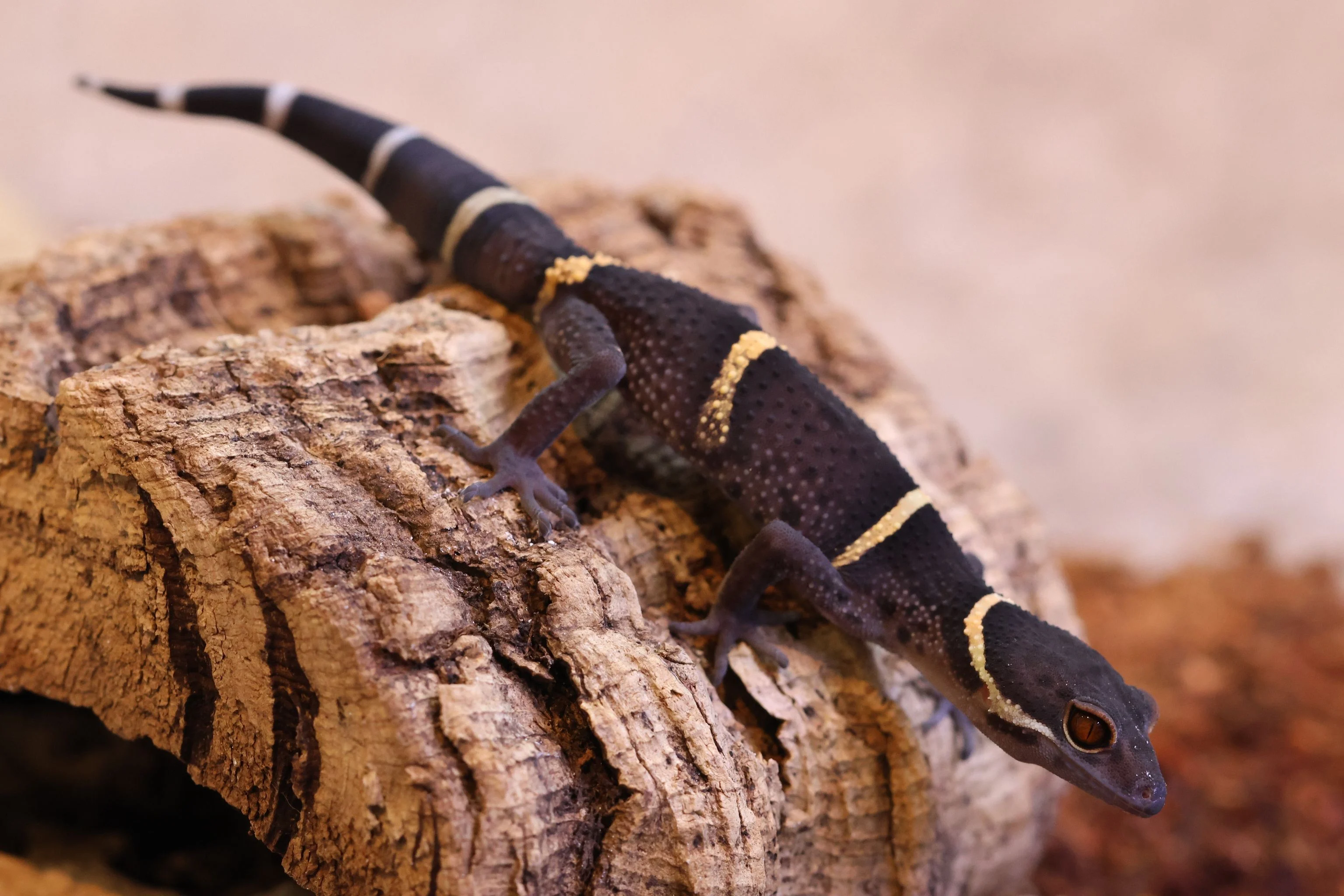
Successful Chinese cave gecko (Goniurosaurus hainanensis) care cannot be reduced to the word “humid.” A cool thermal gradient, humidity that rises at night and falls by day, substrate that can partially dry, adequate ventilation and multiple snug retreats must work together. Neither a permanently wet box nor a warm, dry desert setup recreates the animal’s requirements.
The values below are starting points for one adult. Enclosure material, room temperature, ventilation, lamp distance and the individual animal change actual surface temperature and humidity. Do not copy a bulb wattage or misting count. Measure at the height the animal uses with digital probe thermometers, an infrared thermometer and a hygrometer.
For natural range, behavior, current synonymy and conservation context, read the Chinese cave gecko natural-history profile. This guide does not diagnose disease or prescribe medication. Persistent appetite loss, weight loss, abnormal breathing, retained shed, swelling, tremors or egg-laying difficulty require records, photographs and consultation with a reptile-experienced veterinarian.
| Minimum starting size for one adult | 60 × 45 × 45 cm; larger when possible |
| Warm-retreat surface | 27–28°C |
| Cool zone / night | 22–25°C / 20–22°C |
| Relative humidity | 50–90% cycle; rises at night, partial dry-back by day |
| UVB | UVI 1.0–2.0 at back height, with access to shade |
| Substrate | 5–7 cm moisture-retentive mix plus leaf litter; ventilate and drain |
Before acquisition: origin, health and quarantine

Confirm that the animal is G. hainanensis, not another species sold only as a “cave gecko.” The 2025 revision placed G. sinensis and G. kwanghua in synonymy with this species, so older names may remain in records. Ask for captive-bred status, hatch date, basis for sexing, accepted feeders, recent weight, last shed and feces, and parentage or import/transfer records. Because the genus is covered by CITES Appendix II, documented legal origin is not optional.
Observe a new arrival for at least 60–90 days in a separate area with no shared air path or equipment where practical. Use white paper towel or another easily replaced quarantine substrate so feces, urates, mites and regurgitation are visible, and keep dedicated tongs, water bowl and cleaning tools. Weigh weekly with the same scale at a similar time, but do not increase stress by removing the animal every day. Discuss fecal testing and examination timing with a veterinarian if abnormalities appear.
For the first two weeks, avoid handling beyond essential water, feeding and cleaning. Watch from a distance for changes of retreat, prey tracking, and maintenance of tail and flank condition. Hiding during the day is normal and does not require forced “taming.” When a newcomer refuses food, first review temperature, retreat security, night humidity, visual cover and time since arrival instead of repeatedly presenting new feeders.
In acquisition photographs, check for clear symmetrical eyes, absence of discharge or crust around nose and mouth, no retained shed around toes or tail tip, and no abnormal hollowing or swelling of the abdomen. A regenerated tail is not itself disease, but asking when and why it was lost helps reveal previous stress and cohabitation history. Compare verbal claims with actual records.
During quarantine, collect observations before moving new soil, plants or decor into the permanent enclosure. Recording insects eaten, fecal dates, shed, weekly weight and night behavior in one table reveals change earlier than “it seems to eat well.” Wash hands and tools after contact, and prevent quarantine water or substrate from reaching established enclosures. Quarantine ends with repeated normal observations, not merely the passage of a date.
Enclosure size and structure: floor area first

Use 60 × 45 × 45 cm (L × W × H) as a minimum starting point for one adult. A specialist institutional report considers the older 40 × 30 × 20 cm standard suitable only for quarantine or rearing and regards 80 × 50 × 50 cm as acceptable. The difference is between survival space and room for exploration, hunting and microclimate choice. Provide more than 60 cm when possible and build several routes and microclimates rather than leaving a body-length box empty.
A front-opening enclosure reduces overhead approaches during service and helps prevent escape. Place snug retreats on both the warm and cool sides, plus a permanently moist humid retreat in the middle or cool side. Cork, secured flat rock, low sturdy branches, leaf litter and plants should create complete visual cover and slightly elevated lookout points. Anchor rocks and branches to the base or structure so digging cannot make them collapse.
Cohabitation is not required for welfare. Never house males together because territorial conflict can cause injury. Females can still monopolize food or pressure one another out of retreats, so a group requires more hides than animals, several feeding stations and a ready spare enclosure. Housing a male with females without a breeding plan can exhaust females through repeated laying. For a beginner, solitary housing is safest for observation, portion control, fecal monitoring and health records.
Stage-specific housing must consider observation as well as body size. A small temporary enclosure can make juvenile food and feces easier to find, but must not be so small that thermal and humidity gradients disappear. Plan the move to at least a 60 cm enclosure as growth proceeds, transferring a familiar retreat to preserve scent and structure. A large enclosure can also be safe for a juvenile when cover and feeding points are dense.
Background and height are usable area, not decoration. A specialist report observed animals scanning for prey from elevated sites, so provide low shelves and sloping cork from which a fall is harmless. Do not expect smooth vertical glass to be climbed; provide a texture that catches the claws. Shake-test every furnishing for trapping gaps, sharp cut edges and rocks that become slippery after misting.
Temperature, lighting and UVB: making cool conditions measurable

Start with a 27–28°C floor or surface inside the warm retreat and a 22–25°C cool zone. Allow a natural fall to 20–22°C at night, but do not force a healthy adult colder in routine care. Prolonged ambient temperature above 28°C increases heat-stress risk. In a hot summer room, air conditioning, ventilation and enclosure relocation take priority over heating; merely switching off a lamp may not solve the problem without active room cooling.
Put heat at one end only and limit its maximum with a thermostat. Secure the probe inside or on the surface of the warm retreat where the gecko actually makes contact, not suspended in the air, and use a second digital thermometer at the opposite end. Check floor, rock and cork at multiple points with an infrared thermometer. Avoid exposed internal bulbs and reachable heat cable. If a heat mat is needed, install it outside and control it with a thermostat.
Provide about 12 hours of visible daylight for circadian rhythm. Nocturnality does not reduce the value of UVB to zero. Install shaded, low-output linear UVB over part of the enclosure and measure UVI 1.0–2.0 at the animal’s back height. Mesh, reflector and lamp model change the required distance, so package distance alone is insufficient. Always preserve deep shade and retreats without UVB so the gecko chooses its exposure.
Specialist breeding records use winter cooling to 16–18°C with a shorter photoperiod, but this is an advanced procedure for planned breeding of healthy adults, not a routine target for a new or ill animal. Cooling without knowing lineage, condition and female nutrition can burden digestion and immunity. Without a breeding plan, maintain the stable daily gradient and ordinary seasonal variation of the room.
Measurement devices should be cross-checked. One inexpensive analog dial high on a wall can miss the floor conditions the gecko experiences. Place two digital thermometers side by side to compare error, and check hygrometers with a salt test or reliable reference. Preselect an evacuation tub and cool room for power loss, thermostat failure or a heat wave; this reduces the temptation to place ice directly against an animal during an emergency.
Humidity, ventilation, substrate and water: a wet–dry rhythm

Use a relative-humidity cycle of roughly 50–90% as a starting range, lower by day and higher at night. Mist in the evening to create the night peak, then ventilate enough for some surface drying by day. One hygrometer at mid-height is less informative than differences inside hides, at the substrate surface and on the cool side. Condensation on all glass throughout the day and a musty odor indicate poor ventilation and excessive wetness, not successful “high humidity.”
A 5–7 cm layer can combine unfertilized organic topsoil with a moisture-retentive material such as coconut fiber, topped by generous leaf litter. Avoid sand alone, aromatic wood chips, large pieces that compact if swallowed, and garden soil containing fertilizer or pesticide. Do not turn the entire floor into mud. Let the lower cool-side layer hold moisture while the warm-side surface can dry. Humid-hide moss or soil should be damp, not wet enough to squeeze water from it.
Keep clean water in a shallow, stable bowl at all times. Replace it daily and clean immediately if feces or a slimy film appears. Check the humid retreat every day for mold and waste. If a mister or humidifier is used, sanitize and dry its reservoir and lines regularly. Color may dull and hiding may increase before a shed, but retained skin around eyelids, toes or tail tip calls for review of the humidity cycle and humid retreat. Do not pull dry retained skin by force.
Adjust mist timing and volume with the season. Winter heating may dry the air rapidly, while the same spray volume may never dry during a summer monsoon. Instead of obeying a fixed spray count, record the nightly peak, surface dry-back the following day and moisture in the humid retreat, then revise the pattern. Create cross-ventilation high and low without directing a strong draft at the animal.
A bioactive enclosure does not eliminate cleaning. Isopods and springtails process small organic material, but the keeper must still clean the water bowl, visible feces, large food remains and spreading mold. Plant lighting is not UVB, and live plants should be washed and quarantined for pesticide or fertilizer residues. Standing, foul-smelling water in a drainage layer calls for review of the whole system, not cosmetic spot repair.
Food, supplements and feeding by life stage

Offer a rotation of live insects. In Korea, practical choices include appropriately sized crickets, silkworms, black soldier fly larvae and small grasshoppers; use mealworms, superworms and waxworms as secondary foods with their fat and cuticle in mind. Prey should not be wider than the gecko’s head, and the portion should match what it responds to within 10–15 minutes. Remove uneaten crickets so they cannot bite the gecko overnight.
Juveniles are vulnerable to dehydration and energy deficits, so offer small prey at least three times weekly and adjust frequency to growth and body condition. A healthy adult can start around two to four feedings per week, with quantity adjusted to weight, tail condition and activity. Breeding females and recovering animals need closer nutritional planning with veterinary input. Regular weights and body condition are safer than unlimited feeding and help prevent obesity and excessive reproductive burden.
Gut-load feeder insects with nutritious food and moisture for 24–48 hours. Apply calcium as a light dusting according to the label and the animal’s UVB and vitamin D3 exposure, and use multivitamin on a defined schedule that avoids accumulation. Products differ in concentration, so one universal frequency is inappropriate. Do not use heavily caked powder or an old supplement indefinitely; record opening date, dosing schedule and UVB replacement date.
Feeding response is part of the health record. Note whether the gecko rushed the tongs, how many prey it swallowed, whether it tried again after a miss, and whether it regurgitated. Missing one meal on an inactive night differs from prolonged anorexia with weight loss. Appetite may change briefly before a shed, after arrival or with season, so evaluate a two-to-four-week trend rather than one feeding.
Nutritional balance cannot be created by powder alone. Feeder hydration, fat content, calcium-to-phosphorus ratio and gut-load must vary; long reliance on one insect can produce deficits and excesses together. Compare labels so that calcium with D3, multivitamin and UVB do not duplicate excessive vitamin D3. Lethargy, tremors or straining in a laying female require veterinary assessment rather than repeated calcium dosing at home.
Handling, cleaning, health signals and the weekly check

This is better treated as an observation animal than a frequently handled pet. When movement is necessary, work over a low container and form a path with both hands so the gecko walks voluntarily; never grip the body or tail. Fast overhead approaches and sudden removal of a retreat increase flight, defense and tail-loss risk. The animal can learn to take food from tongs, but wiggling fingers like prey invites mistaken bites and stress.
Remove feces and contaminated leaves immediately, and rinse the water bowl daily. Weekly, inspect glass, retreats, vents and thermostat probes. Determine full substrate replacement from odor, mold, pests and drainage rather than a calendar alone; three to four months is a useful review point for a typical non-bioactive setup. Use reptile-safe disinfectant at the specified dilution and contact time, then rinse and dry completely.
Warning signs include continuing weight loss, appetite loss and lethargy lasting more than two weeks, open-mouth or noisy breathing, nasal discharge, swollen jaw or limbs, tremors, repeated retained shed, diarrhea or blood in feces, cloacal prolapse, and abdominal swelling or straining in a female. Do not assign a diagnosis from one sign. Bring four weeks of temperature/humidity logs, weights, feeding and fecal records, plus substrate and supplement details. Rapid decline, trauma, breathing difficulty or suspected egg binding should not wait for a routine appointment.
The goal of handling acclimation is not a gecko that sits on a hand for long periods, but reduced fear during necessary care. Repeating the same order of lights, water and door opening and providing a gentle cue improve predictability. Training the animal to enter a clear transfer tube, or moving it inside a cork retreat, can reduce tail-loss risk during veterinary visits and major cleaning.
A weekly check should search for equipment failure as well as body changes. Confirm that the thermostat probe is attached, mist nozzles are not soaking one spot, door gaps and cable ports have not widened, and mold or feeder insects are not multiplying under leaf litter. Plot weight as a series. If an unexplained 5–10% adult loss continues, review environment, parasites and disease with a veterinarian before simply increasing food.
Practical care checklist
- Daily: replace water, observe position, breathing and posture, and remove feces and uneaten prey
- Daily: check warm-retreat surface, cool-side temperature and the nightly humidity peak
- Weekly: record weight or body condition and inspect the humid retreat, vents and probes
- At feeding: record prey size, intake and supplement, and remove insects that remain
- Monthly: review UVB distance and replacement date, thermostat operation, secured furnishings and substrate drainage
References
- German Federal Agency for Nature Conservation (BfN), captive-breeding evaluation
- ReptiFiles Chinese Cave Gecko Care Sheet
- Baines et al. (2016), UV-Tool for reptiles and amphibians
- The Reptile Database: Goniurosaurus hainanensis
- CITES species listing: Goniurosaurus
- Ngo et al. (2023), habitat and conservation context
Suggest an edit
Tell us which sentence may be incorrect and provide a verifiable source. Submissions are reviewed before publication.