Last updated 2026.09.16 · Edited by silveston · Compiled by an independent hobbyist without professional credentials
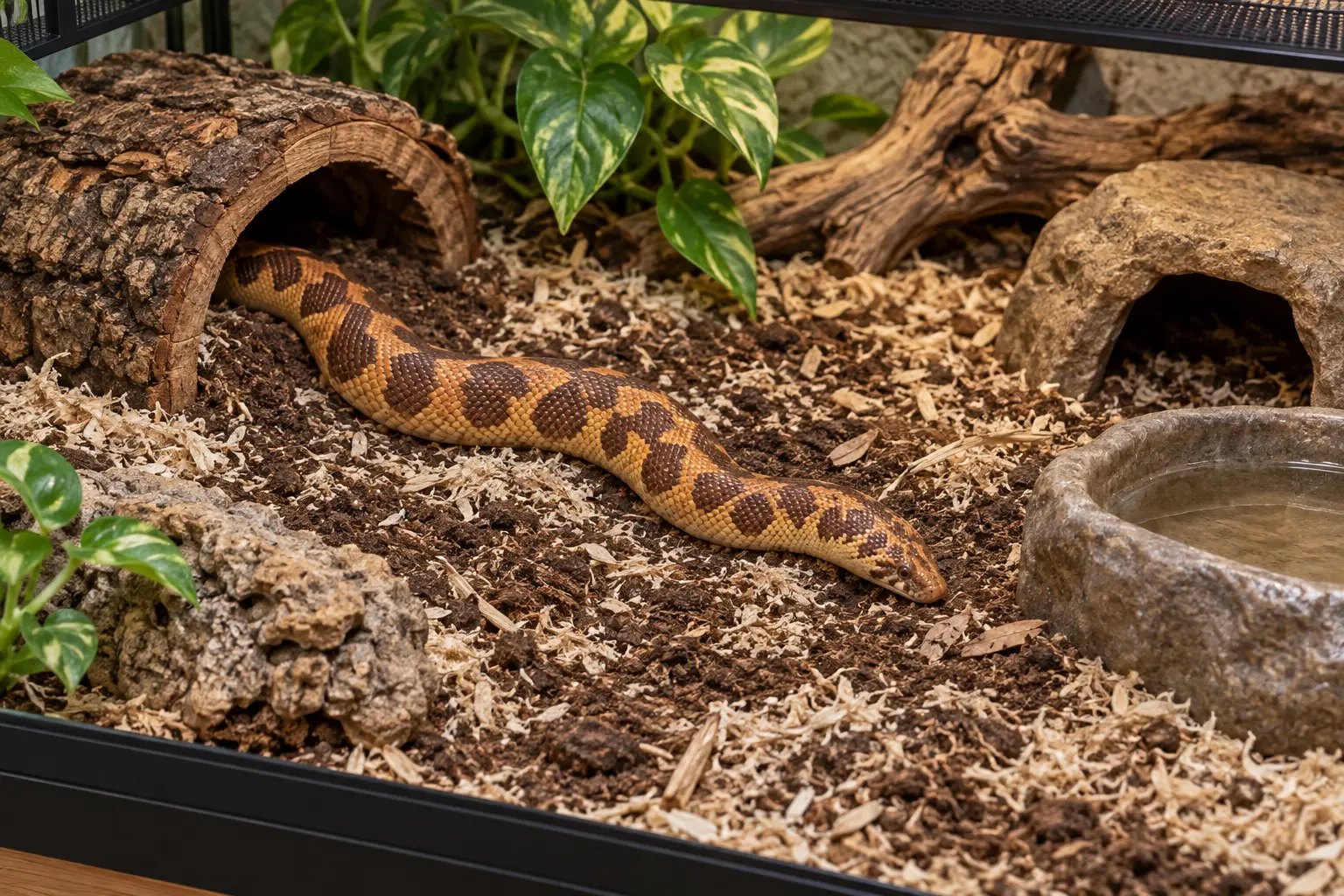
The Kenyan Sand Boa (Eryx colubrinus) is small and relatively docile, but assuming that a small snake requires only a small enclosure can lead to husbandry issues. Key requirements for this species include deep, stable substrate, a proper temperature gradient, controlled feeding, and an environment that allows for complete concealment.
The figures below serve as a starting point for a healthy, typical specimen. Actual equipment output and readings may vary depending on ambient room temperature, enclosure material, and the snake’s growth stage and health status. You should use thermometers, infrared temperature guns, and thermostats to verify the temperatures at the specific spots the snake actually occupies.
| California Kingsnake wiki. | Beginner to Intermediate |
|---|---|
| Adult Enclosure | Minimum 90×45×45 cm recommended for females; even smaller males require sufficient space for a temperature gradient and burrowing. |
| Warm surface | Approx. 32–35°C |
| Cool side | Approx. 24–27°C |
| Nighttime | Generally 21–24°C; provide supplemental heating if room temperature drops lower. |
| Ambient humidity | Approx. 40–60%; avoid keeping the entire enclosure damp, but provide a localized humid hide during shedding. |
| Substrate | Soil-sand mix that holds burrows without creating airborne dust, or other safe burrowing substrates. |
| Diet | Feed appropriately sized thawed rodents; adjust frequency based on body condition. |
| Co-housing | Solitary housing recommended, except for breeding purposes. |
Is this species right for me?
This species is a good fit if you are looking for a snake that can be kept relatively easily in a small space and don’t mind not seeing it every day. Kenyan Sand Boas spend most of their time buried in the substrate, so they are not the type of display animal that is always visible.
You must be comfortable handling thawed rodents for feeding and be prepared with a thermostat and accurate measuring equipment. Juveniles and males are very small and can easily slip through gaps, so the locking mechanism and the spacing of ventilation vents must be checked.
Adult size and life expectancy
There is a significant size difference between the sexes. Males are generally smaller and slender, while females grow much thicker and longer. As size varies greatly depending on the individual and lineage, it is better to track muscle condition along the back and flanks, the base of the tail, and weight changes, rather than judging health based on length alone.
Properly cared-for individuals can live for a long time, so they should not be impulse purchases. While estimates of exact lifespan vary, it is safest to plan for a lifespan of over 15 years, considering factors such as potential relocation, food storage, and access to veterinary care.
Enclosure size and structure

Before introducing the snake, run the empty enclosure for at least a few days to record day-night temperature fluctuations. Check that a cool refuge remains available even when the heat source cycles on and off, and ensure that the lid and doors do not warp due to temperature changes. Secure decorations and water bowls directly to the enclosure floor to prevent them from collapsing onto the snake while it burrows, and seal any cable access holes so that the snake’s head cannot fit through them.
When determining enclosure size, consider not only the animal’s sex but also its actual adult length and stretching behaviors. Professional veterinary sources suggest a minimum size of 90×45×45 cm for a single adult, and ReptiFiles notes that females larger than average require more spacious accommodations. Rather than simply assuming “bigger is always better,” understand that a spacious enclosure offers more options when it includes multiple hiding spots and deep substrate to minimize the animal’s sense of exposure. A large, empty enclosure does not provide a safe environment for a small individual.
Front-opening enclosures reduce the stress caused by hands reaching down from above and facilitate spot cleaning, but door gaps and ventilation vents must be carefully inspected. Young individuals can squeeze their entire bodies through any gap large enough for their heads to pass. Place heavy items like water bowls and rocks directly on the bottom glass or panel, then fill the surrounding area with substrate. Placing heavy decor on top of the substrate is risky; if the snake burrows underneath, the support base may shift, potentially leading to crushing injuries.
A floor area of at least 90×45×45 cm is recommended for adult females. While smaller males can be kept in smaller enclosures, the setup must clearly provide distinct warm and cool zones, with hiding spots available in both areas. Enclosure size should be determined based on temperature gradients and behavioral options, not just body length.
Provide substrate deep enough to completely cover the snake’s body. For adults, start with a depth of approximately 10–15 cm and observe whether the animal is able to construct stable burrows. Do not place heavy stones or decorations directly on top of the substrate; instead, secure them firmly to the enclosure floor to prevent collapses while the snake is burrowing.
Temperature Gradient & Measurement

For daytime settings, aim for a surface temperature range of approximately 32–35°C on the warm side and 24–27°C on the cool side. Colorado Exotic Animal Hospital recommends a warm spot of around 35°C and a cool side of 24–27°C, while ReptiFiles also suggests a warm surface temperature of approximately 34–35°C.
Do not assume that the initial power output setting will remain constant throughout the season. Measure temperatures at the same locations in both the morning and evening, and re-verify trends over several days whenever indoor heating or cooling settings are changed. Recording the warm surface temperature, air temperatures on both the warm and cool sides, and the nightly minimum temperature allows for the faster detection of equipment malfunctions or probe displacement.
More important than the specific type of heat source is creating a warm zone large enough for the snake to comfortably occupy while preventing overheating. A tiny, intense hot spot can overheat only a portion of the snake’s body, whereas heating the entire enclosure to a uniform temperature leaves the snake with no cool area to retreat to. When using lamps, install protective guards to prevent burns and ensure secure mounting; never use heating mats or ceramic heaters without a thermostat. Secure the temperature probe so the snake cannot push it aside or cover it with substrate, and cross-reference the probe’s reading with the actual temperature at the snake’s resting spot.
Temperature monitoring involves more than just noting the numbers displayed on the equipment. Measure multiple points on the warm surface using an infrared thermometer and track the high and low air temperature trends at both ends of the enclosure using fixed probes. Since infrared thermometers can yield inaccurate readings on reflective glass or glossy surfaces, measure the matte surfaces that the snake actually comes into contact with. Prepare for power outages or thermostat failures by keeping a spare thermometer and a safe, portable temporary container on hand, and track seasonal indoor temperature extremes.
Readings must distinguish between ambient air temperature and surface temperature. Use an infrared thermometer to check the surface temperature directly beneath the heat source, and a digital probe to monitor the air temperature at both ends of the enclosure. Connect all heat sources to a thermostat and securely fasten the probes to prevent them from shifting.
While nighttime temperatures can generally drop to 21–24°C, consult a veterinarian experienced with reptiles to adjust conditions if the snake is sick or young, or if the room temperature drops significantly lower. It is preferable to use a non-light-emitting heat source paired with a thermostat rather than red or blue night-viewing lights.
Humidity and Ventilation

Although they are a species native to arid regions, “lower humidity is always better” is not the rule. Maintain a relative humidity of approximately 40–60% with good ventilation during normal conditions, and avoid keeping the entire enclosure damp for extended periods.
Place the hygrometer at a representative spot midway up the enclosure, rather than directly above the water dish or where misting occurs. Look beyond just the numerical reading; consider fluctuations between day and night, the dryness of the substrate surface, and shedding outcomes. Placing a humid hide in the cooler half of the enclosure—and keeping only its internal material lightly moist—allows the snake to choose whether to use it without wetting the entire enclosure. Replace the contents immediately if wet sphagnum moss mixes with waste or develops a sour odor.
Spraying the entire enclosure daily because of repeated incomplete sheds can mask the underlying cause. Instead, check the following in order: access to the water dish, use of the humid hide, ventilation levels, excessive dryness near the heat source, and potential skin or parasite issues. Conversely, if the surface is constantly wet and condensation persists on the glass walls, increase ventilation and remove soiled substrate. If respiratory issues or skin blisters occur, do not simply wait while adjusting humidity levels; veterinary care is required.
When the eyes become cloudy and the skin tone dulls prior to shedding, provide a small humid hide. Ensure that wet moss or paper substrates remain moist without pooling water, and check frequently for mold or contamination. If shed skin remains on the eyes or tail, do not force it off; instead, adjust the environment, and seek veterinary care if the issue persists.
Lighting and UVB
Spending a lot of time in hiding does not mean a light cycle is unnecessary. Provide a consistent day-night cycle and position the enclosure so that direct sunlight does not cause overheating in glass tanks.
Low-output UVB can be used as an option if appropriate distance and shaded areas are provided. Always verify the manufacturer’s distance guidelines and the impact of any mesh screens, ensuring there is a dark zone where the snake can completely escape the light. Even if UVB is not used, maintain a diet of balanced whole-prey items and a regular light-dark cycle.
Substrate and Hides

Natural habitats do not consist solely of pure beach sand. A mixture of soil and sand—which is low-dust and holds a burrow shape reasonably well—can be a natural choice. Materials that facilitate burrowing, such as aspen shavings, are easy to maintain but must be replaced quickly if they become wet.
Substrate should be deep enough to allow for burrowing and must not clump into hard masses or contain sharp particles if ingested. A mixture of additive-free potting soil and washed sand holds its shape well, but one must ensure it is free of fertilizers, pesticides, and wetting agents. Aspen shavings are lightweight and hold burrows well, but they are prone to mold if wet spots are left untreated, so the area around the water bowl requires frequent checking. No single material is a perfect, maintenance-free solution.
Newly acquired individuals or those requiring monitoring of waste output can be kept on paper towels for a quarantine period before being moved to burrowing-friendly substrate. Keeping them on a thin layer of paper for too long restricts a key behavior of this species, so clear objectives and criteria for ending the quarantine period should be established. When feeding inside the enclosure, food can be placed on a small dish or a flat piece of cork to prevent excessive substrate from sticking to it. The risk of substrate ingestion is influenced by a combination of factors, including prey size relative to the material, low temperatures, dehydration, and improper feeding methods.
Avoid calcium sand, strongly scented wood shavings, sharp gravel, and excessively fine powders that easily stick to the mouth. Place low-profile hides that fit the snake’s body size on both the warm and cool sides of the enclosure, and secure any décor to ensure safe movement, even when the snake is burrowing beneath the substrate.
Prey and Feeding Intervals

Thawed rodents serve as the staple diet. Start with a prey item whose thickest part is similar to or slightly smaller than the snake’s thickest part to prevent excessive distension after swallowing. Live rodents are not recommended, as they can bite and injure the snake.
After thawing in the refrigerator, warm the prey—while still in its sealed bag—in warm water to ensure it is thawed through to the center. Avoid using a microwave, as it can cause uneven heating or bursting, and do not refreeze prey that has been left at room temperature for an extended period. When offering food with tongs, avoid repeatedly poking the snake’s face; instead, create subtle movements near the entrance of its hide. If the snake does not eat, remove the food within an appropriate timeframe based on the product’s condition and room temperature rather than leaving it out overnight.
Feeding intervals of 1–2 weeks for juveniles and 2–4 weeks for adults serve as a starting point, not a mandatory schedule. While males are known to refuse food during the breeding season, one should not automatically attribute all instances of fasting to this cause. Monitor the snake to ensure its weight remains stable and its activity, respiration, and excretion are normal; if there is continuous weight loss or other symptoms, evaluate its environment and health. Habitually coating prey—which is already a complete nutritional source—with excessive supplements can disrupt nutritional balance without justification; therefore, avoid arbitrary overuse unless directed by a veterinarian.
Adjust the feeding schedule based on trends in body weight and physical condition rather than sticking to a fixed calendar date. Taking a photo from the same angle and weighing the snake once a month makes it easier to distinguish between healthy growth and excessive weight gain in adults. If the spine protrudes excessively, the flanks appear deeply sunken, and weight continues to drop, check the temperature and potential illness before simply increasing the amount of food.
ReptiFiles suggests feeding intervals of approximately 1–2 weeks for juveniles and 2–4 weeks for adults. Since other care guides may recommend more frequent feeding, do not rely solely on a calendar; instead, observe the animal’s growth rate and body condition. Obesity can lead to reduced burrowing activity and long-term health issues.
Do not immediately offer a different type of food just because the animal refused a meal. First, check the temperature, shedding cycle, season, hiding spots, stress levels, and prey size. If weight loss persists or is accompanied by respiratory abnormalities, oral lesions, or lethargy, seek veterinary care from a clinic experienced with reptiles.
Water and Hydration
Always provide a clean water dish, though it does not need to be large enough for the animal to soak in. Place a shallow, tip-resistant dish on the cooler side of the enclosure to minimize excessive humidity caused by evaporation.
Do not remove the water dish even if the animal does not appear to be drinking. Since the dish and surrounding substrate can easily become contaminated with waste or food scraps, check them daily and replace them immediately.
Handling and Preventing Escape

Avoid handling the snake immediately after feeding or during the pre- and post-shedding periods; start with short sessions of around five minutes. Support the body from below and allow the snake to move onto your hand on its own; do not hold it solely by the tail or restrain its head. If an individual has only its head exposed from the substrate, it may have a quick feeding response; instead of immediately inserting your hand, open the enclosure door and lightly touch its side to signal that you are there for maintenance. In households with children or other pets, a locking mechanism and a separate, secure area for the enclosure are essential.
Avoid unnecessary handling or full-scale cleaning for at least 48 hours after feeding. If regurgitation occurs, do not re-feed immediately; instead, check the temperature, prey size, thawing status, and potential signs of stress or illness. Symptoms such as repeated regurgitation, persistent weight loss, bloody droppings, or an inability to right itself warrant immediate veterinary attention. Bringing environmental records, photos of symptoms, and details regarding recent prey size and feeding dates to the clinic can help narrow down the cause.
Knowing what constitutes a healthy state allows for the early detection of abnormalities. Immediately after adoption, weigh the snake using the same scale at a consistent time of day, and take photos of its eyes, nostrils, mouth area, ventral scales, cloaca, and tail tip. Subsequently, track and compare monthly weight, shedding quality, defecation intervals, and feeding responses. The trend of multiple readings is more important than a single data point; if sudden changes occur, check husbandry conditions but do not use arbitrary medications or insecticides.
After initially bringing the animal home, allow at least a week for environmental acclimation and ensure it is feeding reliably before attempting brief handling. Do not grab the snake suddenly from above; instead, support its entire body. Wash hands that smell of food, and do not use tools to roughly dig through the enclosure when searching for the snake.
Secure all lids, sliding doors, and cable ports. Young males, in particular, can squeeze through surprisingly narrow gaps. When cleaning the enclosure, move the snake to a secure temporary container and prevent contact with other pets.
Solitary Housing vs. Co-housing Risks
Permanent co-housing is not recommended. Issues such as competition for food, stress, biting, or unwanted breeding may occur, and problems within hiding spots might go unnoticed until it is too late. Seeing them hiding side-by-side does not necessarily indicate friendly social behavior.
Even when co-housing for breeding purposes, verify the sex, weight, and health status of the animals, and limit the interaction to a period where supervision is possible. Breeding places significant nutritional and physical strain on the female; do not attempt it without prior experience and a veterinary care plan.
Cleaning and Quarantine
Whenever possible, keep new individuals in a separate area from existing reptiles for 60–90 days and use separate tongs, water bowls, and cleaning tools. Attending to healthy, established animals before handling quarantined individuals helps reduce the risk of transmission via equipment or hands. Upon initial adoption, record baseline data—such as weight, full-body photos, and the status of excretion and shedding—and consult a veterinarian specializing in reptiles for a physical examination and fecal analysis.
Rather than performing a complete deep clean every day, it is more stable to spot-clean soiled areas immediately and periodically assess the overall condition. Before disinfecting, remove organic matter such as waste and substrate; adhere to the product’s recommended dilution ratio and contact time, and ensure the enclosure dries thoroughly. Do not use strongly scented household detergents or mix different cleaning agents. After cleaning, re-check the security of locks, temperature probes, heat source guards, and heavy decorations.
Spot-clean waste and wet substrate immediately upon discovery. Determine the schedule for a full substrate replacement based on the rate of soiling and the type of substrate used; however, monitor the animal’s condition during the process to avoid causing stress by completely removing all familiar scents and burrow structures at once.
Quarantine new animals in a separate space from existing reptiles and do not share equipment between them. Keeping records of weight, food intake, excretion, and shedding helps in the early detection of issues. Signs such as mites, persistent loose stools, or weight loss may indicate a need for veterinary evaluation, including fecal analysis.
Signs of health issues
- Breathing with the mouth open, wheezing, or nasal discharge/bubbling
- Repeated incomplete shedding or retained eye caps
- Refusal to eat accompanied by persistent weight loss
- Red spots in the mouth, discharge, or abnormal odor
- Burns, skin blisters, or small moving specks between scales
- Neurological symptoms such as inability to right itself or abnormal twisting of the body
These items are not diagnoses but warning signs requiring veterinary attention. Do not arbitrarily raise temperatures or administer medication; instead, consult a veterinary clinic experienced with reptiles, providing records of the enclosure environment along with recent data on weight, feeding, and defecation.
Common Mistakes Made by Beginners
- Not connecting a thermostat to the heat source
- Measuring only the warm side and failing to provide a cool retreat
- Assuming that a shallow layer of fine sand satisfies the need for burrowing behavior
- Frequently feeding prey that is too large to a small snake
- Keeping the entire enclosure constantly wet in an attempt to aid shedding
- Digging through the substrate daily to locate the animal simply because it is not visible
- Housing a male and female pair together permanently
Weekly/Monthly Checklist
Daily
- Temperatures at both ends and thermostat operation
- Water dish and locking mechanism
- Waste, wet substrate, and signs of respiratory issues
Weekly
- Feeding response and body condition records
- Stability of hides and decor
- Mold or contamination in the humid hide
Monthly
- Weight trend monitoring
- Probe placement and thermometer cross-check
- Inspection of vents, door gaps, and locks
Related Articles
- Kenyan Sand Boa Wiki — Adaptation to burrowing and wild ecology
- Green Tree Python Wiki — Arboreal snakes and lifestyle comparison
- What is a reptile?
FAQ
Should I use only sand?
No. Natural environments contain a mix of sand, soil, gravel, and vegetation. Choose a substrate that is low-dust, holds burrows well, and minimizes the risk of ingestion.
How often should I feed them?
Start with intervals of roughly 1–2 weeks for juveniles and 2–4 weeks for adults, then adjust based on body condition and growth rate.
Can they be housed together?
Permanent cohabitation is not recommended. Keeping them individually is safer, except for breeding purposes.
Is UVB lighting necessary?
Husbandry practices regarding its necessity vary. If used, ensure you use low-output equipment, provide ample hiding spots, and adhere to the manufacturer’s recommended distances.
Reference Materials
- Colorado Exotic Animal Hospital. Kenyan Sand Boa Care.
- ReptiFiles. Kenyan Sand Boa Care Sheet.
- Oakland Zoo. Kenyan Sand Boa.
- The Reptile Database. Eryx colubrinus.
Suggest an edit
Tell us which sentence may be incorrect and provide a verifiable source. Submissions are reviewed before publication.