Last updated 2026.09.16 · Edited by silveston · Compiled by an independent hobbyist without professional credentials

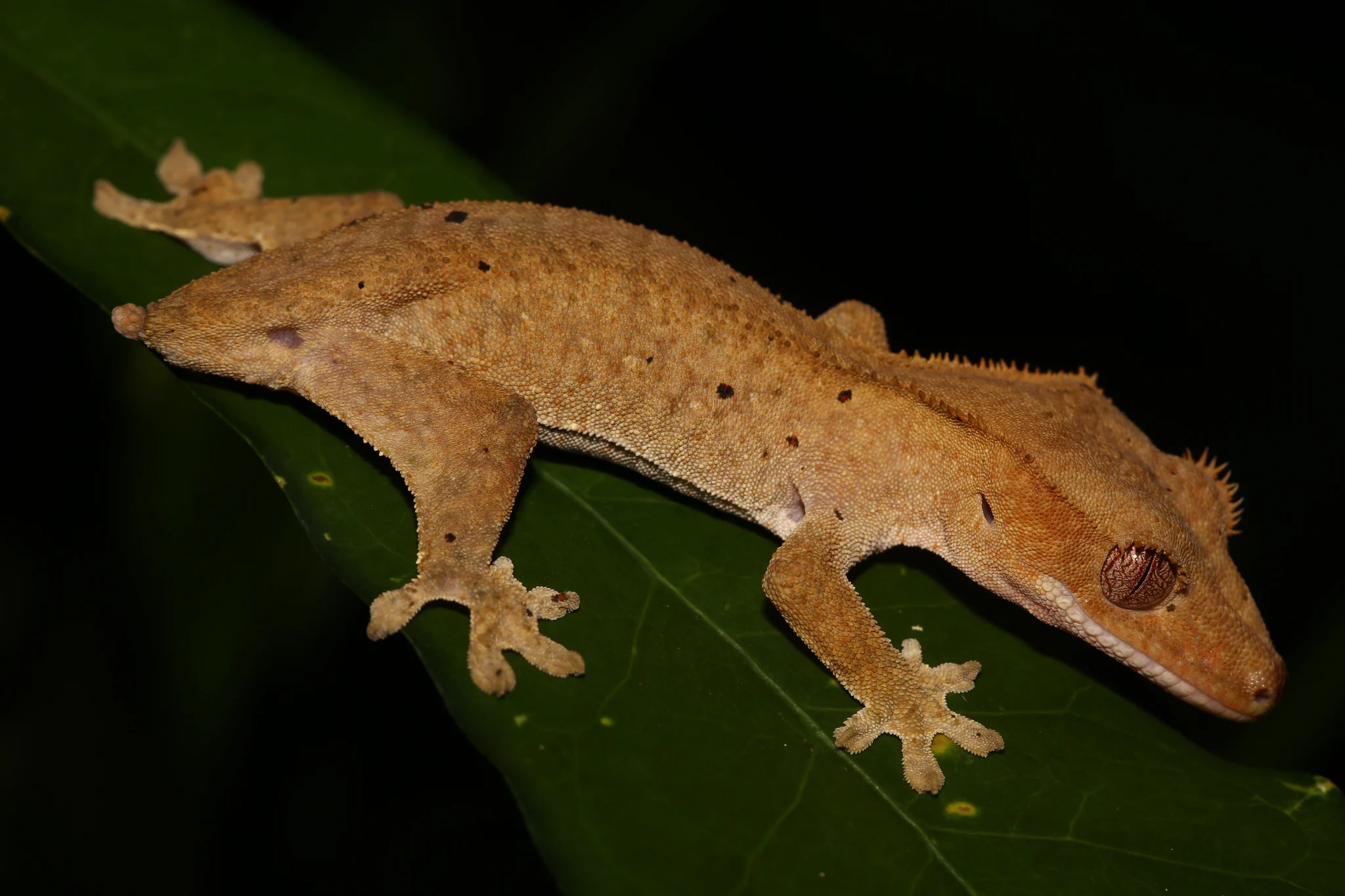
This document summarizes the essentials of actual Crested gecko care: temperature, humidity, enclosures, diet, nutrition, and health monitoring.
Information on their distribution in the wild, behavior, and evolution Crested gecko Wiki can be found here.
Housing Environment
| Category | Recommended Range & Key Points |
|---|---|
| Daytime Air Temperature | Approx. 22–26°C |
| Upper Basking Spot | Approx. 26–28°C; avoid temperatures above 28°C for extended periods |
| Nighttime | Approx. 18–22°C |
| Humidity | Cycle: 50–70% normally; rises to 70–80% after evening misting, then dries out during the day |
| Substrate | Use paper towels during the quarantine period. Use materials that offer both moisture retention and drainage, such as coco peat, fertilizer-free soil, or a leaf litter layer. |
| Essential Supplies | Vertical enclosure, cork bark/branches/horizontal perches, foliage for hiding, digital thermo-hygrometer, low-output UVB light, feeding station |
More important than the frequency of misting is the cycle of wetting and drying. If the surface remains constantly damp, mold growth and skin issues increase; conversely, excessive ventilation can lead to dehydration.
Diet and Supplements
- The staple diet should be a complete diet formulated for New Caledonian geckos (CGD), mixed with water according to product instructions.
- Gut-loaded insects, such as crickets or Dubia roaches, can be offered as a supplementary food source about once a week.
- Do not arbitrarily add calcium or vitamins to the complete diet. Lightly dust insects with calcium appropriate for the specific diet and UVB conditions.
- Do not leave leftover “Super Food” out at room temperature for longer than the product guidelines specify.
Temperament, Handling, and Health Concerns
- It is safest to handle them by letting them step alternately from hand to hand at a low height.
- Their jumping direction is unpredictable; do not grab their tails or forcibly pull them away.
- Weight loss, skeletal deformities (pelvis/back), jaw tremors, retained shed skin on toes, persistent diarrhea,
and lethargy require veterinary attention. - Be alert for metabolic bone disease, dehydration, overheating,
egg-laying complications, and tail or toe injuries.
Check the movement path before considering height.
The RSPCA’s minimum recommended size for an adult is 45cm (W) x 45cm (D) x 60cm (H). Simply meeting these minimum dimensions while leaving the interior empty results in very little usable space. Install branches and cork bark at various heights, and provide foliage for cover and horizontal resting spots. Ensure the animal can navigate to the feeding station without descending to the floor, and check that the upper area isn’t entirely too hot or bright, leaving no place to retreat.
Adjust based on readings taken before and after misting.
Do not rely solely on high humidity readings immediately after misting; compare values from before misting, immediately after, and during the day. If moisture lingers on the glass or leaves, check ventilation and drainage in addition to the misting volume. Even if you observe them drinking water droplets, provide a separate dish of clean water. In summer, avoid placing the enclosure near windows with direct sunlight, and monitor both the ambient indoor temperature and the temperature at the top of the enclosure.
Distinguish between complete diets and treats.
Not all products featuring a gecko image are complete diets. Check the target species, whether it is labeled as a complete or complementary food, the water mixing ratio, and storage instructions; also, keep records of actual consumption, droppings, and body weight. The RSPCA document referenced outlines a diet that includes fruit and insects, noting that not all commercial products are treated the same way. Apply the specific mixing instructions for your current product separately from insect feeding, and avoid repeatedly offering only fruit puree if the animal refuses to eat.
Three things to check during the first week after setup
Run the equipment without the animal before adoption to observe daily fluctuations. After the animal arrives, establish a baseline by observing at the same time and location, rather than frequently rearranging the setup. The table below is not for diagnosing illness but serves as a record-keeping format to distinguish between environmental conditions and food intake.
| Observed Situation | Items to Check | Details to Record |
|---|---|---|
| Food remains untouched on the feeding platform | Check the “complete diet” label, mixing ratio, and access path to the feeding platform | Record the amount served, traces of leftovers, and droppings |
| Glass and floor remain wet even during the day | Check misting volume, as well as ventilation, drainage, and the deep substrate layer | Misting time, and humidity/surface condition before the next misting |
| Stays at the bottom, avoiding the upper area | Check maximum temperature at the top, shade behind leaves, and resting perches | Observation time and location, and the room’s maximum temperature for that day |
Should I take the animal out to check if it isn’t visible at night?
Constantly lifting leaves or moving hiding spots can disrupt the animal’s rest and acclimatization. Check for signs of feeding, waste, and nocturnal movement first; when weighing or checking physical condition is necessary, keep the process brief and consistent. Distinguish between normal hiding behavior and warning signs such as weight loss or repeated falls. When taking photos, compare body condition under consistent lighting rather than just selecting images where their colors appear most vibrant.
Record-keeping and Medical Safety
Keep a dated log of feeding, waste elimination, shedding, activity levels, weight, and environmental readings. If a loss of appetite coincides with weight loss, or if you observe respiratory issues, tremors, bleeding, hernias, suspected egg-binding, or impaired limb function, prioritize a consultation with a veterinarian specializing in reptiles over attempting self-treatment.
References
Suggest an edit
Tell us which sentence may be incorrect and provide a verifiable source. Submissions are reviewed before publication.