At a glance
Original paper published: August 11, 2026 · Institutional announcement: August 20, 2026
Research institutions: Field Museum, Louisiana State University Museum of Natural Science, Papua New Guinea National Museum and Art Gallery, etc.
Paper: A new species of Papuan groundsnake (Squamata: Colubridae: Lielaphis) from New Guinea
Subject: Official Korean name pending · Slash’s groundsnake · Lielaphis slashi
Key findings: Genetic data, morphological characteristics (including scales), and habitat modeling all supported the classification of the northeastern New Guinea lowland population as a distinct new species.
What happened?
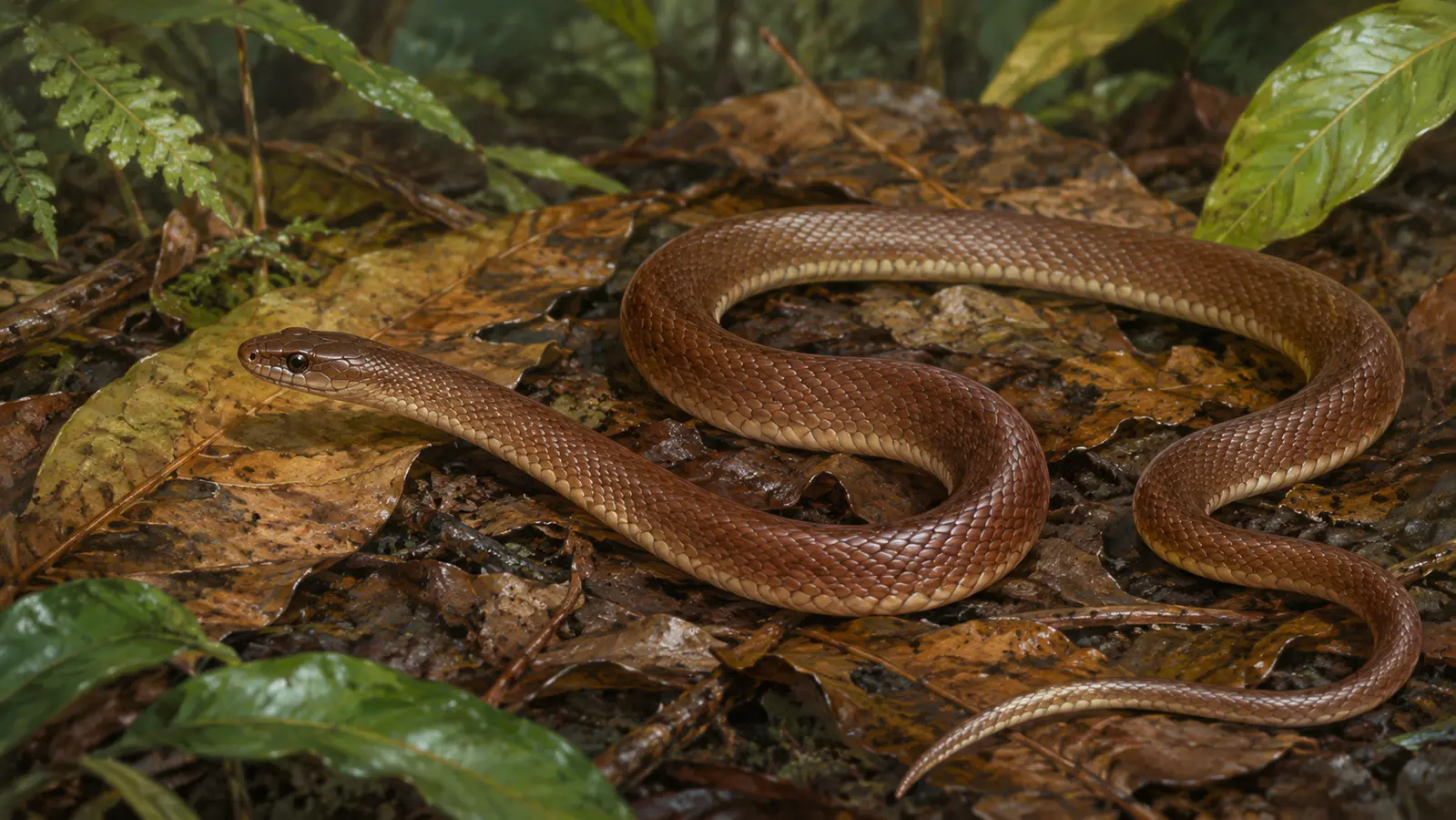
A species of ground snake from New Guinea was officially named in August 2026. Researchers identified the reddish-brown snake in the lowlands of northeastern New Guinea Lielaphis slashi, thereby Lielaphis increasing the number of known species in the genus from 19 to 20. The specific epithet slashi honors Slash (real name Saul Hudson), the guitarist for Guns N’ Roses. He has long been a supporter of reptiles and natural history museums; the name also reflects the influence he had on lead researcher Sara Ruane, who aspired to become a herpetologist during her childhood.
While the name generates buzz, the scientific core of the study lies in how researchers distinguished a distinct species from snakes that look remarkably similar. It was difficult to conclude that the specimen discovered during a 2006 night survey was a new species based solely on appearance. Consequently, the research team compared preserved museum specimens, high-throughput genetic data, morphological traits (such as scale counts and head scale arrangements), and ecological preferences.
Why is this important?
Lielaphis Ground snakes are primarily nocturnal and share similar body colors and patterns, making them difficult to distinguish through field observation alone. There are few records, and their taxonomic history is complex. Relying on a single characteristic to classify such ‘hidden diversity’ can lead to lumping distinct species together or, conversely, misidentifying variations within the same species as separate ones. This is why the study integrated genetic, morphological, and ecological data.
Furthermore, naming a new species is not merely about adding an entry to a list. Understanding which organisms live where is essential for assessing the impact of habitat changes. The research team noted that the forests inhabited by this snake are under pressure from land-use activities such as coffee cultivation and mining. However, this study alone cannot determine the population size, rate of decline, or official conservation status. There is a distinction between a species being ‘potentially threatened’ and being formally classified as ‘endangered.’

Study details
The research team analyzed Lielaphis high-throughput sequencing data from specimens of the new species— Stegonotus a sister taxon to 12 previously described species. The results L. slashi showed it to be a genetically distinct lineage from similar species within the same genus. Morphological examination of preserved specimens was also conducted. The paper diagnoses the species based on a combination of traits, including an unpatterned reddish-brown dorsal surface, a white or cream-colored ventral surface, 17 rows of mid-body scales, and specific counts of ventral and subcaudal scales.
Ecological modeling also revealed that this population exhibits environmental preferences distinct from those of closely related species. The fact that all three lines of evidence point in the same direction strengthens the case for classifying it as a new species. However, as it is a nocturnal snake that quickly disappears into the wild, details regarding its diet, reproduction, behavior, precise distribution, and population size remain largely unknown. Based on the presence of enlarged rear teeth—a feature seen in other species of the genus—it has been suggested that the snake may prey on small skinks or reptile eggs, though this has not been confirmed through direct observation of feeding habits.
What reptile enthusiasts should know
The announcement by the Field Museum L. slashi explains that it does not produce venom harmful to humans. However, this does not mean wild individuals should be handled or treated as pets. Venomous snakes with similar appearances exist in New Guinea, and field identification is challenging even for experts. This news concerns wild classification and conservation, not husbandry. Species identification should rely on official scientific names and specimen records rather than photographs or trade names alone.
“Key Points
- Lielaphis slashi It was formally described in *Zootaxa* on August 11, 2026.
- The study combined genetic analysis, morphological comparison, and ecological modeling.
- With this discovery, Lielaphis the number of known species in the genus reached 20.
- While the name honoring Slash highlights the connection between pop culture and natural history, the classification of the new species itself is based on multiple lines of scientific evidence.
- There are still significant gaps in knowledge regarding its wild ecology, population size, precise distribution, and conservation status.
Related Documents
- What is a reptile? — Comprehensive overview of characteristics, evolution, and classification
- Reptile Wiki — Ecology, distribution, and behavior by species
- Reptile News
- Bearded dragon ReptiLearn Automated Behavioral Experiment
Sources and References
- Huang T, Austin CC, Bernstein JM, Iova B, Roberts JR, Frederick JH, Ruane S. (2026). A new species of Papuan groundsnake (Squamata: Colubridae: Lielaphis) from New Guinea. Zootaxa 5866(2): 305–319. DOI: 10.11646/zootaxa.5866.2.6.
- Field Museum (2026-08-20). Welcome to the jungle: newly-discovered snake named after Slash from Guns N’ Roses.
Timeline of events and data: Field discovery (2006); original paper publication (August 11, 2026); institutional press release (August 20, 2026); article review (August 24, 2026).
Reply 남기기