Last updated 2026.10.12 · Edited by silveston · Compiled by an independent hobbyist without professional credentials
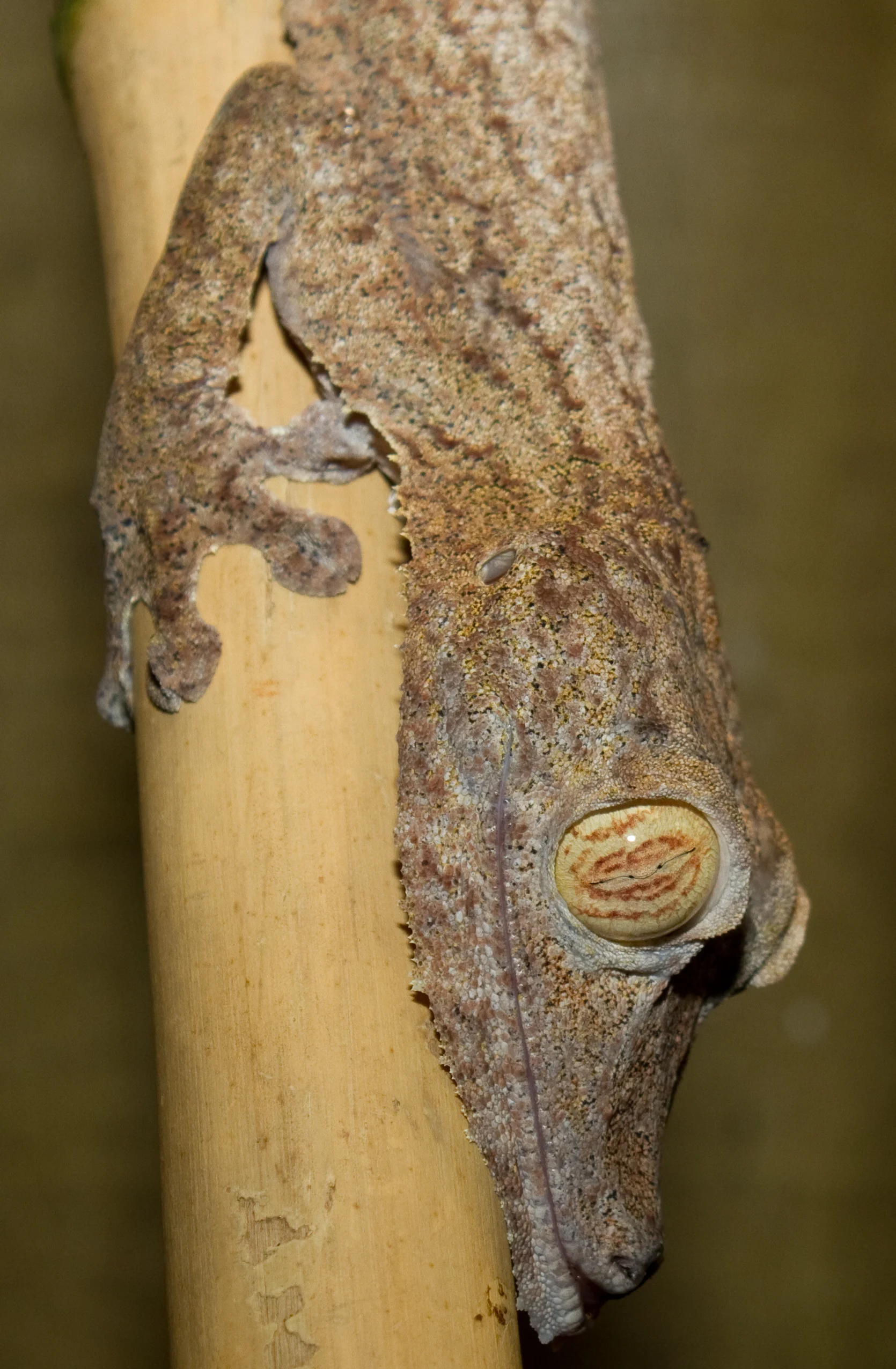
In the night forests of eastern Madagascar, a fringed leaf-tailed gecko can sit on a trunk and still disappear. Brown and gray blotches are only part of the trick. Thin fringes along the body and chin scatter the shadow that would reveal the skin against wood, while the broad tail resembles peeling bark or a dead leaf. A large gecko around 30 cm long can effectively erase itself in plain sight, a perfect opening to its natural history.
| Field | Details |
|---|---|
| Scientific name | Uroplatus fimbriatus (Schneider, 1797) |
| Common names | Fringed Leaf-tailed Gecko · Common Flat-tail Gecko · Giant Leaf-tailed Gecko |
| Classification | Squamata · Gekkota · Gekkonidae |
| Range | Lowland rainforest in northern and central eastern Madagascar and nearby islands |
| Activity | Nocturnal and arboreal |
| Conservation and trade | IUCN Least Concern, CITES Appendix II |
A giant gecko pressed to bark
The valid name is Uroplatus fimbriatus, a member of Gekkonidae. The Reptile Database treats Schneider’s 1797 description as the current name. Older literature retains combinations such as Stellio fimbriatus, so synonyms matter when searching historical records. Korean trade names often transliterate the species epithet, while the translated name “flat-tailed gecko” is also used.
Adults are commonly reported at about 25–33 cm total length, placing large individuals among the giants of Uroplatus. The head is broad and flat, the eyes are large, and expanded toe pads suit life on vertical trunks and branches. Gray, brown, and tan vary greatly with the individual and background, so color alone is unreliable. Identification should combine the lateral fringes, contours above the head and eyes, tail shape, scalation, and locality.

A narrow but deep world in Madagascar’s eastern forest
The range is centered on the eastern rainforest belt of northern and central Madagascar, with records from islands such as Nosy Mangabe and Sainte Marie. Rainy lowland forest, layered large trees and vines, and shaded trunks that retain moisture through the day form the core setting. The word “tropical” can suggest constant heat, but forest microclimates are cooler than sunlit clearings and temperatures fall at night.
Arboreal does not mean living only in the canopy. Individuals move among thick trunks, branches, vines, and vertical surfaces near forest edges, resting flattened against them by day. Habitat quality depends not merely on tree count but on trunk diameter and texture, shade for concealment, insect prey, humidity cycles, and connected forest. Fragmentation removes both nocturnal travel routes and secure daytime resting sites.
Camouflage that erases shadow before color
This camouflage goes beyond matching background color. Thin dermal fringes along the flanks and lower jaw break the dark line between body and surface. With the head pressed down and limbs spread sideways, the outline of a solid animal becomes a set of bark fissures. The epithet fimbriatus derives from Latin for fringed or bordered, and the species exemplifies the morphology of the fimbriatus group recognized in recent phylogenetic work.
Camouflage is completed by stillness. By freezing rather than fleeing and even minimizing eye movement, the gecko makes it difficult for a predator to resolve its shape. Skin blotches resemble moss, lichen, or scars in wood, while the broad tail becomes a loose flake of bark. Human lights and camera flashes can burden nocturnal eyes, however, so field observers should not prolong illumination merely to obtain a perfect photograph.

A broad tail and eyelidless eyes
The tail is more than a decorative leaf. It extends the final body contour into the background and assists balance during movement. Like many geckos, the animal can shed it under threat, but a regenerated tail may not recover the original form or pattern. Autotomy is a natural defense, not a trivial event that handling or captive management may safely provoke. It costs energy and stored resources and leaves a wound that must heal.
A transparent spectacle covers the eye because there are no movable eyelids. The pupil narrows in light and opens widely in darkness, while the intricate iris pattern disrupts the circular target of the face. The gecko licks dust and droplets from the eye. A day-roosting animal with narrowed pupils may look lethargic, but it can simply be resting on a normal nocturnal schedule.

Waiting at night and a short lunge
After sunset the gecko raises its head and begins reading small movements around it. Arthropods—including crickets, moths and larvae, beetles, and cockroaches—form the main diet. The large head and mouth help secure relatively substantial prey, and an opportunistic individual may attack a small vertebrate. Wild diets nevertheless shift with locality, season, and body size and are not fixed to one or two prey types.
Hunting resembles ambush and a short launch more than continuous pursuit. The body remains against the trunk while the head aligns on the target, then adhesive feet close the distance in an instant. Returning to the background after swallowing saves energy and limits exposure. A large mouth does not mean every possible item is safe; jaw width, digestion, parasites, and toxicity all constrain prey choice.
Open-mouthed and vocal defense
When detected, the first choice is usually to maintain camouflage. If a threat keeps approaching, the gecko may lift its body, gape, vocalize, or bite. Dramatic in photographs, the display is better understood as a final demand for distance. The bright mouth and broad head make the animal look more dangerous than it is. Repeatedly provoking the posture for photographs recreates stress rather than documenting normal behavior.
Passive flattening and a sudden active display coexist in one species. The choice can change with predator type, speed of approach, and availability of an escape branch. Jumping from a tree or shedding the tail may enable immediate escape but adds injury risk. It is more accurate to read defense as a costly response to circumstances than as a permanently aggressive personality.

Two hard-shelled eggs and a beginning on the forest floor
The species is oviparous, and a female usually lays two relatively hard-shelled eggs. Rather than attaching them high in a tree, reports place eggs beneath leaf litter, under decaying wood, or around plant bases where forest-floor humidity is buffered. The arboreal life of the adult is thus connected to the ground at the start of the next generation. Both waterlogged and fully desiccated conditions are hazardous to eggs.
Breeding is influenced by seasonal signals such as rainfall, temperature, and rising insect abundance. Repeated clutches demand substantial calcium and energy, so successful mating alone does not demonstrate healthy reproduction. Weight loss, behavioral change, or delayed laying in a gravid female requires review of both environment and health. Survival of eggs and hatchlings in the wild is much harder to study than adult occurrence.
An unexpected record of eating its own species’ egg
In 2019, intraspecific oophagy—the consumption of an egg of the same species—was documented in captivity for the first time. One observation does not mean that every individual does this frequently. It shows that a large-headed opportunistic predator may broaden its diet when it encounters a nutritious item. Exposure of eggs to adults, food availability, and chance discovery must be considered separately as possible contexts.
Unusual cases are easily exaggerated. Turning the species into “the egg-eating gecko” would obscure its usual insect-centered diet and ecological relationships. The scientific value lies in confirming that the rare behavior exists and framing questions about its frequency and conditions. Keepers can reasonably treat the record as a reason to monitor breeding animals and laying sites closely.

A name tag that shifts among close relatives
The genus Uroplatus was once organized into a small set of look-alike species, but accumulated morphology and DNA work has revealed species groups and hidden diversity. Large flat-tailed geckos such as U. giganteus, U. henkeli, and U. sikorae resemble one another enough that trade names and photographs can mislead. Current taxonomy, provenance, and diagnostic morphology must be considered together.
The fringed leaf-tailed gecko is known for extensive lateral fringes, large size, and a broad, relatively smooth flat tail. A regenerated tail or poor camera angle can hide those features. Names such as “giant leaf-tail” are used loosely for other large species, which makes scientific naming essential. When new species are described or ranges revised, older records may require re-identification.
Between forest loss and international trade
The IUCN lists the species as Least Concern, but that category is not a declaration that threats are absent. Logging, agricultural expansion, charcoal production, fire, and fragmentation in eastern Madagascar alter both arboreal roosts and food webs. Even a broadly distributed species can lose movement and genetic exchange among local populations when connected forest is broken. Island and isolated-forest populations deserve separate attention within the species.
The genus Uroplatus is listed in CITES Appendix II, so international trade is subject to permits and records. Appendix II is not a blanket ban; it requires control so trade does not harm wild populations. Choosing legally captive-bred animals and retaining scientific-name, parentage, import, and transfer records are part of buyer responsibility. Traceable origin matters more than unusual color or a low price.

A ranavirus record connecting wildlife and trade
A 2005 study reported isolation of a ranavirus from sick U. fimbriatus. This proves that the virus has been detected in the species, not that appetite loss or skin change can diagnose ranavirus. Similar reptile signs can arise from temperature, hydration, nutrition, parasites, bacteria, trauma, and other causes. Diagnosis requires history, physical examination, and appropriate testing.
The record demonstrates the value of quarantine and dedicated tools. Immediately combining a newcomer with established animals can transfer pathogens, mites, intestinal parasites, and unfamiliar microbial communities at once. Disease belongs in natural history not to create fear, but to show how international trade and captive collections can build transmission routes that would not exist in the wild.
The trace an observer leaves in the forest
A field individual is best observed briefly where it rests rather than peeled away. Forcing adhesive pads from a surface can damage toes and skin, while interrupting a daytime roost increases exposure and energy loss. Night surveys should avoid prolonged bright light near the face, and sensitive locality coordinates should be disclosed cautiously. A good record does not disrupt what the animal would do next.
The greatest surprise is not mere strangeness. Skin fringes, blotches, posture, eyes, tail, and forest light work as one system. Even while resembling a fragment of bark, the animal is reading temperature, humidity, prey, and predators around it. The paradox of an invisible giant gecko shows that evolution can refine outline and behavior together with color.
The physics of arboreal life in one toe pad
Expanded toe pads carry immense arrays of microscopic hairs that contact minute surface irregularities. Adhesion does not harden like glue; it exploits molecular-scale forces when structures approach closely enough. This lets the gecko support itself on glass as well as moderately rough bark. Laying the toes in the direction of travel and changing their angle to release them combines strong attachment with rapid detachment.
Toe pads are not infallible. Water, mud, loose moss, dusty surfaces, and retained shed can interfere with contact. In the wild, if one foot slips, the other feet, the tail, and a low body posture help prevent a fall. Connecting form to function reveals that broad toes, a flattened body, and branch-hugging posture are not separate ornaments but parts of one locomotor system.
What color change really means
Individuals can appear lighter or darker with time of day, temperature, arousal, skin moisture, and lighting. It is an exaggeration, however, to say they look at a background and instantly copy it like a popular image of a chameleon. Basic blotches and texture differ among individuals, while physiological color change more often adjusts contrast and brightness within that pattern. Flash, white balance, and wet skin must also be considered when comparing photographs.
Camouflage success cannot be measured by color match alone. A predator’s visual system may differ from ours, and contrast under moonlight and forest shade is unlike a daytime photograph. Body alignment with the trunk, contact between fringes and surface, and concealment of the eyes and mouth all contribute. Placing the animal on a white background to test color change fails to explain natural behavior and adds needless stress.
A food web carried by one tree
A tree bearing a gecko is more than a support. Bark fissures provide daytime roosts, moss and fungi attract small invertebrates, and nocturnal insects gather around flowers and sap. Gecko feces and prey remains become resources for decomposers. Isolating a hunt from forest nutrient cycles leaves only “a lizard eating insects”; viewing the tree as a center reveals a small ecosystem connecting predator, prey, and decomposer.
This relationship explains why habitat restoration does not end with planting a few large trees. Complex surfaces of old trunks, leaf litter, moist valleys, dry ridges, and seasonally shifting insect communities must recover together. Young plantations can gain value over time but cannot instantly replace old-forest structure. Conserving a master of camouflage requires conserving the background it must resemble.
How researchers find an animal built not to be seen
By day, researchers scan trunks slowly for an abnormal line made by fringes or the reflection of an eye; by night, they examine branch and trunk outlines with limited light. Detection depends strongly on observer experience, weather, moonlight, time, and search height. A low count in one survey cannot automatically be read as population decline. Routes, timing, and effort must be repeated and recorded for comparison across years.
Specimens and photographs remain important for identification, but modern surveys increasingly minimize disturbance to living animals. High-resolution images, genetic samples, habitat measurements, and repeat observations can broaden questions while shortening capture time. Citizen-science records with accurate dates, environmental notes, and appropriately disclosed localities can help detect range change. Exact coordinates of rare animals must be balanced against collection risk.
How seasons change the forest and the gecko’s day
Seasonal change in eastern Madagascar is not a simple division between a rainless desert period and a flood season. Rainfall, nighttime minima, wind, and insect emergence shift together, while valleys and ridges within one forest differ in moisture. A gecko may extend activity after rain, change where it searches for prey, or choose trunks and covered surfaces that reduce heat loss on cool nights. A monthly climate average cannot represent the full microenvironment experienced by an individual.
Seasonality also reaches reproduction and juvenile survival. When laying and hatching overlap periods of insect abundance, young geckos are more likely to encounter suitably small prey, yet heavy rain can flood the leaf litter holding eggs. Rain that benefits an adult on a trunk may be excessive for an egg on the forest floor. Understanding the life cycle requires viewing adult trees, ground-level laying sites, and low vegetation used by hatchlings as one connected scene. Repeated observation of the same site across seasons is needed to read how those links change.
Further reading
For practical application of vertical space, day-to-night cooling, humidity cycles that dry after misting, UVB, and feeding, continue to the Fringed Leaf-tailed Gecko Care Guide.
References
- The Reptile Database — Uroplatus fimbriatus
- CITES CoP13 Inf. 32 — Proposal support for inclusion of Uroplatus spp. in Appendix II
- Smithsonian’s National Zoo — Giant Leaf-tailed Gecko
- Cunningham & Allain (2019), First Record of Intraspecific Oophagy in Uroplatus fimbriatus
- Marschang et al. (2005), Isolation and characterization of ranaviruses from reptiles, DOI: 10.1638/04-008.1
- Mark D. Scherz (2023), a new giant leaf-tailed gecko and the fimbriatus group
Suggest an edit
Tell us which sentence may be incorrect and provide a verifiable source. Submissions are reviewed before publication.