Last updated 2026.10.09 · Edited by silveston · Compiled by an independent hobbyist without professional credentials
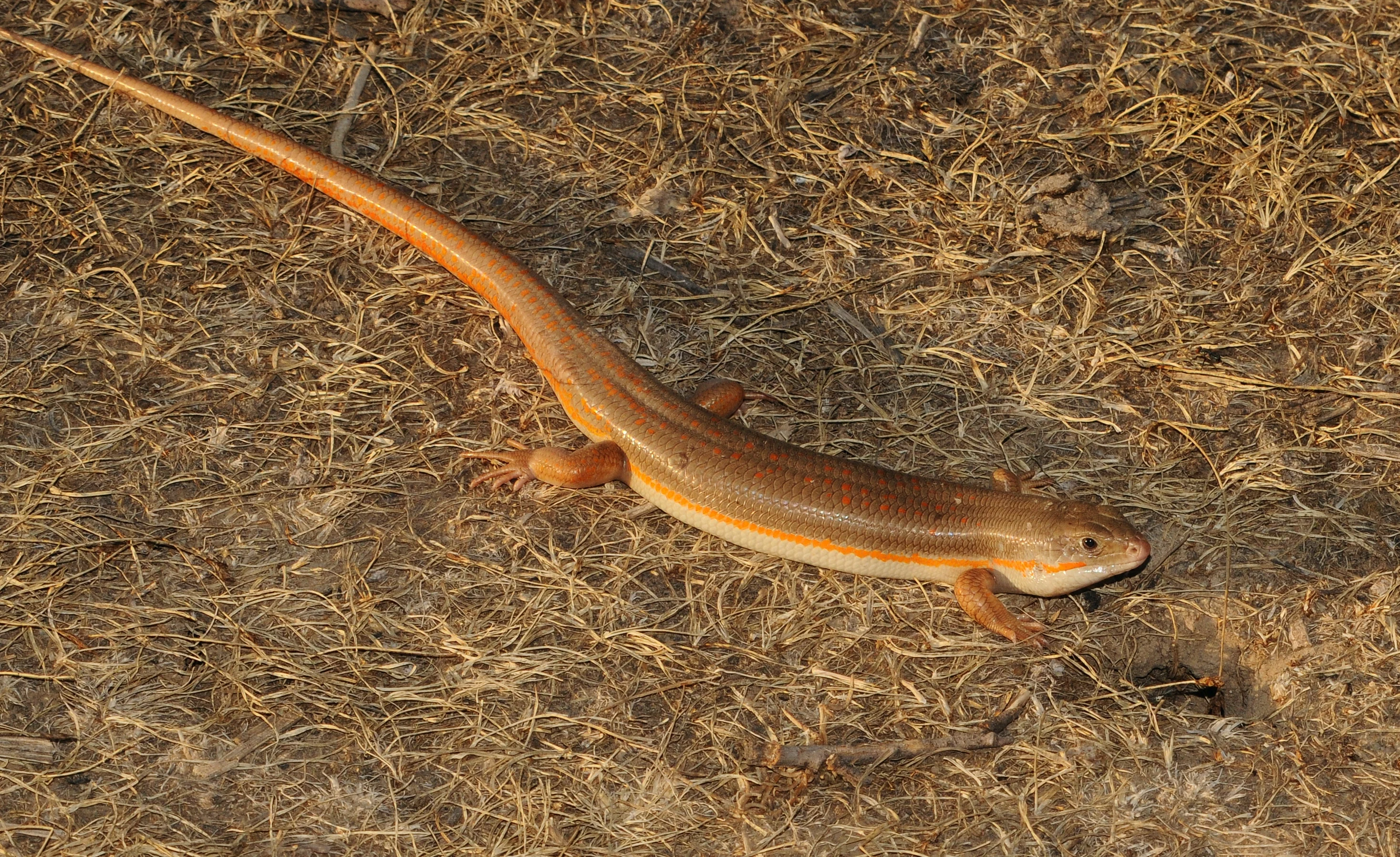
Schneider’s skink (Eumeces schneiderii) is a medium-sized skink that looks as though orange spots have been scattered across a sand-colored body. It can appear unhurried while basking in the open, yet when alarmed it uses its low profile to slide rapidly into a crevice or burrow. Its broad range stretches from North Africa through western and Central Asia. Rather than representing empty dune seas, it is especially associated with dry transitional landscapes where soil, stones, and vegetation occur together. Powerful digging limbs, smooth scales, and a seasonal life cycle are combined in a single animal.
In the pet trade, “Schneider’s skink,” “Berber skink,” and “orange-spotted skink” are often used interchangeably. A commercial label or color form, however, should not be treated as a taxonomic species. This article follows the currently accepted name Eumeces schneiderii; combinations and spellings such as Novoeumeces schneideri and Eumeces schneideri are useful when searching older literature. Dealer copy was used only as a sign of current interest, not as evidence for natural-history claims.
Taxonomy and key facts at a glance
| Classification | Reptilia · Squamata · Scincidae · genus Eumeces |
| Scientific name | Eumeces schneiderii (Daudin, 1802) |
| Common names | Schneider’s Skink · Berber Skink |
| Range | Dry and semi-dry regions of North Africa, the eastern Mediterranean, western Asia, and Central Asia |
| Size | Usually about 30–45 cm total length; varies with tail condition and population |
| Activity | Primarily diurnal; greater use of mornings, late afternoons, and burrows in extreme heat |
| Diet | Omnivorous, centered on insects and other invertebrates with some plant material |
| Reproduction | Oviparous; reproduction is synchronized with seasonal climate |
| Conservation | IUCN Least Concern (2009 assessment) |

.jpg)
Names and taxonomy: why the genus changes in older books
François Marie Daudin described the species in 1802. It was long placed in a broad concept of Eumeces, but a system that grouped many Old World and New World “long-legged skinks” together did not fully represent their evolutionary relationships. Some authors therefore separated the western Asian lineage as Novoeumeces, leaving Novoeumeces schneideri in husbandry books and trade records. The Reptile Database currently treats Eumeces schneiderii as the valid name. Records ending in -ii or -i may refer to the same species, so locality and original context should be checked.
Subspecies schemes also differ among references. Names such as E. s. schneiderii, E. s. aldrovandii, and E. s. princeps have been used for regional populations, but the species’ broad, fragmented distribution and limited genetic sampling mean that not every boundary has equal support. Recent work indicates that morphological and life-history differences among Iranian and Central Asian populations may be more than simple color variation. Boundaries may change as specimen and genomic coverage improves, so captive animals should not be assigned to a subspecies from appearance alone.
Range: a long belt across three continents
The range begins in North Africa and extends through Sinai and the Levant, parts of Arabia, the Iranian Plateau, the southern Caucasus, and Central Asia. A country list can make it look like one continuous population, but suitable habitat is broken apart by mountains, deserts, farmland, and river valleys. Animals near sea-level Mediterranean scrub and those on inland upland steppe experience very different winter lengths, rainfall seasons, and summer maxima.

Nor is every colored area on a range map occupied at equal density. The animal needs diggable soil, nearby sun and shelter, and vegetated edges where prey accumulates. New records near the northeastern edge of the range, including Kazakhstan, show that the species can use more varied dry landscapes than once expected. A single record, however, is not proof of a large stable population; coordinates, season, numbers, and repeated observations all matter.
Habitat: diggable margins rather than empty sand desert
Typical habitats include semi-desert, dry steppe, open scrub, stony alluvial soil, farm margins, and low hills. The key is not “dryness” alone but a combination of structures. Exposed patches provide heat, shrub roots and stones offer refuge from predators and extreme temperatures, loose soil permits burrowing, and post-rain pulses of arthropods create brief periods of abundance. Small vegetation patches and topographic variety can therefore matter more than a uniform expanse of bare sand.
A burrow is more than a bedroom. By day it serves as a cooling chamber, at night it buffers rapid heat loss, and in drying winds it reduces water loss. Conditions only a short distance below the surface change more slowly than the air above. On days when no skinks are visible, they may not have left the area at all; they can be waiting underground for a favorable window.

Appearance: orange spots, a streamlined body, and digging limbs
Adults are olive-brown, gray-brown, or sandy brown, with rows of small orange to reddish spots along the flanks and edge of the back. The head is broad, the snout blunt, and the neck blends smoothly into the trunk. Glossy scales reduce friction while the animal passes through soil and crevices. The underside is usually pale, while the contrast and extent of orange vary considerably among individuals and regions.

.jpg)
Juveniles may show stronger bands and spots and a more vivid tail than adults. Because these colors soften with age, a juvenile photograph should not be treated as evidence of a separate species or “morph.” The four limbs are relatively well developed for a skink and the toes are long, useful for pushing loose soil and moving quickly over stone. The tail may exceed the trunk in length and contains important tissue for energy storage and movement, so it must never be grabbed or pulled.
Size and records: tail condition comes before the number
Adults are commonly reported at about 30–45 cm in total length, with large animals near the upper end. Total length in a skink, however, changes dramatically with an intact, regenerated, or partially lost tail and with how the animal was positioned. Meaningful comparisons record snout–vent length (SVL), tail length, and mass separately. Online “maximum size” claims often omit methods and specimen data, so measured research or museum specimens deserve priority.
Body size is also shaped by local climate and the seasonality of food. An animal with a long growing season cannot be compared simply by age with one whose activity is shortened by winter or extreme summer heat. A 2024 life-history study that included orange-tailed populations in Iran showed that geographically separated groups can differ in growth and reproductive strategy alongside their environments. One species does not necessarily grow at one universal rate or to one uniform size.
Daily rhythm: commuting among sun, overheating, and burrows
The species is mainly diurnal and raises its body temperature in direct sun or on warmed ground. “Diurnal” does not mean continuously exposed. It may appear near a burrow entrance or on stone in the morning, retreat when midday surfaces become dangerously hot, and emerge again in late afternoon to forage. Cloud cover, wind, soil moisture, and predators can change exposure time even within one day.

In northern or upland parts of the range, activity falls sharply in the cold season and animals remain sheltered for long periods. In very hot southern areas, summer overheating may be a greater constraint than winter cold. Such seasonal dormancy is not merely sleep; reduced metabolism and movement help the animal outlast an unfavorable period. A sudden increase in sightings after rain or warming can occur because many hidden animals use the same short activity window.
Diet and hunting: finding opportunities in the soil
In the wild it primarily eats beetles, grasshoppers, larvae, spiders, and other arthropods, while taking small mollusks and other available animal matter. Records of fruit or tender plant material place it closer to omnivory than strict insectivory. The balance of plant and animal foods changes with season, locality, and body size; a fixed captive feeding ratio should not be projected onto every wild population.
Foraging relies less on long high-speed pursuit than on searching the ground, litter, and shrub roots with scent and vision. The snout can push soil aside while the forelimbs expose hidden larvae. After rain brings prey to the surface, feeding opportunities can rise briefly. Strong jaws help process tough exoskeletons, but do not mean that prey wider than the animal’s head is safe to swallow.
Defense: vanishing, biting, and a detachable tail
The first defense is to avoid detection. Sandy colors break up the outline among soil and gravel, and a low posture blends with shadows beneath shrubs. Once discovered, the skink rushes to a nearby crevice or burrow and twists its body to resist extraction. If caught it may defecate, roll, or bite forcefully. It is not venomous, but strong jaws and sharp teeth can injure careless hands.
Like many skinks it can autotomize the tail. The detached tail continues moving and distracts a predator while the body escapes. It can regrow, but the original shape and scale pattern may not return fully, and regeneration costs energy and time. Tail loss is therefore an expensive survival payment, not a harmless trick. A short blunt tail in a photograph should prompt consideration of regeneration before a different subspecies is proposed.


Reproduction and life history: using a short favorable season
Schneider’s skink is oviparous. In temperate and upland populations, mating and yolk development follow reduced winter activity as temperatures rise and prey becomes abundant. Females place eggs in stable sites within soil or burrows. Clutch size and egg size vary with female size, locality, and conditions that year, so a number from one source should not be treated as a universal constant without population context.
Hatchlings have stronger pattern contrast than adults and begin foraging independently. Prolonged feeding or guarding of young has not been established; maternal choice of nest temperature and moisture is more important to embryo survival. Small bodies heat and cool quickly and face a wider range of predators, so juveniles make heavy use of tightly spaced shelter and microhabitats rich in small prey.
Relationship with people: a familiar pet with incomplete trade records
Its calm-looking appearance and orange markings have kept it in the international pet trade for decades. Historically, many animals were wild-caught and sold without precise locality, subspecies, age, or import records. Captive-bred animals with lawful provenance should be prioritized, and scientific names and individual histories matter more than sales labels. Wild collection can pressure local populations and also brings risks associated with parasites, dehydration, and transport stress.
Around farmland it may share an indirect benefit with people by consuming insects, yet pesticides, clearing, and roads are hazards. Removing every stone pile and shrub eliminates both shade near burrows and the prey base. Some individuals also use gaps in artificial structures or irrigated margins, so responses to human landscapes are not a simple choice between “adapts” and “disappears.”
Conservation status and unanswered questions
The 2009 IUCN Red List assessment classified the species as Least Concern, citing its broad range and occurrence in protected areas. “Least Concern” does not mean threat-free. Local collection, agricultural intensification, soil disturbance, road mortality, and pesticide exposure can disappear inside a range-wide average. An older global assessment should not be used as a certificate that every present-day population is secure.
Key questions include how strongly distant regional populations remain connected, where traded animals actually originated, and how climate change alters activity seasons and nesting success. Citizen observations, museum specimens, and lawful captive records are most useful when dates, locality, and photographs are documented accurately. Sensitive wild localities should not be disclosed indiscriminately, and local law and researcher guidance must be followed.
Distinguishing similar species
- Against other Eumeces, consider orange flank spots together with head proportions, scale arrangement, and verified locality.
- Blue-tongued skinks have a much heavier trunk, proportionally shorter limbs, and different tongue and head morphology.
- Lighting and editing strongly alter trade photographs, so color alone is not an identification.
- If the tail is short, check for regeneration after autotomy before proposing a different species.
Continue to husbandry guidance
Its movement among burrows, sun, and shade explains why captive care requires deep substrate and a genuine thermal gradient. See the Schneider’s Skink Care Guide for enclosure dimensions, measurement locations, UVB, diet, and health monitoring.
References
- The Reptile Database: Eumeces schneiderii. Taxonomy, synonyms, and distribution.
- IUCN Red List: Eumeces schneiderii. 2009 assessment.
- Life-history evolution in orange-tailed skink populations. 2024.
- Wikimedia Commons: Eumeces schneiderii. Source images, authors, and licenses.
Suggest an edit
Tell us which sentence may be incorrect and provide a verifiable source. Submissions are reviewed before publication.