Last updated 2026.09.29 · Edited by silveston · Compiled by an independent hobbyist without professional credentials
A Palm-Sized Forest Dweller in Armor
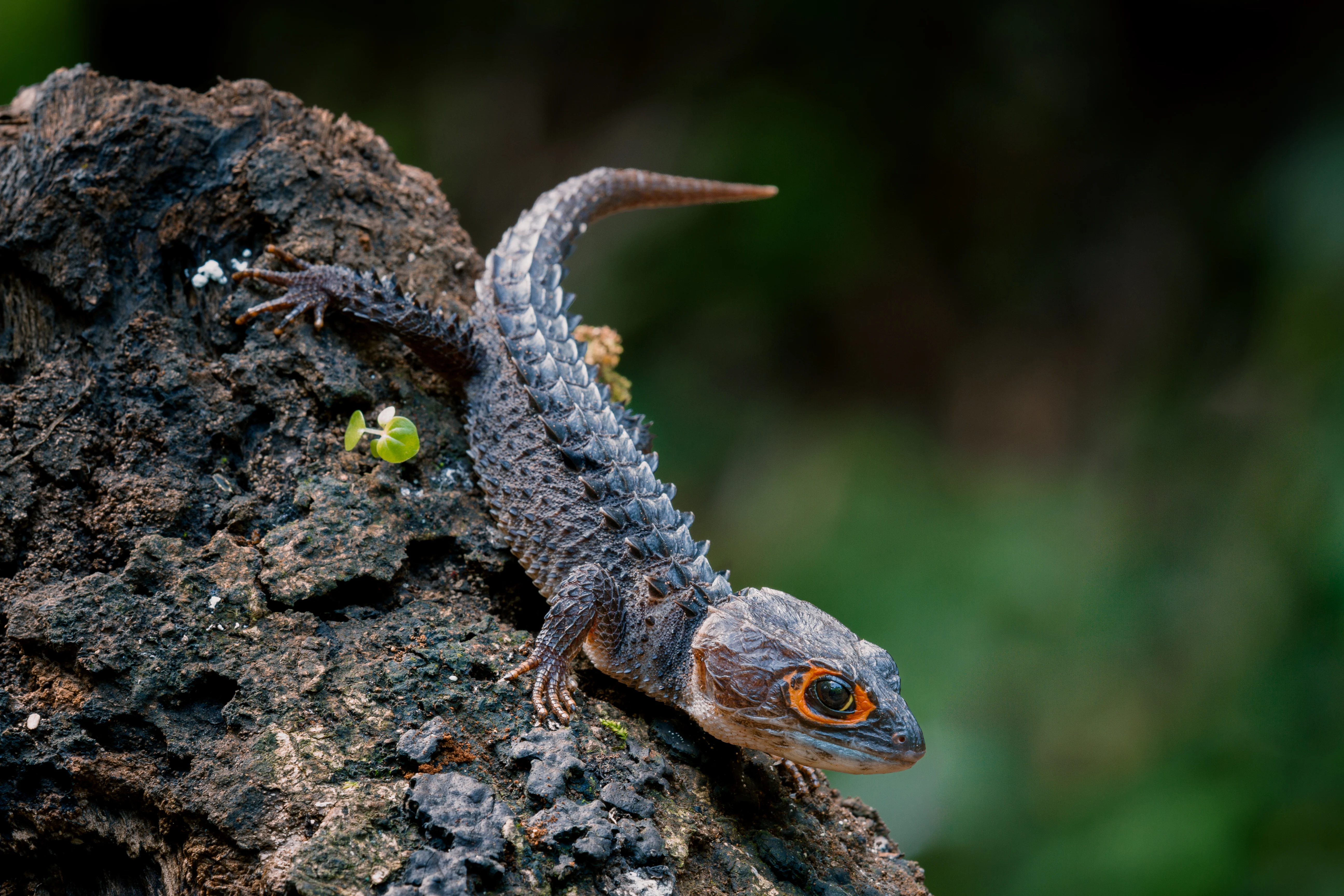
The red-eyed crocodile skink (Tribolonotus gracilis) is a small New Guinea forest-floor lizard, usually about 16–20 cm in total length. Its angular head, four rows of keeled scales, and orange-red eye rings create a crocodilian appearance, but the armor belongs to a secretive leaf-litter skink rather than a miniature aggressive predator.
Common and trade names vary. The Reptile Database recognizes T. gracilis as a valid scincid described by de Rooij in 1909. Identification should combine the eye ring, head and dorsal scales, and locality because T. novaeguineae can look similar.
The raised scales disrupt the outline among roots and leaves. Eye-ring intensity varies with age, condition, and lighting, so color alone cannot determine sex or health. Its defining behavior is a low, cautious passage across the forest floor followed by a sudden disappearance into cover.

Leaf Litter Beside Water in New Guinea
The species is native to New Guinea, especially lowland humid forests of Indonesian Papua and Papua New Guinea. It uses wet litter, mossy logs, soft soil, and root spaces near streams, pools, and seepages; studies describe crocodile skinks as secretive semi-fossorial lizards close to water.
A rainforest floor is not a permanently flooded tub. Air crosses exposed leaves while deeper substrate retains moisture, creating nearby choices between damp feeding edges, stable retreats, and relatively drier places. This moisture-and-ventilation mosaic matters more than one humidity number.
Flooding, drought, logging, and land use can rapidly alter the forest floor. Limited dispersal makes loss of logs and litter important even within remaining forest, although shaded secondary growth may still be used. Microhabitat continuity is more informative than a broad range polygon.

A Secretive Animal of Dusk and Night
Usually described as nocturnal, the species may also move at dusk and early morning depending on temperature, humidity, prey, and disturbance. It rests beneath cover by day and travels short distances between shelters after dark, which explains sparse observations and activity that keepers notice only indirectly.
Its low gait helps it enter litter. The tail supports balance and escape, and autotomy is possible. A regenerated tail differs in structure, scales, and color, so tail loss is a costly last defense rather than a routine event.
Secrecy is not inactivity. In darkness the skink explores, follows prey, and changes moisture zones. Repeatedly lifting shelters replaces normal behavior with freezing and escape; night cameras and tracks offer better observation.

Freezing as Defense—and a Lizard with a Voice
When escape fails, the skink may become rigid and motionless in apparent death-feigning. Spiny scales, a robust head, and dark coloration make seizure difficult, while sudden stillness may interrupt a visual predator. Concealment and avoidance normally precede biting.
Hartdegen, Russell, and Young documented vocalization in defensive and social contexts. Short squeaks can convey information, but sounds during restraint indicate distress and should never be provoked for entertainment.
Armor, immobility, calls, struggling, biting, and tail loss form a defensive sequence. Repeated calling or death-feigning in captivity means handling or housing is too stressful, not that the animal is becoming tame.

Small Hunts Beneath the Leaves
The diet consists mainly of insects and other small invertebrates from litter, including larvae, worms, arthropods, and mollusks. Short close-range strikes suit the low head and pointed teeth better than extended pursuit.
The skink is both predator and prey in the forest-floor web. It transfers energy from invertebrates to larger vertebrates, and even armored animals need immediate cover beside feeding sites.
Wild dietary data remain limited, so it is best regarded as an opportunistic insectivore of damp litter rather than a specialist on one insect. Captive diets should rotate well-fed feeder species instead of relying on one fatty larva.

Few Eggs, Greater Investment
A female generally lays one relatively large egg in or near a retreat rather than producing a large clutch. Timing and interval vary, and greater investment in fewer offspring fits a life centered on secure humid cover.
A 2001 study reported adults near eggs and juveniles, responses to threats, and close family association. This does not mean elaborate care is universal, but it challenges the idea that reptiles always abandon eggs; vocalization may help regulate social distance.
Hatchlings have less reserve for heat and hydration and need smaller prey. Their dependence on cover means repeatedly lifting a wild nesting log can be costly; leaving the microhabitat intact is the best field practice.

Relatives and an Evolutionary Map of Islands
Tribolonotus species occur across New Guinea and other Melanesian islands. Austin and colleagues used 2,252 bp from two mitochondrial and three nuclear genes to reconstruct the first genus phylogeny and examine biogeography and body size.
The history includes dispersal, island isolation, and ecological differences among lineages. Differences in microhabitat and size may help T. gracilis and T. novaeguineae coexist in New Guinea.
Taxonomy is a revisable hypothesis. Locality, legal origin, parentage, and breeding records should accompany a name; eye color in one photograph cannot replace the complex history of island populations.
Trade, People, and What Least Concern Means
The amended 2022 IUCN assessment lists the species as Least Concern, meaning evidence did not justify a higher category—not that threats are absent. Local trends and collection may be poorly known, while logging, conversion, fire, and hydrological change affect microhabitat.
International pet demand and a history of wild capture make documented captive breeding and legal origin important. Buyers should verify records and law rather than assuming that availability proves legality.
Wild-caught animals may experience transport, chilling, dehydration, and crowding. A South Korean Aeromonas hydrophila mortality report noted that capture, transfer, and low temperature may have contributed, supporting quarantine and veterinary assessment without turning one case into a universal diagnosis.
Microclimate Choices Matter More Than Size
A total length around 16–20 cm conveys scale, but body shape and tail condition alter the impression. Any record maximum must state whether it is snout–vent length or total length and whether it came from a wild specimen or captive animal. Ecologically, the useful question is how a small body selects crevices and gradients, not which individual was largest.
Temperature and moisture change across only a few centimeters of forest floor. Moss, hollow logs, leaf surfaces, soil, and stream margins offer different microclimates that allow thermoregulation, hydration, and escape. Field records should therefore document the exact shelter, not merely regional weather.
This perspective also clarifies climate and habitat threats. Loss of canopy, litter, and fallen wood may erase cool humid refuges before a regional average seems extreme. Protecting forest connections, riparian vegetation, and coarse woody debris preserves the structure and moisture needed by hidden reptiles.
Respecting the Time It Spends Unseen
Red eyes and armor attract attention, but hidden time defines the ecology. Damp litter near water, stable retreats of different depths, and small prey must coexist for normal behavior.
Replace lifted logs, avoid repeated capture and flash, and protect precise coordinates where collection is a risk. Good records document time, weather, microhabitat, and undisturbed behavior rather than manufacturing a dramatic image.
This is not a primitive miniature crocodile but a modern island skink with vocalization, parental behavior, and layered defenses. Understanding it requires seeing New Guinea forests and trade pathways alongside its appearance.
Read Next
References
The Reptile Database: Tribolonotus gracilis
Suggest an edit
Tell us which sentence may be incorrect and provide a verifiable source. Submissions are reviewed before publication.