Last updated 2026.10.15 · Edited by silveston · Compiled by an independent hobbyist without professional credentials
A small bearded dragon with a complicated name


Rankin’s dragon belongs to Pogona, the same genus as the central bearded dragon, but it is not simply an undersized bearded dragon. The currently accepted name is Pogona henrylawsoni Wells & Wellington, 1985. Korean trade names such as Rankin’s dragon and dwarf bearded dragon usually refer to this species. A small individual of another Pogona species, or a hybrid, should not be assumed to be the same animal.
English names include Rankin’s dragon, Lawson’s dragon, black-soil bearded dragon and Downs bearded dragon. “Black soil” describes its habitat, not its scales. The scientific epithet honours the Australian poet Henry Lawson. The Reptile Database treats Pogona brevis as a synonym, while the circulated name Pogona rankini was never established as the accepted scientific name.
The tangled naming history shows how knowing a living animal does not immediately settle priority among published names and specimens. After the 1985 description, some authors still treated it as undescribed. In 1994, P. brevis was proposed after the original type was thought to be lost. Because that holotype was not actually missing, current usage retains the earlier P. henrylawsoni.
Compared with the central bearded dragon P. vitticeps, this species is smaller, with a shorter, rounder head and a less developed throat ‘beard’ and flank spines. Similar appearance does not mean that enclosure size, social tolerance or temperatures can be copied without thought. Captive hybridisation between the two has been reported, so a seller’s label alone cannot prove pure ancestry.
This account separates observations in the wild from captive experience. Its most detailed field source is Turner and Valentic’s account of 14 lizards seen in western Queensland in 1996 and published in 1998. The observations are vivid, but they came from two days along roadsides. A behaviour not seen in that short survey should not be declared impossible.
Patterns, size and rapid colour shifts


Adults are often described as about 25–30 cm in total length, but separating body and tail measurements makes comparisons meaningful. In seven lizards measured by Turner and Valentic, mean snout–vent length (SVL) was 121.3 mm; the mean intact tail length was 133.2 mm. Thus a 12 cm body and a 25 cm total length are compatible descriptions. A damaged or regenerated tail should not be used to claim a record total length.
The same small field sample averaged 72.6 g. Seven animals in one period cannot establish an ideal weight for the species. Earlier adult measurements included a male with an SVL of 148 mm and a female of 152 mm. ‘Up to 30 cm’ does not mean every individual reaches that length. Sex, locality, growth history and tail condition all influence the number.
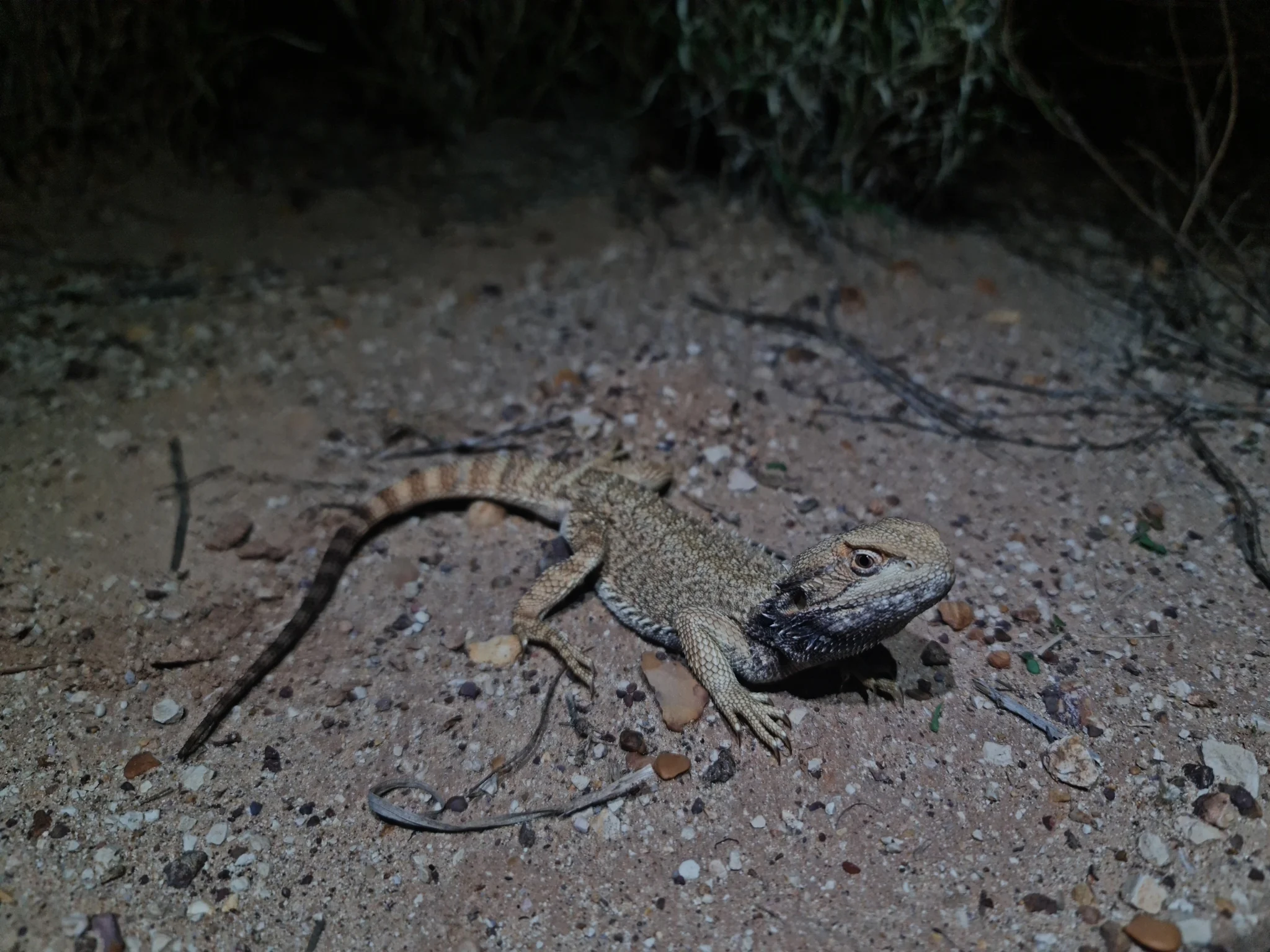
The back ranges from yellow-brown to grey-brown, often with five or six pale oval blotches on either side of the spine. Dark bands repeat along the tail; 13–19 were recorded in the field sample. Up close the body is squat and sturdy, while the spines are smaller and sparser than the central bearded dragon’s dramatic armour. On the broad black-soil plains, its colours blend into the ground rather than advertise it from afar.
The iris is usually golden, sometimes tinged red-brown. A gaping animal may reveal a surprisingly lemon-to-orange mouth and bright orange tongue. There is no reason to frighten a wild lizard deliberately to see this. An open mouth can be associated with thermoregulation or with a threat display when cornered; its whole posture and surroundings matter.
Colour is not permanent paint. In the 1998 account, one captive individual’s belly changed from white to grey-brown mottling within about 5 minutes, while three others changed from yellow-brown at capture to dull grey-brown by the next morning. Light, temperature and stress changed together, so no single cause can be proved. This rapid change alone is not evidence of a morph or disease.
Life on a nearly treeless black-soil plain


The species is centred on central-western Queensland, Australia. The Reptile Database and Queensland government records recognise it there. Turner and Valentic described black-soil country from Gregory Downs towards Longreach and Aramac. Calling it merely an ‘Australian desert lizard’ misses the defining feature: clay plains that split into deep cracks when dry.
During the 1996 survey, drought left the landscape nearly treeless and shrubs sparse. Mitchell grass can grow there, but little remained during the visit, leaving dark brown soil exposed. The friable surface held clear footprints and opened into deep fissures and labyrinthine cavities. These cracks are not just scenery: they offer three-dimensional refuge from heat and danger.
The narrow verge between road and fence held more rounded stones than the surrounding land, possibly exposed during road construction. A human-made edge may thus have supplied basking stations, but not without a cost. The team also recorded lizards on the bitumen and one road-killed individual. Visibility near a road does not prove that the species prefers roads or is rare farther into the plain.
Despite the word ‘dragon’, this is not an animal of tall trees. Most lizards in the survey basked on low rocks; one perched on a branch about 0.4 m above ground. None was observed on fence posts. That does not mean it cannot climb. The evidence better supports use of modest vantage points near shelter than a life high in the canopy.
Air temperature during observations was 29.0–37.4°C and relative humidity 31–42%; one ground reading was 42.3°C. These are measurements of air and ground at particular moments, not instructions to heat an entire enclosure to 42.3°C. In the wild the lizard could move between hot surfaces and shaded cracks. The crucial captive principle is choice among temperatures and refuges, not one isolated number.
Hide first; raise a small beard if cornered


When a person approached in the field, some lizards flattened themselves against soil or rock. Staying still while watching the intruder allowed grey-brown markings to dissolve into the surface. Researchers could pick up three animals using this cryptic posture and approached another to about 0.5 m. Avoiding detection, not attacking, was one first response.
Others descended from basking rocks and hid behind them or ran into nearby soil cracks and burrows. Shelter was often beside the rock, although one lizard crossed roughly 12 m of open ground to reach a burrow. Another was visible about 0.3 m vertically below the surface in a crevice. A plain that appears simple from above is a maze of entrances at lizard scale.
When escape was blocked and an animal was restrained, the response changed. It broadened its body, erected its modest throat beard and gaped to appear larger. Several made jumps of less than 10 cm towards an overhead object and attempted to bite. Marketing descriptions such as ‘gentle small dragon’ do not mean it is safe to grip one tightly.
Head-bobbing and arm-waving are familiar Pogona signals, but species-specific field data on when and how often this dragon uses them remain limited. We do not present signals absent from this survey as its defining wild behaviour. Captive observations also should not automatically become claims about territorial life in nature.
No obvious juveniles were identified among the 14 lizards in the 1998 field survey. This does not show that young were absent. Smaller animals might use different places or be less likely to appear during the survey. Two days of observations along a road cannot reveal the population’s age structure. Resisting that leap makes the field story more, not less, interesting.
What remains unknown about food and breeding


There is a surprisingly important blank in accounts of wild food. Turner and Valentic explicitly noted the shortage of information on natural diet, predators, growth and population structure. A captive animal eating crickets and greens does not prove that a particular insect, seed or flower is its staple in the wild. Invertebrate foraging is plausible on grassy soil plains, but species-specific stomach-content or direct field data are needed to establish precise prey and proportions.
Captive guidance treats the species as an omnivore offered insects and leafy vegetables. Proportions change with age and body condition, and a captive menu is not proof of a wild menu. One animal’s preference for mealworms or refusal of greens is not the diet of an entire species. This distinction is easy to miss but central to a natural-history account.
Current taxonomic sources record this lizard as egg-laying. Older literature mentions gravid females in January, during the Australian summer, but the October 1996 field visit found no animal whose reproductive state could be confirmed. A laying calendar from northern-hemisphere captivity cannot simply be copied onto wild southern-hemisphere breeding. ‘Every spring, exactly this many eggs’ is not a defensible summary.
Bowling Green State University’s captive-care summary reports 5–18 eggs in a clutch, laying 2–3 weeks after breeding and potentially multiple clutches in a season. These are captive-care figures, not a measured wild average. They suggest the need for a suitable laying substrate and secure refuge in husbandry, but they do not demonstrate parental care or nest revisits in nature.
Temperature-linked sex reversal has been studied in the central bearded dragon P. vitticeps. It should not be transferred to P. henrylawsoni as though sex determination had been established for this species. Close relatives can differ in reproductive physiology. Where direct species-level evidence is lacking, stating that gap is the accurate natural history.
What research reveals about people and this dragon


The field authors compared wild adults with a few captive hybrids. The small hybrid sample tended to be larger, but different conditions and limited numbers mean body size alone cannot diagnose hybrid ancestry in a wild lizard. Trade animals should not be assumed incapable of hybridising with P. vitticeps. Equally, unusual colour or a broad head does not prove that every such individual is a hybrid.
Reducing conservation status to ‘common, so no concern’ would be careless. An IUCN Least Concern assessment is not a statement that road mortality or local habitat change is irrelevant. The image sources include individuals from different dates and observations; unlike copies of one product photo, they offer a glimpse of variation among real animals.
One striking point in the survey is the overlap between rocks exposed by people and basking by wildlife. Stones can collect warmth while the nearby road can become a lethal route. Using low sunny perches next to soil fissures might work temporarily in such modified habitat. Measuring the benefits and risks requires comparative surveys away from roads.
In captivity, Australian origin must be distinguished from the provenance of a traded animal. A sales photograph may start identification but cannot prove legal origin, ancestry or health. Check current transfer and import documents, and clearly label whether an image or observation comes from the wild or from captivity.
Rankin’s dragon is more than a ‘small beardie’. It basks on low rocks, flattens into black soil and, when trapped, reveals a modest beard and vivid mouth. Yet its wild diet and the lives of juveniles remain incompletely known. Showing both the confirmed scenes and the gaps gives a clearer portrait of the species.
Read the care guide for this species
References
- The Reptile Database — Pogona henrylawsoni
- Turner & Valentic (1998), Observations on Pogona henrylawsoni
- Queensland Government WildNet — Pogona henrylawsoni
- Western Sydney University — The care of central and pygmy bearded dragons (2020)
- IUCN Red List (2017) — Pogona henrylawsoni, Least Concern
Suggest an edit
Tell us which sentence may be incorrect and provide a verifiable source. Submissions are reviewed before publication.