Last updated 2026.10.06 · Edited by silveston · Compiled by an independent hobbyist without professional credentials
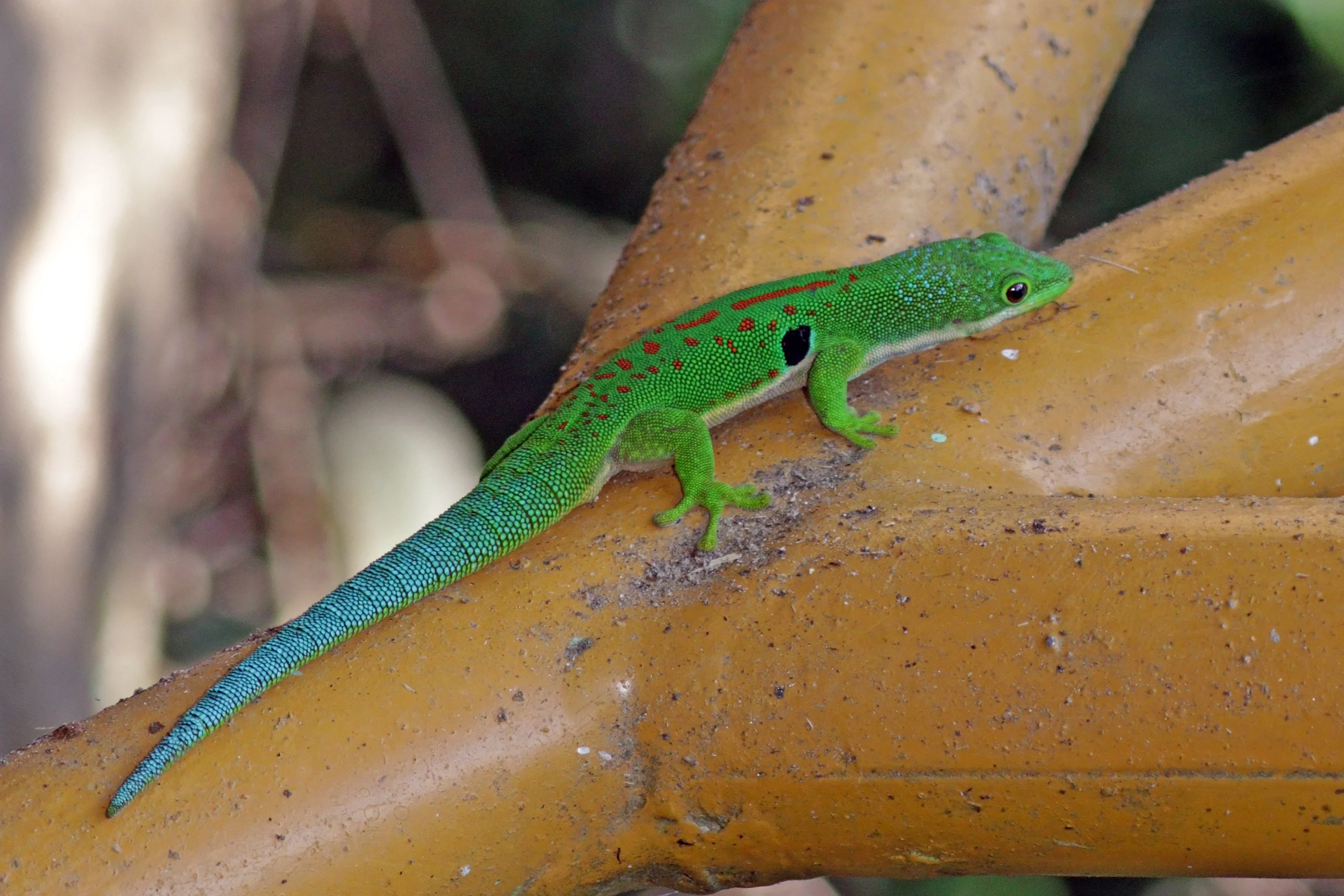
Phelsuma quadriocellata is a small day gecko from eastern Madagascar. It is sold as the peacock day gecko and also called the four-spotted day gecko for its dark flank ocelli. Its real distinction is the way it integrates light, vertical space, food, and defense.
Adults are commonly about 12–13 cm long, varying with sex, population, condition, and tail regeneration. The small body favors short jumps among leaves and stems. Captive parameters are in the peacock day gecko care guide.
Peacock day gecko at a glance
| Scientific name | Phelsuma quadriocellata (Peters, 1883) |
|---|---|
| English names | Peacock day gecko, Four-spotted day gecko |
| Classification | Squamata · Gekkonidae · Phelsuma |
| Range | Endemic to eastern Madagascar |
| Size | Adults commonly about 12–13 cm |
| Lifestyle | Diurnal and arboreal |
| Diet | Small arthropods, nectar, and fruit juices |
| Conservation | IUCN Least Concern (2011), CITES Appendix II |
Day geckos exploit bright daylight within a largely nocturnal gecko radiation. Vision, color, thermoregulation, and territorial behavior function together.
Useful size records include snout–vent length and tail condition, because a regenerated tail changes total length. Measurement context matters more than one maximum figure.
“Peacock” is a useful trade name, not a taxonomic unit. Records should include the scientific name, parent origin, and hatch information rather than treating morph labels as species.
Four ocelli and changing green


Dark oval spots edged in blue or turquoise lie between the limbs. Four visible ocelli inspired both quadriocellata and the peacock name, though size and color vary.
The back ranges from green to blue-green with fine red or brown marks. Temperature, light, stress, health, and camera white balance all alter apparent color.
Green can camouflage at distance while red and turquoise marks signal at close range. Camouflage and display can coexist depending on distance and posture.
The ocelli may affect predators, but direct tests are limited. They are best described as key identification marks and possible defensive signals.
An endemic of eastern Madagascar


Its native range is restricted to eastern Madagascar, where rainfall, elevation, and vegetation shift rapidly. Apparently continuous forest is a mosaic divided by rivers, roads, farms, and ridges.
Endemic means naturally found nowhere else. Captive animals abroad do not expand the native range, and records must distinguish wild, captive, and introduced settings.
Rivers, dry zones, ridges, and forest gaps can isolate a small arboreal animal. One species name does not erase regional variation or the need for provenance records.
Madagascar’s isolation produced exceptional reptile endemism. Captive animals elsewhere cannot replace a lost local population’s ecological role or evolutionary history.
Forest, Pandanus, and farm edges


Most activity occurs above ground among trunks, leaves, shrubs, and broad-leaved plants. Crevice-rich Pandanus can combine shelter, egg sites, droplets, and feeding surfaces.
The species also uses secondary growth, plantation margins, and gardens. This tolerance does not make habitat loss harmless; usable structure and microclimate must remain.
Edges offer sun and insects but expose the gecko to birds, lizards, spiders, and rapid night cooling. Dense routes permit short jumps and immediate cover.
Walls and fences may provide sun and insects, but pesticides, cats, collisions, pruning, and night lighting add hazards. Occurrence in modified habitat is not a preference for disturbance.
Daylight vision and territorial behavior
The gecko finds prey visually and manages social distance through posture and head movement. Males watch from elevated perches and may present the flank or chase.
Resource exclusion can occur without obvious fighting. A subordinate confined below may lose heat, UVB, and food, especially in a small enclosure.
The eyes have no movable lids and are covered by a clear spectacle. Licking cleans dust and droplets; damage can impair feeding and movement.
Artificial light can induce nocturnal activity in some day geckos, but genus-level evidence does not make this species nocturnal. Darkness and rest remain necessary.
The physics of adhesive toes


Microscopic setae beneath the toes approach surfaces closely. Weak molecular forces across a vast area provide adhesion without liquid glue.
Oil, wet soil, sticky fruit, water films, and dust reduce adhesion despite some self-cleaning through repeated steps.
Claws grip rough bark while pads handle smooth surfaces. The combined system links many textures in the forest.
Adhesion is essential to escape, feeding, and thermoregulation. Retained shed or toe damage can restrict all three.
A hunter that also seeks sweetness


It visually detects small insects and spiders and attacks in short bursts. Vision and adhesion work together during capture.
It also licks nectar and fruit juices. Plant sugars add flexibility but do not make the gecko a fruit-only herbivore.
Pollen may adhere during flower visits, but visitation alone does not prove indispensable pollination of a named plant.
Different foods elicit different search behaviors. Captive prepared diets should never be described as natural wild foods.
Two eggs, hidden crevices, independent hatchlings


Females commonly produce two eggs and place them in concealed leaf axils, bark gaps, or hollow stems.
Rainfall, food, light, and female condition shape reproduction. Captive schedules are useful but do not equal wild seasonality.
Hatchlings receive no active parental care. The female’s choice of a protected microhabitat is still a major reproductive investment.
Hatchlings cool faster and require tinier prey. Their microhabitat and energy balance differ from those of adults.
Subspecies and changing names
Recognized subspecies include P. q. quadriocellata, P. q. bimaculata, and P. q. lepida. Former P. q. parva is now Phelsuma parva.
Taxonomy integrates pattern, scales, geography, and genetics. Species elevation changes conservation, breeding, and trade records.
Synonyms such as Pachydactylus quadriocellatus and Phelsuma bimaculata connect historical records, while the valid name prevents duplicate counting.
A photograph alone cannot prove subspecies. Reliable locality claims require continuous parental and breeding records.
Distinguishing related day geckos
Many Malagasy day geckos are green. This species combines small size with dark flank ocelli.
Color alone is unreliable. Pattern, proportions, toes, locality, and several views are needed, while sensitive coordinates may require protection.
Juveniles, stress, and tail regeneration alter appearance. An uncertain genus-level identification is better than a confident error.
Trade names are leads, not evidence. Scientific identity must be checked against current databases and primary literature.
Conservation and CITES Appendix II
The IUCN assessed the species as Least Concern in 2011. The assessment is old, and local forest loss, fragmentation, and collection still matter.
CITES Appendix II regulates rather than completely bans international trade. Current national rules and permits must be checked.
Captive-bred claims require legal parent origin, hatch dates, transfers, animal condition, and continuous documentation.
Captive breeding cannot replace habitat conservation or the species’ ecological relationships in Madagascar.
Responsible encounters with people
Use of gardens does not make a wild gecko tame. Capture and baiting can damage it and disrupt established routes.
Record time, weather, perch height, and plant type from a distance. Sensitive coordinates should not facilitate illegal collection.
Reducing pesticides and retaining connected vegetation improves movement opportunities; heavy pruning and night lighting alter food, refuge, and rest.
The species links island evolution, wildlife trade, and biodiversity in modified landscapes. Pet interest gains value when connected back to native forests and provenance.
Observation points and common misconceptions
- Ocelli vary, so one spot cannot prove subspecies.
- Diurnal does not mean remaining under intense heat all day.
- Toe pads use microscopic physical interactions, not secreted glue.
- Fruit sugars do not make it a fruit-only herbivore.
- Least Concern is not threat-free, and CITES Appendix II regulates trade.
- Captive values require context before application to wild populations.
The peacock day gecko is more than four false eyes. Its real story is how color, feet, behavior, and reproduction evolved together in a vertical forest.
References
- The Reptile Database — taxonomy, synonyms, and range.
- IUCN Red List 2011 — assessment.
- CITES taxon page — Appendix II.
- Wikispecies — Peters (1883).
- Wikimedia Commons — images and licenses.
- DOI: 10.1111/aec.13012 — day geckos under artificial light.
- HERP.BLOG care guide — captive parameters.
Suggest an edit
Tell us which sentence may be incorrect and provide a verifiable source. Submissions are reviewed before publication.