Last updated 2026.10.13 · Edited by silveston · Compiled by an independent hobbyist without professional credentials
Summary: The Halmahera giant gecko, Gehyra marginata, is a large nocturnal gecko of the vertical forests of the northern Moluccas. This article explains its current taxonomy, island biogeography, form, behavior, diet, reproduction, conservation, and recent revision.
The Giant Gecko of the Northern Moluccas at a Glance

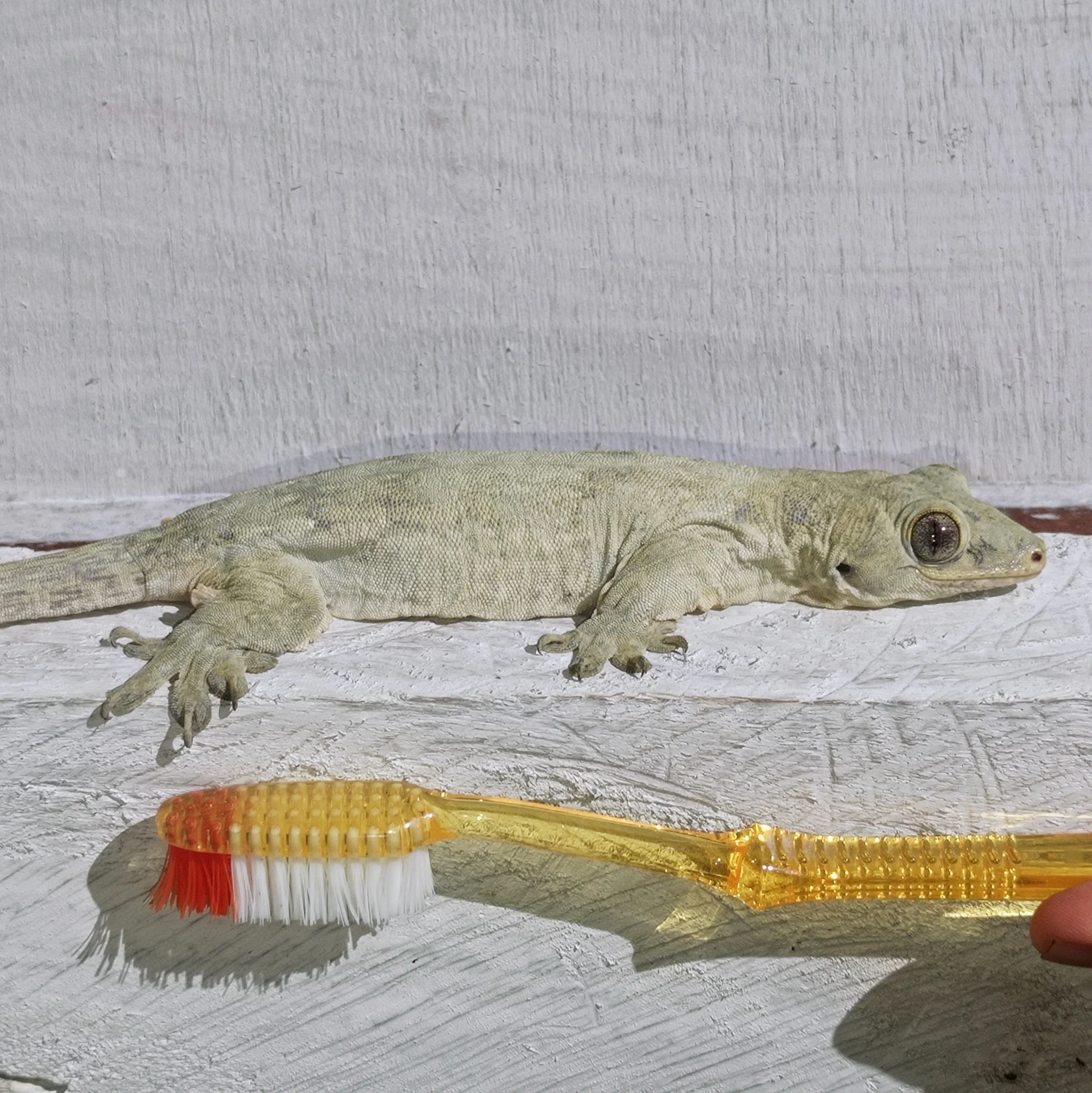
The Halmahera giant gecko is a large arboreal member of Gekkonidae. Adults exceed 130 mm in snout–vent length and immediately show a broad flattened body, stout tail, and widely spread toes. The body can shift from pale gray to deep brown, making the animal look different in a daytime refuge and on bark at night. Halmahera giant gecko, Moluccan giant gecko, and marginated gecko are all used in English, but the accepted scientific name is Gehyra marginata. Its importance lies not only in size but in a complicated taxonomic history that long placed similar New Guinea specimens under the same name.
| Item | Details |
| Accepted name | Gehyra marginata |
| Classification | Squamata · Gekkonidae |
| Secure range | Northern Moluccas, Indonesia, including Halmahera and nearby islands |
| Activity | Primarily nocturnal and arboreal |
| Key traits | SVL above 130 mm, broad toes, webbing, thick tail |
Names and Classification: The Persistent “vorax” Confusion
In the international and Korean trade, “Halmahera gecko,” “giant Halmahera,” and sometimes Gehyra vorax are mixed together. Yet G. vorax applies to a separate Fijian and western Pacific lineage, while the accepted name for the large Halmahera animal is G. marginata. Searches may also encounter historical combinations and synonyms such as Peropus marginatus and Gehyra fischeri. Trade names readily preserve morph labels, locality labels, and old misidentifications, so one photograph and a sales name cannot establish a species. Locality, toe scalation, body proportions, and reviewed specimen records must be considered together.
How a Giant Gecko Is Measured
Size records should prioritize snout–vent length (SVL) rather than total length. A tail may be lost during a predator attack or capture, and a regenerated tail is usually shorter and differently shaped. Adult G. marginata reveal their large size through a combination of SVL above 130 mm, a short broad head, a stout tail, and large adhesive pads. Sex, growth stage, and nutritional state also alter mass and proportions, so one “maximum centimeters” figure cannot define whether an animal is normal. Useful specimen records state SVL, whether the tail is original or regenerated, and the measurement conditions.
Color-Changing Skin and Camouflage
Skin color can range through pale gray, tan, olive, and deep chocolate, while the contrast of mottling and margins also changes. This is safer to interpret as a physiological response linked to background, light, body temperature, and stress than as a purely flamboyant chameleon-like signal. A dark animal at night and a pale one in a daytime refuge may look like different species, so color is only a supporting clue in photographic identification. Flattening the body against bark reduces the outline and can make even a large gecko disappear quickly. Toe structure, head proportions, and locality are more stable identification evidence than color.
Microscopic Engineering of Adhesive Toes

A gecko foot is not a suction cup creating a vacuum. Broad plates beneath the toes carry dense microscopic hair-like structures that exploit molecular forces at very close range, allowing adhesion even to smooth surfaces. G. marginata has broad digits and extensive webbing that spread its large body load across bark, leaves, and rock. Claws add purchase in rough crevices. The system is directional, and a running gecko curls the toe tips upward to release contact rapidly. Adhesion, claws, a low posture, and the balancing tail must work together for safe movement through a vertical world.
Northern Moluccan Range and the Removed New Guinea Records

The secure center of distribution is now Halmahera and neighboring islands in Indonesia’s northern Moluccas. Older sources mapped the species broadly into New Guinea and nearby islands, but Fred Kraus’s 2024 specimen revision separated the large New Guinea animals formerly called G. marginata into other species. This was not a minor cartographic correction; it redrew the lineage’s evolutionary history and conservation unit. Broad historical maps should therefore be checked against current specimen identifications. Trade phrases such as “New Guinea giant” cannot be assumed to match modern taxonomy.
Wallacea as an Evolutionary Laboratory
Wallacea is a mosaic of deep-water islands between the Asian shelf and Australasia. Even when sea level fell during glacial periods, many islands remained separate, and small founder populations that crossed the sea diverged in isolation. The long use of one name for Halmahera’s giant Gehyra and similar New Guinea animals shows how comparable forest settings can encourage convergence while limited specimens conceal differences. A record from one island is not merely a dot; it is a biogeographic clue involving straits, wind, rafting, and human movement. Understanding the range requires the depth and geological history of seas between islands, not only political maps.
A Vertical Life in Tropical Forest
This species moves chiefly through vertical structures—tree trunks, large branches, bark fissures, and sometimes high building walls—rather than across the forest floor. By day it wedges into close-fitting spaces or behind loose bark, then peers out after sunset. Tropical forest does not mean that every surface remains wet all day. Rapidly drying trunks after showers, breezy canopy zones, and humid cavities can occur within a short distance. The microclimate actually used by the gecko becomes visible only when wet–dry cycles, refuge depth, and nocturnal airflow are considered together rather than reduced to one average humidity number.
Nocturnal Patrols and a Sensory World
After sunset it leaves its refuge and patrols trunks with the body held low. Large eyes help detect small moving prey in dim conditions, while tongue sampling reads chemical information on surfaces and traces left by prey and other geckos. Geckos are often assumed to be silent, yet brief chirps, lower calls, posture, and tail movements can combine in warning and courtship. The wild vocal repertoire of G. marginata, however, has not been quantified adequately. Direct observations must be separated from comparisons with other geckos rather than transferred to this species as established fact.
Diet: An Opportunistic Nocturnal Predator

Quantitative studies of the wild diet are scarce, but the build and observations of a large arboreal gecko suggest opportunistic use of insects and other arthropods, with possible small vertebrates, soft fruit, or plant sugars. Moths, roach-like insects, crickets, beetles, and spiders are plausible prey on trunks and in the canopy at night, but a captive feeder list must not be presented as direct evidence of the wild diet. Hunting is more likely a short ambush and rush than a prolonged chase. Once movement is detected, the head steadies, the gecko closes the distance, and the broad mouth seizes the target. How seasonal and island-specific arthropod communities alter diet remains a valuable research question.
The Sequence of Defense Under Threat

The first defense is to go unseen. Flattened against bark-colored surfaces and slipping into a fissure, even a large animal can vanish quickly. If exposed, it flees and may inflate the body, gape, or vocalize to demand distance. When restrained it can bite with powerful jaws and twist; the nature of gecko skin means rough capture may cause tearing and serious injury. Tail autotomy can save a life but costs stored energy and a balancing structure and requires resources for regrowth. Defensive behavior is better read as a sequence for surviving predation than dismissed as an aggressive temperament.
The Tail and the Cost of Regeneration
The stout tail is not ornamental. It helps control body rotation around trunks and between branches and stores energy for periods of food shortage. Autotomy can distract a predator, but the regenerated tail does not reproduce the original bone and scale arrangement and may be blunter in shape. An animal that has lost its tail must restore both balance and energy reserves, potentially changing movement, growth, and reproductive investment. Recording tail condition with date and locality in wild photographs can provide indirect comparative evidence about predation pressure and recent experience.
Reproduction and Eggs: More Gaps Than Answers

General gekkotan patterns and captive observations suggest that a small number of hard-shelled eggs may be attached or concealed in a secure crevice. However, the wild laying season, annual clutch frequency, and temperature-specific survival and sex ratio of G. marginata remain inadequately tested. Exact dates and numbers from trader anecdotes should not become universal rules for the species. Field research is needed to learn whether wet seasons and prey increases change breeding, whether communal laying sites occur, whether adults remain near eggs, and whether juveniles use different heights. Lack of confirmed parental behavior must also be distinguished from proof that parental care is absent.
The Different World of Juveniles
A hatchling resembles a miniature adult, but its ecological constraints differ. A small body loses water faster, enters fine branches and narrow fissures unavailable to adults, and selects much smaller prey. Rapid growth brings frequent shedding, and retained skin on toe tips can immediately impair locomotion. Growth reflects the combined effects of food quality, hydration, disease, and competition—not temperature alone. Making an animal grow quickly is not the same as making it healthy; excess calories may increase mass faster than the skeleton and organs mature. Wild longevity and age at maturity remain uncertain because long-term mark–recapture evidence is scarce.
When Individuals Meet
Encounters can be tense where secure refuges and feeding routes are limited in vertical space. A large male may guard a route or chase an approaching animal, while a smaller individual can be displaced from food and warm positions without an obvious fight. Brief proximity in the wild does not prove sociality. Even use of the same crevice must be separated into preference versus a shortage of safe sites. Color, posture, tail movement, short calls, and escape direction should be recorded together to interpret an interaction. For an understudied species, stating what remains unknown is more valuable than offering a persuasive personality story.
Distinguishing Similar Giant Gehyra
Large Gehyra can look extremely similar in photographs because they share broad feet, smooth skin, and gray-brown patterning. G. marginata is diagnosed by combining large size, a relatively short broad head, a stout tail, extensive toe webbing, and the arrangement of subdigital pads. No single trait should decide an identification; adult size, sex, tail regeneration, and precise locality must be considered together. Museum taxonomists carefully count whether plates beneath the toes are divided, how rows are arranged, scale numbers, and body proportions. If these characters are invisible in a photograph, stopping at “Halmahera-type giant Gehyra” is better than spreading a false identification.
When Museum Specimens Begin to Speak Again
The central achievement of the 2024 revision was not merely adding another name. Recomparison of toe plates, body size, scales, and locality showed that New Guinea “Halmahera giant geckos” stored under one name were an assemblage of different species. Museum specimens are traces of past expeditions, but also biological archives that can be reread with new questions. Island names, collection dates, and preservation condition on old labels can all guide modern research. Even when genetic data are limited, careful morphology and geographic verification can reveal hidden diversity and show field researchers what to seek and where.
People: Lights, Buildings, and Trade
Artificial lights may gather moths and other insects, creating temporary feeding sites around buildings, while wall and roof crevices can substitute for bark cavities. Such flexibility means the animal can occur in human settings, not that natural forest is unnecessary. Large size and unusual skin also attract international pet-trade interest, but mislabeled stock and lost locality data blur both captive lineage management and research on wild distribution. Before acquisition, keepers should verify lawful origin, claims of captive breeding, transfer or import records, and body condition. Regulations and quarantine requirements can change, so authoritative guidance current at the time of trade takes priority.
Responsibility in Wild Collection and Captive Breeding
Wild-collected animals may experience dehydration, weight loss, parasites, skin injury, and prolonged stress during capture and transport. Remaining motionless on a surface does not necessarily indicate stability, and some animals enter trade without adapting to the new environment. Captive breeding can reduce pressure on wild populations, but without correct identification and pedigree or locality records it can spread hybrids and incorrect names. Responsible keeping extends beyond possessing an unusual animal. It includes lifetime welfare, access to qualified veterinary care, prevention of escape and release, plans for future custodians, and informational accuracy.
How to Read Its Conservation Situation
Conservation is not a simple choice between “common” and “rare.” If the accepted range is narrower than previously believed, the same number of observations has a different meaning for the total population. On Halmahera and nearby islands, forest conversion, mining, roads, settlement growth, and localized collecting may alter habitat connectivity. Records near buildings do not justify dismissing dependence on intact forest or the possibility of regional decline. An IUCN category summarizes evidence available at the time of assessment; it is not a permanent guarantee. When taxonomy changes, older assessments must be checked for whether they combined several species, and evidence must be gathered again within the revised range.
The Power and Limits of Citizen Science
Photographs from night walks can fill gaps in distribution and activity timing. Useful records include date, island and broad locality, height, surrounding vegetation or buildings, behavior, and original images. Several angles showing toes, head, back, and tail are especially valuable for identification. By contrast, one blurred image labeled only with a trade name can repeat an old mistake. Exact coordinates for rare animals or sites vulnerable to collecting should be withheld or obscured with platform tools. Citizen science does not replace expert review and specimen research, but it is a powerful starting point for deciding where to survey again.
Climate and Microhabitat Buffering
Climate change on tropical islands is not expressed only as a rise in mean temperature. Shifts in rainfall seasonality, intense rain, dry periods, and canopy damage after storms can alter refuge temperature and moisture together with the emergence of insect prey. Tree cavities and thick bark may buffer short extremes, but simplified forest reduces the menu of microhabitats. Learning what temperature and moisture G. marginata actually selects requires simultaneous measurements at body-contact sites and observations of behavior. A regional weather-station average cannot describe the night inside a bark fissure.
Questions Researchers Should Ask Next
Large ecological gaps remain even after basic taxonomy is clarified. Long-term work is needed on genetic connectivity among islands, height differences between juveniles and adults, seasonal shifts in wild diet, breeding season and laying sites, vocal signals, sex ratio, survival, and longevity. Mark–recapture, fecal DNA and stable-isotope analysis, autonomous recorders, and microclimate sensors on bark can fill different gaps. Study designs should compare settlements with intact forest, wet with dry seasons, and multiple islands. New evidence should update both husbandry practice and conservation assessment; maintaining revisable records matters more than defending old certainty.
A Natural-History Observation Checklist
When observing this species in the field, record location and behavior without touching the animal. If it is above eye level, do not pull it down; use magnified photographs to document toes, head, and tail condition. Minimize flash and avoid repeated lighting that disrupts hunting or escape. Include bark width or a known structure for rough scale rather than placing a ruler near the gecko. Weather, recent rain, time, height, surface type, surrounding lights, and the presence of other individuals turn an attractive photograph into ecological evidence. Eggs and refuges should not be opened, moved, or disturbed.
Why This Gecko Matters
The Halmahera giant gecko runs over walls on enormous toes, disappears into bark through color and posture, and carries the history of sea-separated islands in its body. It also shows how easily a widely repeated internet name can diverge from scientific identity. The removal of New Guinea records in the 2024 revision demonstrates that taxonomy is not a frozen list but a hypothesis responsive to new evidence. The most interesting question does not end with “How large does it grow?” A complete natural history asks on which islands it evolved, how it differs from look-alikes, and what evidence can resolve what remains unknown.
Principles for Observation and Records
- Do not identify the species from a trade name alone.
- Compare locality, toe structure, and current taxonomy.
- Use a provisional label for uncertain animals.
- Do not publish sensitive coordinates for wild animals.
Continue to the Care Guide
This article focuses on wild natural history and taxonomy. For vertical enclosure design, thermal gradients, ventilated humidity, UVB, feeding, handling, and health observation with measurement conditions, see the Halmahera Giant Gecko Care Guide.
References
- The Reptile Database: Gehyra marginata — accepted name, synonyms, and range.
- Kraus, F. (2024). Revision of the giant Gehyra of New Guinea and the Moluccas. Zootaxa. — morphological diagnosis and reassessment of New Guinea records.
- Wikimedia Commons: Gehyra marginata — original photographs and license metadata.
- IUCN Red List — assessment framework and conservation categories.
Suggest an edit
Tell us which sentence may be incorrect and provide a verifiable source. Submissions are reviewed before publication.