Last updated 2026.09.27 · Edited by silveston · Compiled by an independent hobbyist without professional credentials
A lizard crowned by the forest


A branch suddenly shakes beside a Central American stream. On it sits a green lizard with a tail far longer than its body. In a male, the crests behind the head and along the back and tail catch the sunlight like little sails. The green basilisk is famous for running on water, but it spends most of its day moving between branches and the bank, finding food and watching for danger.
Its scientific name is Basiliscus plumifrons. The current Reptile Database places it in Basiliscus and the family Corytophanidae. Some older zoo material lists it under Iguanidae, reflecting an earlier, broader grouping of iguanians. A different family label does not make it a different animal. The accepted species name and older usage need to be considered together to identify the same species.
The name plumifrons joins the Latin words pluma, meaning feather, and frons, meaning forehead. It refers to a thin crest on the forehead, not real feathers. The English names plumed basilisk and green crested basilisk also emphasize the crest. Korean names include green basilisk and plumed basilisk, while the nickname Jesus lizard comes from its run across water.
Basilisk is also the name of a mythical monster. The real lizard poses no such threat to people and tends to hide or flee rather than fight a predator. The mythical name and dramatic water-running footage attract attention, but the deeper interest lies in the way the animal quickly connects forest, trees and water. That ability is part of a much broader natural history than a single stunt.
Length needs a qualification: body and tail are different measures. The Smithsonian National Zoo reports that total length can reach about 90 cm. Much of that is the long tail, so its build cannot be compared directly with that of a stockier lizard of the same length. Most wild individuals will not reach a record size. Age, sex, condition and any tail damage matter when interpreting a length figure.
Green body and multiple crests

.jpg)
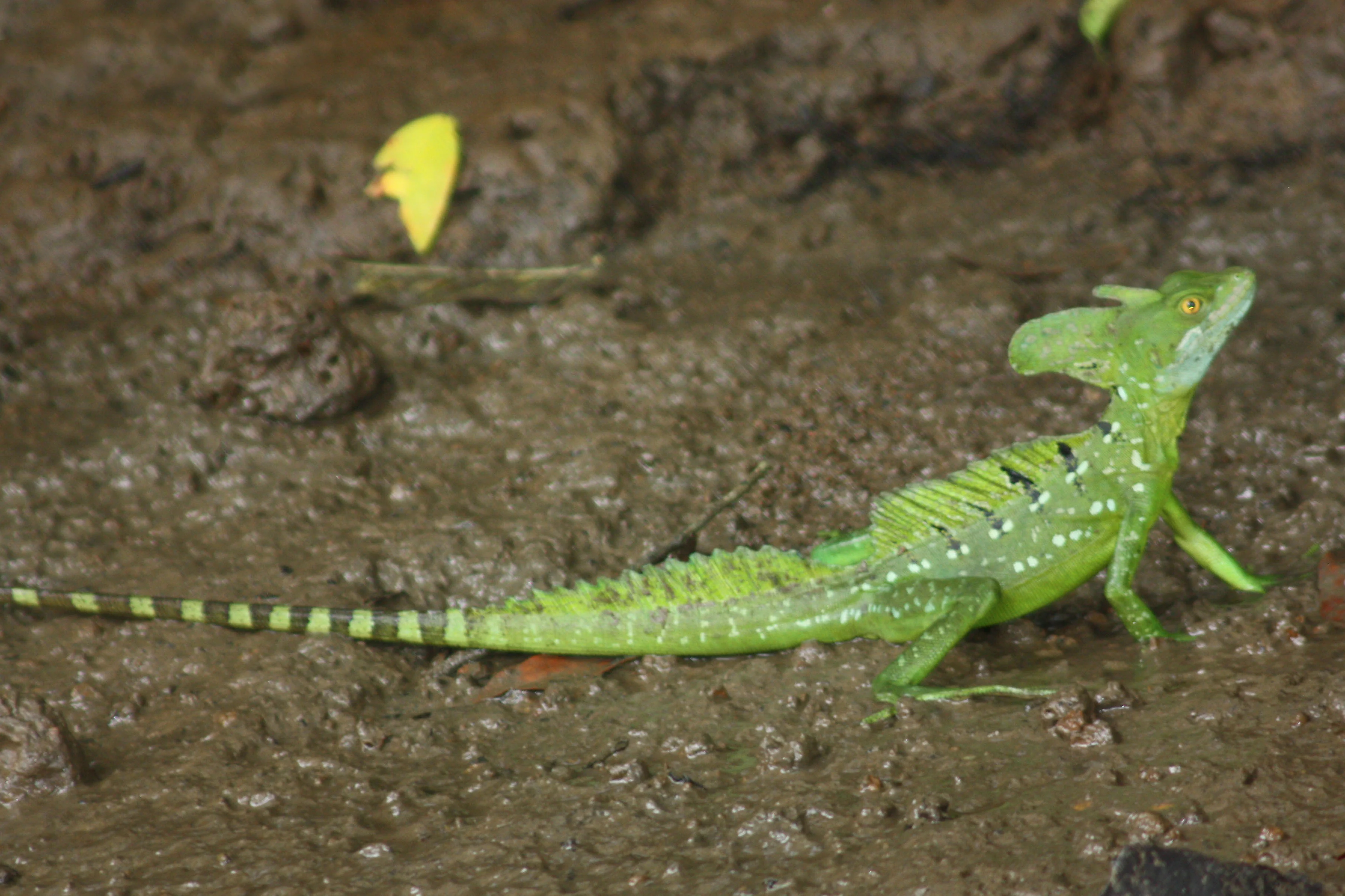
Bright green is the first color one sees, but a closer look reveals white, gray or pale blue markings; some populations also have dark marks along the back. The belly is paler than the sides. Yellow irises, round pupils, a triangular head profile and fine scales shape the face. Unlike a uniformly colored toy, real individuals vary considerably with light, background and age.
A male shows a small crest behind the eyes, a larger crest at the back of the head, and further crests on the back and tail. Females and young animals have a much lower head crest and a weak tail crest. A small crest in one photograph does not establish another species. Sex and maturity should be checked first, followed by markings and scale arrangement. That is why photographs of the two sexes can look surprisingly different.
The hind legs are longer than the forelegs, and the toes are long and flattened. That form helps support the body in vegetation and accelerate near water. A laterally compressed body and tail change the outline among branches and during swimming. The crests catch the eye, but rapid hind-leg strokes and foot movement, not the crests, power a water sprint.
Brilliant green is not always conspicuous. Among bright leaves and dappled shade it can break up the animal’s outline. A 2025 field report documented an adult whose color contrasted with the background being taken by a bare-throated tiger heron. One event cannot establish a general rule about color and survival, but it highlights why matching the background may matter when avoiding birds.
Close relatives such as the brown basilisk Basiliscus vittatus and common basilisk Basiliscus basiliscus also have long hind legs and lives tied to water. The green basilisk’s vivid color and crest combination is particularly striking. The Reptile Database also notes smooth ventral scales in this species, compared with keeled scales in B. vittatus. In the field, locality and several characters are more useful than color alone.
Why the waterside forest is home


Current species records and Smithsonian material together place the core native range in Honduras, Nicaragua, Costa Rica and Panama. Not every Central American basilisk sighting belongs to this species. Other members of the genus inhabit different slopes and drainages, making superficially similar reports easy to mix up. Georeferenced observations and specimens help resolve that confusion.
Streams, rivers and pools in lowland tropical forest provide the setting. An overhanging branch is both a basking site and a lookout above predators. The water below is an escape route and a place to swim. The edge where trees meet water explains the lizard’s behavior better than either habitat alone. A large tree and the surface beneath it function almost as one refuge system.
The Smithsonian summarizes habitat records from sea level to about 775 m. This does not mean every individual prefers the same elevation or temperature. A sunny river stone, a shaded branch and damp ground differ within a few steps. The basilisk’s frequent short moves can be understood as use of these small-scale climates.
By day it basks and searches for food around waterside vegetation. It does not remain in one sun patch for every daylight hour. Researchers have studied its activity budget precisely because rest, travel, vigilance and feeding require direct observation. The spectacular sprint captured in one video is only a brief moment. Ordinary waiting and short hunts fill much of the day.
Field observers have also recorded individuals sleeping on riverside rocks at night. The observation shows that the green basilisk is not simply a tree-only animal. Wading birds, including the heron in the 2025 predation report, share the same edge. Water offers refuge but also brings predators, so background cover and fast decisions both matter. That helps explain why protective branches and an escape route to water are so close together.
What happens during a water run


A threatened basilisk rises onto its hind legs and accelerates explosively toward water. Each foot strike must generate support, so this is no leisurely walk. The moving foot creates an air cavity and pushes water, allowing a short passage above the surface. When speed falls, the animal uses all four legs, sinks partly and continues by swimming. It is a momentary sprint between running and swimming.
It is often said that surface tension alone supports the animal. Experiments instead measured the forces as a foot hits the surface and moves down through water. Water running is not a trick in which the feet never touch; it is an exceptionally fast interaction with water. Foot form, body mass, speed and posture all contribute. Treating one factor as the whole secret misses the mechanics.
A kinematic study filmed animals ranging from roughly 2.8 g hatchlings to roughly 78 g adults and analyzed their steps. The researchers used a 4.6 m water track and cameras recording 250 frames per second. Those figures are not a maximum body mass or a universal running distance. They describe the experimental design used to ask how young and larger animals move.
The run ending does not mean the escape failed. Smithsonian notes that this species swims well and can remain submerged for more than 10 minutes. A leap from a branch, a sprint, then a swim form a continuous escape route. Short videos show only the run; the real strategy connects the canopy, surface and underwater refuge.
Nor does every threat trigger a dive. When a bird watches from above, remaining concealed among green leaves may be better. A snake approaching from below changes the value of a leap into water. That contrast underlies the interpretation proposed by researchers in 2025. It is an evidence-based explanation, not a rule obeyed by every individual.
The small hunter’s unexpected menu


The green basilisk is not limited to insects. Smithsonian’s summary of wild food includes spiders, smaller lizards, small mammals, crayfish and snails as well as insects. It is an opportunistic hunter that seizes available prey. Individual diets vary with place and season; the list should not be mistaken for a fixed daily menu.
Researchers in Costa Rica documented a green basilisk taking a juvenile iguana in 2022. The food-web arrow pointed in a surprising direction. The young iguana was already a lizard, but size and opportunity made it prey. A single event does not make iguanas routine food; it shows how broad the feeding possibilities can be.
A separate 2023 observation recorded predation on the night lizard Lepidophyma flavimaculatum. Short natural-history notes differ from large experiments, yet they fill in who eats whom in an actual forest. Many prey types may simply remain unobserved. Published food lists should not be treated as complete biological limits.
Smithsonian says its zoo feeds these basilisks insects and earthworms. That is an example of managed feeding, not a reproduction of everything eaten in the wild. A prey item caught in nature, a documented field event and food offered in captivity are different kinds of evidence. Mixing them can distort an account of wild behavior.
The basilisk is also prey. The 2025 paper directly documented predation by a bare-throated tiger heron, while birds and snakes stood out in reviewed records for the genus. It hunts crayfish or young iguanas and is hunted in turn by waterside birds and snakes. A place in the food web cannot be described in only one direction.
Eggs buried and left to develop


The male’s large crests make it conspicuous in the breeding context. A photograph of the display cannot reveal an entire mating system, however. Individuals may keep their distance or display, and encounters depend on habitat and density. Observed laying and growth are a firmer starting point than a rigid story about social structure.
Smithsonian describes females digging into soil and laying roughly 15–17 eggs in a clutch. Age, health and body size affect clutch size, and multiple clutches have been observed in a breeding season. That is not a fixed schedule for every female. In nature, nest temperature, moisture and predation can strongly influence the eggs’ fate.
Zoo material summarizes hatching at about 8–10 weeks. Small hatchlings can soon move and seek cover on their own. The long tail and hind legs are already evident, while the male’s large crests and adult size develop with growth. A juvenile photograph beside an adult shows how different the outlines of one species can be.
Smithsonian gives roughly 18–24 months as the time to sexual maturity. It is a reference range under observed management conditions, not a clock that runs identically in every wild animal. Food access, seasons, health and growth can matter. A large-looking juvenile should not automatically be labeled an adult.
Water running attracts attention, but most of a life is the passage from egg through vulnerable young to adult. The number surviving each year cannot equal the number laid; predators and habitat change make the difference. We did not verify species-specific evidence of prolonged parental care. It is more accurate not to inflate egg burial into an unsupported account of extended care.
The distance between forest and people


The green basilisk may be commonly seen in parts of its range, yet it is not immune to changing forest edges. Smithsonian identifies habitat loss from development as a main threat and notes occurrence in protected areas. Removing riverside trees or simplifying waterways can erase basking sites, cover and escape routes together. Counts alone do not capture habitat quality.
The species also appears in the pet trade, but Smithsonian notes that more research is needed on the impact of collection. Neither a claim that every sold animal is wild-caught nor that trade has no impact follows from that evidence. Choosing an animal with a clear captive-breeding history and preventing abandonment are basic human responsibilities.
Releasing a lizard outside its native area can have unexpected ecological effects even if the climate seems suitable. Captive experience and the animal’s role in nature are different matters. An impressive wild individual need not be caught for a photograph or chased into a water sprint. Flight is a sign of perceived danger, not a performance.
Modern classification places the species in Corytophanidae, while Iguanidae persists in older works. Records also differ between 1875 and 1876 for the authority year. The Reptile Database explains a publication-version issue around Cope’s original work. The discrepancy reflects bibliographic and classification history, not the discovery of a new animal.
The most interesting story is broader than the sentence “it runs on water.” Leaf-green coloring can conceal it in one setting, fast feet push against water, and it is both hunter and prey in the food web. Following one basilisk through a day reveals the structure of a Central American riverside forest.
References
- The Reptile Database: Basiliscus plumifrons
- Smithsonian National Zoo: Green crested basilisk
- Three-dimensional hindlimb kinematics, DOI 10.1242/jeb.00679
- Running on water: force generation
- Predation by a bare-throated tiger heron, 2025
- Predation of a juvenile Iguana rhinolopha, DOI 10.18475/cjos.v52i2.a7
- Predation of Lepidophyma flavimaculatum, 2023
- Habitat use and activity budgets, DOI 10.1643/CP-11-025
Suggest an edit
Tell us which sentence may be incorrect and provide a verifiable source. Submissions are reviewed before publication.