Last updated 2026.10.06 · Edited by silveston · Compiled by an independent hobbyist without professional credentials
The Florida Kingsnake (Florida Kingsnake) is a nonvenomous snake centered on the Florida peninsula. In the pet trade it may appear as a “Brooks Kingsnake” or “White-sided Brooks Kingsnake.” White-sided describes a selectively emphasized color-pattern trait, while Brooks is a legacy name connected to the former combination Lampropeltis getulus brooksi. Neither trade label represents a separate wild species. This account follows the currently recognized species name, L. floridana.
Its yellow-and-black contrast is striking, but the deeper story is ecological. The snake moves among wetlands, pine habitats, agricultural canals, and cover objects; it eats not only rodents but also other snakes and turtle eggs; and when threatened it may vibrate its tail, musk, and bluff. A 2023 paper documented a Florida Kingsnake consuming a juvenile Burmese Python in southern Florida. That is a remarkable instance of a native predator eating an invasive snake, but one observation should not be inflated into proof of population-level control.
A common mistake in reading Florida Kingsnake natural history is treating pet-trade color names as fixed units in nature. The same wild animal can look radically different with sunlight, shed cycle, age, and camera processing, while only a few generations of captive selection can exaggerate a trait. Wild intermediates, in contrast, are not “impure failures” but evidence of evolution in contact zones. That is why this account presents length, band counts, and scale rows as ranges and tendencies. Knowing an animal accurately means distinguishing stable features from those that vary with environment and inheritance, not memorizing one perfect archetype.
Another mistake is dividing snakes into only dangerous and useful categories. The Florida Kingsnake is not a medically dangerous venomous snake and it does eat rodents and other snakes, but it does not exist for human convenience. It consumes eggs and young reptiles, is eaten by larger predators, and shares burrows and logs within a broader food web. Its dramatic predation events are worth appreciating without turning the animal into a hero. Range, reproduction, refuge use, and road mortality reveal its real place in the Florida landscape.
Finding the species in a Korean sales listing was only the starting point for candidate selection, not evidence for natural history. A shop page can show inventory, morph names, and price, but it is not designed to verify wild range, maximum size, reproduction, or conservation. The numerical claims here therefore cross-check a museum identification account, a current taxonomic database, and peer-reviewed papers. Their roles remain separate: market evidence shows how the animal is labeled domestically, while institutions and research explain what it is in nature. Keeping those roles distinct prevents morph names from becoming species and historical subspecies names from being presented as current taxonomy.
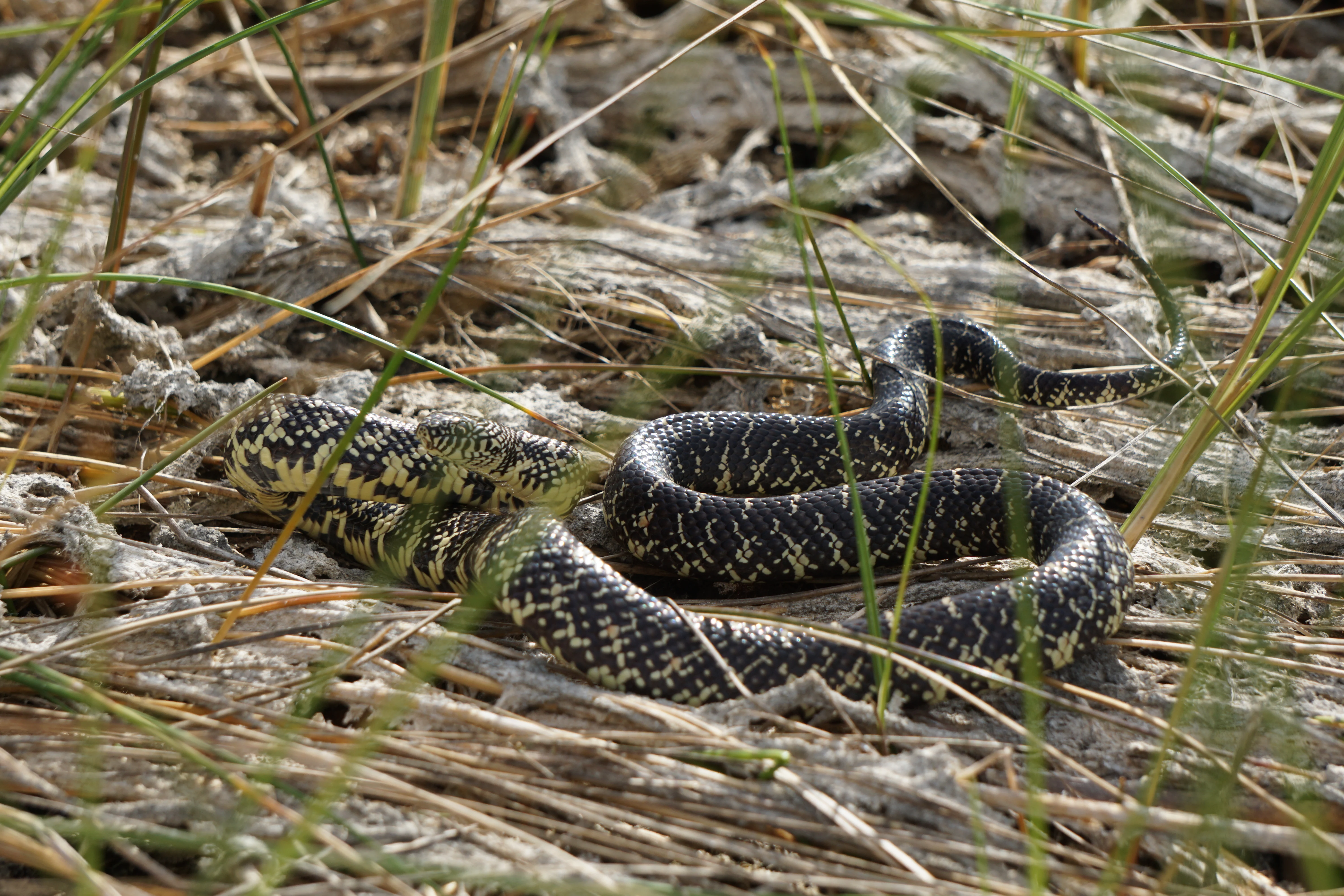
Photographs also need context. Four field images in this article were made on the same day in Shark Valley, Everglades National Park, while three others show adults from southern Florida. Different views demonstrate how one animal’s pattern changes with posture and light, and the additional adults add individual variation. Seven photographs still cannot represent the species’ full diversity. Images help explain form; they are not a sample for calculating range or frequency. Reading locality, photographer, date, and license with each caption preserves both information and rights.
Quick Reference
| Scientific name | Florida Kingsnake (Blanchard, 1919) |
|---|---|
| English name | Florida Kingsnake |
| Family / genus | Colubridae / Lampropeltis |
| Range | Centered on the Florida peninsula; contact and intergradation with neighboring lineages in the north |
| Typical adult length | About 90–122 cm; record 176.3 cm |
| Activity | Diurnal, crepuscular, or nocturnal depending on season and temperature |
| Diet | Small mammals, birds and eggs, amphibians, lizards, turtles and eggs, other snakes |
| Reproduction | Oviparous; roughly 3–30 eggs, usually fewer than 12 |
| IUCN | A formal species-level assessment is not readily confirmed; regional pressures still matter |
Name and Taxonomy: From Subspecies to Species

For many years the Florida Kingsnake was treated as a Florida subspecies of the Common Kingsnake, Lampropeltis getula floridana. The literature also preserves names such as L. getulus brooksi, L. getula brooksi, and L. getulus sticticeps. The Reptile Database currently lists Florida Kingsnake (Blanchard, 1919) as valid and organizes those older combinations as synonym history. Encountering an old name does not mean that several separate species are involved.
A 2017 phylogenetic study by Krysko and colleagues combined mitochondrial evidence with morphology and geography across the eastern North American Lampropeltis getula complex and recognized the Florida lineage at species rank. Florida, Eastern, and Apalachicola kingsnakes were treated as distinct lineages. Yet gene flow and intermediate animals occur in northern Florida contact zones, so nature does not divide as neatly as a line on a map.
“Brooks” remains familiar in the hobby, but taxonomic writing should separate trade names, morph labels, and historical scientific names. Traits such as white-sided do not represent the standard wild phenotype. Generalizing from a pale captive morph to all wild Florida animals erases geographic variation and color changes that occur with age.
To understand why the classification changed, it helps to look beyond labels to the questions being tested. Researchers did not ask only whether pale Florida snakes looked different; they examined whether lineages had evolved independently, where they met and exchanged genes, and whether morphology matched geography. The 2017 conclusion therefore redrew part of the peninsula’s biogeographic history rather than merely renaming a pet-trade animal. Broader nuclear-genome sampling may still refine contact-zone boundaries and the interpretation of species limits.
Size and Pattern: Yellow That Changes with Age

According to the Florida Museum identification account, adults commonly measure about 90–122 cm in total length, while the record reaches 176.3 cm. A record is an exception, not an average. Sex, food availability, locality, and individual build all affect length and mass, so “up to 180 cm” is not a forecast for every adult. The species can be long and powerful without having the heavy build of a python.
A typical animal has a dark brown to black ground color crossed by more than 40 yellowish bands. As it grows, pale pigment may spread into scales between the bands, making adults look more yellow overall than juveniles. Head and neck markings, band width, and the degree of speckling vary. That variability is why southern animals and snakes from northern contact zones cannot be forced into one rigid visual template.
Midbody dorsal scales are usually counted in 23 rows, and the smooth surface often appears polished. That suits the usual derivation of Lampropeltis from Greek words for a “shining shield.” Photographs alone, however, may not resolve similar kingsnake lineages. Distribution, scale counts, ventral pattern, precise locality, and sometimes genetic evidence are needed to assess animals from contact zones reliably.
Field identification should not depend on one trait. More than 40 crossbands and 23 midbody scale rows are useful, but wear, growth, photographic angle, and geographic intermediates create exceptions. Head-only photographs and pale captive morphs are especially easy to misidentify. Because exact locality disclosure can increase collecting pressure, citizen-science records should balance evidence and protection: retain several views and a broad locality while obscuring sensitive coordinates.
Range and Habitat: A Terrestrial Snake of Wet Country

Its core range is the Florida peninsula, with broad contact and intergradation toward Eastern Kingsnake lineages in the north; it is also recorded on Key Largo. Calling it a Florida snake is accurate, but habitat continuity and lineage contact matter more than political borders. Northern intermediates are not failures of classification; they record a history of exchange between neighboring lineages.
It occurs in pine flatwoods, hardwood hammocks, cypress strands, prairies, freshwater marshes, and the edges of estuarine habitats. Records also come from sugarcane fields, melaleuca-invaded ground, canal banks, and remnant suburban greenspace. It is not an aquatic specialist, but it makes active use of terrestrial cover and canal margins embedded in wet landscapes.
By day it may regulate temperature and water balance beneath logs, in mammal burrows, under debris, or inside crevices. During mild weather it can move in daylight, while hotter periods may shift activity toward dawn, dusk, or night. Labeling it permanently diurnal or nocturnal misses that behavioral flexibility. Long periods under cover are not laziness; they are strategies for avoiding predators, heat, and desiccation.
The species occupies a mosaic of land and water. Floods and dry seasons alter prey distribution and refuge availability, prompting movement among canal levees, higher ground, and decaying logs. In fire-adapted pine flatwoods, appropriate fire management helps maintain a mixture of open ground and cover, whereas drainage and development sever those links. Surveys that combine seasonal movement corridors and road mortality with local counts reveal more for conservation than a single snapshot of abundance.
Hunting and Diet: Why It Is Called a Kingsnake

The Florida Kingsnake does not subdue prey with venom. It seizes with its teeth and kills by constriction. Wild prey includes small mammals, birds and eggs, amphibians, lizards, turtles and turtle eggs, and other snakes. Reptiles and their eggs are prominent in its natural history. Describing it merely as a rodent-eating snake misses much of its ecological role.
Its tendency to eat other snakes is central to the name “kingsnake.” It can attack venomous species, but saying it is completely immune to all venom is an exaggeration. Resistance to some toxins from sympatric snakes does not erase mechanical injury or geographic and biochemical differences among venoms. Successful predation reflects a combination of prey detection, rapid control, forceful constriction, and physiological resistance—not magic immunity.
In 2023 researchers reported a Florida Kingsnake consuming a juvenile Burmese Python in the Big Cypress region. It is a striking observation from a landscape transformed by an invasive giant snake. One event cannot establish that kingsnakes will solve the python problem. Its value is more precise: it directly documents a broader-than-expected prey spectrum and the ability to exploit a novel prey item.
Hunting is not guided by vision alone. Tongue flicking collects chemical particles from air and ground, and the vomeronasal system helps follow prey trails into cover. That chemical sense is closely tied to finding eggs and hidden reptiles. Once prey is seized, constriction is not simply “bone-breaking force”; it rapidly disrupts circulation and breathing. The strong constriction seen in kingsnakes has been discussed as an adaptation for overpowering snake prey that can tolerate low oxygen unusually well.
Reproduction and the First Year of Life

Florida Kingsnakes lay eggs. During the warm season, females select sites with relatively stable temperature and moisture, such as decaying logs, soil cavities, mammal burrows, or spaces beneath vegetation debris. Reported clutches range roughly from 3 to 30 eggs, though they are usually fewer than 12. That broad range does not mean every female produces a large clutch; reproductive investment varies with body size, condition, locality, and year.
Hatching is generally observed from June through September. Young snakes must find prey and choose refuges on their own; their parents do not guard or provision them. Small size brings agility but also greater risks from predators and dehydration. Crisp juvenile bands may be transformed as pale scales increase with growth, producing the broader yellow impression of many adults.
Wild longevity is difficult to measure because marked snakes are hard to relocate and spend long periods underground or under cover. Captive-care references suggesting 15–25 years for kingsnakes are useful as a reminder of long-term responsibility, but they are not equivalent to average survival in nature. Lifespan figures should always be read with their source and context.
Reproductive success depends as much on the nest microenvironment as on clutch size. Eggs cannot move to find better moisture, so excessive dryness removes water while saturation impairs gas exchange and encourages fungal growth. Decaying wood and deep vegetation debris buffer rapid weather changes. Removing every “messy” log and debris pile may create a tidy-looking landscape that is empty of nesting opportunities. Habitat management therefore includes small refuge structures, not just large tracts of forest.
Defense: Nonvenomous Does Not Mean Passive

Its first response to danger is usually escape or concealment. When cornered it may flatten, move rapidly, and vibrate the tail tip against dry leaves to create a rattling sound. It may also gape, strike repeatedly, bite, and chew. This is not a perfect theatrical imitation of a rattlesnake; it is a package of signals that can make a predator hesitate.
Releasing strong musk from glands near the cloaca is another common defense. It smells unpleasant to people, but for a small snake it is an inexpensive weapon that may make a captor let go. Picking up a wild animal for a photograph imposes unnecessary stress and injury risk on the snake while exposing the person to bites and microbes. The best observation is made at a distance while leaving an escape route.
Nonvenomous means that it lacks a medically significant venom-delivery system; it does not guarantee that a bite is inconsequential. The rear-curving teeth grip prey, and a large animal that holds on can leave many small wounds. It does not pursue people in the wild. Most conflicts begin when someone tries to catch, restrain, or step on the snake.
Seasonal activity creates observation bias. A lack of sightings at midday in midsummer does not prove a population has vanished, and more records on a cool spring day or after rain do not indicate an instant boom. A snake that spends long periods underground or under cover requires multiple survey approaches—road searches, cover boards, mark-recapture, and potentially environmental DNA—to reveal trends. Separating detection rate from actual abundance is the starting point for sound conservation decisions.
People, Threats, and Conservation
It is often called beneficial because it eats rodents and other snakes near homes and farms, but the value of a predator is not limited to removing prey that inconveniences people. Eating turtle or bird eggs is also part of a natural food web. Reducing the species to a “pest controller” obscures its more complex relationships with habitats and other animals.
The Florida Museum identifies habitat loss and fragmentation, road mortality, pollution, invasive fire ants, and overcollection as pressures. A ground-moving snake is especially vulnerable when roads cut between wetland and forest patches. Even a species that appears common can lose gene flow and recolonization opportunities when local populations become isolated. Maintaining landscape connectivity matters more in the long term than occasional individual rescue.
In the pet trade, a legally documented captive-bred animal should be chosen over a wild-collected snake of uncertain origin. Buyers should look beyond the sales label and verify the scientific name, hatch year, feeding and shedding records, sexing method, and transaction documents. Availability in a domestic market does not automatically make an animal beginner-suitable or harmless to wild populations. Before acquisition, review the Florida Kingsnake care guide for space, temperature, food, and long-term costs.
The most practical protection is to avoid killing encountered snakes, allow safe road passage when this does not endanger people, and seal building gaps without harming animals. When relocation is truly necessary, contact a local wildlife authority or experienced rescuer. Releasing a pet creates simultaneous risks of disease transmission, genetic mixing, and death of the released animal. Turning an animal of uncertain origin loose in nature is not conservation, even when motivated by affection for the species.
References
- Uetz, P. et al. The Reptile Database: Florida Kingsnake (accessed 2026-10-06).
- Florida Museum of Natural History. Florida Kingsnake — Florida Snake ID Guide (accessed 2026-10-06).
- Krysko, K. L. et al. (2017). Phylogenetics of Kingsnakes, Lampropeltis getula Complex, in Eastern North America. Journal of Heredity. DOI: 10.1093/jhered/esw086.
- Krysko, K. L. & Judd, W. S. (2006). Morphological systematics of kingsnakes, Lampropeltis getula complex, in the eastern United States. Zootaxa 1193: 1–39. DOI: 10.11646/zootaxa.1193.1.1.
- Crawford, P. F. et al. (2023). Florida Kingsnake consumes a juvenile Burmese Python in southern Florida. Reptiles & Amphibians 30(1). DOI: 10.17161/randa.v30i1.19971.
- Domestic-market check: Seoul Reptile kingsnake listings (accessed 2026-10-06). Sales copy was not used as natural-history evidence.
Last reviewed: 2026-10-06. Taxonomy and trade names can change; recheck primary sources before acquisition or citation.
Suggest an edit
Tell us which sentence may be incorrect and provide a verifiable source. Submissions are reviewed before publication.