Last updated 2026.10.07 · Edited by silveston · Compiled by an independent hobbyist without professional credentials
The Emerald Tree Skink (Lamprolepis smaragdina) is a tropical arboreal skink, leaf-green and capable of lightning-fast runs along trunks. Its range from the Philippines through Indonesia, New Guinea, and many western Pacific islands looks like the success story of one species. Genomic research, however, reveals isolated lineages that crossed seas and then exchanged little or no genetic material. The brilliant captive lizard in front of us also carries a history of island evolution.
This account does not treat the trade label “emerald skink” as a taxonomic conclusion. It cross-checks the current Reptile Database treatment, the IUCN assessment, a 1999 Micronesian ecology study, a 2010 reproductive specimen study, and 2013 and 2025 phylogeographic research. Husbandry targets are reserved for the linked care guide; the focus here is why this body and behavior evolved in the wild.
In one sentence: the Emerald Tree Skink is not simply a green tree lizard, but a diurnal micro-predator that crossed seas and built independent histories on islands.
| Classification | Scincidae · genus Lamprolepis |
| Size | Generally about 22–25 cm total length, with strong population variation |
| Activity | Diurnal and arboreal |
| Diet | Primarily insects and small invertebrates; small amounts of plant matter observed |
| Range | Southeast Asia, New Guinea, and many western Pacific islands |
| Conservation | IUCN Least Concern (amended 2022 assessment) |
Name and classification: more complex than an emerald color
The currently accepted name is Lamprolepis smaragdina, a skink in the family Scincidae and genus Lamprolepis. The Reptile Database recognizes Lesson’s 1829 name and lists six subspecies. Historical combinations such as Dasia smaragdina, Lygosoma smaragdinum, and Scincus smaragdinus refer to this same taxon and must not be counted as separate species.
The genus name Lamprolepis evokes shining scales, while smaragdina means emerald-colored. Yet not every animal is bright green. Brown, olive, turquoise, white-speckled, and black-mottled individuals occur under the same name, and color frequencies vary markedly among islands. The common name captures one conspicuous phenotype rather than summarizing the entire species.
The deeper issue is the boundary of that “species.” A 2013 mitochondrial study found old, geographically stable lineages across the huge range. A 2025 genomic study reported little or no gene flow among neighboring Lesser Sunda island lineages and suggested that several species may be involved. Formal descriptions and boundaries still require further work, so the accepted name remains appropriate, but captive animals without provenance should not be assigned confidently to a subspecies.
Size and appearance: green armor and a long counterweight
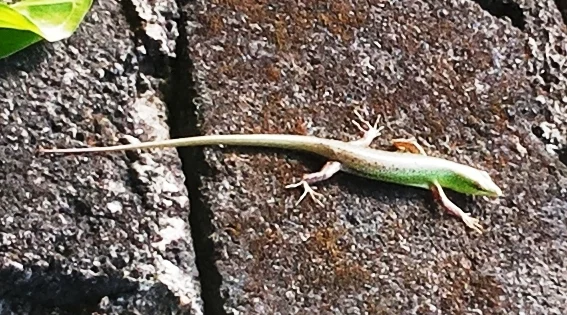
Adults are commonly reported at roughly 22–25 cm in total length, much of it a tail that is slimmer and longer than the body. Population and sex differences are substantial, so 25 cm should not be treated as a universal target or absolute maximum. A robust trunk, pointed snout, relatively large eyes, and five well-developed toes suit rapid changes of direction on tree trunks.
The smooth, overlapping scales reflect light. A green animal can lose its outline among leaves, while brown hindquarters and tail merge with bark and shade. Some individuals are predominantly brown or heavily black-speckled. Sex alone does not explain the variation; island lineage, age, condition, and individual differences all contribute, making locality or subspecies identification from one photograph unreliable.
The tail is more than decoration. It serves as a counterweight during rapid runs and turns and can be shed when a predator grasps it. The detached tail continues moving, drawing attack while the body escapes into cover. A regenerated tail may differ in color, shape, and scale pattern, and regeneration has energetic costs, so autotomy is not harmless simply because a tail can regrow.

.jpg)
Range: a “supertramp” that crossed seas
The range spans many islands of the Philippines and Indonesia, Timor-Leste, New Guinea, and the Bismarck, Solomon, Marshall, and Micronesian archipelagos. The Reptile Database also records an introduced population on Saipan in the Northern Mariana Islands. This is not one continuous habitat but a mosaic of islands separated by sea. How a terrestrial lizard occupied such a broad oceanic region is one of its most compelling natural-history questions.
Researchers describe it as a “supertramp” lizard adept at colonizing islands. A 2025 study estimated that southern Wallacean animals diverged from the Peleng Island lineage about 1.25 million years ago, with Lesser Sunda lineages separating roughly 1.0–0.4 million years ago. Remarkably, more than half of the inferred over-water dispersal events ran across or against present-day currents. Rafted vegetation, storms, and historically different currents may all have contributed.
Reaching islands was not the same as maintaining gene flow among them. The 2025 genomic dataset found minimal connectivity even between nearby islands thought to have joined during glacial low sea levels. One rare rafting event can establish a population, but without repeated exchange each island continues an independent evolutionary trajectory. The species combines vast distribution with striking local isolation.
Human transport may also interact with this dispersal ability. Animals could hide in nursery plants, wood, or freight, but a 2013 study found deep, geographically stable lineages rather than the low differentiation expected from only recent human-mediated spread. Explaining the entire range as a lizard moved by people is therefore much too simple.
Habitat: vertical structure, not rainforest alone
Typical habitat includes trunks and branches in humid tropical forest, but the species also occurs in open-canopy lowland forest, mangroves, forest edges, and trees in gardens and parks. This breadth does not mean it thrives anywhere. Sun and shade in close proximity, rough bark and crevices, arthropod prey, and vertical surfaces that can dry after rain are recurring features.
Position changes through the day even on one tree. An animal may warm on illuminated bark in the morning, rotate into leafy shade or the far side at midday, and dash briefly when prey passes. After rain it can lick water from leaves and bark, yet it does not remain permanently in a soaked cavity. A microcycle of high tropical humidity followed by surface drying shapes its living space.
Calling it arboreal does not mean the ground is irrelevant. It may descend after prey or use low trunks and fallen wood. Still, much of its activity occurs on vertical surfaces and branches, so height, branches of varied diameter, and continuous cover provide more choices than a broad but flat area. This structural perspective matters in both field ecology and enclosure design.

.jpg)
Daily rhythm: reading light, heat, and shadow
The Emerald Tree Skink is diurnal. Its conspicuous green body operates in daylight, but the animal is not a static basker. Short exposure for warming alternates with shaded exploration, prey tracking, and rest. A change of only tens of centimeters in height or trunk orientation alters surface temperature and light, enabling thermoregulation through small movements.
Sunlight provides more than heat. Visible light supports activity and prey detection, while UVB is linked to vitamin D metabolism. Excess exposure, however, increases overheating and predation risk. Animals move among bright surfaces, leafy shade, open branches, and hollow bark refuges. Their behavior depends on a gradient of choices rather than one fixed temperature.
Temperature and activity fall at night. Maintaining daytime heat all night can erase a natural daily rhythm and increase dehydration pressure. Yet a tropical species should not be assumed to tolerate cold drafts. Unlike buffered wild crevices, a small enclosure tracks room changes quickly, so both daytime maxima and nighttime minima must be recorded.
Movement and hunting: speed released after stillness
At rest the animal lies low and still on a trunk and may appear slow, but prey or danger triggers an instant sprint to another branch. Toes and claws grip rough bark, while the long flexible body and tail balance rapid turns. Unlike geckos that rely on broad adhesive pads, it needs texture that claws can engage and surfaces of varied diameter.
Hunting consists of observation and short pursuit rather than continuous chase. The skink tilts its head slightly to confirm the movement of a small insect, then lunges within range. When prey disappears, it searches bark gaps and leaves again. It is fast, but not continuously active; moments of high expenditure alternate clearly with concealment.
Color and movement work together as camouflage. Among wind-shaken leaves, a green body blends with the background, while brown hindquarters and tail interrupt the outline against bark. Stillness erases the contour; sudden acceleration makes tracking difficult. Protection comes from habitat choice, immobility, and explosive speed rather than color alone.


Diet: insect-centered but not absolutely uniform
Insects and other small invertebrates form the core wild diet. Ants, beetles, moths and larvae, spiders, and other suitably sized prey moving across bark can be taken opportunistically. Exact proportions vary by locality and season, so the species cannot be reduced to one insect type. Dietary flexibility may help it persist across a broad island range.
Zoo accounts and field observations also mention small amounts of fruit or flowers. This does not make plant material a replacement staple. It may provide sugar or water, or be consumed incidentally, and its importance may vary by place and season. Such observations do not justify converting a captive diet to fruit alone.
For a tree hunter, prey is behavioral as well as nutritional. Searching for hidden insects, judging distance and angle, and making a brief chase engage senses and movement. A bowl containing the same prey every time may meet calories while removing exploration. The ecological principle is the experience of locating varied, small, moving prey, not a particular commercial feeder.
Predators and defense: sacrificing a tail to save the body
Raptors and other birds, snakes, and carnivorous island mammals are reported predators. Vivid color seems risky on an exposed branch, yet broken sunlight and foliage readily disrupt the outline. When danger appears, the skink can rotate to the far side of a trunk or flee into leaves and bark gaps. The three-dimensional structure of one tree becomes a shield.
When seized, it may twist and shed the tail. Continued movement of the detached part attracts attack and buys time for the vital body to escape. Autotomy planes and regeneration vary among individuals, and the new tail grows around a cartilaginous core rather than recreating the original vertebrae. Tail loss may save life but carries costs to balance, signaling, and energy.
The same response can occur when handled by people. Rapid pursuit, grabbing the tail, or pulling an animal from furnishings can trigger defense. Understanding wild predator avoidance explains why this species is better suited to observation and voluntary approach than frequent manual handling.


Social behavior: head-bobs and territories
Males are territorial and respond to rivals over space and breeding access. Head-bobbing occurs in both competition and courtship, so the same movement changes meaning with partner and context. Body presentation, height shifts, approach, and retreat must be read as a sequence rather than in isolation.
Bright green is simultaneously concealment and display. The same color can merge with foliage for a predator yet provide nearby conspecifics with information about health, locality, or identity. Strong color variation among islands suggests that visual signals may have diverged with local light environments and lineages.
Several animals on nearby trunks do not necessarily form a stable social group. When basking sites, prey, and refuges concentrate, individuals may tolerate proximity around a resource. Competition can appear not only as chasing or biting but as increased hiding, reduced feeding access, or displacement to lower-quality perches.
Reproduction and life history: repeated small clutches
A 2010 study of Papua New Guinea specimens found a mean clutch size of 1.9 eggs among ten reproductive females, with a range of 1–2. One female carried oviductal eggs while beginning yolk deposition for a later clutch, supporting multiple clutches within a year. Philippine work also reported a long or year-round reproductive season.
This primary evidence conflicts with the 9–14 eggs stated in some popular accounts. Those figures may combine communal deposits or different observations; for an individual female’s single clutch, the anatomical sample of 1–2 eggs is more reliable. Distinguishing what was actually counted matters more than repeating a familiar number.
Eggs may be placed under loose bark or in protected cavities. A small clutch repeated through time spreads risk rather than concentrating reproduction in one event. Incubation duration varies with temperature and locality, making one number an unreliable rule for the whole complex. Juveniles use tiny prey and dense cover, expanding to larger vertical spaces and thicker branches as they grow.


Relationships with people: from garden resident to traded reptile
Where trees, prey, and shade remain, the species can live in parks and gardens within human-modified landscapes. That does not make development irrelevant. Removing mature trees and bark cavities or intensive pesticide use reduces food and refuge together. Urban records show adaptability but also reveal which structural features of green space remain.
Bright color and inquisitive behavior have increased interest in the pet trade. Yet breeding animals from different islands without provenance can erase local genetic information within this broad species complex. Legal captive-bred origin, locality and parental records, and the keeper’s ability to supply food long term matter more than color alone.
Wild-caught animals can arrive with transport stress, dehydration, parasites, and uncertain origin. Availability for sale does not guarantee legality, health, or sustainability. Prioritizing captive-bred animals, checking documents and current rules, and quarantining newcomers away from established reptiles reduce risk to animals and keepers.
Conservation: Least Concern does not mean no concern
The amended 2022 IUCN assessment lists the Emerald Tree Skink as Least Concern because of its enormous range, use of varied habitats, presence in protected areas, and absence of one known threat driving rapid species-wide decline. Least Concern is a risk category, not a declaration of unlimited abundance or safety everywhere.
If island lineages rarely exchange genes, the broad map of the named species can hide local loss. A population disappearing from one island may not be replenished naturally from another. The strong isolation reported in 2025 signals that conservation units may need to be finer than a single species name.
Future priorities include locality-based taxonomic revision, population trends, and data on wild collection and trade routes. Citizen-science images can help track color variation and range when location, date, and habitat structure are accurate. Captive photographs without provenance should not be treated as wild distribution records because they blur lineage and conservation decisions.


Relatives and the future of classification
The genus Lamprolepis includes species such as L. leucosticta in addition to the Emerald Tree Skink. Arboreal skinks can look similar while differing in scale characters, distribution, and phylogeny, so trade names cannot replace identification. Listings that mix “emerald skink,” “green tree skink,” and the old genus Dasia require both a scientific name and locality.
The six currently recognized subspecies reflect historical morphology and geography, but 2025 data show that Lesser Sunda differentiation may be more complex. The authors considered the absence of gene flow strong evidence for multiple species, while emphasizing that their number and intra-island contact zones require more samples and formal description. A new study does not justify inventing replacement names prematurely.
The fascination lies in contradiction rather than green color alone. This lizard crossed seas repeatedly yet barely exchanges genes among nearby islands; it moves openly by day yet disappears among leaves and bark. An animal held under one name contains multiple independent evolutionary histories, making the Emerald Tree Skink a living lesson in island biogeography.
Continue with the care guide
See the Emerald Tree Skink care guide for a practical sequence covering vertical enclosure design, visible light and UVB, thermal gradients, humidity cycles, feeding, and health records.
References
- The Reptile Database. Lamprolepis smaragdina.
- IUCN Red List. Lamprolepis smaragdina. 2022 amended assessment.
- Reilly et al. (2025). Rampant Dispersal Without Gene-Flow. Journal of Biogeography 52:e15087.
- Linkem et al. (2013). Stochastic faunal exchanges drive diversification. Journal of Biogeography 40:507–520.
- Perry & Buden (1999). Ecology, behavior and color variation of the green tree skink. Micronesica 31:263–273.
- Goldberg & Austin (2010). Notes on Reproduction of the Emerald Skink.
- Marwell Wildlife. Emerald skink species account.
Suggest an edit
Tell us which sentence may be incorrect and provide a verifiable source. Submissions are reviewed before publication.