Last updated 2026.10.14 · Edited by silveston · Compiled by an independent hobbyist without professional credentials
The Sudan plated lizard (Broadleysaurus major) has a complex natural history beneath its hard scales. This account connects field observations with anatomy and explains why the former name Gerrhosaurus major remains common.
At a Glance
| Field | Detail |
| Current scientific name | Broadleysaurus major (Duméril, 1851) |
| Former combination | Gerrhosaurus major |
| Classification | Squamata · Gerrhosauridae |
| Key traits | Large plated scales, terrestrial habits, egg laying |
An Armored Lizard with a Confusing Name


The Korean trade name ‘Sudan plated lizard’ is not a scientific name that pinpoints the animal’s origin. Current taxonomy places this species in the plated-lizard family Gerrhosauridae as Broadleysaurus major; Gerrhosaurus major, still common in older literature and listings, is a synonym. English names include Sudan plated lizard, rough-scaled plated lizard, and great plated lizard. Treating these names as different species can duplicate records or mix incompatible husbandry advice.
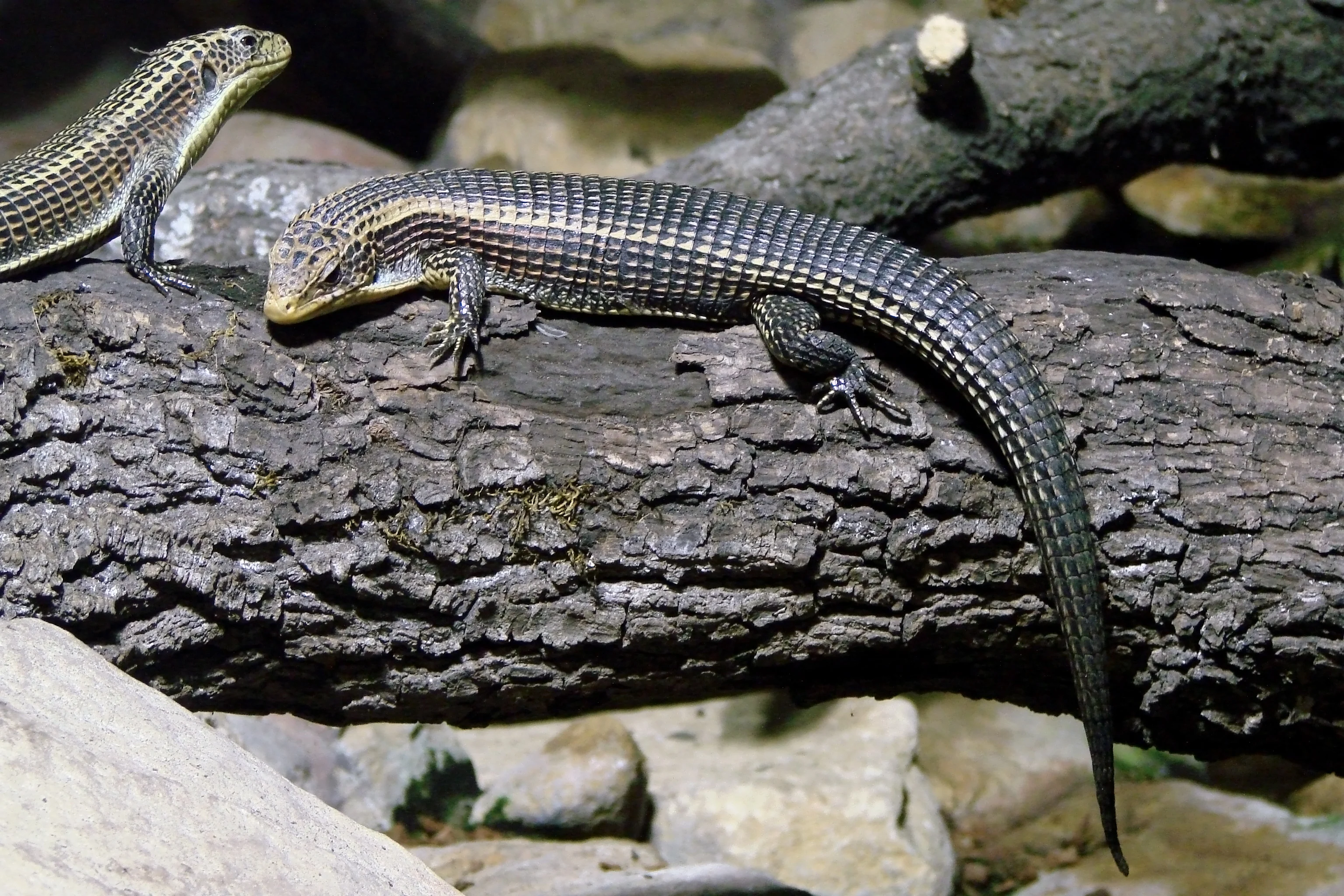
At first glance this stout, short-legged lizard resembles a large skink, but it is not a member of the skink family. Squarish plates run from head to tail. Individuals range from tawny to dark brown, with narrow stripes, spots, or relatively plain coloration. A single photograph cannot safely establish a subspecies or locality. Treatments of older subspecies names also differ among sources, so the accepted species name and observed location should be recorded separately.
A 2013 phylogenetic study reexamined genetic relationships among African plated lizards and separated this lineage from Gerrhosaurus as Broadleysaurus. The Reptile Database adopts that combination. This is more than a change of label: similar armor does not guarantee the closest relationship, and both scale counts and genetic evidence are needed to reconstruct ancestry.
Identification does not end with a trade name or an impression of armor. The genus diagnosis in The Reptile Database notes 31–38 transverse dorsal scale rows in this lineage, compared with 49–67 in the Gerrhosaurus species examined. Counting these on a moving animal is impractical, but the comparison explains why careful measurements matter in museum work and photographic identification. A traded animal also needs its scientific name and provenance documents checked.
Size and Scales: Flexibility Beneath the Armor


Size claims must distinguish snout–vent length (SVL) from total length including the tail. The University of Texas DigiMorph account gives a maximum SVL of about 23 cm, while a specialist husbandry source cites approximately 24.5 cm from the phylogenetic study. Frequently repeated total-length reports of 51–61 cm include the tail; trade descriptions with unclear measurement methods should not be promoted as records. Tail loss and regrowth further complicate total-length comparisons.
The plate-like dorsal scales are more than decoration. Their rough surface and heavily shielded head suit life around rock gaps and burrow entrances. A lateral fold of smaller, more flexible scales leaves room for bending and expansion. A truly rigid suit of armor would hinder movement and breathing; the interesting adaptation is the balance of strength and flexibility. Scales do not make the animal safe from falls or crushing.
High-resolution CT data from the University of Texas let researchers digitally remove the bony plates over the skull and inspect what lies beneath. A head that looks like one solid shield conceals several bones and their joints. Scanning matters because physically removing fused plates can damage a specimen. Linking a living lizard’s visible armor to museum imaging makes the phrase ‘scale armor’ anatomically meaningful.
Descriptions report more conspicuous juvenile markings, but color also varies with locality, individual, and lighting. Zoo photographs are useful for studying behavior and scale detail; they do not represent wild color frequencies or average size. Captive and exhibition images here document the species’ appearance, not a natural range at the place of photography. Distinguishing field images from exhibition images makes biological photographs more informative.
A Savanna Day of Sunlight, Rocks, and Burrows


The name invites an image of a lizard restricted to Sudan’s driest desert. Records instead extend through semi-arid eastern and southern Africa, coastal woodland edges, thickets, and savannas. The Reptile Database lists an even wider set of countries, but shifting subspecies concepts and identifications caution against treating every site as one ecological template. Zanzibar is recorded as the type locality.
This is a diurnal species described as warming in sunlight before foraging. Field photographs from Watamu, Kenya show an individual spread across a sunlit rock. Yet even one site contains hot surfaces, shade, and cooler air beneath stones. ‘Likes sun’ does not mean remaining on a hot patch all day; it is better understood as moving among microhabitats to select a suitable body temperature.
DigiMorph reports use of burrows and termite mounds. A mound is not merely a place containing prey; its internal temperature, humidity, and passages differ from the open ground. That source does not establish how long an individual uses any particular mound. If the lizard moves among rock gaps and burrows, much of its life may occur during the hours when it is least visible to a photographer.
Where wet and dry seasons alternate, surface prey, soil moisture, and resting sites change together. A specialist care source’s seasonal description helps frame this broad pattern, but it is not a direct year-round activity study of every local population. Instead of imagining a savanna as permanently dry sand, picture a mosaic of ground and underground spaces, sun and shade, within a few steps.
The Dietary Surprise: More Than Insects


Its armored appearance may suggest a specialist in hard-bodied insects, yet accounts include arthropods as well as fruits, flowers, other plant material, and small vertebrates. The proportions may vary by locality, season, and body size. ‘Omnivore’ is not permission to offer any human food. Opportunistic feeding in the wild and a repeatable captive diet are different questions.
A 2024 field note from Dar es Salaam, Tanzania, documented Broadleysaurus major preying on a guttural toad, Sclerophrys gutturalis. Its value is not a claim that toads are routine food. Recording a real event with species and locality expands the known behavioral repertoire. A single observation establishes possibility, not frequency.
Toads can defend themselves with skin secretions, making the event striking. But a short predation note cannot establish toxin resistance or a detoxification mechanism. Nor should a surprising wild meal become a husbandry tip. Captive animals should receive identifiable feeder insects and suitable plant foods, not wild toads or unidentified vertebrates.
Why is hunting seldom photographed? During brief periods of prey abundance it may capture food quickly, while spending much of the remaining day under rocks or in sunlight. Responses to moving prey, seasonal plant foods, and small animals around burrows require different observation methods. A zoo feeding photograph or a seller’s feeding claim cannot represent the entire wild diet.
Reproduction and Young: What Remains Unknown

.jpg)
This species lays eggs. Yet claims that it always lays a fixed number or hatches after an exact number of weeks deserve caution. Long-term studies following wild nests and hatching success are far scarcer than husbandry accounts. A single breeding calendar is also unlikely to describe its entire range, where rainfall and temperature vary by season. Egg laying is an established life-history trait; the clutch history of one captive group is a different and more conditional kind of evidence.
Hatchlings have the same basic design of scales and tail as adults, but their smaller bodies leave them vulnerable to a wider range of predators. Cracks, leaf litter and pockets in the soil are not mere background: they are hiding resources. A burrow or rocky patch useful to an adult can be both a travel corridor and a danger zone for a youngster. The habitat therefore looks different at a hatchling’s scale. A sunny spot is not equally safe at every age.
Body length alone is also an unreliable clock. Food quality, season, temperature and health can all alter growth. A large individual is not necessarily old, and a small one is not automatically a recent hatchling. Connecting size to age in the field requires longitudinal evidence such as marking and recapture. There is a larger gap than one might expect between a photograph’s impression and an animal’s life history.
Sexing an animal from a photograph raises similar problems. Angle and developmental stage change the apparent shape of the head and body, while nutrition changes the silhouette of captive animals. Field observers learn more by recording behavior, season and nearby individuals as well. This species’ reproductive story is better read as an active research question than as a collection of suspiciously precise numbers. The gaps explain why further fieldwork matters.
Questions about nest safety, microhabitats used after rain and when young animals appear at the surface matter to conservation. Surveys biased toward conspicuous adults can miss the needs of nests and juveniles. Conserving habitat means more than leaving one rock for a large lizard; it means retaining a range of spaces through hatching and growth.
Relatives and People: An Old Name, New Observations


The Sudan plated lizard was long presented as Gerrhosaurus major. The Reptile Database now accepts Broadleysaurus major while retaining the older combination among its synonyms. A genus-level revision informed by phylogenetic work in 2013 explains why both names persist. An older zoo sign or photo filename saying Gerrhosaurus does not by itself identify a different species. Still, the broad common name ‘plated lizard’ is not enough to authenticate a photograph; its original identification and provenance matter.
Comparing relatives in Gerrhosauridae shows that similar armor does not imply identical ecology. Species with comparable dorsal scales and elongated bodies can differ in range, size, shelter and activity space. Transferring a temperature or diet observation from one species to another can mislead. Using the correct name is not academic ceremony; it keeps natural-history evidence and care advice attached to the right animal.
Modern documentation offers another surprise. University of Texas DigiMorph CT material reveals the skeleton hidden beneath the scales. A field photograph, by contrast, shows posture, soil, rock and the direction of light at one instant. Bones cannot tell us what the animal did that day, and a photograph cannot establish its internal anatomy. Reading these records together gives the nickname ‘armor’ a richer anatomical and ecological meaning.
A small field note, such as the 2024 Tanzanian record of toad predation, can reshape the picture of a species. One event should not, however, be inflated into the standard diet of the entire population. An intriguing anecdote begins a question; it does not answer every question. Researchers still need to test how often it happens across places and seasons and how prey size and capture method vary. The real appeal of natural history lies in this exchange between discovery and verification.
The label ‘Sudan plated’ on a sales page is likewise only a starting point. A product name does not automatically establish lineage, lawful provenance or correct species identification. Understanding the effects of habitat damage or collection requires separate evidence and attention to local rules. In the wild, documenting distance and habitat context is more useful than dismantling a burrow or holding an animal for a long time. Prospective keepers can consult the separate Sudan plated lizard care guide for environmental requirements.
Key Checks
- Broadleysaurus major is currently accepted; Gerrhosaurus major is a former combination.
- Interpret plated scales, burrow use, and varied foraging in their habitat context.
- The toad predation record is notable but does not establish diet proportions.
References
- The Reptile Database: Broadleysaurus major
- University of Texas DigiMorph: Gerrhosaurus major
- 2024 toad predation field report; DOI: 10.17161/randa.v31i1.22356
Suggest an edit
Tell us which sentence may be incorrect and provide a verifiable source. Submissions are reviewed before publication.