HERP MORPH ATLAS · CORN SNAKE
Corn Snake Morph & Genetics Guide
Pantherophis guttatus · Compare 20 core traits and major combinations across 62 photographs of real animals, with inheritance, visual and het labels, identification, and welfare notes.
Korean · English
The essential rule: similar color does not prove the same gene. Corn snake markets use “morph” for simple recessives, allelic variants, dominant patterns, selectively bred lines and hybrid-derived projects. Identify in this order: eyes → belly → dorsal saddles → lateral pattern → parent records.
The photographs link to real animals identified as the stated morph or combination by their original sources. A photograph alone cannot confirm lineage or recessive carrier status. Every caption states the morph name, observation points, and original source; selecting an image opens its source page.
30-second visual triage
| Check first | Feature | Candidate | Confirm next |
|---|---|---|---|
| Eyes | Red/pink, no black pigment | Amel and Amel combinations | Separate true iris color from reflections |
| Belly | Checks greatly reduced/absent | Diffused, Motley/Stripe locus | Inspect through the tail region |
| Dorsum | Long central stripe, mosaic sides | Tessera | Genetics differ from recessive Stripe |
| Flanks | Irregular white patches | Pied-sided | Exclude scars and retained shed |
| Skin | Dorsal scales greatly reduced | Scaleless | Ventral scales remain; inspect injury |
| Overall | Colored flecks scattered on white | Palmetto | Document eye shape and parentage |
Korean market labels used in this edition
Current Korean listings use labels such as Albino, Amel, Amel Tessera, Snow, “Palmetto 50% het Albino,” and Creamsicle Tessera side by side. This guide keeps Korean market names for searchability while standardizing genetic records as follows.
| Label seen in Korea | Recommended record | Why |
|---|---|---|
| Albino | Amelanistic (Amel) | A more precise gene name than “Albino” |
| Amel Tessera | Amel + Tessera | Separates the color gene from the dominant pattern |
| Snow | Amel + Anery A | A combination of two recessive loci |
| Palmetto 50% het Albino | visual Palmetto, 50% possible het Amel | Separates visual status from possible heterozygosity |
| Creamsicle Tessera | Creamsicle-line + Tessera, ancestry disclosed | Records the possible hybrid ancestry of traditional lines |
Korean market-language checks used the Seoul Reptile corn snake listings and the NEWRUN Cheongju listings. Store labels were used to document market usage, not as standalone genetic evidence.
Reading genetic labels
- Visual: the phenotype is expressed; for a simple recessive, the animal is usually homozygous at that locus.
- 100% het: non-visual, but parentage proves one recessive allele is present.
- 66% possible het: the conditional probability among non-visual offspring from het×het; it is not “66% visible.”
- 50% possible het: a pedigree probability produced by a specific pairing.
- Line-bred / polygenic: a look strengthened through selection. It should not be sold as a simple-gene “het.”
- Dominant: one copy may be visual; Tessera is the key example here.
- Allelic: different variants at the same locus. This matters for Amel/Ultra and Motley/Stripe calculations.
Twenty core morph, color and pattern entries
1. Normal / Wild-type · Miami · Okeetee
Inheritance class: line-bred / locality-derived appearance, not a single mutation
The wild type has red saddles edged in black and a black-and-white checked belly. Miami and Okeetee are locality-derived, selectively bred looks, not single-gene visuals.
Confusion and purchase check: Do not treat labels such as “het Okeetee” as if Okeetee were a simple recessive gene. Without provenance and parent photos, do not assume locality purity.


2. Amelanistic (Amel)
Inheritance class: autosomal recessive
Melanin is absent, leaving red, orange and white with red/pink eyes. A true visual Amel should not retain black scales or a black pupil.
Confusion and purchase check: Candycane, Reverse Okeetee and Fluorescent are selectively bred looks built on Amel. “Albino” is common hobby language, but Amel is the clearer sales label.


3. Anerythristic A
Inheritance class: autosomal recessive
Red/orange pigment is strongly reduced, producing black, gray and white. Dietary carotenoids may add yellow near the neck with age, so yellow alone does not rule Anery A out.
Confusion and purchase check: Charcoal (Anery B) is a different locus. Normal-looking offspring from the cross may carry both recessives, so keep the loci separate in records.


4. Charcoal / Anery B
Inheritance class: autosomal recessive
Charcoal tends to look more neutral and coal-gray with less warm coloration, but lighting and age make photo-only separation from Anery A unreliable.
Confusion and purchase check: It is independent from Anery A. Blizzard usually means Amel+Charcoal, but some sellers include Diffused; always list the component genes.


5. Caramel
Inheritance class: autosomal recessive
Red tones shift toward gold, caramel and brown while melanin remains. Butter is Amel+Caramel; Honey is Sunkissed+Caramel.
Confusion and purchase check: Do not call every yellow corn a Butter. Butter lacks melanin and has red eyes; Caramel retains dark eyes and brown pigment.


6. Hypomelanistic (Hypo A)
Inheritance class: autosomal recessive
Melanin is reduced, softening black borders to brown and brightening the animal. Unlike Amel, melanin is not completely absent.
Confusion and purchase check: Sunkissed, Lava and Ultra are separate mutations that can all look hypo-like. A recessive het cannot be confirmed by appearance.


7. Lavender
Inheritance class: autosomal recessive
Typical traits are a pinkish ground color, gray-purple saddles and ruby/burgundy eyes. Age-related change is substantial, so compare animals under neutral light.
Confusion and purchase check: Opal is Amel+Lavender, Moonstone is Anery A+Lavender, and Plasma is Lavender+Diffused. A purple cast in one photo is not proof of Lavender.


8. Cinder
Inheritance class: autosomal recessive
Look for an ash-gray ground color and wavy, irregular saddle borders. Although associated historically with Upper Keys stock, phenotype and locality provenance should be recorded separately.
Confusion and purchase check: It is commonly confused in photos with Charcoal, Anery and Kastanie. Parentage, test breeding and records take priority over color alone.


9. Sunkissed
Inheritance class: autosomal recessive
Assess more than brightness: smaller rounded saddles and a characteristic head pattern are important parts of the phenotype.
Confusion and purchase check: Stargazer syndrome was historically linked to some Sunkissed lines. Do not equate the morph with the disorder; ask breeders about tested clean lineage and any affected hatchlings.


10. Lava
Inheritance class: autosomal recessive
Dark pigment shifts toward gray-purple in this strong hypo-like recessive. Ice is Anery A+Lava.
Confusion and purchase check: Track it separately from Hypo A, Sunkissed and Ultra. Camera white balance can exaggerate purple tones.


11. Diffused · Bloodred
Inheritance class: autosomal recessive pattern plus line breeding
The key Diffused markers are a clean belly and fading lateral pattern. Bloodred is best treated as Diffused plus selective breeding for red saturation and reduced pattern.
Confusion and purchase check: Juveniles may retain dorsal pattern and become more uniform with age. In records, separate het Diffused from Bloodred line information.


12. Motley · Stripe
Inheritance class: recessive alleles at the same pattern locus
Motley typically has a clean belly and ring/chain dorsal pattern; Stripe has longitudinal lines. They are treated as alleles at the same pattern locus.
Confusion and purchase check: Do not confuse them with selectively bred Aztec, Zigzag or Banded patterns. When both Motley and Stripe are listed, confirm the exact allelic genotype.


13. Tessera
Inheritance class: autosomal dominant
A long organized dorsal stripe and mosaic-like lateral pattern are typical. As a dominant trait, a heterozygous visual parent is expected to pass it to about half the offspring.
Confusion and purchase check: Unlike recessive Stripe, Tessera is dominant. Verify genotype and parentage rather than relying on “super” marketing language.


14. Okeetee · Reverse Okeetee
Inheritance class: selective line; Reverse Okeetee is Amel-based
Okeetee projects select an orange ground, red saddles and thick black borders. Reverse Okeetee is Amel-based, replacing black borders with bright white ones.
Confusion and purchase check: Separate appearance-bred Okeetee from documented locality lineage. “Extreme” and “High White” describe selection, not independent genes.


15. Miami Phase
Inheritance class: selective line/locality-derived appearance
The target look is a silver-gray ground with strong red/orange saddles. Because the ground color changes with age, do not judge solely from hatchling photos.
Confusion and purchase check: Miami is not a simple recessive. Candycane and Creamsicle may overlap in color, so record lineage and component genes separately.


16. Palmetto · Scaleless
Inheritance class: Palmetto: incompletely dominant to wild type; classic visual is homozygous. Scaleless: recessive; hybrid-origin lines exist
The classic white, flecked Palmetto is the homozygous expression. Current hobby classification treats the allele as incompletely dominant to wild type, with subtle color effects possible in heterozygotes. Scaleless is a separate recessive trait that greatly reduces dorsal scales while ventral scales remain.
Confusion and purchase check: Protruding eyes are reported in some Palmetto lines and severity should be documented. Do not guarantee a heterozygous Palmetto from appearance alone; verify parentage and clutch records. Scaleless animals warrant extra monitoring for abrasion, shedding and skin injury.


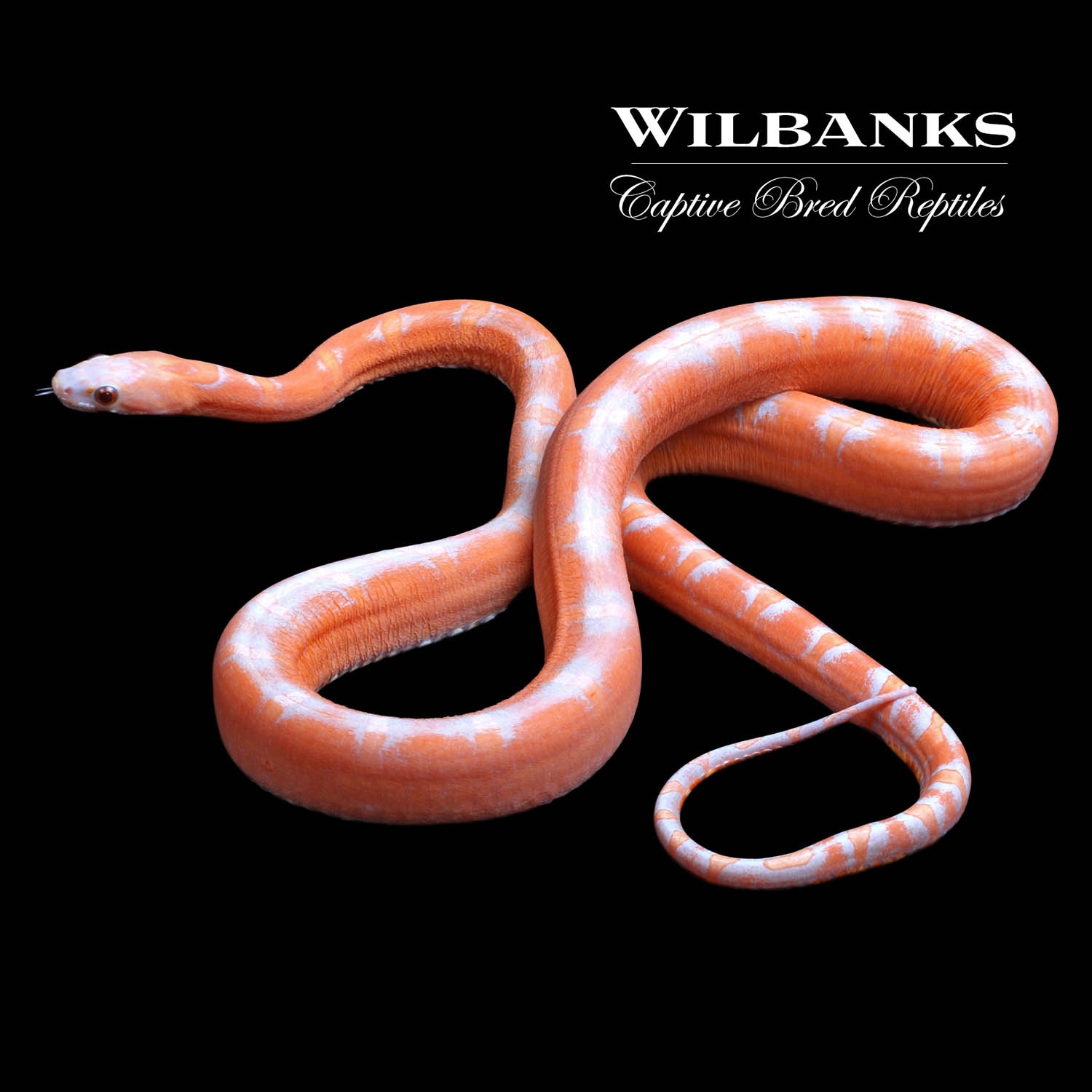

17. Pied-sided · Rootbeer · Creamsicle
Inheritance class: mixed: Pied-sided recessive; Rootbeer/Creamsicle may denote interspecies-derived lines
Pied-sided produces irregular white patches along the sides. Rootbeer and traditional Creamsicle labels commonly refer to lines with Emory’s ratsnake ancestry.
Confusion and purchase check: Not every white patch is Pied-sided; distinguish it from scars and retained shed. Obtain written disclosure on whether the animal is pure corn or from hybrid-derived stock.


18. Ultra · Ultramel
Inheritance class: allelic series at the amel locus; hybrid-origin history
Ultra is a melanin-reducing allele; Ultramel is the Amel/Ultra compound heterozygote. Do not calculate Ultra and Amel as independent loci.
Confusion and purchase check: Ultra lines have a widely documented gray ratsnake-derived history. Sales records should disclose both genotype and hybrid ancestry.


19. Snow · Blizzard · Avalanche · Opal
Inheritance class: multi-locus recessive combinations
Snow is Amel+Anery A; Blizzard is usually Amel+Charcoal; Avalanche is Amel+Anery A+Diffused; Opal is Amel+Lavender. Similar pale color does not mean the same genotype.
Confusion and purchase check: Eye color, residual pattern and age-related yellow/pink change are clues, not proof. Parent records and clutch outcomes are decisive.


20. Combo planning · proof
Inheritance class: depends on component genes
Read component genes before the combo name. Example: Motley Butter = Amel/Amel + Caramel/Caramel + Motley/Motley. Each recessive locus must be homozygous to be visual.
Confusion and purchase check: A possible het is not visually confirmed. “66%” is the conditional probability among non-visual offspring from het×het; “50%” follows specific pairings such as visual×normal.


Additional combination comparisons
These two supplementary examples show why a combination name cannot be inferred from one component gene alone.


Worked inheritance examples
| Pairing | Expected visuals | Label for non-visual offspring |
|---|---|---|
| Amel × Normal | 0% Amel | 100% het Amel |
| het Amel × het Amel | 25% Amel on average | Non-visual offspring are 66% possible het |
| Amel × het Amel | 50% Amel on average | 50% 100% het Amel on average |
| Tessera (heterozygous) × Normal | 50% Tessera on average | 50% Normal on average |
| Snow × Snow | 100% Snow | None; both loci are homozygous |
Probabilities are long-run expectations, not guarantees for a four-egg clutch. One clutch does not prove every possible het carried by a parent.
Six naming traps
- Bloodred as a separate simple color gene: record Diffused separately from red line-breeding.
- One universal Blizzard recipe: ask whether the seller means Amel+Charcoal or also includes Diffused.
- Creamsicle as only Amel+Hypo: traditional Creamsicle lines may include Emory’s ratsnake ancestry.
- Calculating Ultra and Amel independently: they belong to an allelic series at the same locus.
- Using “het Miami/Okeetee”: locality-derived and line-bred looks are not simple recessives.
- Calling any bright photo Hypo: neutralize lighting, shed cycle and editing; inspect eyes and dark borders.
Welfare cautions
- Stargazer: neurological signs were historically associated with some Sunkissed lines. Animals showing upward head posture, twisting, inversion or feeding difficulty should not be bred and should be evaluated by a reptile-experienced veterinarian.
- Palmetto bug eye: document severity, symmetry and corneal condition. Do not dismiss a pronounced eye abnormality as cosmetic.
- Scaleless: avoid sharp or abrasive décor and overly dry setups. Inspect dorsal skin and the snout after sheds; retained ventral scales do not guarantee normal skin protection elsewhere.
- Amel lines: pigment reduction alone does not justify claiming a disease-level light sensitivity. Every corn snake should still have shaded hides and control over exposure.
- Hybrid-derived projects: ancestry does not automatically mean poor health, but concealing it damages long-term breeding records and buyer consent.
Twelve buyer questions
- Is each photo the actual animal or a reference animal?
- Are neutral-light, eye, belly and subcaudal photos available?
- Are parent genotypes and parent photos documented?
- Are visual, 100% het and possible het kept separate?
- Can the seller explain the pairing behind 66% or 50% possible het?
- Are line-bred names kept separate from simple genes?
- Is possible hybrid ancestry disclosed for Ultra, Creamsicle and Rootbeer lines?
- Has Stargazer history been checked in Sunkissed projects?
- Are frontal and lateral eye photos available for Palmetto?
- Are skin and shedding records available for Scaleless?
- Are recent feeding, weight, fecal and shed records available?
- Are photo identity, description and genetic guarantee recorded in writing?
Photo sources
Each photograph links to its original source. Final morph identification should also use parentage and offspring records.
Sources and cross-checks
- HERP.BLOG Morph & Genetics category — duplicate-topic check
- South Mountain Reptiles Corn Snake Morph Photos — exact gallery/listing labels for photographed animals
- MorphMarket Morphpedia: Corn Snake Traits — current hobby terminology cross-check
- South Mountain Reptiles: Palmetto genetics and history — incomplete-dominant classification and origin record
- Wikimedia Commons: Pantherophis guttatus — real-animal photo source
- Seoul Reptile corn snake listings — current Korean market terminology
- NEWRUN Cheongju reptile listings — Korean Amel Tessera and Snow labels
This guide supports morph identification and record-keeping; it does not replace veterinary diagnosis for an individual animal.