Last updated 2026.09.24 · Edited by silveston · Compiled by an independent hobbyist without professional credentials
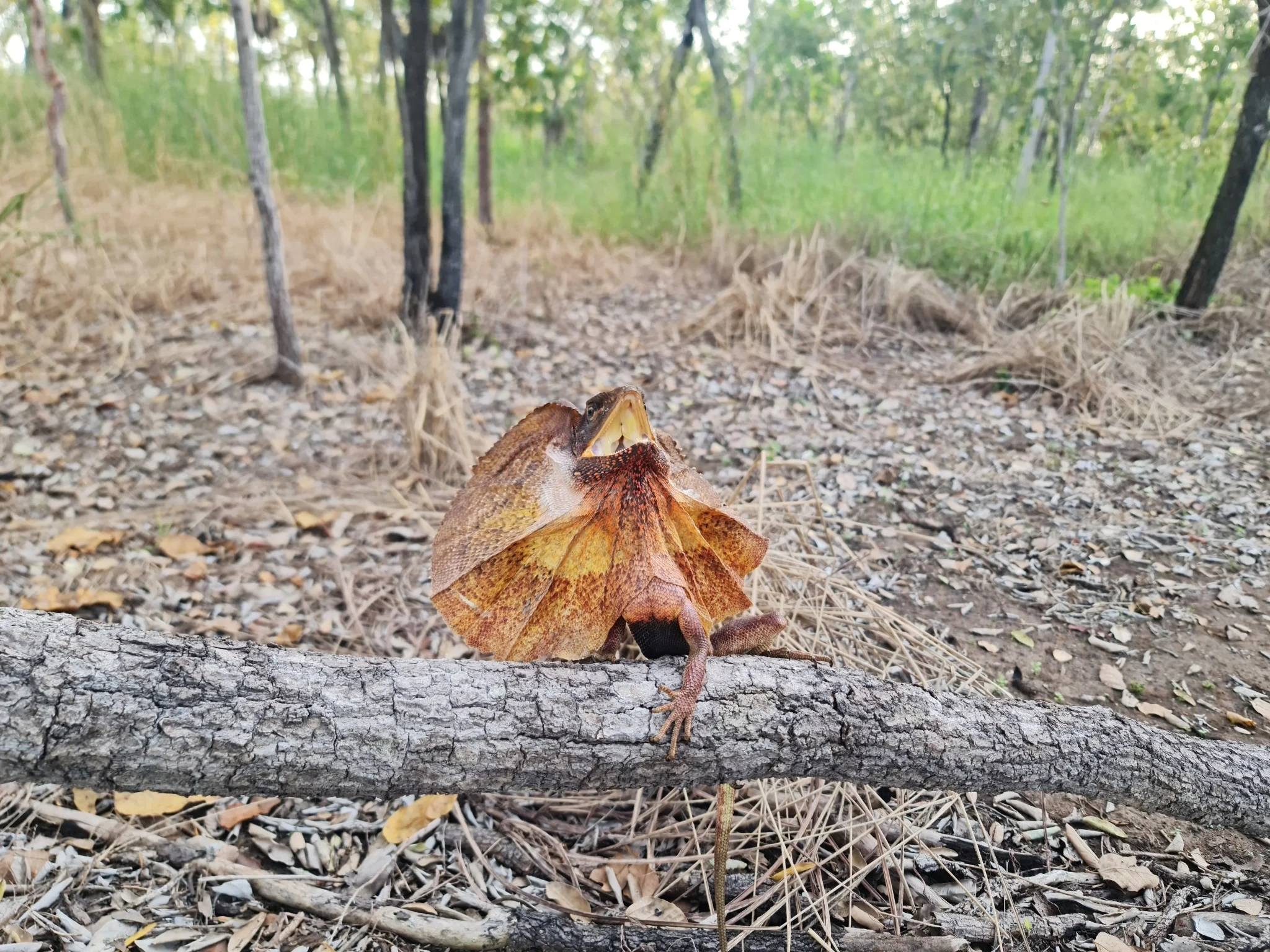
A frilled lizard is less “one large lizard” than a long-term project built around vertical space and intense light. Adults commonly reach roughly 70–90 cm including the tail, climb quickly, and may spread the frill or injure themselves while fleeing when startled. Keeping a juvenile setup for too long, or providing heat while neglecting UVB, ventilation, and measurement points, is a common route to failure. Before acquisition, secure the adult enclosure, electrical capacity, a reliable feeder-insect supply, and access to a veterinarian experienced with reptiles.
This guide covers general management of a healthy captive animal. Origin, age, sex, body size, existing disease, and enclosure design can change requirements. Every number should be interpreted as a reading measured where the animal actually sits, not as a setting printed on equipment. If appetite declines or repeated falls, abnormal breathing, or weight loss appears, do not diagnose the animal online or medicate it without supervision; arrange an examination.
Essential parameters
| Difficulty | Upper-intermediate to advanced; a large measured vertical system is essential |
|---|---|
| Adult enclosure | Begin around 120 × 60 × 180 cm (W × D × H); provide more for large males |
| Daytime ambient | Broad gradient around 27–32°C with a cooler retreat |
| Basking surface | About 38–43°C, verified with a surface thermometer |
| Night | Generally 21–24°C, with a controlled gentle drop for healthy adults |
| Humidity | Use roughly 50–70% as a reference while allowing post-misting peaks, drying, and ventilation |
| UVB | A linear T5 HO lamp providing a selectable UVI around 3–5 after accounting for branch distance and mesh |
| Cohabitation | House singly by default |
The table is a starting point, not an automatic recipe. Chicago Exotics lists an ambient range of 84–90°F (about 29–32°C), a night temperature around 72°F (22°C), and a basking area of 95–100°F (35–38°C). Other professional husbandry sources place the basking surface around 40°C or slightly above. Differences often reflect whether air or surface temperature was measured, lamp distance, and animal condition. Use air probes, an infrared surface thermometer, and thermostatic control together, then record the animal’s choices.
Enclosure size and vertical routes through growth
A juvenile benefits from a layout where food and water are easy to locate rather than from a huge empty box, but it should not remain in a small plastic tub. Provide height and lateral range several times the animal’s body length, linking vertical and diagonal branches of different diameters. Record growth monthly; upgrade as soon as the tail constantly touches walls or one leap crosses the entire enclosure. A temporary enclosure should be temporary only while the adult habitat is being completed, not a solution postponed for another six months.
A practical minimum starting point for an adult is about 120 × 60 × 180 cm, with at least 180 cm of width and greater depth preferable for large males or active animals. A tall telephone-booth shape is not enough. Horizontal and diagonal routes must connect a warm upper zone with a cooler lower zone and a bright front with a shaded rear. Include broad branches that support the whole body and tail, cork panels for concealment, foliage, and side barriers that interrupt lines of sight.


Thermal gradient and measurement positions
Place a branch or shelf broad enough to warm the whole body under the basking lamp and begin with a surface target of 38–43°C. A tiny hotspot above 45°C can overheat only part of the back. Create choices: roughly 29–32°C in the warm upper air, 26–29°C through the middle, and about 24–27°C in the coolest retreat. Persistent gaping or hiding in the lowest corner can indicate overheating; an animal that never leaves the lamp may be compensating for low ambient heat or impaired digestion.
Fix probes at three sites: warm air at basking-branch height, the middle activity zone, and the coolest retreat. Use an infrared thermometer daily on branches, cork, and substrate, but never treat a surface reading as air temperature. Connect every heat source to a thermostat, and select lamp wattage and distance so a displaced or covered probe cannot create catastrophic overheating. Run a new system empty for at least 48 hours before introducing the animal.
At night, switch off bright heat lamps and allow a gentle fall, generally to 21–24°C. If the room drops substantially below that range, use a non-light-emitting ceramic heater or radiant panel under thermostat control. Red or blue “night bulbs” are not truly dark to the lizard and should be avoided. Even when seasonal change is intended, abrupt cooling for breeding should occur only within an experienced plan that accounts for health and provenance.


UVB and visible light: designing brightness
As a diurnal arboreal species, a frilled lizard cannot rely on one small compact UVB bulb to cover a large vertical enclosure. Mount a linear T5 HO UVB tube in a reflector beside the basking zone so heat and UVB can be selected together. Aim for roughly UVI 3–5 on the principal basking branch while preserving retreats near zero beneath foliage or toward the rear. Lamp model, reflector, mesh, and branch distance strongly alter output, so verify with a UV meter when possible rather than trusting a generic chart.
Glass and most clear plastics block nearly all useful UVB. Mesh also reduces output, so the safe distance differs when a lamp sits above screening versus inside the enclosure. Replace tubes according to the manufacturer’s effective-life guidance and remeasure after replacement. Strong UVB in an otherwise dim enclosure does not reproduce a bright diurnal habitat. Add neutral or daylight LEDs and maintain a consistent photoperiod of about 12 hours with timers.


Humidity, misting, ventilation, and water
Use an average relative humidity around 50–70% as a reference without fixing it at one number all day. A more realistic cycle rises briefly toward 70–80% after morning or evening misting, then falls as surfaces dry. Cross-ventilation near both the upper and lower enclosure prevents warm damp air from stagnating. High humidity combined with poor airflow promotes bacteria, mold, and respiratory problems; continuous heat and dryness make hydration and shedding difficult.
Many individuals lick droplets from leaves and branches, but a clean water bowl should always be present. It need not be deep enough for full-body soaking; choose a stable, easily scrubbed bowl. Replace water daily and immediately after contamination by feces or feeder insects. For automated misting, disinfect the reservoir and tubing regularly and ensure no nozzle floods the substrate. Use at least two hygrometers, one in the warm upper zone and another at middle or lower height.
Branches, cover, planting, and substrate
Anchor both ends of major branches so they cannot rotate or flex under the animal’s weight. Combine vertical trunks with 30–60-degree diagonals and horizontal resting stations, offering both diameters the toes can wrap around and broad supports for the body. Select materials below the heater that will not reach dangerous surface temperatures, and remove sharp decor from fall paths. Artificial foliage or nontoxic live plants can block sight lines, but should not become so dense that they obstruct routes or airflow.
Although the floor is not the adult’s main living surface, it affects cleaning, humidity, and impact absorption. During quarantine, white paper towel or unprinted paper makes feces, urates, and parasites easier to inspect. For an established animal, a soil-based mixture of organic topsoil, coco coir, and leaf litter can work if it is free of fertilizer, pesticide, and perlite. Avoid a permanently waterlogged deep bed, cedar or strongly aromatic wood, sand alone, and large chips likely to be swallowed with prey.


Diet and feeding through growth
Base the diet on varied gut-loaded insects. Rotate crickets, legal roach species such as dubia where permitted, locusts, silkworms, and black soldier fly larvae; reserve fatty mealworms, superworms, and waxworms as minor items. Prey should not greatly exceed the width between the lizard’s eyes. Avoid wild-caught insects because of pesticides, parasites, and legal concerns. Gut-load feeders for 24–48 hours with nutritious greens and formulated diets while providing a clean moisture source.
Feed rapidly growing juveniles once daily or nearly daily in modest portions, judging body condition and the growth curve rather than a fixed insect count. Subadults may eat four to five times weekly, while adults commonly require two to four feeding days according to weight and activity. Scheduled variety with prompt removal of leftovers is safer than a large dump of insects. If an adult steadily gains excess fat, reduce frequency and also review enclosure routes and temperature.
Match calcium and vitamin supplementation to UVB output and feeder composition. With appropriate UVB, lightly dust most juvenile meals with plain calcium and use D3-containing products and multivitamins less often according to product concentration. Adults may need a lower frequency. Oversupplementation is harmful, so do not stack multiple products; record label concentrations and veterinary advice. Vertebrate prey such as pinky mice are not required staples and should be considered, if at all, only as very rare extras because of obesity and nutritional imbalance.


Shedding and skin care
Healthy shedding can occur in patches; the entire skin need not come off at once. Color may dull beforehand, and appetite or activity may briefly decline. Rough cork, branches of varied diameter, a humidity cycle that rises after misting and then dries, and adequate hydration allow the lizard to rub skin away. Under bright light, check toes, the tail tip, and folds of the frill for retained skin that could constrict circulation.
Do not pull dry retained skin or force the frill open. Temporarily provide a warm humid retreat, correct husbandry, and allow the material to loosen naturally. Swelling, discoloration, bleeding, odor, or repeated incomplete sheds warrant veterinary assessment. Assuming every problem is simply “low humidity” can obscure nutrition, skin infection, burns, or systemic disease.
Behavior, handling, and signs of stress
An open frill is not entertainment; it means the animal already feels threatened. Repeatedly provoking it wastes energy, creates chronic stress, and can cause nose, jaw, or toe injuries when the lizard rushes into glass or decor. With a new animal, minimize unnecessary contact for at least two weeks and until feeding, elimination, and thermal choices are stable. When handling is necessary, approach slowly from below, support the body and all four limbs, and never restrain by the tail.
Distinguishing normal caution from illness-related lethargy requires a baseline. Once weekly, note preferred height, response to food, and hiding behavior when people pass. Sudden repetitive glass surfing, nose rubbing, darkened coloration, persistent gaping, or falling indicates an environmental or health problem. For conditioning, predictable feeding times, a target, and a safe platform away from the hand are preferable to forced contact.


Cohabitation and breeding management
Single housing is the default. Males can fight severely over territory and access to females, while a male may subject a female to persistent courtship and mating attempts that prevent feeding or rest. Even females can establish subtle dominance over basking sites and food. A large enclosure does not automatically remove these problems, and continued feeding does not prove absence of stress. Breeding introductions should be supervised and time-limited, with a complete spare enclosure ready for immediate separation.
Provide a potentially gravid female with a lay box at least 25–30 cm deep, filled with slightly moist diggable soil-and-sand mix that holds a tunnel. Offer choices in temperature and privacy, and record pre-laying restlessness, digging, appetite, and body weight. Straining without laying, hind-limb weakness, or abnormal abdominal distension requires urgent assessment. Breeding plans must begin with the female’s health, genetic provenance, and space for every offspring, not anticipated sales.
Cleaning, quarantine, and records
Remove feces, urates, and dead insects daily and scrub the water bowl. Weekly, clean soiled branches and glass and confirm that temperature and humidity sensors remain secured. Match complete substrate replacement or partial renewal of a bioactive system to contamination and drainage. Use reptile-safe disinfectant at the correct dilution and contact time, then rinse and dry completely. Never use heavily scented household cleaners or mix bleach with other chemicals.
Quarantine a new arrival for at least 60–90 days in a separate room with separate tools where possible. Plan fecal testing and a health examination near arrival and again as quarantine ends. Weigh weekly on the same scale at a similar time and graph the result. Recording feeder type and number, supplements, sheds, elimination, basking, and equipment changes reveals the timing of a problem instead of forcing guesses. Clean hands and tools between animals to prevent cross-contamination.
Health warning signs and response
- Persistent repeated gaping for more than 48 hours, nasal discharge, bubbles, or noisy breathing
- Continuing weight loss across twice-weekly measurements or stalled juvenile growth
- Swollen, trembling, or pliable jaw and limbs, or repeated falls
- Sunken eyes, sticky saliva, or concentrated urates suggesting dehydration
- Swelling, injury, odor in frill folds, or discoloration of toe tips
- Persistent straining, lethargy, or hind-limb weakness in a potentially gravid female
These signs are not definitive diagnoses. Photograph the condition, preserve weight records, check temperature at three points, humidity, UVI, recent feeding, and elimination, then contact a reptile-capable veterinarian. Labored breathing, repeated falls, bleeding, or suspected egg retention may require same-day care. Do not administer leftover antibiotics, dewormers, human painkillers, or concentrated vitamins without direction.
Frequent beginner mistakes
- An empty enclosure that is tall but lacks lateral routes and visual cover
- Using one thermometer without measuring the basking surface and coolest zone
- Placing UVB behind glass or ignoring mesh attenuation and distance
- Blocking ventilation and keeping the floor constantly wet in pursuit of humidity
- Depending on one feeder species and excessive supplements
- Provoking frill displays or handling frequently before acclimation
- Cohabiting without a spare enclosure and judging compatibility only by feeding
- Acquiring a juvenile before budgeting for the adult habitat, electricity, and veterinary care
The goal is not to create the highest possible numbers but to create choices and verify that they function. Warmth and coolness, brightness and shade, post-misting humidity and complete drying, exposed observation perches and concealed retreats must coexist. Weekly records reveal which choices the animal uses; a zone that is never used can indicate a structural or environmental error.
Daily and weekly management checkpoints
Each morning after lights come on, confirm that the animal reaches its usual basking position, the eyes and nostrils are clean, and breathing does not produce excessive body movement. While changing water, look for uneaten insects and record the appearance of feces and urates. In the evening, review maximum and minimum climate readings and confirm lamps and timers operated correctly. Repeating this short sequence at similar times makes small changes easier to detect.
On the same day each week, check body weight and condition, then physically inspect branch stability, mesh and door latches, cable insulation, and lamp mounts. If a UV meter is available, record the same marked point on the basking branch at least monthly and compare readings before and after lamp replacement. Inspect misting nozzles, drainage, and odor in deeper substrate. Equipment failures often appear sudden, but records may reveal warning trends such as declining output or rising humidity.
Preparing for transport and veterinary visits
For travel, do not move the animal inside a large glass enclosure. Use a rigid ventilated carrier lined with a nonslip towel and a low object to grip. Excess space can cause impacts during braking, so choose a size that permits turning while limiting violent movement. Never leave the carrier in a hot vehicle; in cold conditions, warm it safely from outside without allowing a heat pack to touch the skin. Before closing, confirm that neither the frill nor the tail is caught in the door.
Before an appointment, prepare four weeks of weights, a feeding and supplement log, enclosure photographs, three-point temperature and humidity readings, UVI, and images of elimination. If possible, bring a fresh fecal sample collected within 12 hours in a sealed container according to clinic instructions. If transport stress triggers the frill, do not force it closed or tape the mouth. Unless the clinic requests fasting, do not withhold food for an extended period; ask when booking about preparation for possible testing or sedation.
Understanding the natural history
For the ecological reasons behind these requirements, the Frilled Lizard species profile covers arboreal living, sit-and-wait hunting, bipedal running, seasonal change, and development of the frill. Captivity cannot reproduce the wild, but understanding height choice among trees, bright daylight, and wet–dry rhythms connects equipment readings to the animal’s actual needs.
References
- Chicago Exotics Animal Hospital — Frilled Lizard Care
- CABI — Husbandry Plan for Frilled-Neck Lizard (2025)
- The Reptile Database — Frilled Lizard
- Animal Diversity Web — Frilled Lizard
- Baines et al. (2016), UV-Tool, DOI 10.19227/jzar.v4i1.150
- Reptile Centre — Frilled Dragon Care Sheet
Suggest an edit
Tell us which sentence may be incorrect and provide a verifiable source. Submissions are reviewed before publication.