Last updated 2026.10.14 · Edited by silveston · Compiled by an independent hobbyist without professional credentials
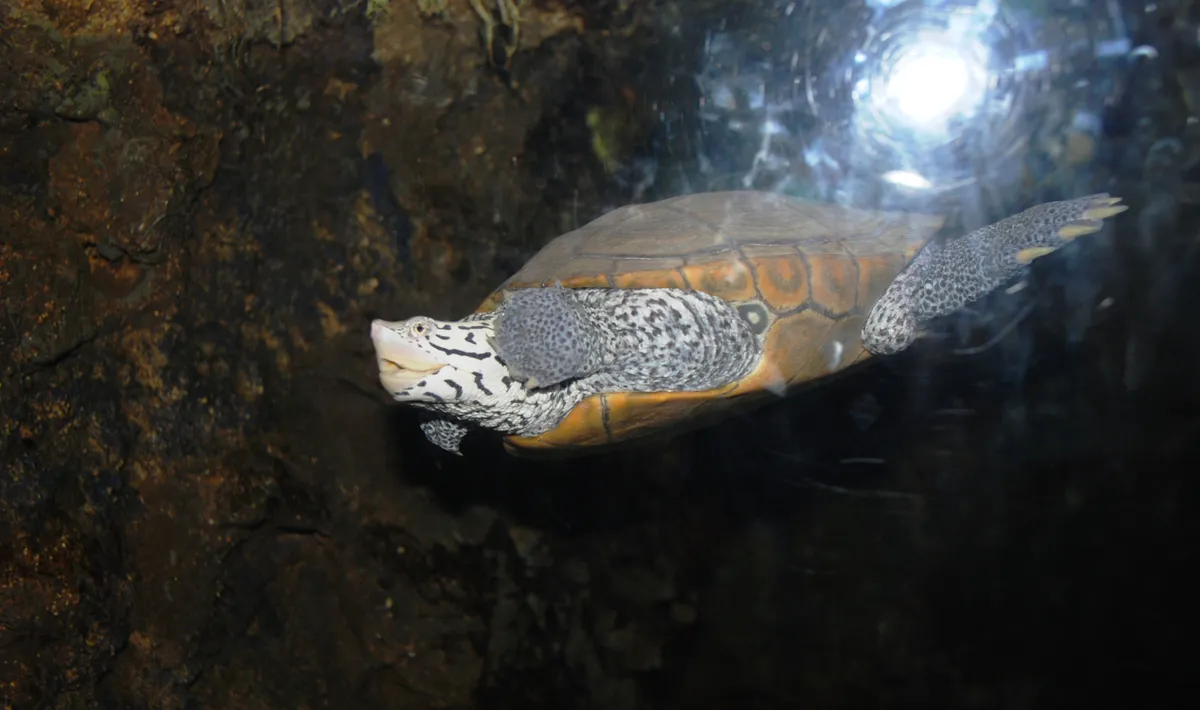
The diamondback terrapin (Malaclemys terrapin) is a semi-aquatic turtle of tidal estuaries. Its ability to use variable-salinity waterways does not mean that adding some salt is sufficient husbandry. The foundation is ample swimming space, a completely dry basking area, stable filtration and water quality, appropriate UVB, traceable foods and fresh drinking water. “Ornate terrapin” is a trade name derived from the subspecies M. t. macrospilota, not a separate species with a separate care formula.
The numbers below are starting ranges from veterinary sources, not prescriptions to impose on every animal. Measure the actual conditions and adjust for sex, body size, age, health and room temperature. Salinity advice differs among sources; do not experiment with high salinity on hatchlings or animals with eye or skin problems. If illness is suspected, take husbandry records to a veterinarian experienced with reptiles.
Before Acquisition: Provenance and Adult Space


A sales listing does not establish lawful import, subspecies identification or health. This species is described as CITES Appendix II, so check import and transfer provenance and current Korean procedures. A pattern label such as “big-spot ornate” is not a pedigree certificate. Match the scientific name and animal details against receipts, relevant import and transfer documents, feeding history and prior care records. Do not encourage wild capture; verify current documentation requirements with the relevant authority.
Catherine Love, DVM, gives typical adult shell lengths of 4–5.5 in for males and 6–9 in for females in a 2024 guide. Aquarium sources note that some females grow larger, so the purchase-size shell cannot determine the final tank. Tree of Life Exotic Pet Medical Center suggests a 20 gal long tank as a juvenile starting point and at least 75–100 gal per adult. Actual water volume, horizontal swimming length and turning room matter more than a tank’s advertised capacity.
Veterinary rules of thumb—10 gal of water per 1 in of shell, or 6 in of tank length per 1 in of shell—help estimate a minimum. For an 8 in female that suggests 80 gal or 48 in of floor length as starting calculations, not proof that meeting either number alone is sufficient. Subtract space occupied by filters and basking structures, then check usable swimming room. Plan for a larger enclosure as the turtle grows, including the ongoing cost of water and electricity.
Do not place a new arrival immediately with other animals. In a separate enclosure, record appetite, swimming posture, waste, skin and shell condition and arrange a reptile-veterinary assessment. Size differences between the sexes, food competition and biting of feet or tails make “they must be kept in groups” a poor general rule. One animal in a spacious, well-managed tank may fare better than several crowded together.
Deferring a purchase when provenance or adult-scale equipment is unresolved is part of responsible planning. This turtle can live for decades, and its water is heavy. Check floor loading, leak contingency, electrical safety and a practical route for water changes before installation. Welfare depends on a system that can be maintained for years, not a single attractive enclosure photograph.
Filtration and Water: Clear Does Not Mean Safe


Terrapins feed and defecate in water, so a filter is not decoration. Use a capable canister or equivalent filter with sufficient media, and guard intakes against trapping the body or feet. Excessive current can exhaust a young animal, so leave quieter resting areas. Remove food debris before it decays in the filter. Keep a gentle route to the surface and places to rest on one side of the enclosure.
Establish the nitrogen cycle before introducing an animal. Waste and uneaten food release ammonia, which bacteria convert through nitrite to nitrate. Veterinary guidance emphasizes testing for 0 ammonia and 0 nitrite before introduction. Both compounds can be present in visually clear water, so use a reliable test kit. Cycling can take weeks or longer; elapsed time alone does not prove that the tank is ready.
During routine care, keep ammonia and nitrite at 0 and track nitrate trends. One veterinary guide gives 20–30% partial water changes every 1–2 weeks as an example; Tree of Life suggests 25–40% weekly or biweekly according to bioload. Do not force these different ranges into one rigid schedule. Adjust frequency and volume to feeding, tests and tank size. Dechlorinate replacement water and match its temperature and salinity closely to the existing water.
Scrubbing all filter media in untreated tap water can disrupt the bacteria supporting the nitrogen cycle. Rinse debris gently in removed tank water and do not replace every medium at once. A small tank changes faster under the same waste load. The notion that a turtle tolerates dirty water can invite skin, eye and shell problems. Water testing is a preventive record, not merely a response after illness appears.
Check water temperature and level, filter flow and noise, and access to the surface every day. Weekly records should include ammonia, nitrite, nitrate, water-change volume, salinity and appetite. If test results change abruptly, review new foods, overfeeding, filter blockage and recent filter cleaning. Do not mask a water-quality problem with salt or disinfectant; investigate its cause and plan safe water changes.
Brackish and Fresh Water: Measure Before Adding Salt


Estuarine salinity changes with rain, tides and evaporation. Tree of Life veterinary guidance offers a brackish specific gravity (SG) of 1.014–1.018 as one adult-care starting range, using marine aquarium salt. But a published hatchling experiment found that growth and freshwater-seeking behavior can vary across salinities. That adult-care range is therefore not a universal answer for all terrapins, particularly hatchlings.
If salinity needs adjustment, do not estimate it by spoonfuls of table salt. Use a marine aquarium salt product and a refractometer or hydrometer to measure tank water and replacement water separately. Evaporation removes water but not salt, so topping off and changing water are different operations. Specific gravity also depends on temperature, so follow the instrument’s calibration instructions. Review previous conditions and provenance before making gradual changes.
Provide separate access to fresh drinking water when an animal spends extended time in brackish water. Wild terrapins can use rainwater or a fresh surface film, but that opportunity does not automatically exist indoors. Offer a stable shallow fresh-water dish or another veterinary-directed approach, and renew it frequently. Even a drinking dish can endanger a small hatchling if it cannot climb out, so depth and access must be designed together.
Salinity is not a medication. Raising it sharply because of skin discoloration or swollen eyes may distract from poor water quality, nutrition or UVB. Conversely, the species’ salty natural habitat does not prove that moving a freshwater-raised animal to strong brackish water in a day is safe. Consider age, previous conditions, water-test history and clinical state with a reptile veterinarian before changing the regimen.
Salinity and water quality are different measurements. Even water within a chosen salt range is unsafe if ammonia is present. Record temperature, specific gravity, ammonia and nitrite in separate columns before and after changes. If several people care for the turtle, share who topped off or changed how much water and with what mix. In a tank where small errors accumulate, records matter as much as equipment.
A Dry Basking Site, Thermal Gradient and UVB


A terrapin must be able to leave the water and dry its entire body. A floating ornament that sinks under its weight or leaves part of the shell wet is not an adequate basking site. Provide a nonslip ramp, a stable platform and enough space for an adult to turn. Arrange heat and UVB so both are available over the platform during the day, while securing lamps against burns or falls into water.
Tree of Life gives example water temperatures of 24–27°C for adults and 25–28°C for juveniles, with a basking surface around 31–33°C. Measure water in the tank with an aquarium thermometer and the actual surface where the turtle sits with an infrared thermometer. Do not assume that air immediately below the lamp equals the platform temperature. At night, turn visible lights off and monitor the room and water so they do not cool dangerously.
A gradient with choices matters more than one hot spot. If water and dry areas are identical in temperature, the turtle has fewer behavioral options for thermoregulation. An overheated dock can deter basking, whereas a cool one may not help warming or drying. Heating the entire pool until basking seems unnecessary is not a solution. Interpret basking frequency and appetite alongside measured temperatures.
Place UVB above the daytime basking platform and use roughly 10–12 h of light as a starting schedule. Do not assume that UVB passes effectively through intervening glass or acrylic. Check lamp type, distance, manufacturer replacement guidance and the animal’s actual position. If possible, use a UV Index meter at the basking site. Sprinkling calcium on food cannot by itself solve imbalances in UVB, heat and diet.
Outdoor sun exposure also requires protection against escape, overheating, predators, pesticides and contaminated water. A small clear tank in direct sun can heat rapidly. “Natural sunlight” is not automatically safe without shade, security and temperature measurements. Establish a consistent indoor lighting and measurement system first, then evaluate outdoor use as a separate management plan.
Food and Feeding in Water: Avoid a Single-Item Diet


In the wild, terrapins eat many snails, crabs, small bivalves and other invertebrates. The National Aquarium describes a strongly carnivorous diet with small amounts of plant matter. In captivity, use a reputable complete aquatic-turtle diet as a nutritional foundation and rotate traceable snails, shrimp, bivalves or earthworms as suitable supplements. Avoid collected shoreline or field prey if parasites, heavy metals or pesticides cannot be ruled out.
A single fresh food can skew micronutrient intake even if growth initially looks impressive. Boneless muscle meat or dried shrimp alone is not a balanced diet. Match food size to shell length and mouth size to reduce choking and fouling. Remove leftovers and compare regular photographs and weights so overfeeding does not silently change body condition.
Tree of Life offers daily feeding up to roughly 18–24 months and every 2–3 days for adults as examples. This does not mean every juvenile changes schedule on the exact same birthday. Adjust for growth rate, body condition, water temperature and appetite. Food consumed in around 10–15 minutes is a starting guide, but record actual intake rather than leaving piles of fish or crustaceans in the water. Several days of refusal in a hatchling or a sudden adult refusal warrants checking conditions and health.
Calcium and vitamin D metabolism connect food to UVB and basking temperature. Even an armored-looking shell is affected by nutrition and environment during growth. If it softens or changes abnormally, do not self-diagnose a specific disease; show a veterinarian records of diet, lighting and water quality. Avoid pushing rapid growth by overfeeding high-protein foods.
In a shared tank, food competition can hide inadequate intake by a subordinate animal. Separate feeding may help, but if moving the animal causes substantial stress, prioritize individual observation and intake records. A wild food list makes interesting reading; captive feeding must also be hygienic and sustainable. Do not recommend feeder insects unavailable legally in Korea; discuss traceable alternatives with a veterinarian.
Shedding, Cleaning and Health: Observe Daily


A turtle does not shed its whole skin in one piece like a snake. Skin fragments and scutes can separate gradually. But unusual peeling, cotton-like patches, odor, soft spots or shell pitting should not automatically be called normal growth. Check whether the animal can dry completely, whether water quality is stable and whether UVB reaches its basking position, then show photographs and a timeline to a reptile veterinarian.
Remove leftover food daily and observe waste, changes on tank surfaces and swimming posture. Listing to one side, inability to dive, repeated open-mouth breathing, nasal bubbles, swollen eyes or food refusal call for veterinary attention. These signs have multiple possible causes; do not diagnose a bacterial infection from an online image or give medication without veterinary direction. Bring dated water, temperature, feeding and weight records to the appointment.
During partial water changes, remove bottom debris and check that the dock and ramp are not slimy or slippery. Keep cleaning agents out of the water while preserving filter bacteria. A spare thermometer and emergency replacement water can help when equipment fails. Emptying and sterilizing the entire tank and every item at once can collapse the nitrogen cycle, so it is not routine maintenance.
Keep handling brief and mainly for necessary inspection or transport. Do not lift the turtle by a leg or keep it inverted; support shell and body securely with both hands. Return it to water where it can orient itself. Reptiles may carry Salmonella, so wash hands after handling tank water or equipment and avoid cleaning tools in the kitchen sink. Take extra precautions around children and immunocompromised people.
Weekly checks should cover water tests, filter flow, lamp position and function, dock stability and dietary variety. Monthly, record weight and shell length under consistent conditions and examine the trend. If weight falls suddenly, food repeatedly remains or breathing behavior changes, use the log to support timely veterinary care. The point of a checklist is not attractive numbers; it is noticing a change in the animal.
Species Wiki and References
For the species’ wild natural history, read the diamondback terrapin species wiki.
- Diamondback Terrapin Guide — Catherine Love, DVM (2024)
- Tree of Life Exotic Pet Medical Center — Diamondback Terrapin Care
- Effects of Salinity on Hatchling Diamond-backed Terrapins
- National Aquarium — Diamondback Terrapin
- The Reptile Database — Malaclemys terrapin
- Florida Fish and Wildlife Conservation Commission — species profile
Suggest an edit
Tell us which sentence may be incorrect and provide a verifiable source. Submissions are reviewed before publication.