Last updated 2026.10.10 · Edited by silveston · Compiled by an independent hobbyist without professional credentials
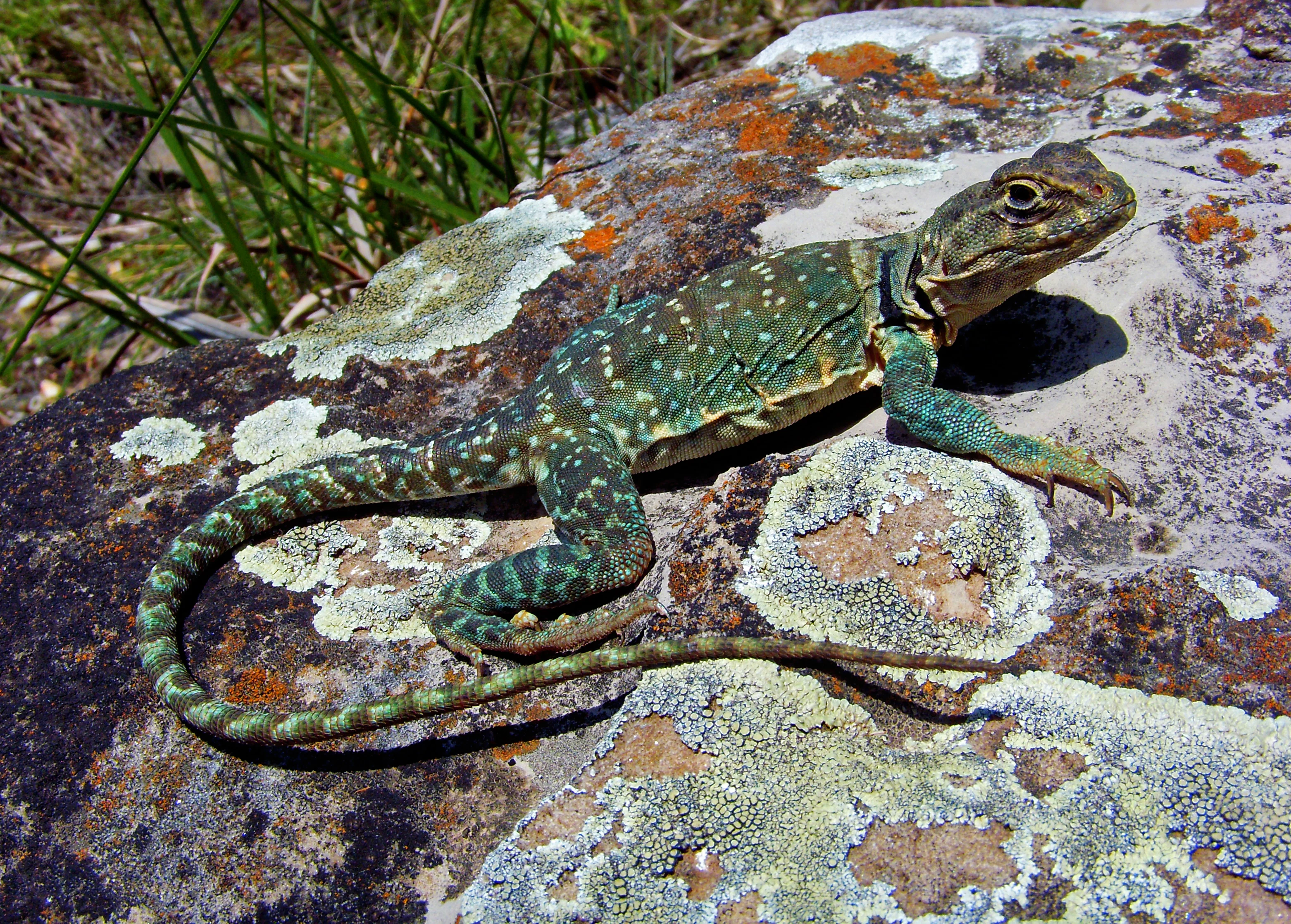
Successful care of the common collared lizard (Common Collared Lizard) is not captured by “it is arid, so keep it hot.” A broad, brightly lit enclosure must offer a very warm basking surface, warm air, a cool secure refuge, strong UVB, and complete shade at the same time. In the wild the animal heats rapidly on exposed rock and retreats into shade and crevices. Captive design must translate that field of choices safely.
This species is extremely fast, launches into sudden jumps and sprints, and males are strongly territorial. It cannot be managed like a small beginner gecko in a compact box, and one imprecise thermometer or weak lamp is not enough. The values below are starting points for a healthy captive-bred animal and must be adjusted for enclosure size, ventilation, equipment, room climate, and behavior. This is not diagnosis or prescribing; consult an experienced reptile veterinarian with husbandry records when warning signs appear.
Quick setup table
| Space for one adult | Start at about 120 × 60 × 60 cm; 150 × 60 × 60 cm or larger is preferable |
| Basking surface | About 40–45°C, measured on the actual rock with an infrared thermometer |
| Warm-side air | About 28–32°C, measured by a fixed probe at animal height |
| Cool-side air | About 22–26°C, measured at the cool-hide entrance |
| Night | Usually a drop to 18–23°C; adjust for health, age, and room conditions |
| UVB | Start around UVI 3–5 at the basking position; verify with a meter and manufacturer distance chart |
| Humidity | Generally dry and well ventilated, with one slightly humid refuge |
| Feeding | Varied, appropriately sized invertebrates; frequency adjusted to age and body condition |
| Cohabitation | Single housing by default; no routine permanent groups outside managed breeding |


Before acquisition: scientific name, origin, and records
Several Crotaphytus species and regional forms can be sold under “collared lizard.” Ask for the scientific name, parent or import records, hatch date, basis for sexing, recent body mass, feeder history, shedding, egg-laying, and medical history. Prefer traceable, legal captive breeding over an animal of uncertain wild origin. Do not turn a color label into a subspecies or genetic diagnosis.
House a new arrival separately from established reptiles with dedicated tools and water bowl. Record arrival weight and standardized photographs, then observe breathing, mouth, eyes, skin, vent, and feces. Avoid repeated handling or forced feeding immediately after transport. Quarantine duration and fecal testing should reflect origin and veterinary advice. Handwashing and equipment separation reduce transmission to both people and animals.
Space by life stage and escape prevention
Juvenile
Starting a juvenile in roughly 90 × 45 × 45 cm or larger makes a thermal gradient and front access easier to manage. Never underestimate the speed or jumping ability of a small animal. Inspect door gaps, cable ports, and screen edges and use a lock. Support heavy rock directly on the enclosure floor before adding substrate so digging cannot cause collapse.
Subadult and adult
Move a fast-growing subadult into a 120 cm enclosure early. For one adult, 120 × 60 × 60 cm is a practical minimum starting point, not an ideal endpoint. An active male or large individual benefits from 150 × 60 × 60 cm or more. Length and depth provide running, turning, and a thermal gradient; height creates safe rock shelves and lamp clearance.
Even a large empty enclosure creates exposure stress. Place a warm hide, cool hide, and slightly humid hide in different zones, linked by low rock shelves, cork, and visual cover from dry or artificial plants. Avoid a straight launch lane through the open door and locate the animal before every service.


Thermal gradient: measure surfaces and air separately
Install a halogen-style basking lamp over one end with thermostat control and a protective guard. Begin with an actual basking-rock surface around 40–45°C, keeping infrared thermometer emissivity and distance consistent. Air at animal height should be lower, roughly 28–32°C on a fixed probe. Adjust space and ventilation until the cool-hide entrance is about 22–26°C.
One wall thermometer cannot describe all three zones. Use an infrared thermometer for the basking surface and separate digital probes for warm and cool air, recording daily maxima and minima. Test an empty enclosure for at least a day after changing lamp height or vents. If the lizard stays under the lamp all day, investigate not only inadequate heat but also whether the cool refuge feels unsafe.
Switch visible lamps off at night and provide darkness. A healthy adult can commonly experience 18–23°C, but juveniles, underweight animals, recovery cases, and cold rooms require individual judgment. If the room becomes excessive, use a non-light-emitting overhead source limited by a thermostat. Red and blue “night” lamps may remain visible to the animal and are not routine night lighting.

,_Wichita_Mountains_Wildlife_Refuge,_SW_Oklahoma,_U.S.jpg)
UVB and brightness: UVI at the animal, not a lamp label
This is a high-light diurnal lizard. Overlap a linear UVB lamp with the basking zone and use approximately UVI 3–5 at the basking position as a starting point. Product branding cannot establish that value. Account for distance, mesh reduction, reflector, and lamp age, and verify with a UV meter. Lower-UV zones and complete shade must remain available in the same enclosure.
UVB alone can leave the enclosure visually dim. Add high-quality bright white visible light and align heat, UVB, and the brightest zone in the same direction. Then following brightness leads the animal toward heat and ultraviolet together. Glass and most clear plastics block much of UVB, so identify every material between lamp and animal.
Begin near a 12-hour photoperiod and keep it consistent with a timer. If seasonal changes are used, adjust gradually over weeks. Replace lamps using both manufacturer guidance and measured UVI decline, then remeasure distance because output can change after replacement.
Humidity, ventilation, and water
Do not keep the entire enclosure continuously damp. Use dry surfaces and strong ventilation while providing one refuge with lightly moist soil or moss that does not drip when squeezed. The humid hide supports shedding choice but must not force the animal onto a cold, wet floor. Persistent condensation or stale odor calls for better ventilation and drainage before more spraying.
Offer fresh water every day in a shallow, stable bowl toward the cool side. Do not remove it simply because drinking is rarely observed. Wash and replace immediately when contaminated. Misting can settle dust or offer brief droplets, but it does not replace a bowl, humid refuge, and appropriate dietary moisture.


Substrate and rock structure
A mix of fertilizer- and pesticide-free topsoil, washed sand, and some clay should hold shape when pressed without retaining standing water. Begin around 8–15 cm deep for an adult, with deeper patches for shallow digging. Fine pure sand alone can collapse and become dusty. A product name such as “calcium sand” does not guarantee safety if swallowed.
Secure a broad basking rock so excavation cannot make it settle or fall; support it on the floor or a structural base. Allow adhesives to cure completely and lose all odor before use. Remove sharp edges and tapering traps, and preserve enough lamp clearance to reach the target surface temperature without burn risk.
Cork, low rocks, and visual barriers are behavioral choices rather than decoration. Link an open basking site, a partly exposed observation point, and fully hidden retreats. Replacing every structure at once erases the animal’s spatial map, so retain one clean familiar hide during major cleaning.
Food and supplements: manage variety with body-condition records
Rotate invertebrates with different movement and nutrient profiles, such as crickets, silkworms, black soldier fly larvae, legally supplied locusts where available, and limited mealworms or superworms. Do not use wild-caught insects because of pesticide and parasite risk. Prey should generally not be excessively wider than the head, and uneaten live feeders must not remain overnight.
Start juveniles with small meals about 5–6 days weekly and adjust from growth and feces; subadults often eat around four times weekly, while adults commonly begin around two or three. These are not rigid rules. Track the tail base, trunk, pelvic prominence, activity, and weight trend. Females around egg production require separate nutritional assessment.
Provide feeder insects with nutritious food and hydration for 24–48 hours before use. Apply calcium and multivitamin lightly according to UVB, product concentration, and life stage. Stacking several products or coating every feeder heavily is not safer. Review vitamin D3 frequency against measured UVI and long-term diet with a veterinarian.
| Juvenile | Start with small prey 5–6 days weekly; adjust from growth, feces, and body condition |
| Subadult | About 3–4 days weekly, rotating feeder types and monitoring fat gain |
| Adult | Common starting point 2–3 days weekly; adjust portion to activity and weight trend |
| Supplements | Match calcium and multivitamin to product concentration, UVB, and life stage |
| Avoid | Wild insects, one feeder indefinitely, oversized prey, and leaving live prey overnight |

.jpg)
Shedding and daily behavior
Color may dull and appetite or activity may briefly fall before a shed. Provide a lightly humid refuge, textured cork, and clean water, but never peel skin forcibly. After shedding, inspect toes, tail tip, and eyes for constricting remnants. Repeated incomplete sheds require review of temperature, hydration, nutrition, and underlying health rather than more mist alone.
Handling and cohabitation
A grab from above easily triggers a predator response. Approach slowly from the front and support chest and pelvis together, never grasping tail or limbs. Keep early sessions to one or two minutes within the enclosure and stop if breathing accelerates or the animal twists to flee. Work near the floor in a closed room because escape is exceptionally fast.
Single housing is the default. Males are strongly territorial, and a male may subject a female to continuous courtship and mating pressure. Even without visible fighting, one animal can be excluded from heat, UVB, food, or shelter and lose weight. Breeding introductions belong only with separate backup enclosures and an immediate separation plan.
Mixed-species housing is not recommended because temperature, UV, diet, behavior, and pathogen risks conflict. “Taming” should mean predictable husbandry with less fear, not prolonged forced restraint.


Cleaning and records
Remove feces, food remains, and contaminated substrate daily and wash the water bowl. Weekly, inspect door tracks, mesh, beneath rocks, probe mounts, and lamp guards. Replace substrate according to odor, mold, mites, and drainage rather than discarding everything on a fixed calendar. Use disinfectants according to reptile-safe instructions, rinse thoroughly, and dry completely.
Weigh at a consistent time about twice monthly and log feeder type and quantity, feces, sheds, basking location, aggression, and female nesting behavior. Record temperatures, UVI, and lamp replacement dates. A trend over weeks matters more than one small fluctuation; standardized photographs help compare body condition.
Health warning signs
- Open-mouth resting, difficult breathing, nasal fluid or bubbles, or repeated respiratory sounds
- Eyes kept closed or swollen, or redness, discharge, or odor in the mouth
- Unexpected weight loss, prolonged refusal of food, abdominal swelling, cessation of feces, or severe diarrhea
- Jaw, spine, or limb deformity, tremors, dragging limbs, or a marked change in basking posture
- Suspected burn, blister, ulcer, mites, or repeated incomplete sheds
- Bleeding, swelling, discoloration, or infection signs after a fall, bite, or tail injury
Do not answer these signs by applying human medicines, piling on supplements, or pushing the enclosure to an extreme temperature. Give the clinic current readings for all three temperature zones, UVI, humidity, diet and supplements, weight chart, and fecal photographs. Respiratory distress, reduced consciousness, uncontrolled bleeding, and major trauma require prompt assessment.
Common beginner mistakes
- Heating the entire enclosure until the cool refuge disappears.
- Treating surface temperature and air temperature as one value and trusting one wall gauge.
- Choosing UVB by product name without measuring distance, mesh loss, and UVI.
- Placing heavy rock on loose substrate so digging can trigger collapse.
- Removing water and a humid refuge because the species is arid, or soaking the whole enclosure every day.
- Relying on one feeder and excessive supplements without body-mass records.
- Handling for long periods because vivid color and stillness are mistaken for calm, or grabbing the tail.
- Sharing tools and bowls with established reptiles without quarantine.
Daily and weekly checklist
| Daily | Basking, warm, and cool temperatures; water; breathing and posture; feces; door lock |
| Feeding days | Feeder type and quantity, response, and removal of uneaten live prey |
| Weekly | Humid hide, substrate odor and drainage, skin, toes, tail, lamps, and probe mounts |
| Monthly | Body mass and standardized photo, thermometer cross-check, UVI, lamp hours and replacement plan |
| After a change | Alter one variable at a time and log date, measurement, and behavioral response |
A weekly operating pattern and seasonal change
In the morning, after the lights have warmed up, read the basking surface, warm-side air, and cool-side air in the same order and record them. Measure surfaces with an infrared thermometer and air with digital probes placed at the animal’s actual height. If a value shifts sharply from the previous day, check lamp position, vents, room heating or cooling, and a displaced probe before interpreting the lizard’s behavior. The animal should be able to flatten under heat and then choose shade. Remaining under the heater all day may mean the cool zone is too cold or that the lizard is unwell.
Offer food after the lizard is warm and active. Avoid late-night feeding because little heated digestion time remains, and remove uneaten live insects before lights-out. Make a brief midday check of behavior and breathing without repeatedly opening the enclosure and disrupting territorial security. Before darkness, inspect the water bowl, feces, loose stonework, and door locks. Keep night truly dark and allow a natural temperature decline when the room remains within a safe range. Red or blue ‘night bulbs’ do not substitute for darkness.
Adjust seasonal conditions gradually according to the indoor environment and the individual, not the calendar alone. Change day length and heater runtime in small steps over several days, and do not sharply alter food, temperature, and light at the same time. Forced cooling to imitate wild winter dormancy is not routine beginner management when breeding is not the goal. Juveniles, underweight animals, recent acquisitions, and animals recovering from illness should not be cooled. If seasonal dormancy is planned, set weight, examination, and termination criteria with a reptile veterinarian beforehand.
Prepare for outages and equipment failure as part of routine husbandry. Keep a spare digital thermometer, replacement lamp, tested thermostat, battery light, insulatable carrier, and veterinary contact together. During a winter outage, never place a hot-water bottle or chemical heat pack in a sealed container in direct contact with the animal. Wrap external heat, ventilate, and continuously measure the actual internal temperature to prevent burns and oxygen depletion. When power returns, restore the normal gradient instead of rapidly overheating the enclosure.
For travel or veterinary visits, an opaque, ventilated carrier just large enough to prevent the lizard from tumbling is safer than a large display enclosure. Use non-slip paper and a light hide; remove rocks and water bowls; secure the carrier away from direct sun inside the vehicle. Do not try to warm the animal immediately before arrival by placing it on a dashboard or heated seat. Weight, feces, breathing, and posture recorded before and after travel provide useful clinical context.
Females preparing to lay and breeding management
A mature female may produce infertile eggs without a male, so evaluate abdominal enlargement, repeated digging, appetite changes, and weight trends together. When laying is possible, provide a box in which her whole body can enter and turn. Fill it deeply with diggable substrate that briefly holds shape when squeezed but does not drip. Place it in a quiet, screened location while checking that it has not become a cold, wet trap with poor ventilation.
Reproduction requires calcium and energy, but indiscriminately increasing supplements is not the answer. Review prey variety, UVB and heat, the supplement schedule, and actual intake together, and weigh the female weekly under consistent conditions. Persistent straining without laying, hind-limb weakness, profound lethargy, a hard asymmetric abdomen, cloacal discharge, or prolapsed tissue warrants prompt reptile-veterinary care. Do not massage the abdomen or force medication or calcium at home; these actions can damage eggs and internal tissues.
If breeding is intentional, individual health records and a separate enclosure come before ‘letting them live together.’ A male’s pursuit and biting can quickly cause injury and chronic stress when the female cannot escape. Consider introductions only under brief, observable conditions; even with multiple feeding, basking, and hiding sites, separate immediately when pressure behavior appears. After laying, track weight, drinking, gait, and appetite recovery, and seek veterinary assessment if recovery stalls or repeated clutches erode body condition.
Read with the natural-history wiki
Wild behavior explains why a bright rock, running room, and complete shade must coexist. Continue with the Common Collared Lizard natural-history wiki for taxonomy, bipedal sprinting, territoriality, diet, and reproductive color.
References
- The Reptile Database: Common Collared Lizard. Taxonomy and distribution.
- ReptiFiles: Collared Lizard Care Sheet. Enclosure, lighting, temperature, and feeding overview.
- Swell Reptiles: Desert Collared Lizard Care. Thermal gradient and equipment reference.
- Baines et al. (2016). How much UV-B does my reptile need? Zoo Biology 35:349–358. DOI: 10.1002/zoo.21250.
- Animal Diversity Web: Common Collared Lizard. Natural history, diet, and behavior.
- Merck Veterinary Manual: Overview of Reptiles. General reptile health and management principles.
- Fitch (1956). An ecological study of the collared lizard. Foundational field data on habitat and behavior.
Suggest an edit
Tell us which sentence may be incorrect and provide a verifiable source. Submissions are reviewed before publication.