Last updated 2026.10.16 · Edited by silveston · Compiled by an independent hobbyist without professional credentials
Before Acquisition and Space Through Growth


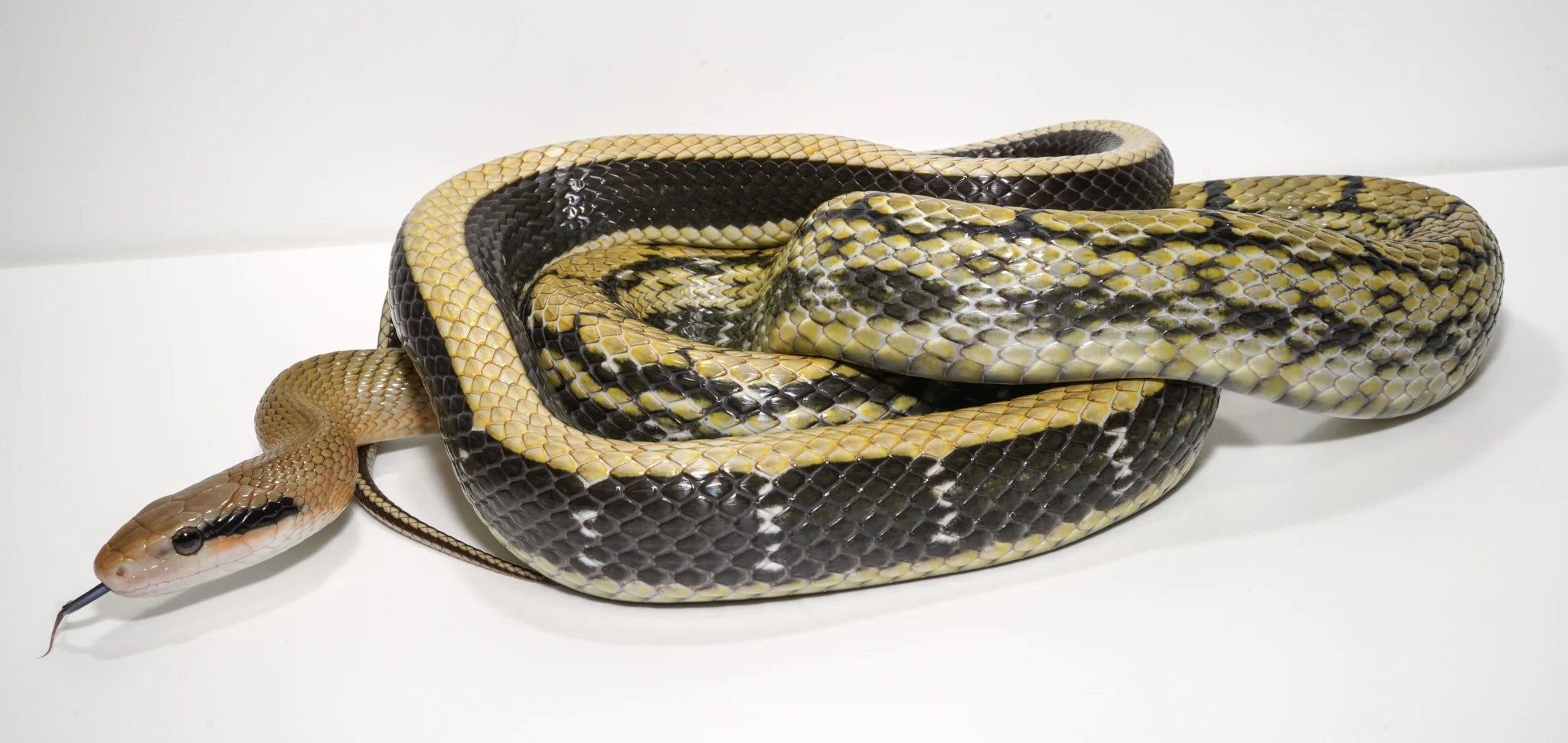
This guide is a starting point for the Elaphe taeniura complex; adjust it to locality, subspecies, and the individual. A sales label such as “blue beauty” does not establish a separate species or a fixed temperature and humidity. Before acquisition, check the accepted name, subspecies and lineage where documented, captive-bred status, previous feeding, last shed and defecation, and transaction records. If you already keep snakes, quarantine the newcomer with separate equipment and plan an examination with a reptile veterinarian. Wild-caught animals of uncertain origin may carry greater risks of parasites, stress, and feeding difficulties.
Adults can be long and partly arboreal, so provide floor space and height. A Taiwanese-form care source mentions an enclosure of at least about 120 × 90 cm, but that must not become a universal final size for all adults. In practice, plan for the long side to be at least the snake’s current length so it can almost straighten, and add height for sturdy horizontal branches. Expand the enclosure as the snake grows. A hatchling in a large box still needs multiple hides and sight barriers; open emptiness does not provide security.
A secure locking door and ventilated openings are essential. This slim, fast-moving snake may find a cable port or gap in a sliding door. Check possible escape gaps against the narrowest part of its body, rather than merely pressing on the lid once. Guard wiring and lamps from contact, and fix branches at both ends to carry the snake’s weight. Provide at least one hide on the floor and one elevated retreat, while preserving a way to observe the animal without opening every shelter.
An early hatchling setup should be clean and make feeding, defecation, and shedding easy to monitor. As the animal grows, increase travel distance, branch diameter, and water-bowl size. “Buy the biggest tub first” does not work if it remains bare and offers nowhere to hide. Keeping a growing snake indefinitely in a small tub is no better. Track length, mass, sheds, and appetite together, and notice whether the snake repeatedly presses against the walls while turning or moving.
Thermal Gradient and Night Conditions


As an initial daytime setup, aim for roughly 28–30°C on the accessible surface of the warm side and about 22–25°C at the cool side. These are not experimentally proven optima for every regional form. They are a trial gradient informed by husbandry reports of an 83–85°F (approximately 28–29°C) warm area and access to cooler retreats. If the whole enclosure is one temperature, the snake cannot choose its body temperature. Room temperature, heat-source distance, and branch height all matter; one thermometer cannot represent the whole enclosure.
Place one probe on the floor of the warm hide or on an accessible heated perch, and another at snake level inside the cool hide. Check accessible surfaces with an infrared thermometer and air temperature with a separate sensor. Heat mats, ceramic heaters, and lamps require an appropriate thermostat and physical burn protection. A detached probe can allow uncontrolled heating, so check its fixing daily. A reading through glass or of the room outside does not substitute for the temperature the snake actually experiences.
Switch off bright white and blue lamps at night and provide a dark rest period. A healthy animal can experience a cooler night, but avoid abrupt drops for juveniles, recovering animals, or a very cold room. If night lows approach about 20°C, connect a non-illuminating heat source to a thermostat and measure the enclosure, including its cool zone. Holding every corner at 28–30°C through the night removes the chance to escape heat. Record seasonal room minima and maxima and adjust the setup accordingly.
Keep a regular bright-day and dark-night cycle with shade the snake can enter. Some species-specific guides recommend UVB, but experimentally established optimal UV-index values for this species are lacking. If you provide low-output linear UVB, check the manufacturer’s distance guidance and how mesh reduces exposure, and measure the basking position with veterinary advice. More intense UVB is not automatically healthier. Guard all lamps against contact burns and replace bulbs according to their specifications.
Humidity, Ventilation, and Three-Dimensional Cover


Manage humidity with a ventilated general area and a locally moist hide, rather than keeping the entire enclosure as a permanently wet “rainforest.” Ambient relative humidity around 50–65% can be recorded as a starting range, not as a single validated optimum for the species. Adjust for regional form, season, shedding, and how quickly the substrate dries. Put the hygrometer at a resting height away from the water bowl, and compare day and night readings.
When a shed approaches, add a hide with damp moss without allowing water to pool. If the snake stays on wet substrate or condensation persists on the walls, review ventilation and misting together. Repeated patchy sheds or retained eye caps call for reassessment of water access, the moist hide, and health. Spraying until the meter rises can hide the underlying cause. Checking for concealed dampness and mold beneath the substrate matters more than watching one humidity number.
Choose a low-dust substrate that permits some burrowing and is easy to replace. Coconut husk and cypress mulch appear in husbandry experience, but replace material that becomes dusty or persistently wet. Adjust the feeding area so prey is not dragged through and coated in substrate. White paper towels in a quarantine setup make feces, mucus, and possible parasites easier to see. Avoid strongly aromatic wood chips, sharp gravel, and very adhesive artificial materials.
Branches are travel routes, not just decoration. Connect low and high perches in several diameters and keep hard objects away from likely fall paths. Access to upper and lower routes on both warm and cool sides lets the snake choose temperature and cover. An opaque hide that lightly contacts the body is often more secure than one enormous, exposed cave. Fix sight-blocking plants and logs in an arrangement that still permits cleaning.
Humidity records should describe a daily pattern, not only a brief peak. An enclosure that reaches 70% just after misting and quickly dries is not the same as one with a wet floor all night. Arrange real high and low airflow paths without directing a strong draft into a hide. Persistent condensation or a moldy smell calls for removing, drying, and cleaning furnishings and finding the cause.
Prey, Feeding, and Water

.jpg)
Use appropriately sized, traceable frozen-thawed rodents as the baseline diet. Begin with prey whose widest part does not greatly exceed the snake’s widest body section, then adjust to mass and body condition. Thaw fully, warm the center appropriately, and offer with tongs; do not microwave prey into uneven hot spots or present it while hot. A wild diet study finding bird eggs and nestlings is no reason to collect wild nests for a captive snake. Live prey can bite and seriously injure the snake.
A starting interval might be about 5–7 days for a hatchling, 7–10 days during growth, and 10–14 days or longer for a stable adult. These are assessment points, not a calendar that must be followed regardless of condition. Reduce prey size or frequency if an oversized bulge persists after feeding or the body becomes round and loses its spinal contour. Recurrent regurgitation or prolonged refusal warrants review of temperature, shedding, stress, and disease with a veterinarian. Do not repeatedly thrust new prey at an animal that refused a meal.
A strongly feeding snake can mistake fingers at an open door for prey. Use sufficiently long tongs and distinguish the cues for cleaning and handling from those for feeding. Remove dropped prey promptly and check that substrate is not stuck to it. Reduce unnecessary handling for at least 48 hours after a meal. Safe feeding routes and accident prevention matter more than enjoying the spectacle of a strike.
Replace drinking water daily in a stable bowl large enough for the snake to drink from or soak in. Directly under a heat source, a bowl can raise enclosure humidity unnecessarily or foul quickly. Clean and refill it immediately after defecation in the water. Prolonged soaking may precede a shed, but also calls for checking parasites, overheating, dehydration, and other possibilities. No single behavior establishes a diagnosis.
Do not set portions solely by whether a meal was swallowed. Length and mass change together during growth, making monthly records useful; in adults, monitor body shape and regular defecation. Two snakes of equal length may differ in muscle and activity. Do not double the next meal after a missed date. Once normal conditions return, resume with one prey item of suitable size.
Behavior, Cohabitation, and Cleaning

.jpg)
Activity does not mean the snake should be held all day. Allow a new arrival to settle; after feeding and defecation are stable, start with short handling sessions low above a safe surface. Support several points along the body rather than pulling the head or tail. Stop if it repeatedly flees or adopts a tense S-shaped posture. Limit contact during shedding, soon after a meal, or while unwell. Handwashing and supervision of children are basic precautions around all reptiles.
Cohabitation is not the default, even within this species. Animals of different sizes sharing one space can conceal competition for food, conflict, unplanned mating, and disease transmission. Putting them together briefly for photographs is not automatically safe. For a breeding project, first verify both animals’ health, lineage, provenance, and quarantine status, and work with experienced specialists. Do not present offspring from mixed regional forms or commercial morphs as representative wild subspecies. Individual housing is usually easier to manage and observe.
Spot-clean feces and damp substrate as soon as found, and wash the water bowl daily. During weekly checks, inspect beneath hides, branch joints, and door gaps. For a full clean, move the snake into a secure temporary container. Dilute, apply, rinse, and dry any cleaner according to instructions for reptile housing. Do not return the animal while a strong chemical smell remains. Recheck probe placement and branch fixings after reassembly to prevent a cleaning-related accident.
Small daily records are worth more than memorizing one care-sheet setting. Log actual warm- and cool-side temperatures, humidity, appetite, feces, sheds, activity times, and water use together. Monthly mass and photographs help reveal changes in body condition. Persistent rubbing at the door or constant escape attempts should prompt checks for inadequate space, insufficient cover, or temperature errors. Conversely, hiding by itself does not establish illness; using a secure retreat can be a normal choice.
Health Signals and a Beginner’s Check Sequence

%20in%20Racer%20Cave%2C%20Gunung%20Mulu%20National%20Park%2C%20April%202025%2001.jpg)
Open-mouth breathing, wheezing, bubbles, or nasal discharge call for prompt assessment by a veterinarian experienced with reptiles. Mouth wounds, retained eye caps, severe shedding problems, repeated regurgitation, diarrhea or blood in feces, unexplained weight loss, and loss of normal posture also merit consultation. Do not diagnose disease from online photographs or administer medication on your own. Bring recent temperature and humidity logs and a feeding, defecation, and shedding history so the veterinarian can assess environmental as well as medical causes.
A common beginner error is reading one thermometer outside the enclosure and assuming conditions inside are correct. Others include using a strong heater without a thermostat, leaving high branches unsecured, and casually blocking door gaps. Pushing more meals on an anorexic snake or saturating the enclosure to raise humidity can worsen a problem. Changing several variables at once makes it hard to know what worked. Within safe limits, alter one factor at a time and record the response.
A short daily check can follow a fixed order: lock, two temperature sensors, heat guards, clean water, wet substrate and feces, and normal posture. Add mass, skin, mouth and eye condition, branch attachments, and vents to weekly checks. Date every meal, shed, and defecation. Prepare a plan for power failures and summer heat waves and a secure temporary container. Release into the wild is not an emergency plan and can harm an ecosystem.
These space, temperature, and feeding figures are conditional so that one subspecies’ husbandry experience is not disguised as definitive physiology for the entire species. Adjust them while confirming that the actual snake can choose comfortable temperatures, eats and defecates normally, and sheds intact. If behavior remains abnormal despite seemingly correct numbers, abandon the assumption that more heat or more food is the answer. Long-term observation, records, and early professional advice are more reliable than one memorized “perfect setting.”
Read the natural-history wiki for wild ecology and regional forms
References
- The Reptile Database, Elaphe taeniura
- DM Exotics, Beauty Rat Snake Care Sheet
- Reptile Centre, Taiwanese Beauty Rat Snake Care Sheet
- Asato et al. (2022), Food Habits of the Taiwan Beauty Snake, DOI: 10.5358/hsj.41.205
Suggest an edit
Tell us which sentence may be incorrect and provide a verifiable source. Submissions are reviewed before publication.