Last updated 2026.10.11 · Edited by silveston · Compiled by an independent hobbyist without professional credentials
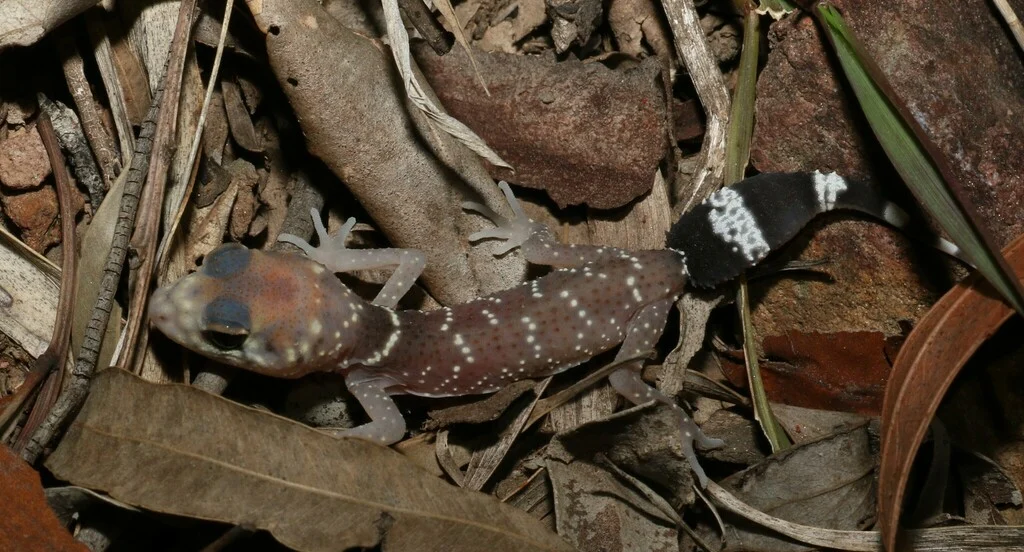
This guide provides measurement-based starting points for safely keeping one Australian thick-tailed gecko. Temperature and humidity must be verified where the animal actually rests, and neither a thick tail nor a defensive bark should be treated as a simple measure of health or friendliness.
Core husbandry principles
The Australian thick-tailed gecko is a nocturnal ground dweller that uses the substrate and low rock crevices, not an arboreal gecko that cruises across glass. Successful care is not about heating the entire enclosure. It is about simultaneously providing a warm surface and cool retreat, plus a dry open area and a moist hide, so the animal can choose. A thick tail and unhurried gait can create false confidence in its hardiness and delay recognition of overheating, dehydration, or obesity.
The values below are target ranges to verify where the animal actually makes contact, not merely equipment settings. Use probe thermometers, an infrared thermometer, and air sensors for their appropriate purposes, recording morning, mid-photoperiod, pre-lights-out, and night readings during the first week. The same lamp can produce very different conditions as room temperature, ventilation, substrate depth, and hide materials change.
Legal origin and quarantine
Collection and export of native Australian reptiles are tightly regulated. Do not rely on a seller’s “CB” label alone; retain breeding-origin information, import or transfer documents, transaction date, scientific name, and identifying photographs. A morph name or the trade label “Barking Gecko” is not enough to establish Underwoodisaurus milii. Confusion with U. seorsus, Uvidicolus sphyrurus, and the old combination Nephrurus milii is possible.
A conservative quarantine of roughly 60–90 days in a separate room is practical for a new arrival. Use paper substrate, washable hides, a water bowl, and dedicated tongs and cleaning tools, but do not omit the moist hide. Record weight, feeding, feces, shedding, respiration, and skin condition with dates. Discuss fecal testing with an experienced reptile veterinarian when abnormalities occur and before joining an established collection.

Enclosure size and life stage
For one adult, about 60 × 45 × 45 cm is a useful starting enclosure because it permits a thermal gradient and several retreats. More room is helpful when cover and travel routes increase with it. Juveniles do not automatically require a tiny box, but feeding and drinking can be hard to verify in a large, exposed setup. Add many low cork pieces and small retreats, then monitor feeding response.
Provide cross-ventilation through lower and upper vents so air does not stagnate. Door gaps and cable openings must be smaller than a juvenile’s head. Place heavy rocks directly on the enclosure floor rather than on excavatable substrate and use stable supports. This gecko squeezes into crevices, so collapsing décor can cause crushing injuries.

Thermal gradient and measurement points
During the active season, begin with one warm surface around 28–30°C and place a fully enclosing warm hide immediately below or beside it. Offer a cool hide around 22–25°C. The important task is to measure the warm surface, inside the warm hide, central air, and inside the cool hide separately rather than relying on one air temperature. Connect the heat source to a thermostat and secure the probe against movement.
At night, switch off light-producing heat and allow a normal room drop to about 18–22°C. Seasonal cooling of healthy adults is a separate breeding-management subject, not a compulsory daily ritual. Do not expose juveniles, recent arrivals, underweight animals, or animals suspected of illness to breeding-season cooling. Reduce heat if the whole enclosure stays at 30°C or the cool refuge rises above 26°C.

Humidity, water, and shedding
Allow the open area to dry around a general relative humidity of roughly 40–50%, while keeping a moist retreat available at all times. Moss or paper inside should be damp but not wet enough to squeeze water from it. Soaking the entire substrate every day can create stagnant air and skin problems. At the other extreme, removing local humidity because this is called a “dryland species” encourages retained shed around toes and the tail tip.
Keep fresh water continuously available in a shallow, stable bowl. Misting should replenish the moist retreat and one limited area, not serve as a ritual that forces the whole enclosure to one number. When the skin becomes dull before a shed, monitor hide use and toes. Do not pull retained skin while it is dry; first correct humidity and hydration, and seek veterinary care when retention recurs or accompanies swelling or discoloration.
Lighting and UVB
Use a basic 12-hour day and 12-hour night, with gradual seasonal adjustment if desired. Do not leave red or blue “night bulbs” running through the dark period. When observation is necessary, use dim ambient light briefly. Avoid illuminating the inside of every hide and preserve a choice of complete darkness.
Avoid both extremes of blasting the whole enclosure with strong UVB and dismissing UVB because the species is nocturnal. Provide low-intensity UVB over part of the enclosure with abundant shade and opaque retreats. Follow the manufacturer’s distance and mesh-loss guidance, and measure UV Index at animal height when possible. Coordinate UVB and dietary vitamin D3 as one plan rather than stacking multiple D3 products.

Substrate and retreat design
After quarantine, a healthy adult can use about 5–8 cm of compactable soil-and-sand substrate. Avoid dusty pure sand, calcium sand, and strongly aromatic wood chips. If substrate is repeatedly swallowed during feeding, use a clean dish or simplify the feeding zone. Risk depends not only on the material but also on dehydration, low body temperature, and oversized prey occurring together.
Provide at least one warm dry hide, one cool dry hide, and a moist hide at an intermediate temperature. Combine cork slabs, low stable rock crevices, and half pipes to create body-contacting spaces and covered routes. Not every entrance should face the front glass; this reduces the stress of constant exposure.
Prey and feeding frequency
Rotate among crickets, black soldier fly larvae, silkworms, and appropriately sized locusts. Dubia roaches are not included in the recommended list. As a general rule, keep prey no wider than the space between the eyes and choose even smaller items when the exoskeleton is firm. Begin with adults every 2–3 days and adjust to body condition and response; offer juveniles smaller meals more often. Remove uneaten live prey rather than leaving it overnight.
Gut-load feeder insects with nutritious food and a water source before offering them. Use calcium in coordination with UVB and reproductive state, and follow the product label for multivitamins. Do not heavily combine D3 and multivitamin at every feeding or routinely add them to drinking water. Record the tail base, trunk outline, and movement as well as body mass to distinguish obesity from wasting.
Handling, defensive calls, and cohabitation
Minimize contact beyond cleaning and health checks for at least the first one to two weeks. When movement is necessary, support the gecko from below with a hand or small container instead of seizing it from above. Never use the tail as a handle. If it arches, gapes, barks, or waves the tail, stop contact and allow it to return to cover. Repeatedly provoking defense does not build trust; it can create chronic stress.
Finding several animals beneath one wild rock does not make cohabitation mandatory. Solitary housing is the default. Never keep adult males together, and pairings should be limited to situations where the female’s weight loss, retreat access, and mating pressure can be monitored. If cohabitation is attempted, provide more food, water, and hides in every thermal zone than there are geckos, and prepare a separate enclosure for immediate use.
Cleaning and routine records
Remove feces and prey remains when found and wash the water bowl daily. Replace material in the moist hide before odor or mold develops. Routine partial cleaning preserves familiar structure better than stripping the enclosure at every service, but suspected infection and the end of quarantine may require full disinfection under veterinary guidance. Remove organic matter before applying a disinfectant, observe the correct concentration and contact time, and rinse thoroughly.
Weigh weekly under consistent conditions and record prey count, feces, shedding, activity, skin and eyes, and tail condition. A healthy nocturnal gecko hiding by day is normal. By contrast, remaining exposed even at night or pacing repeatedly between hot and cool ends warrants a review of the thermal map, number of hides, light, and noise.
Breeding and egg care
Plan breeding only after securing healthy adults, legal lineage records, and separate space for hatchlings. Assess the female’s weight and calcium status beforehand and fill the laying box with a damp but not wet medium. The species usually lays two eggs, but not every mating produces fertile eggs. Repeated clutches can rapidly deplete a female, so separation from the male and active recovery periods are essential.
Captive reports include incubation around 26–27°C for about 73–82 days, but this is a reference rather than a guarantee. Do not rotate eggs; mark their original orientation and keep them off wet surfaces. Verify incubator conditions with an independent thermometer and house hatchlings separately from adults. Do not react to slow development by making abrupt changes in heat or moisture.
Warning signs and common mistakes
Persistent weight loss, food refusal with lethargy for more than two weeks, repeated regurgitation, diarrhea, respiratory noise, oral mucus, cloudy eyes, retained shed with discoloration of toes or tail, flexible jaws, limb tremors, swollen joints, or repeated straining require veterinary assessment. Abdominal swelling and lethargy in a female may signal a laying problem. Do not improvise high-dose medication or calcium, and never attempt to push an egg out manually.
Common mistakes include heating the entire enclosure, omitting a moist hide because the species is considered dryland, overfeeding because the tail is thick, leaving live prey loose, putting heavy rocks on unstable substrate, and misreading defensive barking as friendly behavior. When a problem develops, provide the reptile veterinarian with temperature and humidity records, product and feeding logs, recent weights, and photographs of feces.
A short care checklist
Daily: check water cleanliness, nighttime activity, posture and breathing, leftover prey, and feces. Weekly: review weight and condition, toes and tail tip, equipment security, and thermometer highs and lows. Monthly: check UVB distance and installation date, thermostat operation, doors and vents, and stability of rock structures. At every seasonal change, remap the enclosure to confirm that room temperature has not erased the cool retreat.
This guide does not replace diagnosis or treatment. Values must be adjusted for age, reproductive state, medical history, and the room in which the enclosure operates. The goal is not to freeze one perfect number, but to create safe choices, measure them, and notice departures from the animal’s recorded pattern early.
Field notes for troubleshooting
Map the enclosure instead of copying a heater wattage. Mark four points on paper and measure them four times daily to reveal how sunlight, air conditioning, and seasons change the gradient. An infrared thermometer reads surfaces while a probe reads inside a retreat; one should not substitute for the other.
A hygrometer may read 45% while the floor of the moist hide is damp and the surface beneath the heater is dry. That micro-scale difference is the choice being provided. If condensation persists or the deep substrate smells stale, reduce spraying and increase airflow without allowing the moist retreat to dry completely.
Quarantine records are a way to learn the individual’s normal range. A new arrival that skips food for several days is not the same as one that steadily loses weight. Measurements taken at random times mix differences in hydration and gut contents, so use the same weekday, similar time, and same scale.
UVB matters in terms of delivered exposure, not merely whether the lamp is switched on. Mesh, distance, reflector, and lamp age change output. Record replacement dates and preserve shade and the space behind cork even directly below the fixture so the gecko can avoid light.

When feeding response suddenly weakens, do not keep adding new prey immediately. First review nighttime temperature, the warm retreat, shedding, weight, feces, and possible egg production. Constantly changing prey can obscure the cause, while loose insects may bite the gecko or reduce hygiene.
A feeding log should include prey type and count as well as size and supplement. Ten tiny insects and ten large insects are not the same meal. Requirements can change during growth and egg production, but that does not mean that more vitamins are automatically safer.
Video of defensive behavior can teach the signals that precede biting. Arching, turning the side toward a threat, tail waving, and gaping may all be earlier stages. Respecting those signals reduces unnecessary tail loss and risk to the keeper.
After cleaning, compare décor positions with a reference photograph. Safety settings can fail when a probe moves away from the heater or a void develops beneath a heavy rock. After closing the enclosure, check the lock and cable openings by hand.

Summer heat waves and winter room heating can eliminate the cool end even when the thermostat setting is unchanged. Prepare a ventilated travel container, spare thermometer, safe warming and cooling methods, and reptile-clinic contact details for outages. Never place a hot pack or ice directly against the animal.
Do not diagnose a health problem from one online photograph. Similar signs can arise from temperature, parasites, infection, nutrition, or reproduction. Records do not replace diagnosis, but they help a veterinarian identify onset and rate of change and choose more appropriate tests.
Continue to the natural-history wiki
For the background to distribution, defensive calls, communal resting, and taxonomy, read the Australian Thick-tailed Gecko natural-history wiki.
References
- The Reptile Database — Underwoodisaurus milii
- Pokorná et al. (2014), A ZZ/ZW Sex Chromosome System in the Thick-Tailed Gecko, DOI: 10.1159/000358847
- Oliver & Bauer (2011), Systematics and evolution of Australian knob-tail geckos
- Museums Victoria specimen D 18180 — Underwoodisaurus milii
- PubMed record — thick-tailed gecko ZZ/ZW chromosomes
- iNaturalist — Underwoodisaurus milii observations and licensed images
Suggest an edit
Tell us which sentence may be incorrect and provide a verifiable source. Submissions are reviewed before publication.