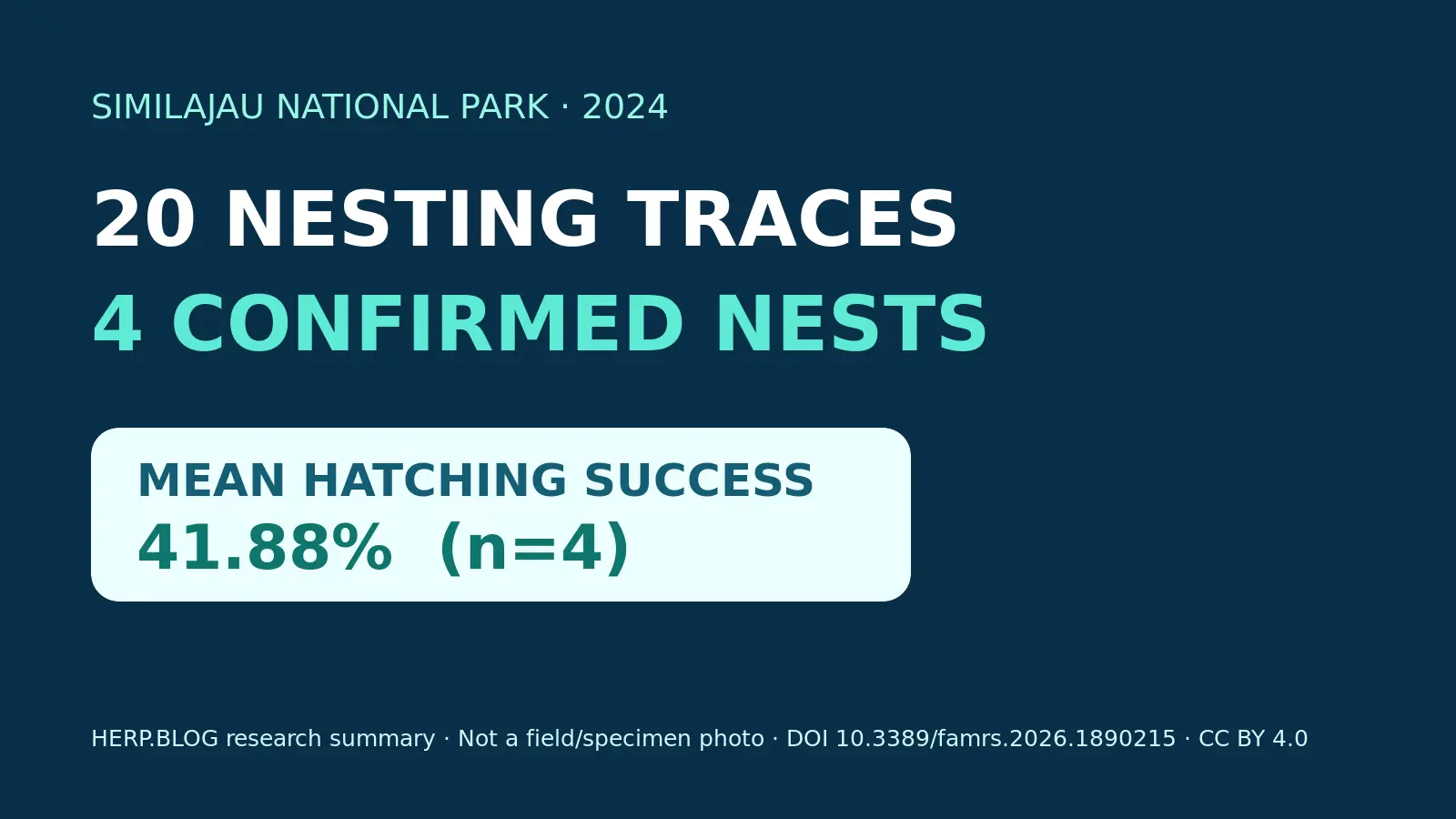
Sarawak green sea turtle breeding A new study tracking green sea turtle breeding has quantified data from a small nesting site on the Malaysian island of Borneo. While patrols discovered 20 nesting traces on the beaches of Similajau National Park in 2024, only four were confirmed to contain eggs. Hatching success rates across these four nests varied widely, ranging from 7.69% to 73.11%.
These results do not lead to simple conclusions such as “relocation ensures safety” or “the population at this beach is on the verge of extinction.” As previously discussed on HERP.BLOG “Relocation of 48 nests in Australia The study sites, data, and research questions differ. This paper serves essentially as a baseline, illustrating what is known and what remains unknown regarding a small breeding site where patrol records had been interrupted. The average annual number of confirmed nests was 3.33 during the 2015–2017 and 2022–2024 periods. In 2024, only four out of twenty recorded traces were confirmed to be nests containing eggs. The average hatching success rate across the four nests—totaling 519 eggs—was 41.88%, with significant variation observed between individual nests. The locations, data, and research questions differ. This paper serves essentially as a baseline, illustrating what is known—and what remains unknown—about a small nesting site where patrol records were interrupted.
30-Second Summary
- The annual average number of confirmed nests was 3.33 for the periods 2015–2017 and 2022–2024.
- In 2024, only four out of twenty traces were confirmed to be nests containing eggs.
- The average hatching success rate across the four nests (totaling 519 eggs) was 41.88%, with significant variation between nests.
- Approximately 95% of the unhatched eggs fell into the category where no embryonic development was observed.
- As patrol intervals and discovery times were not standardized, the specific causes cannot be conclusively determined.
What happened?
Researchers from Universiti Malaysia Sarawak compiled park patrol records from 2015–2017 and 2022–2024, and summarized data on clutch size, apparent incubation period, and hatching success for the four nests confirmed in 2024. The paper was published on August 26, 2026. Frontiers in Amphibian and Reptile Science The periods with no data (2010–2014) and the park closure period (2019–2021) were not filled in to create a continuous time series.
Target Species Information
| Common Name | Green sea turtle |
|---|---|
| English name | Green turtle |
| Scientific name | Chelonia mydas |
| Classification | Order Testudines, Family Cheloniidae |
| Distribution | Tropical and subtropical waters worldwide |
| Conservation Status | IUCN Global Assessment: LC (Least Concern; updated 2025). Regional populations Condition may vary |

“Data and Methods: Distinguishing tracks from nests
Patrol teams searched for flipper tracks and sand pits near the high-tide line. Of the 20 pits discovered in 2024, four contained confirmed eggs, while five showed traces of eggshells, suggesting potential nesting. The remaining 11 pits contained no eggs or could not be verified. Researchers transferred the nests containing confirmed eggs—along with the surrounding sand—into containers on the day of discovery and reburied them in an elevated, roofed, and fenced hatchery to minimize the risk of inundation.
For the first nest, the exact date of egg-laying could not be determined due to a patrol gap of up to 120 hours. Subsequently, the schedule shifted to daily 7:00 AM patrols, meaning the remaining nests were likely discovered within 12 hours of being laid. This discrepancy suggests that the apparent incubation period for the first nest may have been calculated as approximately five days shorter than the actual duration.

Key results and numerical ranges
The number of confirmed nests was 5 in 2015, 6 in 2016, 3 in 2017, 2 in 2022, 0 in 2023, and 4 in 2024. The average across the six years with recorded data is 3.33. Annual average hatching success rates ranged from 24% (2016) to 90% (2022), with an overall average of 45.47%.
In 2024, four nests contained 130, 133, 137, and 119 eggs, respectively. Hatching success rates were 7.69%, 45.11%, 41.61%, and 73.11%, resulting in an average of 41.88 ± 26.8%. Most of the unhatched eggs examined by the research team fell into the NED (No Embryonic Development) category, meaning no visible embryonic development was observed. However, this does not necessarily mean they were all ‘infertile eggs’; very early embryonic death is difficult to distinguish through anatomical observation alone.
Why is this important?
Similajau is a beach where a small number of nests are found irregularly, rather than a large-scale nesting site. In such locations, the failure of just one or two nests can significantly skew annual indicators. Standardized protocols—such as regular patrols, recording discovery times, and documenting temperature, rainfall, inundation, and signs of predation—are essential for comparing the effectiveness of conservation measures. Furthermore, these results cannot be directly applied to captive environments; the data comes from relocated wild sea turtle nests, not from a study testing artificial incubation guidelines for pet turtles.
Aspects to avoid overinterpreting and study limitations
- Gaps in the data over several years make it impossible to calculate long-term trends of increase or decrease.
- As patrol efforts and intervals were not standardized, it is difficult to distinguish whether a count of ‘zero’ indicates a lack of nesting or simply a failure to detect nests.
- As there were only four nests in 2024, it is not possible to statistically determine the causes of differences in hatching rates.
- There is a possibility that the probe damaged the uppermost eggs during relocation, alongside factors such as predation, inundation, and delayed detection.
- A low number of local nests does not necessarily indicate a global decline of the species.
Key takeaways for readers
- The number of signs of egg-laying does not correspond to the actual number of nests.
- Standardized, long-term monitoring is particularly important for small nesting sites.
- Relocation can reduce the risk of inundation but does not automatically guarantee success.
- NED is not synonymous with ‘infertile eggs.’
Related HERP.BLOG Articles
- Latest Reptile News
- Hidden variables in sea turtle nest relocation
- “Genome of the Singapore sea turtle Chelonid herpesvirus
- Reptile Wiki
- Reptile glossary
Reply 남기기